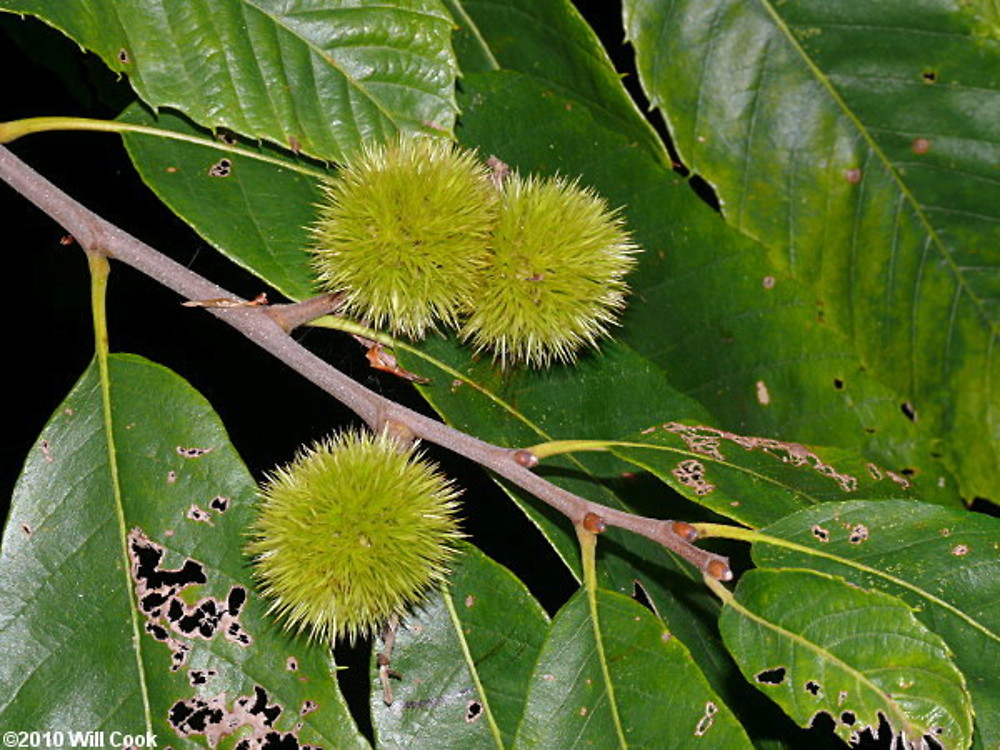
The little chestnut that survived. Photo by Will Cook, North Carolina Plant Photos.

One way to think of Chinquapins is they are small Chestnuts that survived. In the same genus as their bigger relative — Castenea — when the  blight wipeout the Chestnuts, Chinquepins suffered but some managed to endure. One can see the  Allegany Chinquepin (C. pumila) while hiking the Appalachian Trail. Their nut is about half of the size of their deceased relative but still worth collecting. We also know some of the nutrition of another edible Chinquepin, the Ozark Chinkapin (C.  ozarkensis.) 

Chinquapins pack a lot of nutrition.

Per 100 grams it has 443 calories, 18 grams of fat, 57 grams of carbohydrates, 13 grams of protein and 6 grams of fiber. The fat is 10 grams monounsaturated, 4 grams polyunsaturated and 4 grams saturated. Potassium is 77 mg, no sodium reported. A second report says they are 5% fat, 55 protein, 40% starch and 50% water with 4736 calories per kilo. European chestnuts, not affected by blight,  are the only cultivated and consumed nut that has vitamin C, about 40 mg per 3.5 ounce serving. 

In the Beech family the Chinkapin has been called them most  ignored and undervalued native North American nut tree. It has a sweet and edible nut and has been used for fuel, charcoal, fence posts, railroad ties and a coffee and chocolate substitute (as are the seeds of the Blue Beech, aka the American Hornbean, Carpinus caroliniana.)

 Just how many “Castanea” species there are is anyone’s guess. For example the USDA uses the name Castanea pumila for the Allegany Chinkepin. They say it is also called American chinquapin, C. alnifolia, C. ashei, C. floridana, C. margaretta, C. nana, C. paucispina, chinquapin, dwarf chestnut, Fagus pumila, and Golden Chinquapin. We are fairly sure C. ozarkensis is a separate species.  C. davidii, C. seguinii, C. mollissima and C. henryi are from Asia, C. creanata, Japan. To my knowledge all of them have edible nuts. Chinkapin’s native range is New Jersey and West Virginia, west to Missouri and Oklahoma, and south to Texas and Florida. It’s been planted in Wisconsin and Michigan. 

Forager emeritus Dick Deuerling once told me, some 30 years ago, that he found a chinkapin in Wekiva Springs state park, but not where in the park. I’d ask where but he died in 2013 (in July that year I went to three funerals, no wedding.)

Green Deane Itemized Plant Profile

IDENTIFICATION: Chinkapin is a small tree or large shrub that grows six to 15 feet tall. Twigs are densely hairy when young becoming shiny brown with reddish-hairy buds. The leaves alternate, are simple, short-stemmed, prominently veined, oblong with fine pointed teeth or bristles, and hairy on the lower surface. The fruit is a spiny bur with a single nut. Bur opens like a clam shell. 

TIME OF YEAR: Early September with some leeway for location.

ENVIRONMENT: It does not like limestone or sand dunes. Prefers mixed hardwood forests with pines and oaks on ridges and slopes, under 4450 feet. Heat tolerant but intolerant of salt spay or shade.  

METHOD OF PREPARATION: Shelled nuts eaten raw or roasted. 

{ 3 comments }

Wild Parsnip

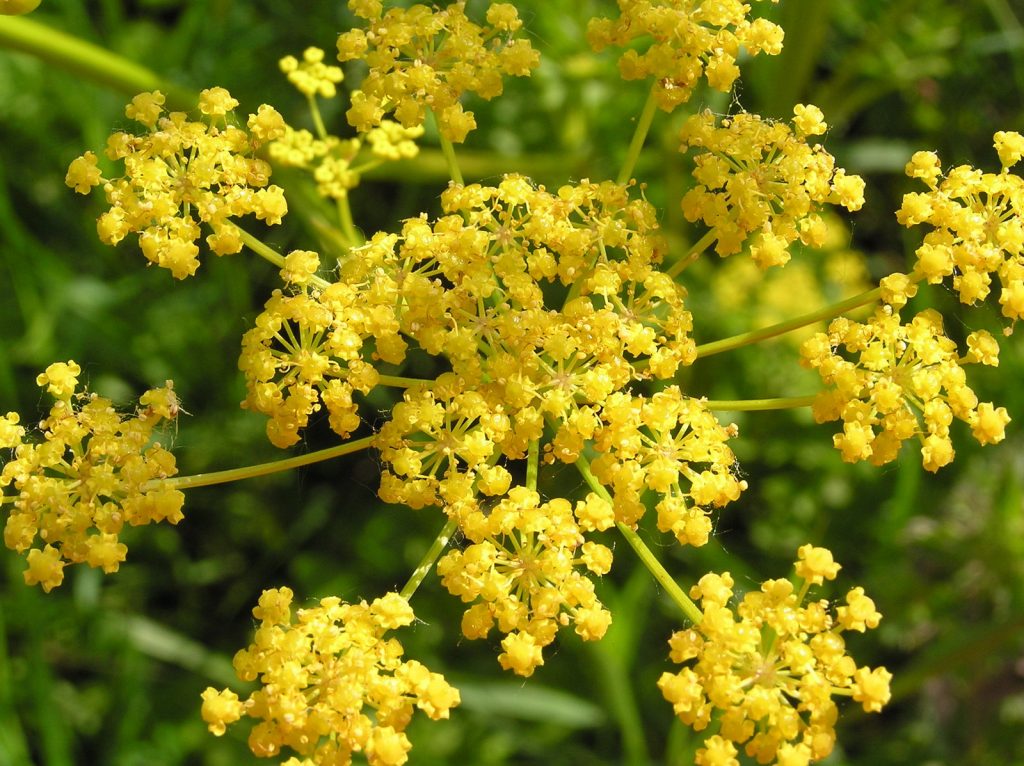
Wild Parsnip makes a flat-top yellow blossom.

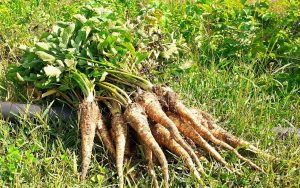
Wild Parsnip, Pastinaca sativa, is native to Europe but is found in all of North America except Alabama, Mississippi, Georgia and Florida. It’s a root vegetable closely related to carrots and parsley and has been cultivated since at least the early Greeks. It was part of the tribute the Germans gave to Roman Emperor Tiberius. Both English immigrants to America and French to Canada brought the plant with them. 

Be sure of your identification.

If we combine two reports we can get a good accounting of Wild Parsnip’s nutrient profile. A 100 gram sample has 76 calories, 1.7 grams of protein, 0.5 grams of fat (mono- and saturated) 17.5 grams of carbohydrates and two grams of fiber. Vitamin A is minor — 3 RE, but vitamin C is good: 16 mg a little over a third of your daily need. The B vitamins are B1 (thiamin) 0.08 mg, B2 (riboflavin) 0.09 mg, B3 (niacin) 0.2 mg, and B6 (pyridoxine) 0.85 mg.  The minerals are potassium 541 mg, phosphorus 77 mg, calcium 50 mg, magnesium 29.4 mg, sodium 12 mg and iron 0.7 mg. 

Tasty and nutritious so what’s the down side? It’s in the same family as Poisonous Hemlock so you have to make sure of the identification. Taste and aroma is not enough. By the account of victims Poisonous Hemlock root also smells and tastes like parsnip. That said Poison Hemlock produces white flowers on stalks creating a more rounded appearance like an umbrella. I tell my students a white umbrella made up of smaller umbrellas. Wild parsnip has yellow flowers on stalks producing a more flat-topped appearance. Wild Parsnip has celery-like leaves and deeply grooved main stalk that is green. Poison Hemlock has smoother stems if not splotched with purple and the leaves are more fern-like. More directly, if the plant you are looking at has white blossoms it is NOT wild parsnip.

What Pastinaca means is foggy. It can be from “pastinum” meaning food or to prepare the ground for planting a vine. If so then “sativa” is redundant as it means “sown.” Parsnip is from Pastinum which passed into Old French as pasnaie then into Middle English as pasnepe. The current ending -nip was added by mistake because folks thought it was related to turnips which it is not. 

Green Deane’s Itemized Plant Profile

IDENTIFICATION: A two-year plant, basal rosette of roughly hairy leaves, strongly aromatic when crushed. Leaves compound,  pinnated, broad, with toothed edges, leaf stems grooved, main stalk grooved, second-year stalk taller than first year. Blossoms yellow making a flat-top arrangement.  

TIME OF YEAR: This is a plant you have to identify this year and the harvest next year. The first year it is a basal rosette growing a tasty root. The second year it sends up a flower stalk. Flowering starts in May and can last to July or even October depending on climate and location. You can also harvest roots at the very beginning of year two. But once the plant is flowering the roots grow woody. 

ENVIRONMENT: It is rudual meaning it likes disturbed ground from abandoned fields to roadsides. It prefer a little dryer soil to a little wetter but it can some moisture.  

METHOD OF PREPARATION: Be sure of your identification. Check with a local expert. Roots raw, boiled, steamed, sauteed, mashed, pureed, baked used in soups, stews, sauces. Also made into beer and wine. Young leaves coked. Seeds used for a dill-like seasoning. Wear gloves and a long-sleeve shirt when harvesting just as you would cultivated parsnips. Sap on sweaty skin which is then exposed to sun can cause a rash that can last for months. 

{ 1 comment }

Lady Thumbs

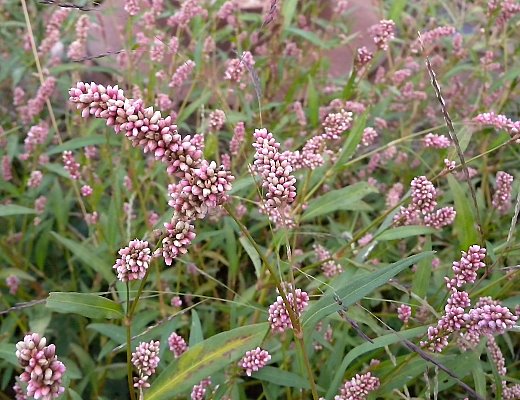
Lady’s Thumbs are closely related to Smartweed.

Where I teach classes in South Carolina — Honea Path — a weed that is prolifically under foot is Lady’s Thumb. Unfortunately the names of it and related species are constantly being changed and shuffled between two genera, Polygonum and Persicaria. This is understandable as the resemblance between the two groups is striking. Sorting out your local species requires attention to detail. Close is good enough as I am not aware of any toxic Persicaria though some may increase light sensitivity. As for edibility, test to determine if the leaf is mild or peppery.  The mild ones are eaten as a salad ingredient or pot herb, the spicy ones as a peppery or spicy green. 

From Eurasia Lady’s Thumb is among the most prolific of the group and is botanically known as Polygonum persicaria or Persicaria maculosa. Common names include Spotted Lady’s Thumb, Jesusplant, Smartweed, Devil’s Pinches, Virgin Mary’s Pinch, Herbe Traitesse, Red Joint, Red Weed, Red Legs, Redshank and more. As the stems can get red that explains that. The leaves often have a brownish spot in the middle — maculosa (mack-cue-LOW-sah) means stained or spotted — and that gave rise to the “pinches” as the leaf was pinched by the Devil, the Virgin Mary, and a Lady’s thumb. Herbe Traitesse refers to a tale in which a woman murdered her husband and wiped the blood off on the leaf leaving a stain leading to her detection. Some Gaelic-speaking folks called it Blood Spot. Other populations call it Lover’s Pride and Saucy Alice. A few folks were not as high-minded calling it Devil’s Arse-wipe.  

Other botanical synonyms include P. maculata, P. ruderalis, P. ruderalis, P. vulgaris, P. dubium, P. fusiforme, P. minus and P. puritanorum. Although Eurasian it was wildly reported in the great lakes region by the mid-1800s. This also might account for why various native people were reported using it in the late 1800s when early botanists were investigating such things.  When handling older and or peppery plants make sure to keep your fingers away from your eyes or they will smart hence another name: Smartweed. 

Names aside we do have some nutritional information for the Polygonum persicaria aka Persicaria maculosa (percy-CARRY-ah mac-you-LOW-sah). A 100-gram serving of fresh greens has 0.33 mg of B2 (riboflavin) 60 mg of vitamin C, and 12 RE of vitamin A. The same amount of cooked greens has 0.18 mg of B2, nothing else reported.  Some names suggest the plant might make a yellow dye so there might be some beta carotene which is the precursor to vitamin A. Also know Lady’s Thumb is on the weed hit list of many states either as a noxious weed or an invasive species. It invades 35 crops in some 50 countries. Not all things are bad, however. This plant provides “persicarin”  which might be used in treating severe vascular inflammatory diseases such as sepsis or septic shock. It can also remove more than 60% of nitrite from ground and surface water. The flowers attract bees, wasps, and syrphid flies. Many insects feed on the species including aphids, beetles, weevils, stink bugs, larvae of sawflies, larvae of several moths, copper butterflies and grasshoppers. Most mammals avoid the species at its peppery stage though the white-tail deer will eat young plants and or flowers thus spreading the seeds. Rodents also eat the seeds such as mice, squirrels and chipmunks. Canadian Geese have been seen eating the species as well and three turtles: Snapper, Painted and Slider. 

There are several native Persiaria some of which can resemble P. maculpsa among them the Nodding Smartweed (Persicaria lapathifolia) and Pennyslvania Smartweed (P. pensylvania.) They like similar habitats and have similar identifying characteristics.  P. maculosa has consistently shorter upright blossoms whereas P. lapathifolia has longer nodding blossoms. P. pensylvanica also has short upright blossoms but those of P. maculosa are usually shorter and more slender. P. lapathifolia and P. pensylvanica occasionally have a dark spot on the upper leaf whereas P. maculosa almost always has a dark spot.

And I saved this for last so not to confuse: Persicaria is from Dead Latin’s “persica” which means peach. Persicaria means leaves that look like peach leaves. 

GREEN DEANES ITEMIZED PLANT PROFILE

IDENTIFICATION: A weed to a yard high. Young leaves alternate, are lance-shaped, approximately two to six inches long, just over an inch wide and hairy on the upper surfaces  Older leaves are slightly hairy. Leaves taper to a point.  Leaves often have a purple/brown spot in the middle of the leaf. Stems are branched, often reddish in color and swollen at the nodes. A thin sheath encircles the main stem at the base of each leaf stem. Flowers are spikes at the ends of stems. Individual blossoms are small and usually pink but can also be white. The shiny seed is a disk to three-sided, brown or black. Tap roots are shallow. 

TIME OF YEAR: Warm weather, usually summer. If flowers from about May to October, depending on your climate. 

ENVIRONMENT: Lady Thumb prefers moist to wet waste ground, disturbed sites, meadows, stream banks, roadsides  and well-watered gardens. It prefers acid loam and does not tolerate alkaline soil.

METHOD OF PREPARATION: Non-peppery leaves in salads or cooked as a pot herb. Peppery leaves used as a spice. 


{ 0 comments }

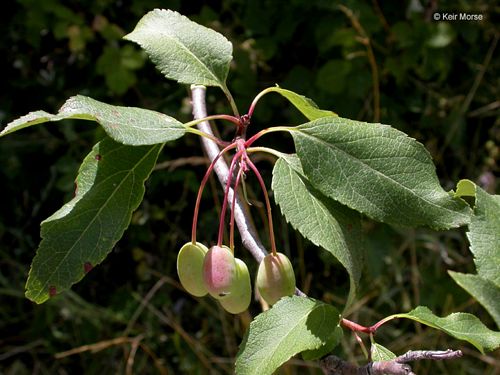
The Western Crabapple. Photo by Ken Morse.

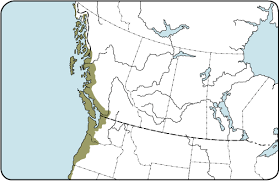
The Pacific Crabapple, Malus fusca, was put in a separate entry because it’s the only crab apple on the west coast of North America from about San Francisco north. It’s a wild apple that manages to survive in Alaska and deserves to be mentioned. (See a separate entry for Wild Apples.) 

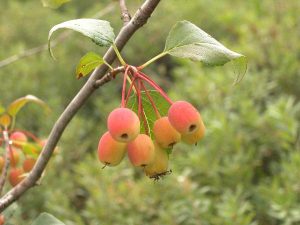
The western carbapple has a different shape than the eastern crabapple.

This small apple was highly important to indigenous peoples who lived anywhere near the tree. At least 19 groups — mostly coastal — harvested it annually. As of 1990 many were still picking it. A hundred grams of Pacific Crabapple have 90 calories, 1.2 grams of protein, 1.6 grams of fat, 17.7 grams of carbohydrates, and 6 grams of fiber. B vitamins are B1 (thiamin) 0.03 mg, B2 (riboflavin) 001 mg, B 3 (niacin) 1.9 mg.  A second study puts the vitamin C level at 8 mg, vitamin A 4 RE and potassium 194 mg. As for the rest of the minerals phosphorus 33 mg, calcium 29 mg,  magnesium 28 mg, sodium 21.2 mg, iron 0.6 mg, manganese 0.33 mg, zinc 0.2 mg and copper 500 mcg.  

Malus is Dead Latin’s version of Greek Malon/Melon for apple. Fusca means dark, swarthy, dusky.  Often called “deer candy” as deer are fond of the fruit.

Distribution map, Pacific Crabapple

IDENTIFICATION: Small tree, leaves irregularly lobed, toothed edges, pointed at the end.  Branches have sharp shoots, fragrant apple blossoms white to pink.  Fruits are small, to half-inch, oblong unlike eastern crabapples, and yellow to orange to purplish-red.  Older bark deeply fissured.

TIME OF YEAR: Late fall to after first frost. Often picked when slightly under ripe to sweeten off the tree. However they turn soft after a frost, turn brown, and become sweeter. 

ENVIRONMENT: Moist woods, edges of wetlands, estuaries. Prefers full sun. 

METHOD OF PREPARATION: Edible fresh, cooked and preserved. Can be mixed with sweeter fruits, are made into jelly and are a good source of pectin. They were often preserved with fish oil and also served with fish oil (ooligan grease.) Their acid content also helps in their preservation.  The bark was used medicinally but contains cyanide-producing compounds. 

{ 1 comment }

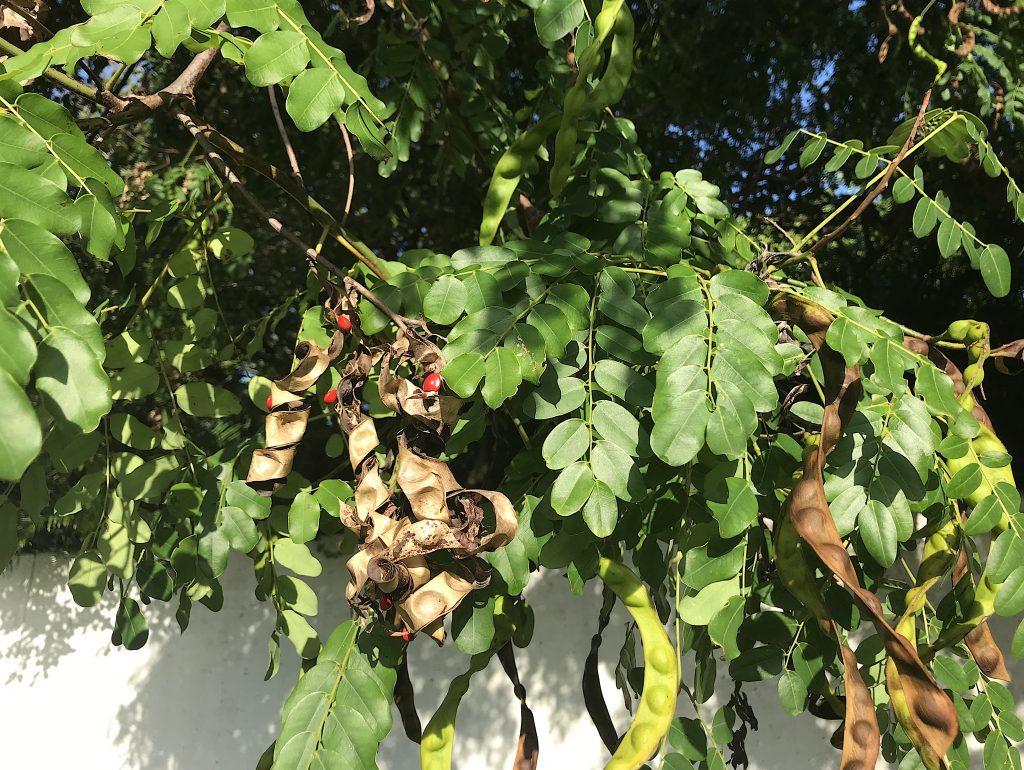
It’s easy to see the Coralwood is in the pea family. Photo by Green Deane

Coralwood seeds and leaves are edible cooked. The tree has been used for centuries as food and medicine so why is it controversial? There are two possible answers: Lack of definitions and the habit of the Internet to cut and paste.
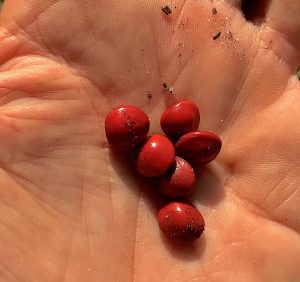
Coralwood seeds are usually weigh a quarter of a gram each. Photo by Green Deane

Adenathera pavonina (ah-den-ah-THER-rha pah-vo-KNEE-ah) is an Old World tropic tree. In the New World it has been introduced from Venezuela to southern Florida. The species is a nitrogen fixer, is cultivated for animal forage, is a garden ornamental, has a huge array medicinal uses and dozens of common names. It is safe to say it’s been the subject or many research papers from food to medicine. The issue is raw seed edibility. 

Cornucopia II, a standard published reference, says on page 152 “Seeds are eaten raw, or roasted and shelled and eaten with rice, tasting like soy beans. The husked kernels contain 25% of their weight of oil with a protein content of 39%. Young leaves are cooked and used as a vegetable.”  That’s from the 1998 edition of Cornucopia II. 

The Internet, revealing cutting and pasting from Wikipedia, references an 1889 Australian book that they say says the uncooked seeds are toxic. I happen to have a copy of that book: “The Useful Native Plants of Australia.” It does not say the seeds are toxic. This is exactly what the author, J.H. Maiden, wrote on page 5:

In India these seeds are occasionally used as an article of food. They are the size of a kidney bean. They would doubtless require boiling, or some similar preparation, for it should be borne in mind that the Leguminosae must be regarded as a poisonous Natural Order in spite of the fact that it yields some of the most valuable foods used by man and beast.”

Heck, in my classes I tell students the pea family is not a friendly one. A lot of species in the pea family are toxic from weeds to trees. What Maiden wrote is far from saying Coralwood has toxic seeds. He wrote a warning in general about the legume family (which also holds true for uncooked kidney beans et cetera.) 
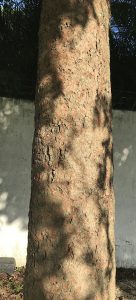
Coralwood is used for firewood, lumber and building houses. Photo by Green Deane

At any rate are doubts: In all the professional studies I read the seeds were cooked. They were made into everything from a nut milk to ground chicken feed. Most of the internet authors who say the raw seeds are edible also say the seeds often have to be cooked to reduce “toxicity.”  That “toxicity” is usually unstated. Perhaps getting closer to the truth a government website in Singapore says “Uncooked seeds (though toxic) have been used as [an] intoxicant.”  Not reported are  the effects of the intoxication. To be on the safe side we should cook the seeds which includes roasting and boiling (which in itself is confusing. Roasting usually degrades a bad chemical, such as calcium oxalate. Boiling often carries a toxin away as when we boil poke weed.)  More digging reveals a possible answer: One study says the seeds “are believed to be toxic when eaten raw.” They think the “toxin” might be a trypsin inhibitor which reduces the breakdown of digested protein thus prevents the body’s utilization of the proteins. Cooking would reduce the trypsin inhibitor.   

Research in the Czech Republic (reported in Emirates Journal of Food and Agriculture. 2020. 32(2): 100-108) reports:  “The analyses showed that the lignoceric [acid] (17.59% and 18.24%), linoleic {acid  an Omega 6 oil found in soybean and canola et cetera] (39.80% and 37.88%), and oleic acids [such as found in olive oil] (14.67% and 14.75%) were the most abundant in the oil of raw and roasted seeds, with the unsaturated forms present in higher amounts than saturated. The seeds were found to be rich of vitamin E (33.09 and 15.94 mg/100 g), whereas the contents of vitamins B1, B2, B3, and B6 were rather low. Calcium, magnesium, phosphorus, potassium, and sulphur were the minerals found in the highest concentrations. Salicylic acid (201.01 and 151.95 µg/100 g) has been detected in higher amounts than other phenolic compounds. In summary, the findings of this study indicate that the both raw and roasted seeds of A. pavonina are good sources of various health-beneficial nutrients, including those reducing the negative effects of obesity. The seeds also contain many phenolic compounds and vitamin E was in four forms: Alpha, Beta, Delta and Gamma.

Adenanthera is a genus with about 13 species found in India and China. Coralwood is endemic to Southern China and India. It has been widely introduced and naturalized in Malaysia, Western and Eastern Africa as well as most islands of Pacific. It is listed as one of the worst invasive species in Jamaica and it has been classified as an invasive plant in Cuba, Puerto Rico, and many islands in the Pacific including American Samoa, Hawaii, French Polynesia, Micronesia and Australia. 

In the medicinal realm the species has anti-diabetic activity, hypo-lipidemic activity, anti-hypertensive activity, anti-diarrheal activity, anti-cancer activity, antioxidant activity, antiviral activity, anti-inflammatory activity and antimicrobial properties. In India a decoction of young leaves is used for  rheumatism and gout. It is also used for inflammations, blood disorders, arthritis, cholera, paralysis, epilepsy, convulsion, spasm and indigestion. Pulverized wood is mixed with water and taken orally for migraines and headaches. Bark and leaf decoction are used to treat dysentery, diarrhea and tonsillitis. Decoction of the seeds were used in pulmonary infection and externally applied in chronic opthalmia. 

As it is fast growing after the first year it is used for shade trees and firewood as well as lumber for furniture, cabinets, decorative wood products and house construction. The leaves are used for fodder — high in protein, low in minerals — and breakdown easily for green manure. 

Adenanthera is from the Greek ‘aden’ (sticky gland) and ‘anthera’ (anthers.) It refers to the flower anthers being tipped with sticky glands. Pavonina comes from the Dead Latin word ‘pavo’ meaning peacock-blue. While no reference is given explaining the name the leaves are dull green on top, blue-green underneath. Other scientific names for Coralwood are Adenanthera gersenii Scheff, Adenanthera polita Miq, and Corallaria parvifolia Rumph. 

GREEN DEANE’S ITEMIZED PLANT PROFILE

IDENTIFICATION: A medium- to large deciduous tree, A. pavonina ranges in height to 45 feet. The tree is generally erect, having dark brown to grayish bark, and a spreading crown. Leaves are bipinnate with 2-6 opposite pairs of pinnae, each having 8-21 leaflets on short stalks. The alternate leaflets are oval-oblong with an asymmetric base and a blunt tip, being a dull green color on top and a blue-green beneath. The leaves yellow with age.

Flowers are narrow spike-like racemes, to five inches long at branch ends. They are small, creamy-yellow in color, fragrant. Each flower is star-shaped with five petals and 10 prominent stamens bearing anthers tipped with minute glands.

The curved pods are long and narrow to eight inches long with slight constrictions between seeds, dark brown in color turning black upon ripening. The leathery pods curve and twist to reveal the 8-25 showy seeds. The hard-coated seeds, are lens-shaped, vivid scarlet, and stick to the pods. The ripened pods can remain on the tree into the next season. There are some 1600 seeds per pound.

TIME OF YEAR:  Early fall locally, seeds can persist into spring. In it’s native range it peaks in May.

ENVIRONMENT: It likes lowland tropics. Can be found as far north as West Palm Beach in Florida. Can tolerate a variety of soil. Growth is slow at first then very fast. 

METHOD OF PREPARATION: Cooked seeds (usually roasted or boiled) and are eaten out of hand or used like soybeans. The red coating on the seed is not eaten. Boiled leaves are considered a famine food. A nut milk made from the seeds is more nutritious than nut milk made from soybeans. The seeds are roasted in a manner similar to peanuts.    

{ 1 comment }