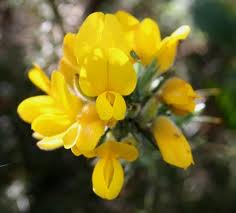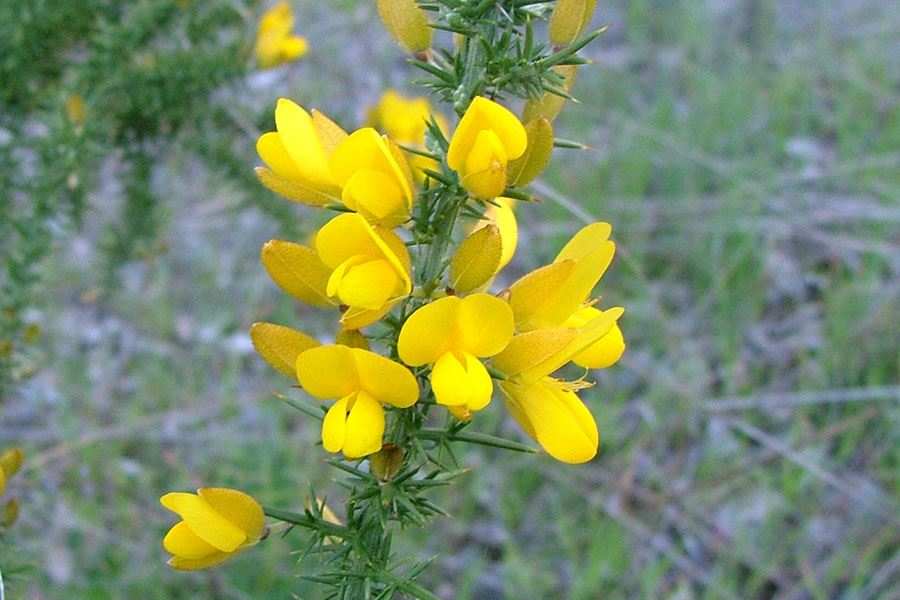
Gorse flowers and thorns, available all year long depending on climate.

 Ulex europaeus: Edible Gorse or Furze Pas

Gorse has edible flowers. It also has thorns… Really bad thorns.

In August 2005 an Englishman, Dean Bowen, 32, left to walk home after many drinks at the local pub. He woke up the next day in the middle of a Gorse patch.  Bowen couldn’t remember how he got there, and couldn’t find a way out of the thorny mess.

On his second day stranded in the patch he caught the attention of a passerby by using a cigarette lighter to reflect sunlight. That brought the rescue squad but they couldn’t get to him. He was surrounded, as they say, in a thorny situation. Bowen was eventually rescued by the British Royal Air Force who lifted him out by helicopter.

“I wouldn’t advise anybody to go into it [gorse bushes], you know what I mean? At first it seems fun but, before you know it, you’re like stuck,” Bowen, from Hunmanby, North Yorkshire, told the BBC after his rescue. “Whichever way I turned it seemed to be the wrong one that day.”

Bowen spent some time in the local hospital recovering from mild hypothermia and dehydration. Colin Yorke, who winched him to safety, said: “The man was in a patch of gorse brush 10-feet deep.

“We’ve no idea how he got there. He was right in the middle of the gorse. It was like he had been dropped there by a spaceship… It was certainly one of our stranger rescues.

Gorse blossoms can make tea or wine

There is a saying: “When Gorse is out of bloom kissing is out of season.” That’s understandable since it is an evergreen that blooms year round. A spray of Gorse used to be put in bridal bouquet as an allusion to this. Pliny said Gorse was used in the collection of gold. The plant was put on stream beds to catch any gold-dust brought down by the current. It’s also been used for fuel in bakers’ ovens and in soap-making, as it contains much alkali. If the spines are crushed it is acceptable animal fodder. It has half the protein of oaks, not bad for wild fodder. Horses in particular like it especially tender young tips. 

Gorse is common in western Europe and has been naturalized in Coastal Australia, New Zealand, South America and North America. In North America it is found along the Mid-Atlantic states, the west coast from California north into Canada, and Hawaii. It can also be found inland.

The only edible part for us are the flowers which have a slight coconut aroma and almond  taste.  They’ve been used in salads, for tea and to make a non-grape wine — recipe below. The buds can be pickled like capers.  Don’t over eat them. The plant contains slightly toxic alkaloids. Soaked seeds are a flea-repellant.

Botanically known as Ulex europaeus (YEW-lex yew-row-PEE-us) Gorse is also called Furze. Ulex is Latin for some unknown ancient plant and Europaeus is of Europe. The word “gorse” comes from the Anglo -Saxon word “gorst” which is a descendant of a German word meaning barley which makes no sense at all. The word “furze” comes from the Anglo-Saxon word “fyrs” which means ‘a waste’ suggesting where it grows or the litter that accumulates around it creating a fire hazard.  Gorse is on many noxious weed lists and is myrmecochoric meaning its seeds are distributed by ants.

Green Deane’s “Itemized” Plant Profile

IDENTIFICATION: Evergreen shrub to six feet, sometimes 10,  forming dense and impenetrable thickets, young stems green, leaves modified into green spines, 0.4-1.4 in long, young seedlings have trifoliate leaves resembling a small clover leaf. Flowers are golden yellow, 0.4-0.8 in) long, with egg-shaped bracts and has a typical pea-flower structure. NON-EDIBLE:  pod, long and dark, purplish brown, 2-3 small blackish seeds.

TIME OF YEAR: Year round if the climate agrees, heavily in spring.

ENVIRONMENT: Non-arid areas neither too hot or too cold, coasts, disturbed ground, grasslands, shrub lands, forest edges, waste places  also as a hedge and in landscaping. Can grow in some shade. Makes soil poorer.

METHOD OF PREPARATION: Flowers as a trail-side nibble, or use to make tea or wine. Buds can be pickled. Do not consume a lot. Flowers have been used as a dye for Easter eggs. Flowers and roots provide a yellow dye for clothes.

Gorse Wine Recipe

* 12 cups of gorse flowers

* 1 gallon of water

* 4 cups of sugar (can substitute with honey, 3.3 pounds)

* 1 1/2 cups seedless white raisins

* 2 oranges

* 2 lemons (or 1/4 oz. citric acid)

* 2/3 cup strong tea or 8 drops grape tannin

* 2 heaping teaspoons all-purpose wine yeast

* 1 teaspoon yeast nutrient

(Optional, two ounces of ginger root)

Put the flowers into the fermenting bucket immediately. Boil half the water, half the sugar and the chopped raisins together for 1 to 2 minutes, then pour over flowers. Thinly peel the rind from the oranges and the lemons, and add to the bucket. Squeeze out the juice and add that too. Add the cold tea or the tannin and stir thoroughly. Make up to 1 gallon with cold water. When tepid add yeast and yeast nutrient, stir well and cover. Ferment for 1 week, stirring daily. After 2 or 3 days, when fermenting well, add the remaining sugar and stir to dissolve. Strain through a sieve or cloth and siphon into a gallon jug or bottle. Fill up to the neck or the jug with cool, boiled water. Rack when clear, bottle and keep for six months.
{ 21 comments }
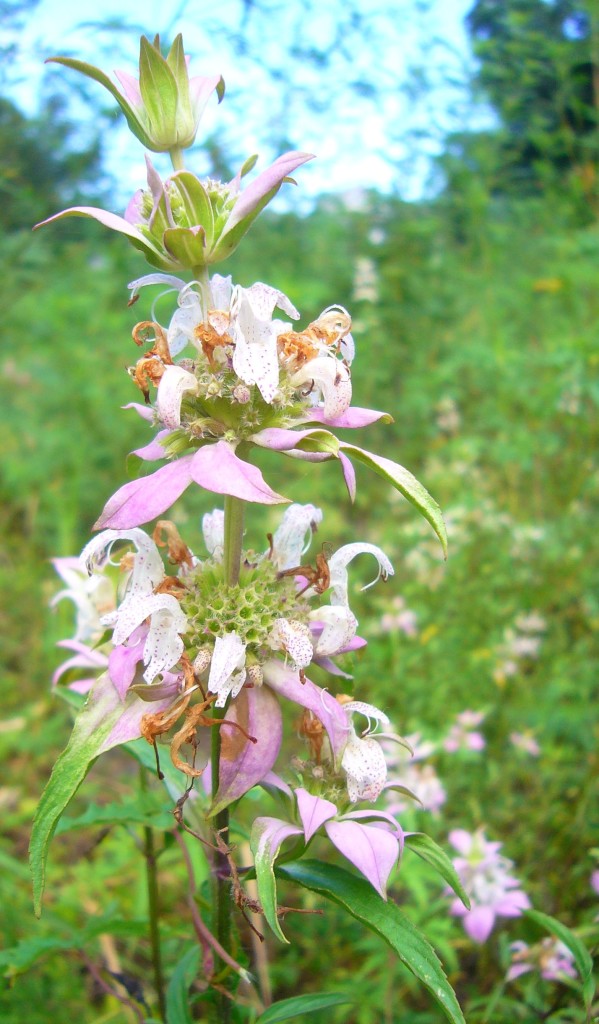
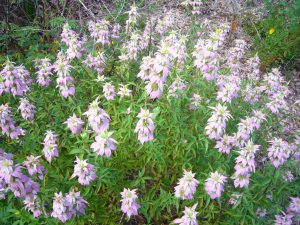
Horsemint with colorful bracts. Photo by Green Deane

Horsemint with colorful bracts. Photo by Green Deane

 Monarda Punctata: Bergamot’s Bud

First the good news: Horsemint makes a nice, intentionally weak tea. Stronger brews are used in herbal medicine. The Native Americans made  a “sweating” tea from it to treat colds.  The major oil in Horsemint is thymol. Externally it’s an antiseptic and vermifuge, internally, in large amounts, the plant can be fatal. That’s the bad news. So, as I said it makes a nice, intentionally weak, tea.

Horsemint grow in clumps, usually alone with other clumps. Photo by Green Deane

Horsemint grow in clumps, alone or with other clumps nearby. Photo by Green Deane

Horsemint is one of those plants that you seem to never notice until you learn to recognize it, then you see it every so often. It tends to grow in small colonies and near each other. If you find one, you will usually find another not too far away.  They can vary in size from six inches to three feet but always very showy and its extroverted colors can last for months.  You can propagate it by seeds or cuttings. I dug mine up and carried it home where it has a very sunny, well-watered spot in sandy soil.

The creamy lilac-spotted flowers (its bracts are pink) attract honeybees, bumblebees, miner bees, plasterer bees, swallowtail butterfly as well as the endangered Lycaenides melissa samuelis (Karner Blue.)  Hummingbirds like it as well. Most mammals know enough to leave the plant alone. Horsemint grows from eastern Northern Canada down to Florida, west to Michigan and New Mexico and California, also into eastern Mexico. A southern variety, Monarda punctata var. punctarta, grows south of Pennsylvania and out to Texas. There are about 20 different Monardas in the United States.

Horsemint has the highest thymol content of all the mints. It is more than an antiseptic, mite-killer and cough-syrup ingredient.  As a depressant, it is one of the most commonly abused substances among anesthesiologists and nurses. If thymol were discovered today it would be a prescription drug. There have been some thoughts towards regulating the species but it is so common in so many places that hasn’t been done. Thymol, incidentally, is also one of the 600 or so ingredients added to cigarettes to “improve” the flavor.

Nicholas Monardes

While thymol has a dark side it also has beneficial aspects. It is one of two chemicals in the horsemint — the other being carvacrol — which prevent the breakdown of acetylcholine, the stuff that makes memory possible. One of the symptoms of Alzheimer’s Disease is reduction in acetylcholine. Unlike a drug now used to prevent the break down of acetuylcholine — tacrine hydrochloride — thymol and carvacrol are not as rough on the liver. One could even make a shampoo out of horsemint and perhaps get the benefits.

As for the plant’s botanical name: Monarda is for Nicholas Monardes (1493-1588), a Spanish physician and botanist who mentioned this flower in his 1569 work on the flora of North America called “Joyfull Newes Out Of The Newe Founde Worlde”. Punctata is Latin for point, or in this case “dotted” because the flower petals have pink dots.  The plant’s name is said: moe-NAR-duh punk-TAY-tuh.

Whether as a weak tea, a stronger brew for the flu, or a poultice for arthritis, the Horsemint, or Spotted Beebalm, is a pretty plant to spot while foraging.

Green Deane’s “Itemized” Plant Profile

IDENTIFICATION: Herb, sometimes woody, shrubby, gangly, multi-branched, opposite leaves and square stems. The stems and leaves are hairy. Flowers small, inconspicuous, but arranged in showy heads of pink to lavender bracts. Flower tubes are pale yellow with purple spots, less than an inch long, leaves smells like Greek oregano.

TIME OF YEAR: Can be year round in Florida but favors late summer and fall, in northern climates flowers June to October depending where you are.

ENVIRONMENT: Likes moist but well drained soil and sunny conditions, but can survive on rainwater in old fields and on roadsides.

METHOD OF PREPARATION: Leaves and flowers for weak tea, some report the leaves can use chopped up and use to flavor salads.  Hanging leaves in the house leaves a nice scent.


{ 33 comments }

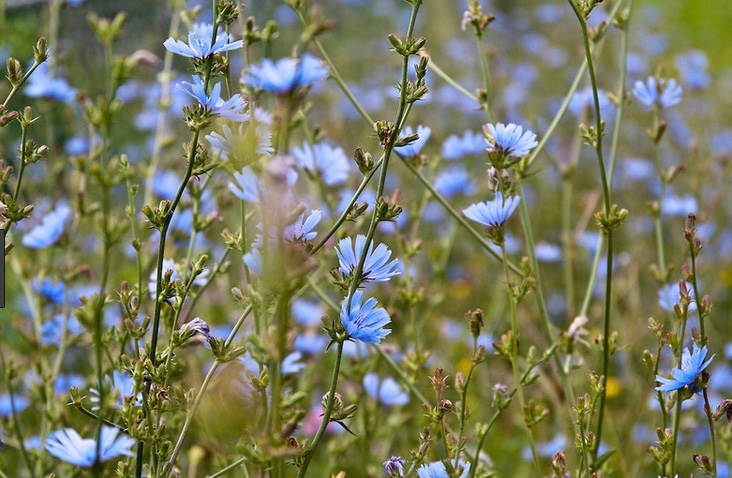
Chicory’s pale blue blosoms are also edible.

Cichorium intybus: Burned to a Crisp

Chicory was not a common plant where I grew up or where I’ve lived for 41 years. But I remember the first time I saw it, in 1990, in a park in Alexandria, Virginia, the bedroom of Washington DC.

What was so exciting was it was textbook perfect. The chicory looked exactly what it was supposed to look like, and that happens so rarely in foraging. That bears repeating: In my decades of foraging chicory is one of two plants I did not know which when I found looked exactly as they should have. That is one reason why pictures are not as good at identifying plants as people think. A good botanical drawing has all the essential elements in representative proportions and eliminates the unnecessary.

At any rate the chicory was instantly recognizable, growing next to a little ditch, and some of the flowers went home with me for my salad. I have since raised its bitter leafy cousins, radicchio and Belgian endive.

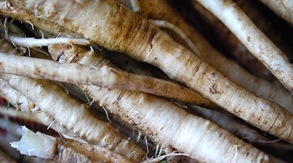
Chicory roots ready for roasting

A friend of mine now passed was a luthier.  Saul repaired very expensive instruments like Stradivarius and Guarneri violins. (Holding a million-dollar violin can make you very nervous.)  He only drank coffee mixed with roasted chicory root, perhaps the most well-known use of the plant. While some call chicory a coffee extender or a substitute for coffee, it is more accurate to say it is a blend that changes the overall flavor profile. If they made chicory coffee decaffeinated I would drink more of it. Caffeine and I had a medical argument at mid-life. It won thus I avoid it.

Chicory has other uses than leading coffee astray. The young leaves are edible in salads, as are the aforementioned blossoms. The flower buds can be pickled and the roots boiled and eaten, though that may take several changes of water.  Blanched spring growth (raised in the dark) are not bitter.

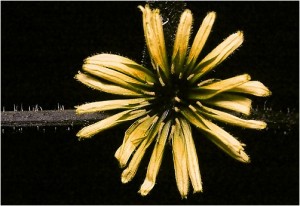
How Insects See The Chicory Blossom, photo by Bjørn Rørslett – NN/Nærfoto

Originally from Europe, chicory is reported throughout all of North America though I personally have never seen it here in central Florida. In my father’s native country, Greece, it’s a common wild green and picked often. As a people, Greeks still forage for greens regularly. It is as much something they do as it is foraging is something American’s don’t do. Thus there is a wide attitude between these two peoples about wild edibles. I have cousins who would be offended by the idea of buying greens. And while their patches of land might be small and scattered they tend to them religiously.

The botanical name, Cichorium intybus  (see-KORE-ee-um IN-tye-buss) has a contorted history. Both words came through Greek then were bastardized by Latin. They are from ancient Persian and Egyptian for, respectively, chicory and its cousin, endive. The ancient Greeks called chicory Kichore but now use αντίδι (ahn-DEE-thee.)  Intybus is from the Egyptian word “tybi”  which means January, the month the vegetable was commonly eaten.  But there is more to it. There was a lot of linguistic drift in the words Cichorium, chicory and Intybus. In fact, both Cichorium and chicory have the same root. Modern Greeks call it Radiki (rah-DEE-kee) the same word the use for dandelion greens.

The Greek horticulturist Dioscrorides called the large leaf version of the plant Seridos or Seris (what we would call endive.)   The skinny-leaf version became kichore which eventually became the genus name, cichorium. That came from talkh shuky in Persian, meaning sour purslane. That changed to tarakhshaquq then kichore then cichorea in Latin (cichorium is the adjective form) and finally to chicory in English. Intybus is from tybi but it went from tybi to  antubiya to hindaba to intybos to intybus to endivia and finally endive.

Green Deane’s “Itemized” Plant Profile

IDENTIFICATION: Perennial herb top five feet, large deep taproot, stems erect, often branching, leaves alternate, lance shaped broadest below the middle, to 12 inches long, three inches wide, toothed and lobed along the edge. Flowering heads up upper part of stems in the junction of smaller leaves, usually bright blue, sometimes pink or white.

TIME OF YEAR: Leaves as soon as possible in the spring, the root fall through spring. Flowers any time.

ENVIRONMENT: Like schalky soil but not fussy can be found along roads, fields, vacant lots, disturbed ground, gardens.

METHOD OF PREPARATION:  Young leaves for salads, crown bases boiled five minutes, roots before stalk appears boiled in several changes of water, or roasted to mix with coffee, pickle flower buds, add open flowers to salads.


{ 11 comments }

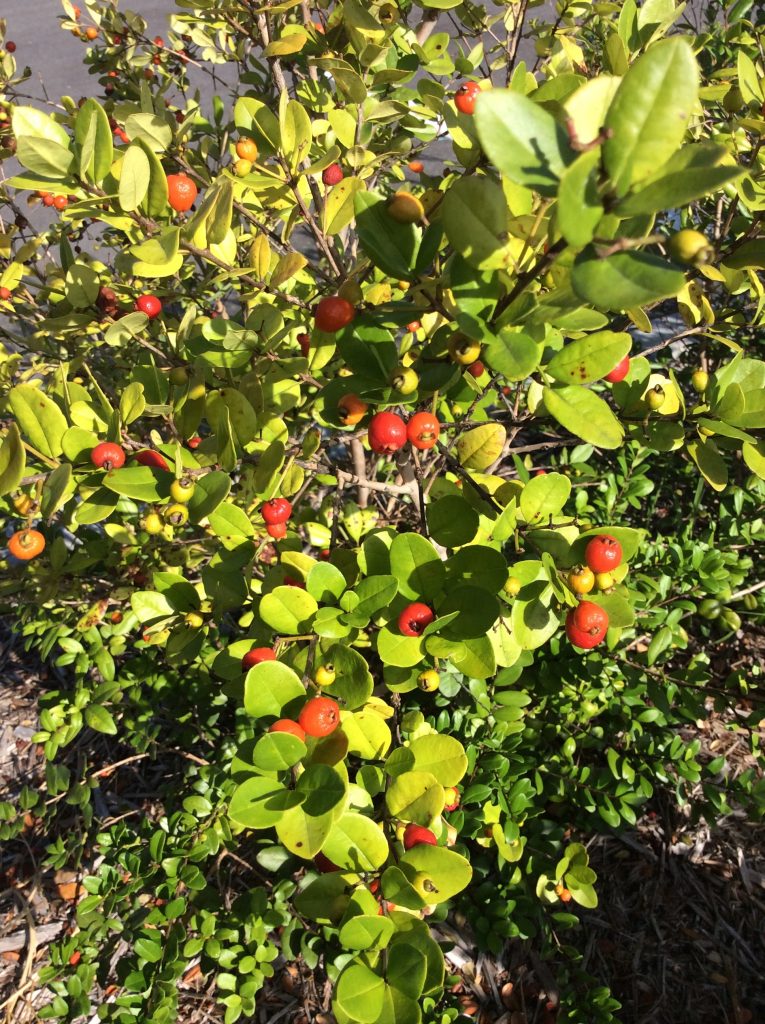
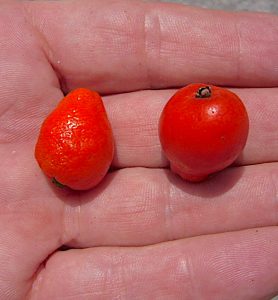
The orange and red fruit of the Simpson Stopper. Photos by Green Deane

Myrcianthes fragrans: Nakedwood Twinberry

I took me about a year to know the Simpson Stopper.

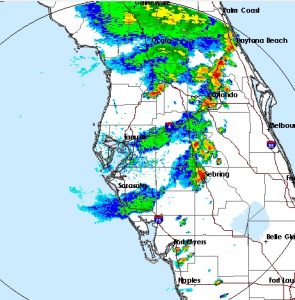
While most people think of Florida as flat there’s actually is a ridge down the middle of the state reportedly from dune fields created in the Pliocene Age, 2.5 to 5.3 million years ago. If you ever drive Interstate 4 from Daytona Beach to Tampa at Lakeland the highway drops over 100 feet down an ancient ocean escarpment, dramatically marking an end to a portion of the ridge. It’s flat from there southwest to Tampa, once ocean bottom.

There more between Daytona Beach and Tampa than Interstate 4. It’s a limestone ridge that crosses and also drops down from the middle towards Sebring. The geographical difference engenders thunder storms.

Several species grow across the flat southern end of Florida and up both sides but not in the higher middle, which tends to be a few degrees cooler in the winter. That is the case with the Simpson Stopper aka Myrcianthes fragrans (mer-see-ANTH-eez FRAY-granz) which is hardy down to 25° F, perhaps into the teens if well-established.  Inland it grows to just north of Lake Okeechobee, then reaches its botanical arms north along the west coast to Tampa and St. Augustine on the east coast but not naturally up the middle of the state.

I first saw it in at the southern end of the state in Dreher Park, West Palm Beach. It was a small tree. The next time was near the manatee viewing area at Haul Over Canal near the space center, some 200 miles north, a small tree that from a distance could be mistaken for a holly. Both Stoppers were intentionally planted but in south Florida and the islands also grows wild.

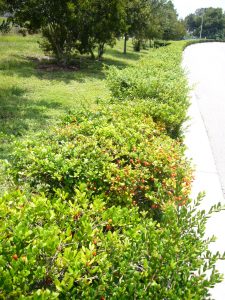
I did not find the artificial mother load of Simpson Stoppers but one of my foraging students did. He asked me to visit a local Wholefood’s store in Orlando to look at the landscaping around the shopping center. He said there was a plant there he couldn’t identify. I found a quarter-mile long hedge of Simpson Stopper, in fruit.

It’s becoming a popular hedge plant.

M. fragrans is in the eucalyptus family. If you crush a leaf it does not smell of eucalyptus but rather citrusy, some think nutmeg, some think a piney citrus aroma. The blossoms are pleasantly fragrant, which helps you identify it from an unpleasant smelling relative, the Spanish Stopper. The sweet, mealy pulp of the red, ripe fruit is edible, but not the seeds as far as I know. Besides, they taste bad. That I do know. The genus is closely related to Guavas as well as Syzigums and Eugenias, In the past many species were moved in and out of these genera and at one time M. fragrans was Eugenia simpsonii. In fact, the particular plant has had some 27 genus or species name changes.  E. simpsonii honored Charles Torrey Simpson, a naturalist and author in Miami in the early 1900’s.

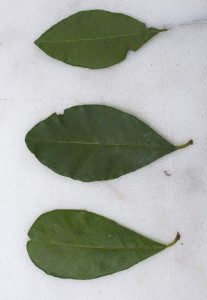
Simpson Stoppers have thee different leaf tipes. Photo by Green Deane

Simpson Stoppers have thee different leaf tips.

Not only are there several “Stoppers” as they are called, but the aforementioned genera also look similar, whether in Florida or Australia. They are generally shrubs to small trees, with leaves about one to two inches long and a half inch to an inch wide. Some have rounded leaves, some have pointed leaves, some are notched. The fruit varies from a black berry to a tiny deep red berry that looks like a pumpkin (the Surinam Cherry.) Some have one or two seeds, others like the Strawberry Guava have many seeds. The fruit tastes like mild orange peeling. They can be small bushy to tall and leggy. In landscaping they are an accent species as well as good hedge material.  

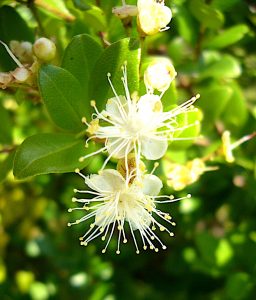
The blossoms are frilly.

There are several identifying characteristics of the Simpson Stopper. Let’s start with the little ones. The orange to red fruit is often in pairs and has a little four-sided round pucker at the end (kind of like a little folded-in blueberry crown made of four triangles.) The closely related Syzigums have a wrinkled cross at the end of the fruit. The leaf of the M. fragrans is also covered with dots. Under a #10 loop the upper surface of the leaf looks like it is covered with tiny drops of water (the dots.) The underside of the leaf is often decked out in what appears to be very tiny green dots, sometimes blackish dots. If you hold the leaf to the light and use a loop you will see gold dots. The leaves can also curl under at the edge. The fruit has one or two bean-shaped seeds, two being more common, often stuck together.  They are one of the favored foods of Cardinals and the Mocking Bird, which is Florida’s state bird. The sweet blossoms attract butterflies.

Also called “nakedwood” because of its smooth bark, it is often planted for its leggy multi-trunk wild growth pattern. Botanically Myrcianthes fragrans means “many thorns fragrant.” In this case the “many thorns” refers to the many stamens of the flower, which is also quite fragrant.

Other “stoppers” you might come across include the rare Eugenia confusa (Redberry Stopper), the Eugenia rhomea (Redberry Stopper) whose new growth is pale red while old growth has tiny black dots on the underside of the leaves; Eugenia foetida (Redberry Stopper) whose leaves and flowers smell foul; and the White Stopper, Eugenia axillaris so called because it has light-colored bark, edible mealy fruit.

Green Deane’s “Itemized” Plant Profile

The berries can reach good size. Don’t eat the seed.

IDENTIFICATION: A tree to 55 feet, and 14 inches through, inner reddish brown bark, flaking, growth similar to a crape myrtle, twigs slender, brown, finely hair. Leaves to two inches long, an inch wide, opposite, finely hairy petioles, blunt or rounded at the end, sometimes notched, sometimes pointed, minute gland dots, upper surface shiny dark green, under light dull green. Flowers in clusters, many spreading white stamens, see right.

TIME OF YEAR: Can fruit and flower year round, but favors August and September.

ENVIRONMENT: Full sun to partial shade, likes to be irrigated, hardy to 25F, found often growing over limestone, shell or marl.

METHOD OF PREPARATION: Pulp of ripe fruit is edible out of hand. The texture is soft and mealy. Fruit and bark are rumored to treat diarrhea when made into a tea but I’ve found no modern reference to support that.


{ 15 comments }

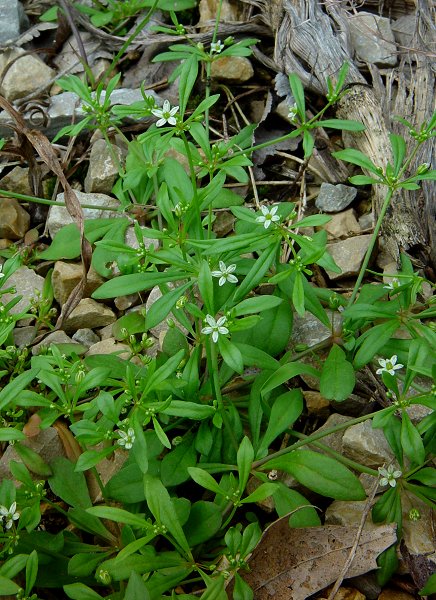
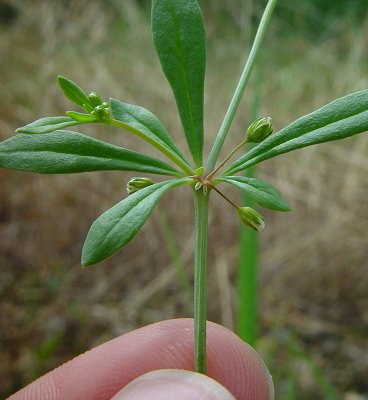
Note the leaves can be skinny or fat.

When it comes to Carpetweed you need to know only two things: It grows nearly everywhere, or will. And the plant above ground is edible. To quote Cornucopia II, page 153:

“The entire plant can be cooked and eaten as a potherb, or added to vegetable soups during the last minutes of cooking.” Yes, I know it says “entire” plant but that usually does not include roots. When roots are edible they are usually mentioned separately.

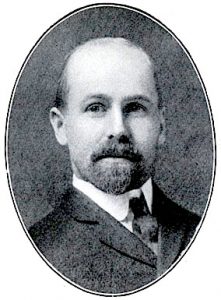
Harvard Professor Merritt Fernald.

Opinions of the species do vary. It is a fast-spreading weed from Tropical America that can survive northern winters, though there is some debate about that. Some folks say it will cover everything in sight. Merritt Fernald, left, no botanical slouch and the leading expert of his day, wrote on page 188 in Edible Plants of Eastern North America: “It is too small for most people to gather, except when very hungry.” Now you have the opinion spread: Will cover every thing in sight, and, too small to be bothered with.  Fernald was not beyond eating this or that strange plant but as he wrote in WWII he was concerned about the growing population and dwindling agricultural resources.

Botanists know Carpetweed is spreading rapidly because they have herbarium examples from almost two hundred years ago and then later in other areas. It has… carpeted… North America and is working on China. There are reports of it in Australia.  Carpetweed is also found in Mexico, West Indies, Central America, South America, Eurasia, and Africa. Not every place, however, is graced with Carpetweed. It is absent from Utah — too dry — and Alaska, too cold. I found no complaints out of Western Europe, yet.

The number of whorled leaves vary 3 to 8.

Botanically the weed is called Mollugo verticillata (mol-LOO-go ver-tee-see-LAH-tuh) which for once actually makes some sense. Often a botanical name has nothing to do with the plant nor describes it. This time it does. Mollugo used to be the genus name for the Galiums, which this plant does resembles. They are better known as Goose Grass, Cheavers, and Cleavers. And verticillata refers to the whorl of leaves the plant has at each node, which goes even further back to Vermes for worms. Mollugo is Dead Latin’s bastardization of the Greek mollis which means soft. Other names in English include Green Carpetweed, Indian Chickweed, and Devil’s Grip. In China it is 种棱粟米草 or zhong leng su mi cao. Botanists have been arguing for years whether there are two genera and exactly how many species there are. Confounding the issue is the fact the plant can vary a lot in the way it looks. Botanists say it is doubtful a species able to overwinter is the same as the original in Tropical America but no consensus has been reached… as if it is a pressing matter.

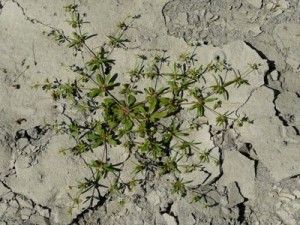
Typical look and location.

As far as opinions go Fernald may win. To find Carpetweed look down for a spot of green one to two feet across, low-growing, usually in dry areas. such as a college lawn watered by rain not irrigation. I think that’s where I last saw an excellent patch of it in Jacksonville at the state college there. Carpetweed can, however, cover more ground but apparently not enough to get into foraging books.

Man, by the way, is not the only nibbler: Birds and small mammals eat the seeds. Lastly consuming Carpetweed may increase your levels of nitric oxide. In theory that should lower blood pressure.

Green Deane’s “Itemized” Plant Profile: Carpetweed

IDENTIFICATION: Mollugo verticillata: It’s a late-germinating, many-branched summer annual forming circular patches one to two feet in diameter, sometimes much larger, often much less. Leaves are in whorls of 3 to 8 at each node.  Leaves attach directly to the stem (sessile) widest above the middle and tapering to the base, often shiny. Don’t mistake for Galiums which show up in the spring. Galiums are rough to the touch, Carpetweed is smooth. Galiums tend to grow up into a tangled mass, Carpetweed grows low, like a carpet. Galiums were bunched up to strain cheese through. Can’t do that with Carpetweed. Stems are smooth, branch a lot, lying on the ground with the ends turning up. Flowers are very small, five white sepals (look like petals) in clusters of two to five on long stalks. Red to orange seeds in an egg-shaped capsule.

TIME OF YEAR: Warm months in northern climes nearly year round in warm climes, flowers summer to early fall

ENVIRONMENT: Fields, gardens, roadsides, moist to dry soils, sand.

METHOD OF PREPARATION: The entire plant above ground can be boiled. Leaves are more preferable; young and tender — the meristem stage — even better.

{ 17 comments }