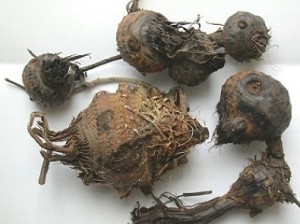
Sea Club Rush roots ready for processing

Scirpus maritimus: a Tough Root to Crack

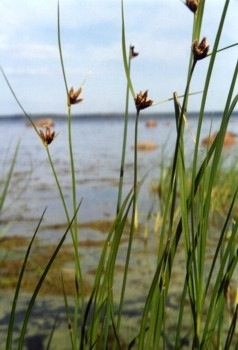
If you mention Sea Club Rush among foragers they give you a very blank stare. Understandably so. It was a fall-back staple in Europe that has naturalized itself worldwide and along North American shores from Prince Edward’s Island to Texas, and California north. It’s even managed to make its way up to Arkansas, Kansas, Utah, North Dakota and Saskatchewan so I suspect it is elsewhere as well.  It is found in estuaries and salty marshes but can also in fresh water and other damp areas often with cattails.

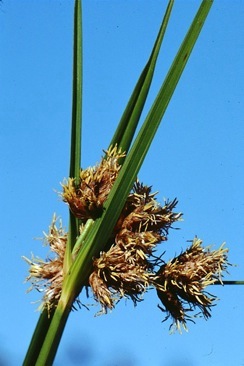
Seed head, all sedges have edible seeds

Most Scirpus tend to be swampy characters with usually soft starchy and sugary roots and stems. (See Bulrush Bonanza elsewhere on site.) Sea Club Rush, Scirpus maritimus (which has many other botanical names as well ) bucks that trend. It can tolerate salty water and has a tough root.  The root is quite fibrous and woody and usually requires flaking or grinding to be palatable. This raises issues.

Calories in and calories out is the name of the foraging survival game, today and in the ancient past. So the Sea Club Rush while a fun affectation when foraging is a hobby is another matter if you are surviving off the wilds. In the distant past it had to be a fall back plant because it requires a lot of labor to make it edible.  The speculation is other available starchy staples were preferred and the Sea Club Rush was only used when another staple was not available. Here is why.

Sea Club Rush

First you have to collect and trim the roots. Then they have to be pounded to remove the red outer bark. Once cleaned they have to be crushed into flaky bits, or ground into powder. That requires time and considerable energy, and if that is all muscle power, lots of calories. However, once processed they can be used in many ways. I suspect ancient foragers didn’t bother themselves with niceties. You can dehusk it, and grind it and mix with egg to make a tasty damper. But it can also be eaten raw if you have the jaw, teeth, stomach and hunger to do so. Timing would be a key in that when young and small they are tender and have a coconut-like flavor. As they age they become tough. While most focus on the root, the seeds can also be ground into flour. They are the only Scirpus seeds that float.

Scirpus maritimus is found in northern temperate and arctic Europe, England, Ireland, the Channel Islands, north Africa, west Siberia, north west India, Asia, Japan and aforementioned North America. Whether in Australia and New Zealand is a bit of debate. Found in Great Britain it is found in Surrey, Berks, and Middlesex, along the Thames, in Cambridge, Huntingdon, Worcester, Warwick, Stafford, Montgomery, Perth, in the Hebrides, and from Ross and Skye.  Scirpus (SKIR-pus) means sharp and maritimus (mare-ree-TEE-mus) in or of the sea.

Green Deane’s “Itemized” Plant Profile

IDENTIFICATION: A three-sided perennial sedge growing to a yard high, hardy to zone 6, Flowers monoecious, either male or female, both sexes can be found on same plant, in dense clusters, seed is three sided, shiny, flattened. Long leaves keeled with channels.  Leaves were used for basketry.

TIME OF YEAR: Flowers from spring to summer, seeds ripen summer to fall, but that can vary greatly with climate and salinity. In fact in some places it can flower and grow in winter if the weather and salinity are right.

ENVIRONMENT: Tolerates most soil — likes sand — and can grow in salty areas, cannot grow in the shade, requires moist or wet soil and can grow in water, can tolerate maritime exposure, along the seashore, in shallow tidal rivers, ditches and ponds near the sea, never in the shade. Can be found above the high water mark and on dunes. Roots usually no more than a foot down. Can be found in salty desert watering holes.

METHOD OF PREPARATION: Root (actually tuberous rhizomes)  raw or cooked, starchy, usually dried and ground into a powder, roots form tubers at along their length, new plants form at these tubers, young tubers white and starchy, coconut nut flavored, turn brown then black and woody with age. Seeds ground into flour. Young shoots of most Scirpus are edible. Probably all Scirpus roots can be eaten. Known to be edible are the roots of S. acutus, S. paludos, S. fernaldi, and S. robustus. Stems of S. fluviatilis  peeled and eaten in Asia, S. lacustris and S. validus seeds are also eaten.


{ 3 comments }

Source of Mauby, Colubrina elliptica

 Colubrina elliptica: Mauby has Moxie

First there was Moxie, then Mauby… actually it was historically the other way around though few until now would know that.  You read it here first.

Ted William for Moxie

Moxie is a soft drink invented by a fellow Mainer Augustin Thompson living in Lowell, Massachusetts in 1876. It is the official drink of the state of Maine, as of 2005. (There is an annual Moxie Chugging Challenge in July. Thanks for the tip off, Kate.) Moxie was the nation’s first soft drink and brilliantly marketed by Frank Archer. “Pioneering” marketing would be an apt description. At one time around WWI, Moxie out sold Coca Cola. However, Moxie did not advertise during the first Great Depression and never recovered its huge market share.

First sold as a medicine, then as a soft drink, Moxie’s still available. President Coolidge liked Moxie as did comedian Ed Wynn and songster George M. Cohan. Slugger Ted Williams was a spokesman for the drink and the oh-so-correct writer “eb white” drank it.  He wrote: “Moxie contains gentian root, which is the path to the good life.” The Moxie formula has been changed at least three times and probably originally had cocaine in it as did Coca-Cola.

Coolidge toasted his presidency with Moxie

Drinking Moxie is a rite of passage for most New Englanders. The initial flavor is similar to root beer — sweet — but then a vigorous bitter aftertaste kicks in and makes itself to home. To like Moxie you have to like bitter flavors. That would be the end of the Moxie story while on the way to talk about Mauby. But there may be more to it than Thompson simply inventing Moxie one day in New England.

You see Augustin Thompson was going to become a doctor. However first he was in the Maine Volunteer Infantry in the Civil War, became a captain, and saw action at the siege of Port Hudson in Donaldsonville, Louisiana, as well as minor action at Fort Pickens in Pensacola, Florida. To the point, he served in the Deep South. Later he was given the rank of lieutenant colonel by an act of Congress… that took Moxie.

Augustin Thompson

After the war he went to what was then a homoeopathic medical school in Philadelphia, graduated with honors at the top of his class, and settled in Lowell, Mass., setting up a practice in 1867. Within 20 years he was the most popular doctor in New England and had the largest client list. But he had a different ambition: Selling his “nerve tonic” Moxie. Patent medicines said to be based on native formulas were hot back then — the back-to-nature health movement of its day. Early marketing says he released tonic as a syrup in 1884. As a syrup it was to be taken before meals to aid digestion. Thompson got a trade mark for it in 1885 as a carbonated beverage.  As a drink it was a “refreshing” tonic. In 1906 Moxie was forced to drop medicinal claims, three years after the doctor died. Now enter Mauby.

Maubry Fizz probably preceded Moxie

Mauby is a drink strikingly similar to Moxie but is made from one of two related trees native to Florida and the Caribbean. Mauby is sweet and bitter, made as a concentrate or a fizzy drink, and is taken to aid digestion. Mauby, or at least the trees it comes from, are mentioned by botanists as early as 1760 and Mauby was certainly a drink among Blacks by the Civil War in Louisiana and Florida.  The intrigue does not stop there.

A mysterious Lieutenant “Moxie” supposedly brought Dr. Thompson some ingredients from South America and it was from them the soft drink was born. According to an early bottle label, Moxie was named after said Lieutenant who discovered the active ingredient, “a simple sugarcane-like plant grown near the Equator and farther south.” But Dr. Frederic Cassidy, editor of the Dictionary of American Regional English, said he thought the lieutenant and the plant may be inventions. No Civil War record of a Lieutenant Moxie has ever been found. Cassidy suggested Thompson could have gotten the name of his tonic from a plant called a moxie-berry (Chiogenes serpyllifolia.) It is one of the very rare white berries one can eat. The Algonquins called it Maski, the cognate for Moxie. It was used by atives and settlers, to make a medicinal tea. There are several “Moxi” place names in New England and Thompson could have easily adopted the name. And since Moxie is close to Mauby, it was a good fit.
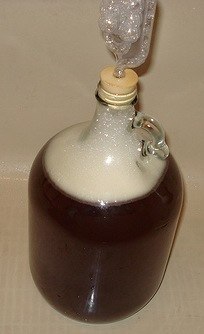
Fermenting Mauby

Mauby/Moxie, Thompson serving in Louisiana and Florida, a mysterious lieutenant, secret ingredient from South America… Is there a connection between Mauby and Moxie? It’s not an unreasonable question. If no connections then there are certainly several coincidences.  Interestingly, Dr. Thompson called his concoction a delicious blend of bitter and sweet, exactly what the aficionados of Mauby call it today. Both Mauby and Moxie taste similar to root beer with angostura bitters added.

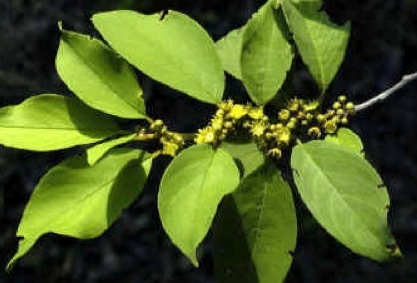
Commercial Mauby is made from the Snakewood Tree, botanically Colubrina ellliptica. Locals also call it Nakedwood, Greenheart, Hogplum and a long list of other names in modern and ancient languages. We will go with Snakewood because its bark kind of grow in a wriggly manner as do its stamens.  Colubrina (kho-lew-BREE-nuh)  is Latin for snake-like” Elliptica (ee-LIP-tih-kuh) refers to the oval leaves of that tree, read twice as long as wide. Arborescens, (ar-bor-ESS-enz.) means becoming woody, tree-like.
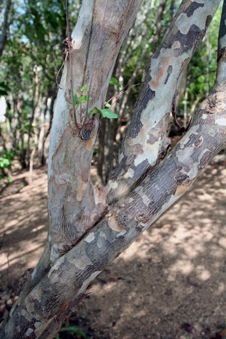
Snakewood bark makes Mauby

Snakebark makes Mauby

To make Mauby the bark is brewed with spices and brown sugar. Skimmed of froth, yeast from a previous batch is added and only allowed to ferment a day or two, preferences vary. Some don’t ferment it at all, other let it become a full-blown truly bitter beer. Usually it is served as a home-made soft drink. Think of it as a Caribbean comfort food with each family handing down its own recipe. Besides being a bit of family legacy it is a very popular commercial product sold on the streets and for home use. There is also some suggestion it can lower high blood pressure.

When you read the Mauby ingredients in the recipes, particularly of the second one, remember the description by commentator and Moxie fan Danny Schlozman of what Moxie tastes like: “The sarsaparilla tones come to the fore, although not quite so strongly as in root beer — one might claim a resemblance with ginger ale. As these flavors recede, vaguely fruity flavors (think cough syrup, say the detractors) combine with an overtone of wintergreen to produce a spicy mouth-feel. Finally comes the vaunted aftertaste, powerfully bitter with a hint of cinnamon and a touch of nutmeg.”

When President Warren Harding died in 1923,  Vice President, Calvin Coolidge, was at the family farm in Vermont bailing hay. The telegraph message arrived at 2 a.m. with the news. John Coolidge, Cal’s father and justice of the peace, swore in his son as President of the United States. They toasted the event with Moxie(it was during Prohibition.)

Moxie, Snowe and Bush

For the recipes below you can get the bark at Caribbean or Puerto Rican markets. You can also buy concentrate but it is considered more bitter and medicinal tasting. If you collect the bark in the wild, it comes off the tree easily with no harm to the tree because is exfoliates all the time. The preferred tree is C. ellliptica however C. arborescens can be used the same way. The latter is rare so be careful.

At right is former President George W. Bush with US Senator Olympia Snowe of Maine and a Moxie T-shirt. There is a bit of a connection between Green Deane and Senator Snow. When just a child, Senator Snow lost first her mother then a short time later her father. She went to live with her uncle and his wife Maria Karantzalis whom Olympia called “Thia” which means “aunt.” Maria is a cousin of Green Deane on his grandmother side, Anastasia Karantzalis, from Konakia, Greece, in The Mani.

Here are two recipes, the quick and the involved:

Quickie Mauby

Ingredients:

1/2 oz Snakewood bark

2 short cinnamon sticks (about two inches, as sold)

3 quarts Water

1 tablespoon Orange Peel

4 clove Cloves

Directions:

Boil the bark, orange peel, cinnamon spice and cloves in one cup of water for about 10 minutes. Let cool and add water and sugar. Brew for about 5 minutes. Strain and place in jug, refrigerate for two days. Serve chilled. Non-alcoholic, non-fizzy, which is the most common way served.

More involved Mauby

Flavor Ingredients:

1 ounce dry Snakewood bark

2 sticks cinnamon (short)

2 bay leaves

2 tablesppons fresh rosemary

2 teaspoons dried marjoram

2 pods star anise

2 cloves

1/4 tsp. grated nutmeg

3 cups water

Bring the three cups to a boil and simmer all ingredients for 10 minutes,

Strain, saving the bark. Put strained liquid into a container that will hold

three gallons. Add the boiled bark.

Sweetening ingredients

4 cups sugar

10 cups water

Heat the four cups of sugar in 10 cups of water. You can use white sugar, brown sugar or half and half. All brown sugar imparts sweetness and another layer of flavor.  Allow it to cool. Pour into the three gallon container. Use a half a cup of starter from a previous batch (that you fed and kept in the frig) or add a packet of beer yeast. Yes you can use bread yeast, but it will change the flavor slightly. If you are going to use bread yeast, bread machine yeast works better. Put on a fermentation lock or cover with a clean towel. You can bottle it in a day, two is recommended, some wait for five days. If you want it fizzy you will have to use bottle made for holding pressure, such as champagne bottles, or sturdy plastic soda bottles. If you don’t want it too fizzy, keep the caps loose enough to let gas escape. Store in the frig. Serve over Ice.

Green Deane’s “Itemized” Plant Profile

IDENTIFICATION: Scrub or tree to 60 feet, with orange-brown bark, flaking in loose, curling scales, old trees have deep, serpentine furrows. Leaves alternate, ovate to elliptic, tapering to a blunt tip, two to four inches long, thin and soft. Flowers, small, greenish yellow, five petaled, fruit a scarlet capsule, three lobed, to a quarter-inch wide, one black seed.   C. arborescens  has brown fuzz on its branches, leaves and flowers, and a purple-black fruit.

TIME OF YEAR: Year round

ENVIRONMENT: Hammocks

METHOD OF PREPARATION: Bark of either made into drink called Mabi Champan in the Virgin Islands. Leaves from C. arborescens can also be use soap.



{ 12 comments }
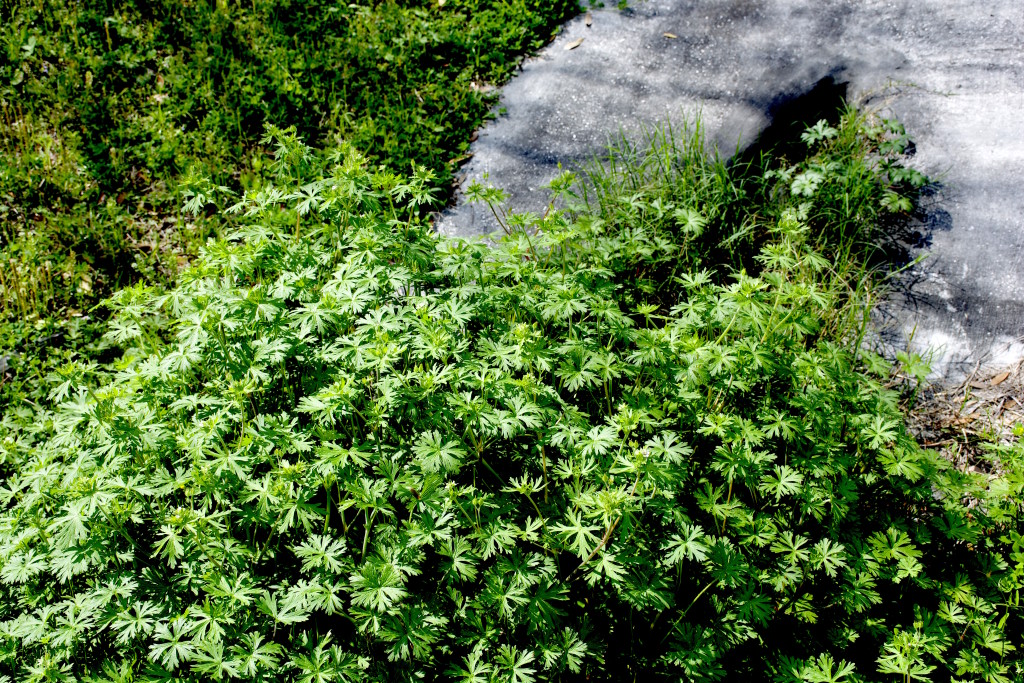
A two-foot high mound of Crane Bill's readying to blossom. Photo by Green Deane

A two-foot high mound of Crane Bill’s readying to blossom. Photo by Green Deane

Erodium circutarium, Geranium carolinianum: Two Bills You Want to Get

Stork’s Bill

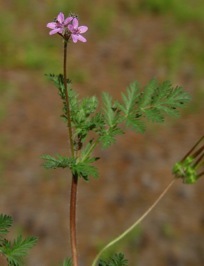
Stork’s Bill is one of those little plants that’s not supposed to grow locally but does here and there. Native to the Mediterranean area, it came here with the Spaniards and later proliferated with the planting of alfalfa, whose fields it likes to inhabit. Now it’s naturalized throughout North America. In northern states and Canada. It’s an annual. In southern and southwest states, a biennial. It is particularly common in deserts and arid grasslands.  Colorado calls it a noxious weed.

Scientifically Stork’s Bill is called Erodium cicutarium (er-OH-dee-um  sik-yoo-TARE-ee-um.)  Erodium is from the Greek word Erodios, meaning heron — now there’s a surprise.  Cicutarium — Latin — means resembling the genus Cicuta, the Poison Hemlock, and it does. The significant difference between them when young is the Stork’s Bill has hairy stems. The Poison Hemlock is not hairy.  Don’t mistake the two. Poison Hemlock is deadly. Remember, Stork’s Bill has hairy stems and a basal rosette. The entire plant is edible raw or cooked, and of course as usual, young and tender is better than old and tough. Though in the geranium family when picked young it has a flavor similar to parsley.  Another name for it is filaree.

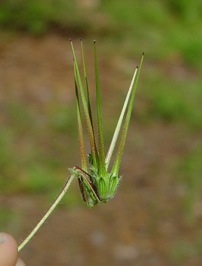
Seed pods look crane-ish

At least three natiave groups picked up on the plant and included it into their diet, the Blackfeet, Shoshone and the Diggers. Man is not the only one who favors the Stork’s Bill. Besides grazed upon by cattle, sheep and goats, the seeds are collected by various species of harvester ants. The seeds are also loaded with vitamin K and have little tails that coil and uncoil with changes in humidity, burying the seed. The seeds are also eaten by upland game birds, songbirds, and small rodents including kangaroo rats. The Brown Argus butterfly also feeds off the plant. And as it is often a very lowly plant the desert tortoise finds it a meal as well. That low growth pattern also lets you find it in lawns as the mower can pass over it.

Incidentally, the Stork’s Bill has a few other claims to fame. The entire plant can be used as a green dye and does not need a mordant to set the color. The old styles (tails on seeds) are humidity sensitive and can used in hygrometers and as weather indicators. Also the powdered plant has been dusted on watermelon seeds prevent disease.

Crane’s Bill, or Cranesbill

The leaves of the Erodium moschatum (er-OH-dee-um  MOSS-kuh-tum) the Musky Stork’s Bill,  are also edible but bitter. Moschatum means musky. It is found from Delaware north, in South Carolina, and the West Coast of the US and Arizona.

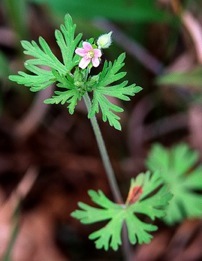
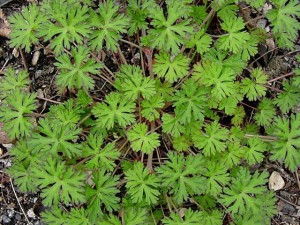
Once the Stork’s Bill is in bloom and seeding don’t confuse it with the Cranesbill Geranium (Geranium carolinianum) which is a Florida native.  The Cranesbill looks like the Stork’s Bill except it has palmate leaves. While it is edible it is very bitter. You can eat it raw or cooked.

The common names Crane's Bill and Stork's Bill are used interchangeably.

The common names Crane’s Bill and Stork’s Bill are used interchangeably.

The G. carolinianum is a miniature version of the G. maculatum. It has a history of medicinal uses. The whole plant, but especially the roots, is astringent, salve and styptic. It can be used as a gargle for sore throats. The plant is high in tannins, which is why it is bitter and used for diarrhea. A medicinal tea can be prepared by boiling 1–2 teaspoons of the root for ten to fifteen minutes in 2 cups of water. One can drink three or more cups per day. A tincture (approximately 1/2 teaspoon) can also be take three times a day

Geranium is from the Greek word geranion which means crane. Carolinianum means from Carolina but has come to mean mid-range America. Maculatum (mak-yuh-LAY-tum) means spotted.  Also called G. bicknellii (bick-NELL-ee-eye.)

Green Deane’s “Itemized” Plant Profile

IDENTIFICATION: Stork’s Bill: Hairy, sticky, sprawling, stems hairy with short white hair and have bright pink five-petaled flowers, in a loose cluster, they often have dark spots on their bases, leaves reddish green, pinnate, fern-like, arranged in two ranks, one on either side of the midrib, to four inches long, seed pod long, shaped a stork bill that bursts open into a spiral when ripe, seeds have little feathery parachutes. Usually ankle high, grows to 12 inches in warmer areas . MAKE SURE THE STEMS ARE HAIRY!

TIME OF YEAR: Flowers February to October, depending upon climate, early spring in south, late spring in north, Seeds are available late summer to fall. It over winters well and often is the first green you will see after the snow melts.

ENVIRONMENT: Desert areas, grass lands, rangeland, prairies, roadsides, sandy soil, inland and onthe coast, dunes, lawns. Prefers sunny areas and non-acid soil.

METHOD OF PREPARATION: While the entire plant is edible, usually the leaves are eaten. Lightly steamed leaves is the best method of preparing them, or boiled in slightly salted water. Can be chopped and added to salads raw.  The root can be chewed like a gum.

HERB BLURB

Stork’s Bill: A leaf tea has been used to induce sweating and is diuretic. The leaves were also soaked in bath water to treat rheumatism. Plant contains tannin, is astringent and a hemostatic. It has been used for uterine and other bleeding, roots and were eaten by nursing mothers to increase milk flow, externally used as a wash on animal bites and skin infections. A poultice of the chewed root has been applied to sores and rashes. It is reputed to contain an antidote for strychnine.

{ 27 comments }


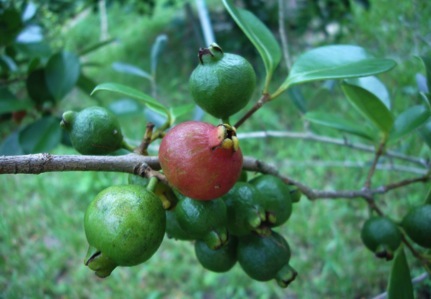
Strawberry guava with green and ripe fruit. Photo by Green Deane

  Psidium littorale var. cattleianum: Strawberry Guava

One man’s fruit tree is another man’s weed. My one Strawberry Guava tree is a fruiting delight. However, in the Caribbean, Hawaii, and parts of Florida, it’s an invasive weed, which also means free food. Then again, when you think of it, foragers are always surrounded by food.

Native to the Atlantic coast of Brazil, the Strawberry Guava has been exported to warm places around the world and naturalized. Where you find citrus you will find Strawberry Guava. It was imported into Florida in the 1880s as an ornamental and for fruit production. Closely related to the common guava, it forms dense stands that overpowers local species. Once entrenched it is hard to remove. Currently there are no controls though Hawaii is in the process of importing an insect to slow its growth. All the while it produces fruit.

That it is a guava is not debatable. That its fruit tastes like strawberries is. When the fruit is extremely ripe it can have a momentary fragrance of strawberry. Otherwise to me it tastes more like tart passionfruit.

I have learned that picking the fruit requires timing. The fruit starts out hard and green. At some point they begin to ripen and become mottled, a little, green, a little white, a little red. As a fruit turns color it also softens. At that stage it is perfect for picking. It will be tart, seeds not quite hard yet, and bug free. If you wait until the fruit turns completely red, or even dark red, it will — here at least — be full of fruit fly larvae. That is not to say, however, that the fruit is unusable then. That depends on whether you like the extra protein.

The fruit of the Strawberry Guava can be eaten right off the bush. The seeds are hard so chew strategically. The skin is tart and some folks prefer to scoop out the sweet flesh and seeds not eating the skin. Some prefer just the flesh, which is sweet. The seeds can be eaten carefully or roasted as a coffee substitute. Thus older, wormy fruit can be collected for their seeds. The leaves of the tree can also be used to make a tea. I’ve made the fruit into jelly and fruit leather. You might want to omit the seeds from the fruit leather. They stay hard and challenge your dentistry, but they can be included if you want. The wood is good for smoking meat and can also be made into tools and toys.

The Strawberry Guava is an all-round versatile weed. Perhaps the only draw back, besides being invasive,  is it fruits only once a year and all at once, over and done with within a couple of weeks. I have found if I pick the ripening fruit daily it ripens more fruit and lessens the fruit fly issue.

Pineapple guava

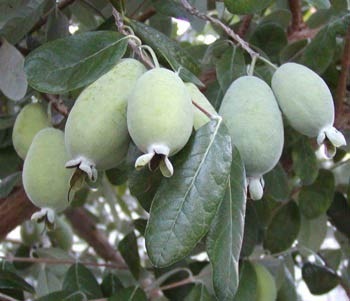
Botanically, the Strawberry Guava is in the myrtle family and is Psidium littorale var cattleianum.  SID-ee-um  lit-aw-RAY-lee  catt-tee-eye-AY-num. Psidium is the Greek word for pomegranate. Littorale is of the sea shore. The variety is named after William Cattley (d. 1832), English horticulturalist  who was the first person to successfully cultivate the species. The Strawberry Guava is also called Psidium cattleianum. Incidentally, there is a Pineapple Guava as well, Feijoa sellowiana.  It’s fruit stays green and has an odd cross shape on the end. It drops when ripe but can be picked before that. See picture right.  Its blossom petals are edible.

Green Deane’s “Itemized” Plant Profile

IDENTIFICATION: Evergreen shrub or small tree to 25 feet tall, with gray to reddish-brown peeling bark and young branches round, slightly hairy. Leaves opposite, simple, no teeth, no hair, elliptic to oblong to 3 inches long. Flowers: To just over an inch wide; single at leaf axils, with white petals and a mass of white and yellow stamens. Fruit golfball size, looks similar to small pomegranates, purple red, whitish flesh, sweet when ripe, many seeds.  There is also a yellow edible version.

TIME OF YEAR: Can bloom and fruit all year but bears its main crop in early to mid summer.

ENVIRONMENT: Extreme. It can grow in near dry conditions to a rainforest. The more water and sun, the taller it can grow. Will not tolerate freezing.

METHOD OF PREPARATION: Many. It can be eaten off the bush, best when between green and red, mottled. Can be made in to pies, jam, jellies, drinks, sauces, fruit leather et cetera. Seeds are edible but hard. Can be roasted and used to extend coffee or as a substitute. A tea can be made from the leaves. A yellow species can be used the same way.  Again, the seeds while edible are tough and hard on your teeth.


{ 37 comments }

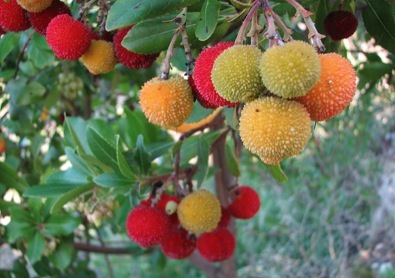
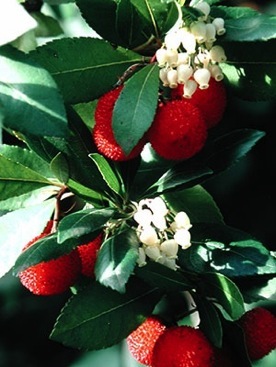
Strawberry Tree Koumaria

Strawberry Tree, Koumaria, Koumara, Pacific Madrone, Madrona

Any plant called “strawberry” other than a strawberry is doomed. Strawberries pack a lot of particular flavor and sweetness. Most other things called strawberry do not.

The Strawberry Guava doesn’t. The Indian Strawberry doesn’t. The Strawberry Tree doesn’t, and its sibling, the other Strawberry Tree doesn’t either. These four fruits have their own flavor and appeal that gets lost in the pronouncement that they are not as good as the strawberry. And that is accurate. None of them are as extroverted as the strawberry, but they are not strawberries. You have to get past that.

Like the rest, the Strawberry Tree, Arbutus unedo,  is doomed in English, as Arbutus mensiesii related Strawberry Tree. In Greek the former is called Koumaria (koo-mar-ree-AH) which is also the name of a town and a heck  of a lot of hotels. The perfectly round fruit of the tree, a favorite of children, is called Koumara (no i.) Goats love the leaves, as do deer. But best of all, Koumara are Koumara, and they’re good unto themselves. A. unedo takes a year to put on fruit and ripen so it is loosing fruit just about the time it is flowering again. Called madronos in Spanish, Corbezzolo in Italian, and sometimes Bearberry in English as well as the Apple of Cain and Cain Apple. The fruit smells like anise but doesn’t taste like that, more along the lines of a woody strawberry, or a cross between guava and nectarine However, unripe it can cause nausea, on the other hand it can ferment on the branch and cause mild intoxication. From a health point of view it does have Vitamin C. The bark has tannins for working leather or as a dye.

A. mensiesii aka A. menziesii

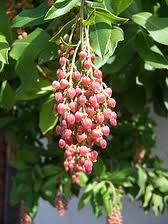
The second Strawberry Tree is A. mensiesii, also called the Pacific Madrone, or Madrona. Native to northwestern North America, it can be found cultivate in non-hot areas of the country. Every September I get several emails from folks wondering if the fruit is edible because there are Internet reports that it is toxic. It is not. Most folks think it is some kind of dogwood, but it is not. It’s berries are edible but astringent. The Indians made them into cider or just chewed them. A more distant relative, the Mayflower, or the Trailing Arbutus, is also an edible. See a separate entry for that.

Arbutus (arb-YEW-tus) means struggle.  Unedo (YOU-nee-doe)  means “I eat only one” from the Latin unum edo. That can be read two ways: It is so good I only eat one, or it is rather it is uninteresting thus I only eat one. We got that in 50 AD from Pliny the Elder (23 AD – August 25, 79), and we don’t know which he meant. Mensiesii honors the discoverer, Archibald Menzies (1754-1842), a Scottish physician and naturalist.

The Arbutuses are in the heath family. Oddly, A. unedo also grows in Ireland where in Gaelic it is called Caithne. Some think it is a pre-ice age hold over. In might have been introduced by the Beaker People around 4,000 BC according to pollen found in bogs.  Incidentally, there is an old Irish folk song “My Love’s An Arbrutus.” The words are by the recipes below.

Koumaria in blossom

Several species in the genus Arbutus are ornamentals. A. andrachne (the Eastern Strawberry Tree) has small edible berries and cinnamon-colored bark. It is often confused with a hybrid, A. andrachnoides , which has small, hard edible fruit and perfectly smooth bark ranging from deep red to bright yellow. Fruit of the Arbutus marina, however, is edible.

When I travel back to the “old country” the two things I notice about plants is how many familiar ones there are. Weeds are cosmopolitan. Then there are the natives. Edible figs grow wild in southern Greece, as does the deadly Oleander but also thyme, basil, savory, rosemary, oregano and marjoram. In Crete the fruit of the Koumaria is made into a local distillation called Koumaro. Having visited Crete many times I think the Cretans can make tail pipe-kicking radiator fluid out of nearly anything.


Green Deane’s “Itemized” Plant Profile


IDENTIFICATION: The Strawberry Tree, grows to 15 to 35 feet tall, evergreen leaves are dark green, glossy, two to four inches long, up to an inch wide with a serrated edge.Young leaves have red veins.  Blossoms are white (occasionally pale pink), bell-shaped, like a blueberry blossom, honey scented. Fruit is a red berry to 3/4 of an inch through,  rough surface, maturing 12 months. In southern US the tree is about 10 feet tall. Older specimens have gnarled trunk and branches. Many cultivars including “Compacta, Rubra, Elifn King, Quercifolia, Croomei, Melita, and Werner.

TIME OF YEAR: Fruit usually ripens in later summer or fall. Mealy, amber flesh. Tree blooms autumn into winter

ENVIRONMENT: Native to rocky well-drained soil, full sun except in deserts where it needs partial shade

METHOD OF PREPARATION: Out of hand, jams, jellies, pies, candied fruit, wine and spirits. See recipes below.

 Strawberry Tree Jam

Two pounds of fruit

A pound of sugar

Four ounces orange liquor

Slowly boil the fruit with a little water until soft. Press through a mill then reheat with the sugar and liqueur. Simmer until a drop mounds on a chilled dish.

Option: Add some cinnamon, cloves, nutmeg and vanilla for added flavor.

Strawberry Tree Jelly

Arbutus berries, sugar, water.

Rinse fruits. Put them in a preserving pan and cover with cold water almost completely. . Bring on the heat and cook for about fifteen minutes over low heat. Pass the fruit through a cheesecloth, pressing well to catch any juice.

Weigh it.  Mix the juice with its weight of sugar.  Simmer over low heat, skimming rather soft at times. Cooking is complete when the juice forms small beads. Cool before placing in jars.

My Love’s An Arbutus

My love’s an arbutus
By the borders of Lene,
So slender and shapely
In her girdle of green.
And I measure the pleasure
Of her eye’s sapphire sheen
By the blue skies that sparkle
Through the soft branching screen.

But though ruddy the berry
And snowy the flower
That brighten together
The arbutus bower,
Perfuming and blooming
Through sunshine and shower,
Give me her bright lips
And her laugh’s pearly dower.

Alas, fruit and blossom
Shall lie dead on the lea,
And Time’s jealous fingers
Dim your young charms, Machree.
But unranging, unchanging,
You’ll still cling to me,
Like the evergreen leaf
To the arbutus tree.

{ 65 comments }