Hawthorne Fruit

The Crataegus Clan: Food & Poison

The very first Hawthorn I ever saw — and the only one I knew for quite a while — grew on the other side of the dirt road that ran by our house in Pownal, Maine.

This Hawthorn was very old. They can live to at least 400 years. It’s gone now — road widening — and I never knew which Hawthorn it was but that’s not unusual with this species. Experts today can’t agree if there are 200 species of Hawthorns or 1,000. The genus has a lot of variability.  What I remember most clearly was its huge thorns, most about two inches long. It also had several families of birds in it each year. Few predators were going to brave those thorns.

Twenty-feet tall with a crown equally wide, it grew on high ground right at the intersection of two pastures, a very fitting place. Haw means hedge and indeed Hawthorns were used as hedges. In fact, in 1845 England pass the General Enclosures Act allowing Hawthorns to be used as hedges to mark off land. That caused a lot of irritation because until then folks could go wandering from hill to dale at will without obstructions. It took another 150 years or so for England to pass a “right to roam act” allowing people more access to such land. Let it not be said that England does not correct bad laws, it may just take a century or two.

The other thing that intrigued me as a kid growing up by the tree was that the writer Nathaniel Hawthorne had the same name as the tree. I’ve never met a Mr. Catalpa, Mrs. Hackmatack, or Ms. Oak. Truth be known that author’s family name was Hathorne (from Haugthorn, a small thorny tree or shrub.) However, one of his ancestors, John Hathorne, was an infamous judge in the Salem Witch Trials. The speculation is Nathaniel change the spelling of his last name to distance himself from that infamous incident. Indeed, just as he had an ancestor who judged “witches” at the trial I had an ancestor  — a distant grandmother — convicted at the trials for witchcraft and hanged (Susannah North Martin. 19 July 1692) Over the years I have met a few Pynes, Apples and one Dr. Maples (the forensic anthropologist who identified Pizarro’s remains and those of the Russian royal family. We met once. He wrote “Dead Men Do Tell Tales.”)

Nathaniel Hawthorne, 4 July, 1804 – 19 May, 1864

The first thing you need to know about the Hawthorn berries is you should not eat the seeds. They contain cyanide bonded with sugar, called amygdalin. In your gut — actually small intestine — that changes to hydrogen cyanide and can be deadly. You can cook the berries then discard the seeds, but don’t eat the seeds. I recently saw a recipe on the internet that called for using hawthorne berries whole. Clearly that cook never made that pie, or if she did, only once. Don’t eat Hawthorne seeds. If you eat the raw berries spit the seeds out. If an adult mistakenly eats one or two seeds they aren’t deadly but they could be to a child. The seeds are best avoided.  Very young spring leaves — called Bread and Cheese — can be a trail side nibble as well as the flower buds or young flowers. Mature flowers should be avoided or any part that smells like almonds when crushed.

The claim to fame for Hawthorn berries is they are high in pectin, so they have been added to other fruits to make jelly as the Hawthorn itself often has little apparent taste. However some Hawthorns are tasty enough in their own right to be made into jelly. Should civil society end and you want to make jelly, the Hawthorn berry is your friend. Just ripe berries have the most pectin and over ripe berries the least.
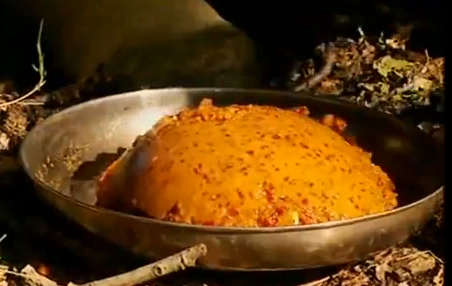
No-cook Hawthorn Jelly, photo courtesy of Ray Mears.

No-cook Hawthorn Jelly, photo courtesy of Ray Mears.

At least one Hawthorn’s berries (those of the Crataegus monogyna, the one-seed Hawthorn) can be made into a no-cook jelly.  If you have the-one seeded Hawthorn here’s the formula with thanks to Ray Mears and Professor Gordon Hillman. If it doesn’t work you can always cook it, add pectin and make jelly.  I would suspect this was how jelly was discovered.
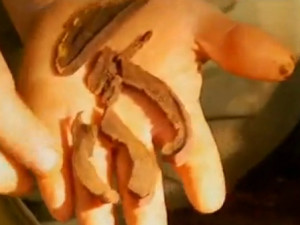
Hawthorn Jelly Dried, photo courtesy Ray Mears

Hawthorn Jelly Dried, photo courtesy Ray Mears

Put the berries in a bowl and quickly crush them thoroughly with your hands. The resulting liquid should be about the consistency of pudding just before it sets. It should be that consistency naturally. If you’ve had a dry year add some water to get to that consistency. Work quickly. Squeeze the seeds out of the berries then quickly filter the thick slurry into a bowl. In about five minutes the liquid will jell. Flip it over onto a plate. It can be eaten as is or sliced or sun dried. It will be sweet and will last for many years. Remember just ripe berries have more pectin that over-ripe berries. To see a video on this go here.
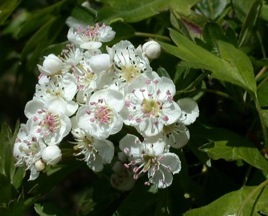
Hawthorne blossoms

Crataegus monogyna is native to Britain and Europe but is naturalized in the United States and Canada. It can be found north and east of Tennessee, up the west coast from California to Alaska, as well as in Utah, Montana and Arkansas. Local and regionally known Hawthorns are C. aestivalis (commonly known as the May Haw. The only tree I’ve tried to raise that died)  C. anomala, C. arnoldiana, C. calpodendron, C. canadensis, C. chysocarpa, C. coccinoides, C. columbiana, C. crus-galli, C. dispessa, C. douglasii, C. flava, C. intricata, C. marshallii, C. mollis, C. oxycantha, C. phaenopyrum, C. pulcherrima, C. pringlei, C. pruinosa, C. pubescens, C. rivularis, C. spathulata, C. submollis, C. succulenta, C. uniflora, and C. viridis. All but the C. phaenopyrum, C. pulcherrima and C. viridis are know to have been used as food. There are no “poisonous” Hawthorns except for the seeds. Many Hawthorns, while not poisonous, are not palatable. Some improve with cooking. The genus has many medicinal uses and is known for its heart support and is actually a beta blocker. Herbalist recommend one teaspoon of leaves or berries (minus seeds) or blossoms seeped in a cup of water twice a day.

Crataegus (krah-TEE-gus) comes from the Greek word Krataigos, which was the ancient name used by Theophrastus (372-287 BC) for a flowering thorn. Kratus means strong — the wood is tough — and akakia or akis, thorn. Monogyna ( mon-NO-gy-nuh) means one seed. I don’t know if there is any connection but most Greeks with a surname that end in -akis come from or had ancestors who came from Crete.

Hawthorn Schnapps

Stalkless berries from Crataegus monogyna or Crataegus laevigata are usually recommended. Direction: Rinse the Hawthorn berries and leave them to dry off. Fill 2/3 of a clean glass jar with berries. Cover with clear, unflavored vodka. Close the jar with a tight-fitting lid. Let the berries steep for 5-6 weeks in a dark place at room temperature, 64-68°F. Shake lightly from time to time. Strain and filter into a clean glass bottle or jar with tight-fitting lid. Age for a couple of months in a dark place at room temperature before serving.

Haw sauce

* 1½ Lb stalkless Hawthorn berries

* ¾ pint vinegar of your choice

* 4 oz sugar

* Salt to taste, optional, some use up to one ounce of salt

* 1 tsp freshly ground black pepper

Wash berries. Put in pan with vinegar and cook gently for 30 minutes. Press the pulp through sieve, return to the pan with sugar and seasonings. Boil for 10 minutes. Bottle and seal.

Hawthorn Berry Soup

One pound of stalkless Hawthorn berries

1/2 cup water

Half a pound of sugar (more or less if you like)

2 cinnamon sticks

Pinch of chili flakes or powder (optional)

Add the Hawthorn berries to a pot  with the water. Bring to a gentle simmer, cover the pot tightly, cook for 30 minutes. Allow to cool, pass through a sieve (throw away the seeds). Transfer the sauce to a pan, add the sugar, cinnamon sticks and chili flakes or powder (if using). Cook until the sauce thickens sufficiently and serve.

Here is Euell Gibbon’s Recipe for Hawthorn Jelly:

To make Haw Jelly, crush three pounds of the fruit, add four cups of water, bring it to a boil, cover and let it simmer for 10 minutes, then strain the juice through a jelly bag and discard the spent pulp, seeds, and skins. If red haws are not too ripe, they will furnish ample pectin for jelly making, but if they are very ripe, add one package powdered pectin to the strained juice. We felt our juice could stand more acid, so we added the juice of two lemons. We put just four cups of this juice in a very large saucepan and brought it to a boil, then added seven cups of sugar and very soon after it came to a boil again, it showed a perfect jelly test.

Hawthorn Berry Catsup, from GatherVictoria.com

Ingredients

-2 cups hawthorn berries

-1/4 cup apple cider vinegar

-1/4 cup of water

– however much sugar or honey you want

-1/3 cup black cherry juice (optional but recommended)

-1/2 tsp sea salt (or as you like)

-Freshly ground black pepper or pinch of cayenne

Instructions

1. Remove the berries from their stalks then rinse in cold water.

2. Place in large saucepan, adding the vinegar and water. Gently bring to boil and simmer for about 25 minutes until the skins start to split.

3. After cooling, push the mixture through a sieve or pass through a food mill to remove the pits (seeds.).

4. Return the mixture to the pan, adding your sweeteners, and slowly heat, stirring frequently. Add spices or flavorings.

5. Bring to a low boil, then simmer for a further 5 -10 minutes, until the sauce thickens and becomes slightly syrupy.

6. Remove from heat, then add, little bit at a time, the black cherry juice, stirring until you find just the right consistency and thickness you prefer in your ketchup. (Remember the sauce will thicken once cooled.

7. When happy with your result, pour the ketchup into sterilized bottles. Refrigerate and use within 3 months.

Green Deane’s “Itemized” Plant Profile

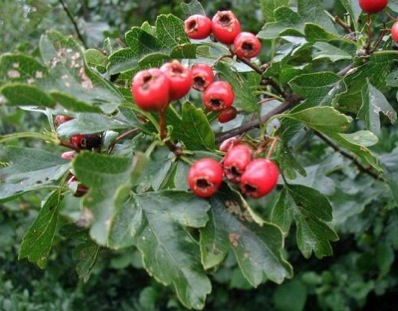
IDENTIFICATION: A medium-sized deciduous tree, 15 to 30 feet tall, branches slightly pendulous if not erratic. Leaves greatly varied, with C. monogyna they are simple, lobed, serrated at lobe tips, alternating to three inches long. Flowers small and white, bloom in late spring, five petals. Fruit a red pome with one seed, other species have multiple seeds. Long thorns on stems. Bark resembles an apple tree.

TIME OF YEAR: Autumn

ENVIRONMENT: Prefers moist fertile soil and full sun. Make a good landscape tree.

METHOD OF PREPARATION: Out of hand (do not eat seeds.) Can be used to make jelly or as pectin for other fruits. Can be made into a sauce for cooking, or used to flavor alcohols.

 Herb Blurb

Herbalists say two teaspoons of leaves or seedless berries (or both) made into a tea twice a day is an effective beta blocker and lower blood pressure.
{ 82 comments }

Cayra coffee, or Hickory Java

Hickories are not a migraine, but when you’re learning trees hickories can be a headache.

Just as plums and cherries are bothin the Prunus genus hickories and pecans are bothin in the Carya genus, and both in the greater Walnut family. Fortunately while there are a lot of Prunus there are only about a dozen Carya in the United States,  some say more, some say less . You really don’t have to tell them apart any more than you do oaks. Be happy they aren’t Hawthorns, even the experts can’t tell the thousand of them apart.

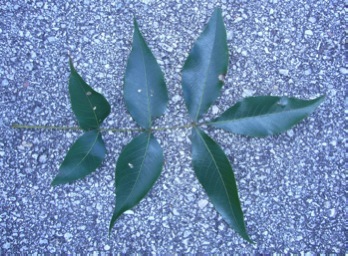
Note leaflet has seven “blades” one at the end

For many years most of my foraging was looking down, not up. To be more specific, other than acorns I kind of avoided the nut-bearing trees. But there comes a point in which you realize while greenery is fine, nutrition comes mainly from roots and nuts. When foraging is a hobby greens and berries will do. When one begins to ask, “can I live off this stuff?” then roots and nuts become more important. That’s when you seriously study roots and nut-bearing trees. That’s when you run in to hickories and pecans. Not only that but the line between hickories and walnuts is thin and that can be confusing as well.

The easiest thing to do is learn which ones grow in your area and then find them. Which species is rather secondary, except for flavor.  As for edibility, like oaks and pines there is no poisonous Carya and no poisonous look alikes. That makes life easy. When you find a hickory nut it will either be edible, or hopefully edible after leeching. The crux, of course, is make sure you have a hickory or a relative, even if you don’t know exactly which one.

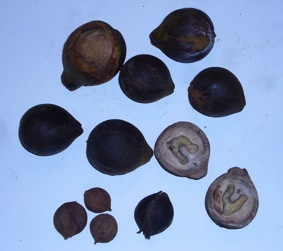
Pignut hickory nuts top and right, water hickory lower left

Some hickories are esteemed — used in ice cream and the like — and others are listed as “not edible.”  That is not toally accurate. They are edible, but they may be astringent or bitter. Often those qualities can be leeched out.

Two hickories that are common here are the Pignut Hickory, Carya glabra, (KAIR-ee-uh GLAY-bruh) and the Water Nut Hickory, Carya aquatica (KAIR-ee-uh a-KWA-ti-ka.) One reads the first is not esteemed and the latter is not edible. Actually, both were used as food by Native Americans.

The Pignut Hickory is so called because when cut the nut resembles the front aspect of a pig’s nose. The Water Hickory is so hailed because it likes to grow in damp areas and is the tallest of all hickories, some times as much as 150 feet. It is usually bitter, and the nutmeat resembles the coloring of a pecan. It can be eaten, though, and you can also leach out the bitterness like you do with acorns. The Water Nut Hickory’s major claim to fame is it is the hickory wood used to flavor foods by smoking and in barbecues. Other Carya include C. floridana, C. tomentosa and C. illinoensis, which is the well-known Pecan. It is not native locally but is planted here and there (Eagle Lake Park in Largo is one location.) C. floridana actually grows only a few miles from me in Wekiva Springs State Park. It has very small nuts and completely covered with prickles.

Circle marks the stop to hit

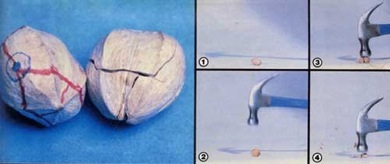
The big issues with hickories is how to get at the nutmeat. There are several ways. You can buy motorized and hand-driven machines that do the work. You can learn how to hit them with a hammer and pick the meat out. You can do what the Indians did. They pulverized the entire nut, added water, then filtered out the particulates leaving hickory milk called pawcohiccora which was shortened by settlers to pohichery  giving in time “Hickory.”

Sometimes instead of adding a lot of water they would sift until few shell bits remained. That can be squeezed into a ball.  Then they put the ball in a small amount of hot water, to float it. The shell bits sink and the rest is poured off for a soup base.

As for shelling by hand, remove husks if they are not off already. Wash and dry the shells. Lay the hickory nut down on its narrowest side and hit the closer seam with a hammer one third the way back from the stem end. It takes some practice. Second method: If you soak the nuts for an hour or more and work with them wet they will open without shattering. Either method is a personal preference. Some say you get a greater yield by soaking them.   Don’t try to use a lever-type nutcracker.  Either the nuts will be too hard or way too soft for that kind of nutcracker to work well.

The name Carya comes the Greek word ka-RI-thee, which is Greek for the hickory nut that they have in Europe, though it is a bit more complex than that. The walnut is kaREEa, named after Carya, daughter of the king of Laconia who was changed into a walnut tree by Bacchus. Glabra is bald, meaning no hair on the leaves or stems. Aquatica, of the water.

Some recipes are on the bottom of the page.

Green Deane’s “Itemized” Plant Profile


IDENTIFICATION: A tree from 30 to 150 feet. Vertical furrowed bark, sometimes shaggy. Leaves usually leaflets of five or seven, two to four on the main stem, three leaflets splayed at the end, terminal leaflet often the largest. Not be confused with an ash. Hickory leaves alternate whereas the ash leaf is opposite.

TIME OF YEAR: Fall, usually october or whenever the tree drops them and for some time after that.

ENVIRONMENT: Varies with variety from dry scrub to root-in-water swamps.

METHOD OF PREPARATION: Raw or roasted as a nut, a flour, a meal in water. No toxic look alikes. Bitter hickories can be leached like acorns.

Recipes

by Linda Schaalma and her parents Ray and Virginia Pamperin, Juneau Wisconsin

Hickory Nut Cake Makes 12 to 16 servings

½ cup (1 stick) butter

1 ½ cups sugar

2 ½ cups sifted cake flour

1 tablespoon baking powder

¼ teaspoon salt

1 cup milk

1 teaspoon vanilla extract

1 cup chopped hickory nuts

5 egg whites, stiffly beate

Hickory nut filling (see recipe)

Boiled frosting to cover 3-layer cake

Additional hickory nuts for garnish (optional)

Preheat oven to 350 degrees. Grease and flour three (9-inch) round cake pans.

Prepare cake: In mixing bowl, cream butter. Gradually beat in sugar. Resift flour with baking powder and salt. Add to butter-sugar mixture alternately with milk, to which vanilla has been added. Add nuts and fold in stiffly beaten egg whites.

Divide batter evenly among prepared pans. Bake in preheated oven 20 minutes, or until cake tester inserted into center of each layer comes out clean.

Let cool in pans on rack 10 minutes, then carefully remove from pans and let cool completely on rack. Run knife around edge of pan to loosen sides and remove from pan.

Prepare hickory nut filling. Transfer one cooled cake layer to serving plate, top with half the filling, then another layer, the remaining filling, and finally, the last cake layer.

Prepare boiled frosting. Pour over cake, spreading evenly with back of spoon. Work quickly; frosting will crease as soon as it is firm. If frosting is not beaten long enough, it will run; if beaten too long, it will not be smooth. Frosting beaten too long may be improved by adding a few drops of lemon juice or boiling water. Note: This frosting is soft and has a glossy surface. If decorating the cake with nuts, place nuts on frosting as soon as it is spread.

Hickory nut filling:

3 cups sugar

1 cup light cream or half-and-half cream

1 teaspoon corn syrup

1 tablespoon butter

1 cup chopped hickory nuts

To make filling, cook sugar, cream and corn syrup in saucepan over medium to medium-high heat, stirring constantly, until temperature on candy thermometer reaches 238 degrees, or a soft ball is formed when dropped into cold water, about 12 to 15 minutes. Add butter and let cool. Beat with mixer on high speed until creamy. Stir in nuts.

Hickory Nut Pie Makes 8 servings

Here’s another family recipe from Schaalma for a pie that substitutes hickory nuts for pecans:

Pastry for one (9-inch) deep-dish pie

3 eggs

1 scant cup light corn syrup

¼ cup (½ stick) butter, melted

½ cup packed brown sugar

1 tablespoon pure maple syrup or ½ teaspoon maple flavoring

1 heaping cup coarsely chopped hickory nuts

Sweetened whipped cream

Preheat oven to 350 degrees.

Fit pastry into 9-inch deep-dish pie pan.

In bowl, beat eggs slightly. Add corn syrup and melted butter; beat well until smooth. Stir in brown sugar, maple syrup and nuts; mix thoroughly. Place pie pan on baking sheet and pour filling into pie shell; if it gets too full, add the last cup after you’ve put the pan in the oven.

Bake in preheated oven 45 to 55 minutes or until middle is set. Nuts will have risen to the surface. Cool to room temperature or chill thoroughly. Serve with whipped cream.

Customer Alverna Filter of Cascade recently shared this recipe for a crisp and nutty butter cookie with Schaalma. Filter told Schaalma in a note with her hickory nut order that she bakes these cookies to ship to her grandson, who is serving in the military in Iraq.

Hickory Nut Refrigerator Cookies Makes about 4 dozen

1 cup (2 sticks) butter, room temperature

1 egg

1 cup sugar

1 teaspoon vanilla extract

2 cups flour

½ teaspoon baking soda

¼ teaspoon salt

1 cup chopped hickory nuts

In bowl, cream butter. Add egg and beat until fluffy. Beat in sugar and vanilla. Stir in flour, baking soda and salt, then hickory nuts. Divide in half and shape into two logs. Wrap in wax paper and refrigerate 1 to 2 hours. Also wrap in plastic for longer storage, or to freeze.

When ready to bake cookies, preheat oven to 350 degrees. Slice dough into 1/8-inch-thick slices and place on ungreased cookie sheet 2 inches apart. Bake in preheated oven 10 to 15 minutes, until light golden on the bottom.

Note: These freeze well both before and after baking.

 This recipe from a www.prodigalgardens.info

Maple Hickory Apple Crisp Makes 15 servings

8 cups sliced apples (9 or 10 medium-size apples)

1 tablespoon lemon juice

3 teaspoons ground cinnamon (divided)

3 tablespoons flour

½ cup water or apple juice

1 cup rolled oats

1 cup whole-wheat flour

1 cup packed brown sugar

1 cup hickory nuts (or chopped walnuts)

1 cup (2 sticks) butter, room temperature

¼ to ½ cup pure maple syrup

Whipped cream or vanilla ice cream (optional)

Preheat oven to 375 degrees. Grease 13-by-9-inch baking pan.

Peel, core and dice apples. In large bowl, toss apples with lemon juice, 1 teaspoon of the cinnamon and the flour. Transfer to prepared pan and add the ½ cup water or apple juice.

Chop oats coarsely in food processor or blender. To oats, add flour, brown sugar, remaining 2 teaspoons cinnamon and the nuts. Pulse until thoroughly mixed together. Add butter and mix until it resembles coarse bread crumbs. (Filling may seem too wet, resembling a paste – don’t get discouraged if this happens, just spread it as evenly as you can; it will be fine.)

Spread topping evenly over sliced apples. Drizzle maple syrup over topping.

Bake in preheated oven 45 minutes, or until topping is brown and apples are bubbly. If desired, serve with whipped cream or ice cream

Hickory Wild Rice Stuffing Makes 12 servings

Water

1¼ cups dry wild rice

8 ounces ground sausage (optional)

1 tablespoon butter

2 large celery ribs, diced

1 medium onion, minced

1 teaspoon salt

½ teaspoon black pepper

2 cups chopped hickory nuts

Follow directions on wild rice package and cook rice until very tender.

In skillet, cook sausage, if using, breaking it up with a spoon, until well done. Add to rice. Add butter, onion and celery to sausage drippings in skillet and sauté until tender. Add sautéed ingredients to rice and sausage mixture, along with salt and pepper and nuts. Mix together well.

Use to stuff a chicken or turkey (¾ cup per pound of poultry), then roast accordingly, until meat is done and stuffing has reached 165 degrees. (Or, place in a 13-by-9-inch greased casserole dish and bake at 325 degrees for 20 minutes or until thoroughly hot.)

Variation: If desired, add about 1 cup sliced mushrooms and/or 1 cup diced apples or cranberries…

Hickory Nut “Coffee”

Roast about six huled, larva-less hickory nuts for 15 minutes at 350. remove and let them cool. Do not cook them longer or at a higher temperature without first scoring them so heat can escape. Split the shells. Put in pan with one to two cups of water., Bring to boil. When water turns golden, strain into cup and enjoy/

{ 3 comments }

Gracilaria: The pot thickens

People eat a lot of seaweed. They just don’t know it. In the industry it is called covert consumption vs overt consumption. What is covert consumption?

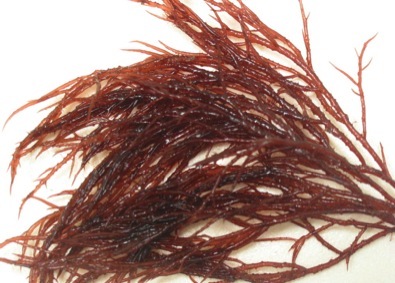
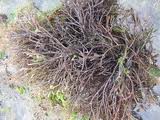
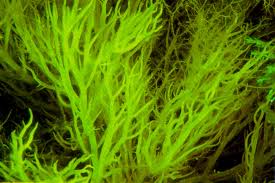
Graceful Redweed, Gracilaria tikvahiae

Did you eat some ice cream recently? You ate seaweed. Some seaweeds have chemicals that control the stability of liquids. One pound of seaweed extract can stabilize a ton ice cream. Look on the label, it’s there, either as agar or carrageenan. Overt consumption is not consuming an extract but the weed itself. One seaweed genus that is used as a table food and an extract is Gracilaria, a red seaweed that’s crunchy like celery with after taste of ocean.

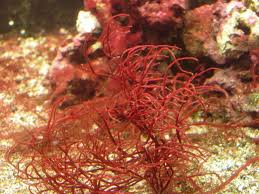
Gracilaria confervoides

Found in most seas Gracilaria tikvahiae (Graceful Redweed, above) in particular is common around the water of where I now live, Florida. In fact, it is one of the major seaweeds — with G. confervoides, left — in the brackish lagoon called Indian River, about 50 miles east of here.   Further, the Keys ship G. tikvahiae to Hawaii for covert and overt use. Hawaii’s Gracilaria species, G. parvispora, seems has been over harvested. The commercial use for Gracilaria is to make agar, to thicken liquid-based foods.

It’s hard to tell many of the species of Gracilaria apart, and each has its own taste and texture. Commonly used around the world are G. arcuata, G. blodgettii, G. bursa-pastorisG. cartilagineum, G. chilensis, G. chirda, G. confervoides, G. coronopifolia, G. crassa, G. Edulid, G. eucheumoides, G. foliifera, G. gracilis G. incurvata, G. lichenoides G. virinioifloia, G. parvispora, G. salicornia, G. sjostedtii, G. taenoides, G. tikvahiae, G. verrucosa, and G. vieillardii. I’m sure I’ve left off scores more.

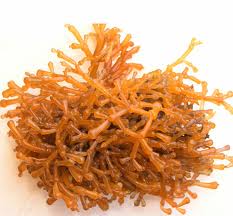
Gracilaria salicornia

Gracilaria are bushy or irregularly branched — think red vegetable-like spaghetti with a delicious fragrance. The branches can be compressed, flattened, but are usually cylindrical. It is like cartilage when fresh, hard when dry — think coarse, dark hair. They range from light pink to purplish, some times yellowish. Gracilaria are usually found on rock and broken coral in a meter of water or so, in the littoral region, which is from the high water mark to the area of the shore permanently submerged. It can also live adrift.

As a food Gracilaria are very versatile but are traditionally used three ways. Washed and eaten as a salad, raw or boiled, as a thickener or sun-bleached, dried and used later on as a vegetable-based gelatin. Nutritionally,  it is high in manganese and has nitrogen, potassium, zinc and vitamins A and B.

In Vietnam the species is collected in March and April, washed in fresh water, then kneaded into slices and dried in the sun. It is also boiled and eaten with fish, or boil, the water allowed to cool then it  is sliced into cubes and sweetened with a sprinkle of sugar. It can also be washed and then pressed by hand into a gelatin-like mass that is eaten as  a kind of pickle/relish or as “dabbo dabbo” which is a sauce of lemon juice and ginger.

Gracilaria coronopifolia, served raw and salted

In Sri Lanka it is made into a soup, pudding or jelly. The most popular preparation is a porridge made by washing the dried seaweed several times and cooking it in water for 15-20 minutes. The thick soup  is strained, coconut cream and lime are added to taste. The commercial recipe is 4.5 pounds seaweed, three limes and 21.5 ounces sugar and 7.5 quarts of water.

In Sri Lanka G. lichenoides is eaten raw or cooked often with salt and tomatoes.  That is done with fresh Gracilaria or after dipping it in boiling water. It is also served with onions and vinegar. For use later It is dried without washing. When wanted it is soaked for a day, cleaned, chopped into small pieces and eaten.

To make agar, rinse the Gracilaria in fresh water five or six time until it has lost its pink color.  Then take one part washed seaweed to 50 parts water and boil gently with on or two teaspoons of white vinegar until the liquid is thick and opaque. Strain it and let it set. When cool, cut into cubes. Some like to add sugar and or fruit juice to the liquid before it jells. Another option is after it jells you can cut it into small pieces and mix with soy sauce, vinegar, garlic juice, salted vegetables, sesame oil, coriander and other spices of your choice. It it is served like a salad. A third method is to stir fry the seaweed for a minute and then simmer at least 30 minute or more with salt, soy sauce, sugar, wine, green onion and ginger. That is then cooled and once set, cut into pieces and served cold.  Others way is to cook it was pork, fish or vegetables, stewing it all together. That can be eaten hot or jelled. Gracilaria can also be fried in tempura batter.

Gracilaria bursa-pastoris

In Hawaii Japanese and Korean cooks wash the Gracilaria, drain, then blanch it. A Miso sauce, or vinegar, or a sugar-soy sauce is used to flavor the seaweed. Prepared that way it’s a strong “sea” flavor that may not meet well with a lot of Western pallets.  In the Caribbean it is made into a seaweed drink that some men think helps their prowess in the bedroom.

Gracilaria, Ogo in Japanese, which sells for about $6 a pound raw, is a major source of agar. Agar is not digestible so it is roughage. It can be used as a poultice for swollen joints and Gracilaria whole makes a good fertilizer.

Locally, G. conferiodes and G. tikvahiae can be found in Florida waters and Indian River Lagoon. They can also be found up the east coast of the United States. There are many Garcilaria on the west coast including G. confervoides and G. sjostedtii. Always wash your fresh seaweed well.  On the beach look for what looks like a sprig of red dill.

Gracilaria (grass-il-AIR-ree-uh) means slender leaved, or graceful leaved. According to the Smithsonian Marine Station at Ft. Pierce, FL., G. tikvahiae is a “highly opportunistic species common in estuaries and bays, especially where nutrient loading leads to either seasonal or year-round eutrophication (Peckol and Rivers 1995a, 1995b). Its morphology is highly variable, with colors ranging from dark green to shades of red and brown; with outer branches that can be either somewhat flattened or cylindrical in shape (Littler and Littler 1989). It can be found in protected, quiescent bays, as well as in high energy coastline habitats. This species grows free or attached to rocks or other substrata, and can reach a height of 30 cm (Littler and Littler 1989). G. tikvahiae grows to depths of approximately 10 m, but is most common at depths less than 1 m.”

Gracilaria-Cucumber Salad

1 pound Gracilaria, thoroughly washed and cleaned

2 medium cucumbers, peeled and thinly sliced

Rock salt

1 sweet onion, sliced in thin rings

1/4 cup cider vinegar

1 pint sour cream

1 tablespoon soy sauce

Salt and pepper to taste

Cut seaweed into 6-inch sections. Make a solution of saltwater with the rock salt and water and soak the seaweed, cucumber and onion. After wilted, drain and rinse well. Make solution of other ingredients and pour over wilted vegetables. Serve chilled.

Gracilaria Spaghetti and Tomato Sauce

1 tablespoon oil (olive)

½ pound ground beef

1 medium onion, chopped

1 clove minced garlic

1/8 cayenne

1 can tomato sauce (8 ounce)

1 cup carrot

2 cups Gracilaria

2 quarts boiling water

½ cup cheese, grated (optional)

Brown meat in oil with onion and garlic. Add tomato sauce, cayenne, carrot and herbs and simmer 15 minutes. Drop Gracilaria into the boiling water for just 15 seconds. Drain, serve with sauce and top with grated cheese. (From Sea Vegetables by Evelyn McConnaughey.)

Gaucomole Sandwich Spead or Dip

1 avocado, mashed (about ½ a cup)

1 tomato, diced (about ½ a cup)

1 cup fresh Gracilaria, washed and chopped

Juice of half a lemon

1/8 teaspoon cayenne or piece of chilli pepper, chopped

¼ cup chopped sweet onion or green onions

¼ cup cream cheese

Blend lemon juice and mashed avocado. Add remaining ingredients and serve on tasted buns, crackers or corn chips.

Gracilaria Relish

2 cups Gracilaria

Half a tomato

Half sweet red onion

1 cucumber (optional)

1 clove garlic, grated

Marinade:

¼ cup vegetable oil

¼ cup cider vinegar

3 tablespoons soy sauce

1 tablespoon sugar

½ teaspoon salt

½ teaspoon fresh ginger, grated

pinch cayenne

Wilt the Gracilaria by steaming very briefly over boiling water. Rinse immediately under cold water. Cut into 2-3 inch sections. Cut the tomato, onion and cucumber into small pieces or strips. Add the Gracilaria and combine with the marinade. Chill. Let stand 2 hours before serving.

Ahi Poke  (Yellow fin tuna)

8 ounces fresh ahi fillet, diced 3/4 inch

1/2 cup Maui onion or red onion, chopped

1/2 cup Gracilaria

2 stalks green onion, sliced

1 tsp. Sesame oil

2 tsp. Soy sauce

3/4 tsp. coarse salt

What to do

Mix all the ingredients together and refrigerate overnight. The next day, serve on a bed of greens and sprinkle with toasted sesame seeds. You can also serve this immediately after mixing.

Simple Seaweed Soup

Two ounces (56 g.) seaweed

1/4 package of Enoki mushrooms

2 inches green onion(sliced length wise into strips)

2 cups Chicken broth

1/4 tsp. salt

Dash of pepper

1 tsp. soy sauce

1. Cut seaweed into bite size pieces. Wash Enoki mushrooms, cut off and discard root. Cut mushroom across into half.

  1. 2.Add pepper, soy sauce, salt (if needed), mushroom, seaweed to chicken broth. In small pot, heat to boiling. Garnish with green onion and serve.

Guacamole Sandwich Spread or Dip

One avocado, mashed

One tomato, diced

1/2 cup Gracilaria chopped

Juice of half a lemon or lime

1/8 teaspoon cayenne or a piece of chili pepper, chopped

1/4 cup chopped onions or scallions

1/4 cup cream cheese or jack cheese pieces

Blend lemon juice and avocado, add other ingredients. Serve on wraps, buns, crackers or chips.

Gracilaria Salad

Two cups Gracilaria, raw or briefly steamed and cooled.

1/2 pound cottage cheese

Four radishes, grated

Two tomatoes, sliced

1/2 cup scallions, chopped

Arrange Gracilaria on the bottom of a serving plate. Mix cottage cheese and grated radishes together and place in middle. Sprinkle with chopped scallions. Arrange tomato slices around the outside. Serve with yogurt dressing.

Gracilaria Kim Chee (takes several days)

Two pounds of fresh Gracilaria chopped into two or three inch pieces (about two quarts)

1/2 cup salt

2 cloves of garlic

1 bunch of scallions, or a chopped onion

Two small chillies

One teaspoon of grated fresh ginger root.

Wash and clean Gracilaria. Place in glass bowl or the like, sprinkle with salt and mix well. Weight down with heavy plate and let stand overnight. Rise well, add other ingredients, mixm pack tightly into jars and keep cool. ALlow to ferment two days until tart and red in color. Refrigerate. Let stand a few days before using.

Spicy Party Dip

Finely chop one cup of Gracilaria kim chee (above.) Add cheese and mayonnaise. Let sit for a few hours at room temperature. Keeps will in refrigerator.

Sunomono (Vinegar Salad)

One cup fresh Gracilaria

Boiling water

Clean and wash the Gracilaria. Blanch by putting in colander and pouring boiling water over it (which will turn it green.) Chill and serve with one of the follow dressings: 1) 1/2 cup vinegar with a tablespoon of honey and salt to taste. 2) One quarter cup  lemon or lime juice, two tablespoons honey and salt to taste. 3) One quarter cup vinegar, one teaspoon soy sauce, one tablespoon honey, salt to taste. 4)  One quarter cup miso, two tablespoon rice or cider vinegar, two tablespoon honey, salt to taste.


{ 3 comments }

Scarlet Gourd

Coccinia grandis: Cucumber’s Versatile Kin

I was riding my motorcycle one day when I rumbled over a raised railroad track in an industrial area and to my immediate right above a greenery-covered security fence I caught a glimpse of  what I thought looked like Turk’s Cap blossoms, but not quite. Turk’s Caps is a bushy mallow that doesn’t grow too tall and I had to look up to see these “blossoms.”

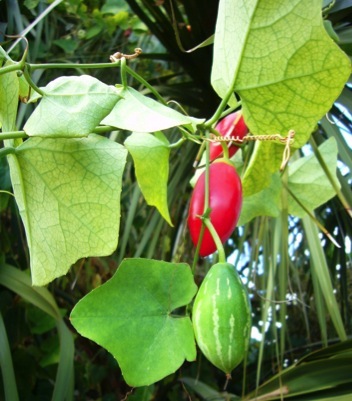
I turned around, parked, and wandered over for a closer inspection while a few workers wondered why a motorcyclist was looking at a plant. The blossoms  were not Turk’s Cap, Malvaviscus penduliflorus, which tend to stay closed taking the shape of a seashell called an Olive. No, these weren’t even blossoms. They were red fruit, ovoid to ellipsoid, about two inches long, 3/4 an inch wide through the middle. I had never seen them before. Nearby were several green ones with white stripes end to end. The large blossoms were five petaled and white. The key, however, was the vine. It looked like a cucumber.

It took some digging but I found it, Coccinia grandis. There was no doubt I had the right plant. As is too often the case, the United States Department of Agriculture maps said it did not grow here… That further confirmed to me I had the right plant. (If you have studied USDA maps you know exactly what I mean. They are inaccurate and woefully out of date.)

Called Ivy Gourd, Scarlet Gourd, Thai spinach, Kovai, Tindora (and a host of other names) the young leaves and slender tops of the stems are cooked and eaten as a potherb, in soups, or as a side dish, often with rice. The young and tender green fruits are eaten raw in salads, or boiled, steamed, fried, added to dishes like curry or soups or even fermented. The ripe, scarlet fruit is fleshy, on the sweet side, and eaten raw. It can also be candied. The fruit is often available in speciality markets and is very common in India. There are two varieties, both bitter and sweet (with no visible differences) and several cultivars both bitter and sweet. A second species, C. quinqueloba, has leaves that are edible cooked, often with Bidens pilosa, an old standby for foragers.  The fruits of the Coccinia rehmannii are edible and its starchy tuber is eaten after roasting. The leaves of Coccinia trilobata are a famine food. With the bitter ones usually only the young leaves and tips are used.

The green fruit of the C. grandis resembles a small, smooth pointed cucumber or long little watermelon. It is packed with seeds inside and while the skin is not tough but has just a little more resistant than a cucumber. The fruit grows red from the inside out. It is possible to have it reddish on the inside and not yet red on the outside. When green it is ever so slightly sour very much like a Melothria pendula, another wild member of the cucumber clan. When fully ripe it gets very soft.

Said kok-SIN-ee-uh GRAN-dees, (Big Red) the plant in the lab has shown anti-oxidant, anti-triglyceride, and anti-bacterial activity and is useful in the treatment of jaundice. It’s also been used to treat abscesses and high blood pressure. C. grandis has been introduced as a food crop in several countries in Asia, as well as Australia, Pacific Islands, Africa, the Caribbean, and the southern United States. It is found in at least Florida, Texas and Hawaii and probably other unreported warm areas.

Ripe Ivy Gourd is high in beta-carotene, has vitamins A and C, but low on the glycemic index. Per 100 g edible portion, the fruits contain: water 93.5 g, energy 75 kJ (18 kcal), protein 1.2 g, fat 0.1 g, carbohydrate 3.1 g, fiber 1.6 g, Ca 40 mg, P 30 mg, Fe 1.4 mg, thiamine 0.07mg, riboflavin 0.08 mg, niacin 0.7 mg, ascorbic acid 1.4 mg. See recipe on bottom and my video.

Green Deane’s “Itemized” Plant Profile

IDENTIFICATION: C. grandis: Stems mostly hairless, green and longitudinally ribbed when young, becoming white-spotted when older and eventually woody, tendrils simple, in the axils. Leaves alternate, simple, broad, ovate, 5-lobed, heart-shaped, stem has 3-8 glands near the base; inflorescence usually solitary, axillary flowers.  Corolla deeply divided into 5 lobes. Stamens 3, present as staminodes in female flowers. Fruit a smooth, striped green turning bright red, ovoid to ellipsoid about two inches long.

TIME OF YEAR: Can produce year round

ENVIRONMENT: Agricultural areas, natural forests, planted forests, disturbed and waste areas.

METHOD OF PREPARATION: Young leaves and slender tops of the stems are cooked and eaten as a potherb, in soups, or as a side dish, often with rice. The young and tender green fruits are eaten raw in salads, or boiled, steamed, fried, added to dishes like curry or soups or even fermented. The ripe, scarlet fruit, is fleshy, on the sweet side, and eaten raw. It can also be candied

Recipe courtesy of Show Me The Curry.

http://www.youtube.com/watch?v=ULMWk9XhURU

Prep Time: 15 minutes
Cook Time: Approx 20-25 minutes
Serves: 4

Ingredients:

Tindora – approx 1 1/2 lbs, sliced
Oil – 1 Tbsp
Mustard Seeds – 1/2 tsp
Cumin Seeds – 1/2 tsp
Asofoetida (Hing) – pinch
Turmeric Powder – 1/4 tsp
Green Chilies – to taste, finely chopped
Coriander Powder – 1 tsp
Cumin Powder – 1/2 tsp
Red Chili Powder – to taste
Salt – to taste

Method:

1. Heat Oil in a medium non-stick pan on medium heat.
2. Add Mustard Seeds and allow them to pop.
3. Add Cumin Seeds and let them sizzle.
4. Add Asofoetida, Turmeric Powder, Green Chilies and Tindora. Mix well.
5. Add Salt, Red Chili Powder, Coriander Powder and Cumin Powder.
6. Mix well, cover and cook until Tindora are tender. Stir every few minutes to cook evenly and prevent burning.
7. When Tindora are tender, uncover and cook for an additional few minutes to lightly brown them.

Tips:

1. In a time crunch, use the slicer blade of your food processor to roughly chop/slice the Tindora.
2. Cleaned and cut Tindora freeze well.
3. Be careful when salting Tindora. They tend to shrink and become a little salty and tangy.

{ 39 comments }

Jack-in-the-Pulpit

Arisaema triphyllum: Jack and Jill and No Hill

For a little plant there’s a lot to write about with the Jack-In-The-Pulpit. Where does one start? What does its name means? How about its ability to change sex?  And of course the misinformation about it on the Internet. Let’s cover it all.

The name “Jack” has many meanings. One is a nick name for John. Another means “male” as in jackass. It has also be used for sailor (Jack Tar) Steeple Jack (laborer) Jack of all Trades (a man who does nothing well) and Jack-O-Lantern who used to be the fellow who went through town carrying a lamp while crying out the time and curfews. Jack has also been a common term for the Devil. And so it fits with Jack-in-the-pulpit, a little plant with a devil hiding and mighty toxic sermon if not prepared correctly.

As for sex… the plant is a switch hitter, Jack sometimes, Jill sometimes. And as foragers we should know the difference because the edible part of the plant — when prepared correctly — differs between he and she.

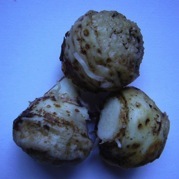
Jack-in-the-Pulpit corms

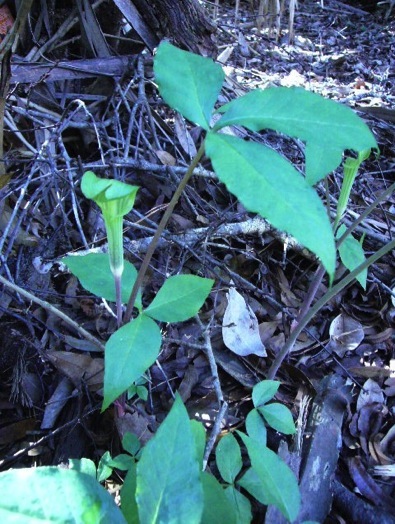
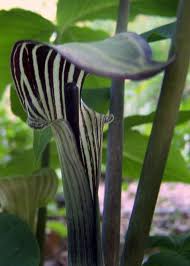
Jack-in-the-pulpits are perennials and grow each season from a corm, kind of like an onion. They can live to 100 years old. The shoot will have one stem or two. Each stem usually has three leaves if we are referring to the Arisaema triphyllum.  The pulpit, or spathe, is green, with white, brown or purple stripes.  The minister, or spadix, is usually a pale cream spike inside.

These plants are either a Jack or a Jill.  If you open the flower and look inside the female has a developing cluster of tiny green berries. The male does not. What difference does it make?

If the corm is packed with nutrients the plant will produce a spathe for a female flower with, usually, two stems for a total of six leaves. If the corm is young or depleted it will produce a spathe for a male flower, one stem and three leaves. This is not always true but is a common display.

If you find a female plant early in the season this tells you there should be a good size corm below — up to three years of storage in fact. If you find a male at the beginning of the season that tells you it is either a juvenile or was a female last year and the corm smaller.  So you don’t want to dig up the male early in the season but rather late in the season after he’s had several months to collect up energy in the corm. You don’t want to dig up the female late in the season but rather early. Exceptions: Very young plants with no corm tend to produce one stem and are small. In fact, most male Jacks are under 14 inches tall. Most Jacks over 14 inches tend to be Jills.

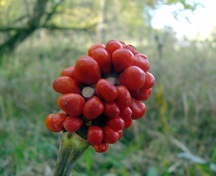
The berries burn, too

To recap: If the plant has one stem and three leaves it’s usually a male, two stems and six leaves a female.  Generally he has bigger corms at the end of the season, she has bigger corms at the beginning of the season.  You can also look down inside the spathe and tell if it is a he or a she. She will be making green bumps that will be future red berries. And what of that corm that the Indians called the “fire ball?”

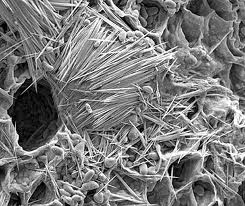
In its raw state chewing on a corm will “burn” your mouth and swallowing it will poison you, while painfully probably not fatally though you may have a rash of kidney stones, which can make death seem a pleasurable alternative. The offending chemical is needle-shaped calcium oxalate crystals called raphides (RAF-ee-dees.) They sting painfully. If you manage to swallow untreated corms the raphides can “precipitate” in your kidneys, which is a fancy word for clogging them up. So don’t try to eat the corms raw. Don’t eat them dry if they produce a burning sensation in your mouth. The goal is to make them burn-free before consumption.

Plant showing spathe

Calcium oxalate, at the very least, causes intense discomfort. Tiny amounts can create the sensation of burning. In some cases it can lead to swelling of the throat and closing off of air. In larger doses, it can cause severe digestive upset, convulsions, coma, and death. Recovery is possible, but permanent liver and kidney damage can happen. The worst part is the effect even in the mouth can be delayed for a few minutes. This is why you must always try only a little after preparing it, chew it, spit it out, and wait ten minutes or more.

Scores of Internet sites that copy each other say boiling the corms makes them edible. That is very misleading.  When I read that I know the writer has never boiled a corm then tried it. I have boiled potato chip thin slices up to six hours and still had them burn some. Maybe at 12 hours, or the two day mark they stop burning, but for a third of an ounce of starch it is not cost effective.

I traced the boil comment back first to 1916 in an article by National Geographic Magazine, then to a Scottish book in 1875 called The Wealth of Nature, our food supplies from Nature. In the article about “Common American Wild Flowers” it talks on page 590 about “boiling the bite” out of the corms. But the writing style is affected and I think the phrase was used for its assonance sound than its accurate information.

The 1875 book, referring to the family in general, says an “Indian plant” can be roasted or boiled. There are also some references in other places to boiling the corms and then drying them. Someone may have presumed boiling was making them edible and drying was for storage. At any rate, the mistake is entrenched. Boiling for a day or more may work but I know for absolute certainty several hours does not do it. Drying is a far better choice.

Raphides of calcium oxalate

Many “edible” plants have calcium oxalate and boiling them doesn’t get rid of it for them either, wild taro roots in Florida, for example. Why should it be different for Jack-in-the-Pulpit?  Dry heat breaks down the calcium oxalate. Short-term moist heat does not. Let me be succinct: Slice thin then air dry for three months or more. Slice thin and dry in a slow oven for three to seven days or so or in a food dehydrator.  One other option is to put them in the microwave.

While my results varied I have made some sliced corms edible after three minutes in my microwave, but some were still burning at five minutes, and 10 minutes tends to incinerate them, unless whole. Clearly air drying is the cheapest and produces the sweetest product. Nuking them produces a cooked nutty flavor but they go from edible to burnt crisps in seconds.

I’ve also sliced and dried them in my solar oven which reaches around 325F. It takes about three days of trying, 15 hours, to get them edible, and little energy is used. And all those times are precautionary times. Your times can certainly vary so carefully try your slices before consuming. Here’s how you do that.

To test them: Chew a quarter-inch square piece on one side of your mouth for a full minute then spit it out and wait ten minutes. And I mean chew for a minute and I mean wait ten minutes and I mean one side of your mouth (to limit the area that burns.)  The effect can be quite delayed. If the calcium oxalate is still present it will make one side of your mouth burn, and your tongue and lips. That can last up to a half an hour or so. If no burn, try a bigger piece the same way. If no burn then, you’re ready to go. You can eat the dry chips as is, or grind them up as a flour. If you air dried them they can be used as a thickener. If you dried them at over 150F they can be used as a flour but not as a thickener because the starch will have already been cooked. Some lemon or lime juice can reduce the burning sensation in your mouth.

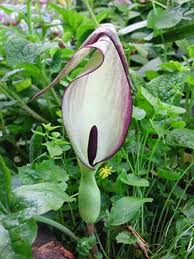
Arum maculatum

In a 1906 book (Studies of Plant Life in Canada by Catherine Parr Strickland aka Mrs. C.P. Traill — yes, two l’s)  she refers to a European relative of the Jack-in-the-Pulpit, the larger Arum maculatum, also called Cuckoo Pint. They were dried thoroughly then pounded or ground then tossed into water where the starch settled, a similar process to extracting starch from the cattail root. That starch was then pounded or ground a second time and put in water again. This was done until the visible impurities were all removed (the calcium oxalate already removed by drying.)  Then the water was poured off and the starch allowed to dry. She reported a peck of roots created a pound of starch. That starch was one time called Portland Sago, from Portland Island in Dorsetshire, England.  It was used like saloop, a drink popular in England in the 17th and 18th centuries before coffee and tea were imported. Ground A. maculatum powder was added to water until it thickened. Then it was sweetened  and flavored with orange flower or rose waters.  Because it would thicken it was also used as a substitute for arrowroot. However, the powder used for saloop and as an arrowroot substitute was from dried not roasted corms since roasting would cook the starch rendering it not useable as a thickener (the same issue with acorns. To use them as a thickener or binder they must be processed without cooking, that is, under 150F.)

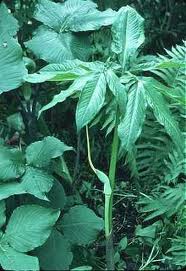
Arisaema dracontium

Catherine Parr Strickland then returned to North America in her book with the comment: “When deprived of poisonous acrid juices that pervade them, all our known species may be rendered valuable both as food and medicine; but they should not be employed without care and experience.”

Now, what about the berries? I have not tried them and they are listed as toxic, probably for the same reason the corms are. There are some references that say the totally dried berries are edible but I have not tried them so I cannot recommend them.

Besides careful humans the only other creatures to find food from the plant are Wild Turkeys and Wood Thrushes who eat the red berries. Those berries, by the way, were used by natives to make red dye. (And early settlers used the starch in the corms to starch their clothes.)

The plant, for all its warnings, is also a pain killer, as reported by Dr. Daniel Austin in his book, Florida Ethnobotany:

“When I was a professor in Florida, a mother and her young son came to me for “advice” about a science project that the boy was doing. He had apparently discovered independently that juice from the live plants applied to wounds stopped the pain. Since he was still in grade school, it seemed unlikely that he had scoured the old literature and learned that the natives of North America used the sap in the same manner. Regardless, he was doing an experiment that involved getting as many volunteers as possible to prick their finger with a needle and then apply juice directly from the plants. I, too, became one of his subjects with plants that they had imported from New England. We dutifully cleaned the instruments, drew the blood from the end of my finger with a needle, and then applied the juice. The pain stopped immediately upon contact with the liquid. They told me that each person they had tested had exactly the same reaction….”

The scientific name for my local Jack-in-the-Pulpit is straightforward. Arisaema  (ar-ih-SEE-muh)  is a combination of two Greek words, “Aris” or “aridos” which was a name used by Pliny for a small herb thought to be in this family, and “hiama” or “haimatos” meaning blood as some of the species have red/purple spots or stripes. Triphyllum  (tree-FIL-um) means three leaves.  There is a bit of a botanical argument where there is one species and variations or three species, or more. Incidentally, the A. dracontium (dray-KON-tee-um)  is used the same way. It has a long tip to its spathe and a different arrangement of leaves.

Green Deane’s “Itemized” Plant Profile

IDENTIFICATION: A flap-like spathe curves over the top of a funnel-shaped spadix. It can be green, purplish or striped. Leaves are long, ovate, usually three per stem. Fruit inside spadix looks like a cluster of little eggs, green at first later scarlet red. Corm is walnut-sized or larger, can have brain-like folds..

TIME OF YEAR: While available year round, gather in the fall or early spring or when dormant. Store in damp sand.

ENVIRONMENT: Likes moist forests and shade, bottom land, damp soil but not waterlogged.

METHOD OF PREPARATION: Only dry heat degrades the calcium oxalate crystals efficiently. Slice thin, dry for three months (in the sun is even better) or in a slow  oven or dehydrator for about five days.  In my experience boiling takes in excess of eight hours to make them approaching edible.  Once cleared of the acid the corms can be used like arrowroot or flour depending on how hot it was heated.


{ 29 comments }