Commelina diffusa: What a day for a dayflower

Common names can be a headache when one is trying to index a plant. The plant to the lower right is commonly known as the Asiatic Dayflower but it is not. It is also called just the Dayflower. More so there are native North American Dayflowers in a different genus. It can get rather confusing. On top of that many Commelinas are reported edible raw but I am beginning to think they should be cooked. They have a high oxalate content, less in young plants, more in older. Pick carefully.

Dayflower, edible blossoms, young shoots

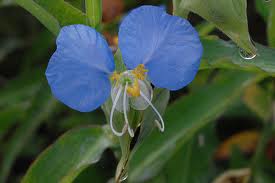
Introduced from Asia to Florida, the little plant to the right is Commelina diffusa (kom-uh-LIN-uh dye-FEW-sah.) The Florida native is Commelina erecta. Another import is C. communis.  How do you tell them apart? With the crawling difussa the three flower petals are almost  the same size and blue. With the erecta and communis two blue petals are much larger than the white one. The erecta tends to stand up on its own, the communis crawls.

The Commelina species are often found in the same place as the spiderwort and young shoots and tips are good steamed, as a pot herb or boiled for a 20 minutes or so or fried. The blossoms are a trail side nibble for me or an addition to salads. Two have starchy roots that are edible cooked but are slimy, Commelina coelestis and Commelina benghalensis,  the latter also has edible young tips when cooked and blossoms. In fact, other than blossoms I think any Commelina said to be edible raw is probably better off cooked and then only shoots or young tips.  That’s what my tummy tells me. Seeds of the Communis have been used as famine food.

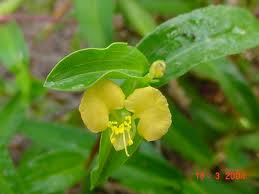
Yellow dayflower

Yellow Commelina Update: While conduction a class in Tampa in 2011 one of my students who has attended many classes, Maryann Pugliesi, spotted a Commelina with yellow blossoms, something I had never seen before. A bit of research showed it to be Commelina africana, or Yellow Commelina, an imported ground cover. Very common in South Africa it’s leaves and root are edible cooked. I suspect the blossoms are edible raw. 

Diffusa means spreading. Erecta means up right. Communis, wide-spread. The name Commelina was used in honor of three Dutch brothers of the Commelijn family, botanists all. One, however, died young and the Commelina communis  was specifically named for them.  Incidentally, the Commelinas are diuretic and have many herbal applications as well. Some yield a dye. Africana means from Africa. To read about spiderworts click here.

Green Deane’s “Itemized” Plant Profile

IDENTIFICATION: Erecta: grows up, two prominent sky-blue petals that stick out like mouse ears,  third petal is tiny, white, below the blossom.  Difussa, three blue petals close to the same size. Blossoms at the end of stems surrounded by  heart-shaped leaf, rest of leaves three-inches long, narrow and pointed, with parallel veins along their length

TIME OF YEAR: Leaves and flowers year round in Florida, leaves all but winter up north, flowers spring and early summer

ENVIRONMENT: Grows in average, medium moisture, well-drained moist acidic soil, full sun to full shade. Tolerates poor soils. Lawns, roadsides, moist waste areas.

METHOD OF PREPARATION: I recommend you cook (boil or fry) the young greens of all the edible Commelina save for blossoms, shoots and young tips which can be tried raw in small amounts.  Roots of the coelestris and benghalensis must be cooked.

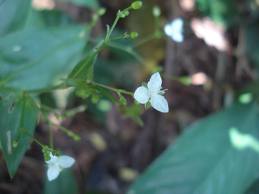
Don’t confuse the Commelinas with a similar-looking escaped ornamental, Gibasis geniculata. It has all-white blossoms on very long stems and its leaves are purple on the back. Though called the Tahitian Bridal Veil it is from Tropical America.

Similar looking is Tahitian Bridal Veil, Gibasis geniculata, is not edible

{ 20 comments }

Dead Man's Fingers, Decaisnea fargesii

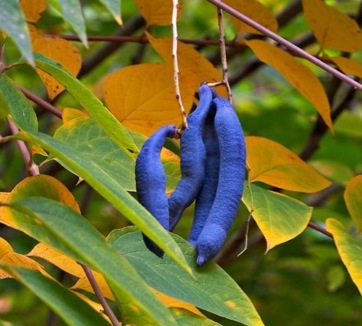
Decaisnea fargesii: True Ghoul Blue

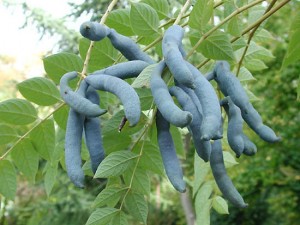
There are three Dead Man’s Fingers: A seaweed, a mushroom, and a shrub, all so-called because of the way they look.

Young Decaisnea fargesii

The seaweed, covered elsewhere on this site is Codium fragile. Soft and velvety, it floats eerily like a hand, and is edible, as are most seaweed. The mushroom, Xylaria polymorpha, like most mushrooms, is not edible. When young it not only looks like fingers reaching out of the ground but it even has fingernail-like tips. The third Dead Man’s Fingers is Decaisnea fargesii, an up and coming and escaping ornamental shrub.

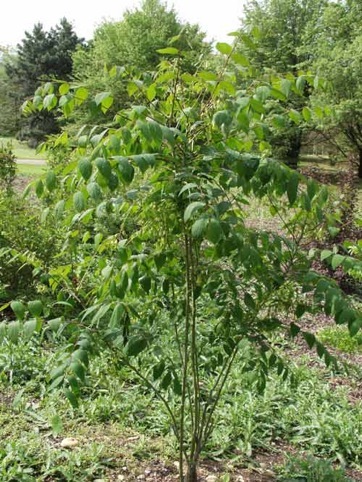
This is a frost-hardy shrub that likes cooler weather and is native to the Himalayas and Western China where it can be found from 6,000 to 10,000 feet. In the United States it is found in zones 6 to 10, or down to about -10° F. You can find it in landscaping in such diverse locales as Kentucky and Ohio to Oregon and Washington. It is also escaping into the wild. It’s main calling as an ornamental is that it has blue, edible, fruit.  Other than the fruit, to a North American eye the shrub resembles a small black walnut

Dead Man's Digits

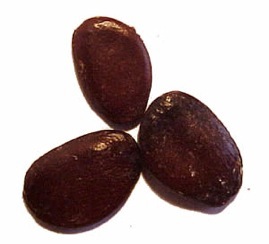
Whether there are one or two species of Desaisnea is a bit of a debate. Some say the D. fargesii is from China with the blue fruit, and others say there is a Decaisnea insignis from Inida with yellowish fruit. The Chinese one, D. fargesii, is the most commonly cultivated and thus escaped into the countryside.  Oddly, it is in the chocolate vine family, Lardizabalaceae. The fruit’s white, juicy phlegm-like pulp, ranges from bland to very sweet. The watermelon-like seeds are not eaten.

The genus name is no help at all in identification. Decaisnea ( deh-KANE-ee-uh) is named for Joseph Decaisne, a 19th century Belgian-born French botanist, horticulturist, and director of the Jardin des Plantes Paris. The species fargesii (far-GHEE-zee-eye) was “discovered” and named for Pere Paul Guillaume Farges (1844-1912) a French missionary and plant collector who lived in China. I always have a problem with a westerner “discovering” a plant. The locals there had been eating or using it for thousands of years.

Don't eat the seeds

Insignis is often translated to mean remarkable or outstanding but the more accurate Latin use would be “uncommon.” Insignis virtus was a common phrase meaning uncommon valor.  It is said two ways, in-SIG-niss or IN-sig-niss. The D. fargesii is also called  Blue Sausage Fruit, Blue Cucumber Shrub and Blue Bean Tree. And if you are wondering,  Lardizabalaceae is said lahr-dee-zab-uh-LÂ-see-ee.

Oh, and to add to the fun, the fruit ripens around halloween.

Green Deane’s “Itemized” Plant Profile: Dead Man’s Fingers

IDENTIFICATION: Decaisnea fargesii: A deciduous shrub to small tree, growing to 25 feet tall. Leaves are pinnate to three feet long, with 13-25 leaflets, each leaflet up to six inches long and four inches wide. Blossoms are produced in drooping panicles to 18 inches long, each flower greenish-yellow, to an inch in diameter, with six sepals and no petals. The fruit is a soft greenish-yellow to bluish pod-like follicle to four inches long and and inch in  diameter, filled with an edible transparent glutinous jelly-like pulp with numerous flat black watermelon-like seeds,  up to a half inch in diameter.

TIME OF YEAR: Flowers in summer, fruits in September to October depending upon the climate.

ENVIRONMENT: Full sun, rich soil, neither very hot or very cold.

METHOD OF PREPARATION: Jelly-like pulp eat raw out of hand

{ 5 comments }

Daylily: Just Cloning Around

The daylily, a standard plant in foraging for a century or more, has become too much of a good thing and now presents a significant seduction to the forager. Here is why: There are too many of them. While that would sound like a good thing, it isn’t because that has created uncertainty about edibility.
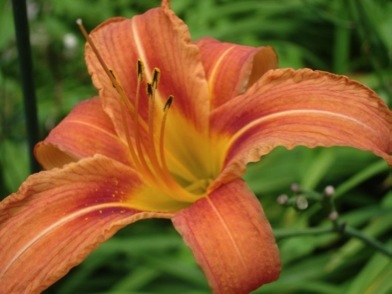
Original Daylily flower, Hemerocallis fulva

The daylily originated in Asia and has been used there for food for perhaps thousands of years. It was first mentioned in European writing in the 1500s. When the daylily was imported to North America in the 1600s there was only the unspotted orange kind, Hemerocallis fulva (hee-mer-o-KAL-is FUL-va) and it was edible, top to bottom. H. Fulva was the only daylily in North America for perhaps 200 years or more. By the 1930s breeders starting to create new daylilies. Now there are some 60,000 cultivars of daylilies. They have been bred for color, height, the number of petals, stature et cetera. The result is they are not all edible. In fact it is anyone’s guess as to whether the cultivars are edible or not. So while it is fairly easy to identify the original daylilly, and to identify a daylily cultivar, finding out if the latter is edible is a challenge. That of course, is why one needs to contact a local expert and or the owner of the daylily. While the original daylily is edible — with some qualifications I will get to — all others are to be suspect no matter what your guidebook says. If someone tells you their daylily is edible ask them to prove it. That’s what I call the “Dick Deuerling Method. Let me explain:

I spent a lot of time in the woods with a red suspender-wearing, bearded forager named Dick Deuerling. He and a friend, Peggy Lantz, wrote a book called Florida’s Incredible Wild Edibles, which is still available. If someone said a plant Dick didn’t know was edible was edible, or if they
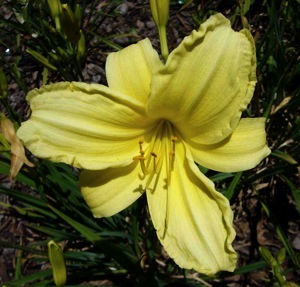
Edible yellow daylily

said a plant he thought wasn’t edible was edible, he’d say this to them: “Invite me over. Let me watch you harvest the plant. Let me watch you prepared the plant for cooking. Let me watch you cook the plant. Let me watch you eat the plant. Then I’ll come back the next day, if you aren’t sick or dead I might try it. “ With any daylily now, other than the original, that is what you have to do. Plants are chemical factories and within a genus there can be edible and toxic plants. The genetic selection that might produce a beautiful flower might also produce an inedible one.  So seek out the original, but for all others demand proof it is edible.

H. fulva is naturalized throughout most of North American except northwest Canada and desert southwest of the United States. Surprisingly, it is not naturalized in California. (I suspect it is, it just hasn’t been reported. I know it grows in the county I live in and one to the north but the state of Florida says it is not here.) The only other daylily that has become naturalized somewhat in North American is Hemerocallis lilioasphodelus (lil-ee-oh-as-foh-DEL-us) which is the yellow version, similar in appearance and wrongly called H. Flava. The Michigan State University Department of Horticulture says H. Iilioasphodelus is edible. Blame them not me if it is not. There is one report that H. Iilioasphodelus gives half the women who eat it a bad taste in the mouth akin to sweaty armpits. No reports that it bothers men the same way. Hemerocallis minor is also reported as edible. I do not personally know that.

The original, H. Fulva,  is a survivor. Actually it’s a clone. It will grow nearly anywhere there is sun and water. It often out lives the buildings it was put around. In many well-fed areas (read countries with obesity issues) it is considered an invasive weed. Since it is sterile it reproduces by underground rhizomes and thus spreads. Cultivated dayflowers stay in clumps and are not considered invasive. And as the name implies, daylilies are open for only a day.

As for edibility….. Young spring shoots and leaves under five inches taste similar to mild onions when fried in butter. They are also a mild pain killer and in large quantities are hallucinogenic.  The leaves quickly become fibrous so they can only be eaten young (but you can make cordage out of the older leaves.)  The flower buds, a rich source of iron, are distinguished from the plant’s non-edible fruits by their internal layering. The blossoms are edible as well, raw or cooked (as are seeds if you find any.) The dried flower contains about 9.3% protein, 25% fat, 60% carbohydrate, 0.9% ash. It is rich in vitamin A.  The closed flower buds and edible pods are good raw in salads or boiled, stir-fried or steamed with other vegetables. The blossoms add sweetness to soups and vegetable dishes and can be stuffed like squash blossoms. Half and fully opened blossoms can be dipped in a light batter and fried tempura style (which by the way was a Portuguese way of cooking introduced to Japan.) Dried daylily petals are an ingredient in many Chinese and Japanese recipes (they usually use H. graminea). Nearly any time of year the nutty, crisp roots can be harvested, but they are best in the fall. They can be eaten raw or cooked. You want to harvest new, white tubers. Older brown ones are inedible.

And now for the warnings to keep the lawyers happy: While daylilies are listed in virtually every foraging book as edible as I said earlier, don’t presume any daylily other than the original is edible. Many are, but don’t assume so. Have it proven.  Some people also have severe allergic reactions to them. In fact, some people can eat them for years with no problem then suddenly develop an allergy.  Also, don’t go overboard with any part of the plant or you’ll be creating a lot of personal fertilizer. They are nature’s laxative. Incidentally, they are toxic to cats, including the plant’s pollen, which can destroy their kidneys when licked off fur.

The flowers don’t attract butterflies or hummingbirds, however, rabbits and white-tailed deer eat tender spring leaves. Among daylily growers the original is considered old fashion and a plant below their purview.  It is rarely offered by various daylily societies. The genus name, Hemerocallis, comes from two Greek words: ἡμέρα (i mera) which means “day” and καλός (kalos) “beautiful”.   Fulva is Latin for tawny yellow brown.  Liliosphodelus is a camelopard of Latin and Greek to mean “a lily with roots that look like they have been eaten away.”  Minor means small and graminea means “grassy”

Oh, one more thing: H. fulva in 2004 research showed strong antioxidant activity. Imagine that: An invasive weed with strong antioxidant properties…. Sometimes I think botanists haven’t a clue.

Day Lily Jelly

Day lily petals, pick as many as you can early in the morning if you possible.

Water to cover.

Bring the petals and water to a boil,remove from heat. Then cover and let sit for 10 to 15 minutes. Then pour into a jelly bag or double layers of cheesecloth in a stainer. Let drip into a large bowl, until all the liquid is in the bowl; overnight if necessary.

DO NOT SQUEEZE.

Measure:-

5 cups juice

4 cups sugar

1/4 cup lemon juice

1 package pectin

Green Deane’s “Itemized” Plant Profile

IDENTIFICATION: A rosette of basal leaves and flowering stalks three to six feet high. The leaves have parallel veins and are hairless. They taper gradually like a sword, tend to bend down from the middle and look droopy. Out of the center of the rosette are one or more flowering stalks, usually taller than the leaves. Stalks are hairless with a few green bracts. The UNSPOTTED flowers facing UPWARD are large, some three or more inches across, each with six orange tepals (three orange petals and three orange sepals similar in appearance making the flower appear to have six petals.)  The inner three are broader than the outer three. The flower throat is yellow with a red band around it, the rest of the flower is some shade of orange. It also has six stamens. Buds are up to three inches long. If seed capsules are produce, they are three celled and have rows of black seeds. The roots, tuberous and yellow, are fleshy rhizomes that grow fibrous.

TIME OF YEAR: Blooms occur in April or May in the South, June and July in northern climates. Blooming lasts about a month. Each flower lasts for just a day.

ENVIRONMENT: Sunny fields, roads, empty lots, old homesteads, escaped from flower gardens.

METHOD OF PREPARATION: Flowers, buds, seed pods, and roots edible raw or cooked. Collect only young white roots. Older brown roots are not edible, poor taste, poor texture.


 

{ 40 comments }

Murdannia nudiflora: Tiny Dayflower Kin

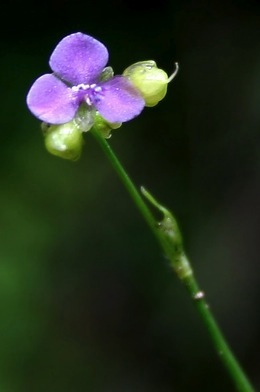
In India the Doveweed is a famine food. That should give you some idea of how it lines up in the culinary kingdom. The Chinese, however, put young shoots in soup.

Doveweed

This is quite understandable to me. The Doveweed is in the greater Commelina family and that family has fallen some in my favor.  Quite a few members of that family are reported to be edible raw and I am beginning to think few are. They certainly should be cooked. Blossoms, and young tips, can be raw exceptions for salads, but I have had a few upset stomachs eating raw adult members of this family. I think that is from calcium oxalate in the older leaves. Thus I recommend cooking for all of them. See the entry for “Dayflowers.”

The Doveweed grows from Virginia south and west to Texas, and in most subtropical to tropical areas of the world, usually infiltrating commercial crops. It’s quite an invasive weed for a ground hugger. The flower is also known by several names, both common and botanical. Naked Stem Dewflower is one. In Uganda they call it Mickey Mouse because the blossoms resemble you-know-who. Botanically it is commonly called Murdannia nudiflora and Aneilema nudiflorum.  It’s even been called a Commelina and Tradescantia and some six others names. And of course, every botanist is right.

As for the botanical name, Murdannia nudiflora (mer-DAN-nee-ah noo-dee-FLO-ree-ah) Nudiflora means “naked flower” and Murdannia was named for Munshi Murdan Ali, plant collector and keeper of the herbarium at the Saharanpur Botanic Gardens in India around 1840. 

Green Deane’s “Itemized” Plant Profile: Doveweed

IDENTIFICATION: Murdannia nudiflora: Annual herb, roots fibrous, slender, stems numerous, creeping, simple or branched, smooth. Leaves nearly all growing on the stem,  hairy throughout, sometimes smooth except for a hirsute line along mouth slit; leaf blade linear or lanceolate, smooth or sparsely bristly on both surfaces, end round or pointed. Angled zig-zagging branches. Flowers in terminal panicles, or solitary, with several densely arranged flowers; petals purple, obovate-orbicular. Seeds 2 per valve, yellow-brown, deeply pitted, or shallowly pitted and radiate white warts.

TIME OF YEAR: Summer into early fall

ENVIRONMENT: Often found in a dense mat in damp areas

METHOD OF PREPARATION: Young tips cooked, blossoms raw or cooked, preferably cooked. Leaves can be used as poultices.


{ 3 comments }

Dry Maria, White Snow, Drymaria, Drymaria cordata. Photo by Green Deane

Drymaria cordata: Kissing cousin chickweed

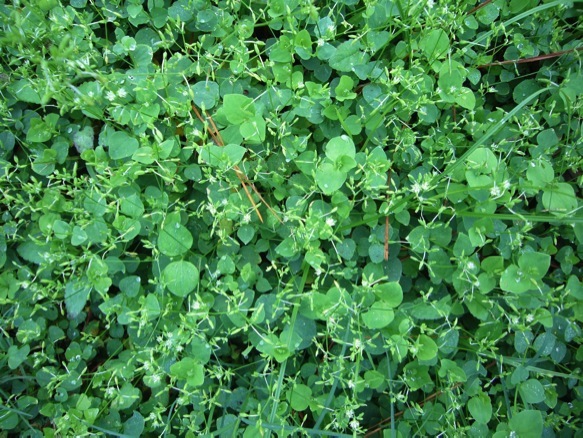
Drymaria cordata is one of those plants that confounds the mind. You know what it resembles: Chickweed. It has one of the main characteristic of chickweed, an elastic inner core. However it ain’t your usual chickweed, but it is a kissing cousin. It reminds you that plants are in families for a reason and they do look alike as many family members do.

D. cordata’s growth habit closely resembles chickweed (Stellaria) but the leaves are wrong, there is no fine line of hair on the stem, and the leaves do not taste like raw corn. Nonetheless. your mind, that great pattern finder, says this is chickweed.

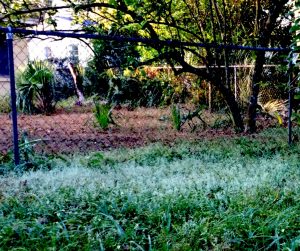
West Indian Chickweed can indeed look like snow.

Were it not for the fact it surrounded my tangerine tree years ago I would have never paid much attention to it. Drymaria cordata (dry-MAIR-ri-ah core-DAY-ta) is one of the few edibles that is not mentioned in virtually any of my 100-plus books on foraging. There is also the issue of what to call it: Drymary, Heartleaf Drymary, Whitesnow, Tropical Chickweed, West Indian Chickweed. It also has a second scientific name Drymaria diandra, though some list that as a subspecies or a variety and it has many herbal uses. And the genus name is no help. Drymaria comes from the Greek word drymos (dreeMOS)  meaning forest. The D. cordata does not grow in the forest, but apparently some relative did thus the name. Cordata helps. The leaves are roughly heart shaped.  Diandra is Greek and means twice the man, or two men. It does not mean “Diana” as a lot of baby name books say. There is no linguistic justification for that. To say Diandra is Greek for Diana is to ignore that the Greek name for Diana is Artemis, and that diandra literally does mean two men. To go from two men to a goddess is a bit of a leap.  However what diandra means referring to the plant is a good guess.  In botany diandra usually means two stamens. The cordata has three stamens.

Unlike its relative chickweed, Stellaria, only the leaves and young shoots of the D. cordata are eaten. They are also ground, boiled, then the water filtered and the water used for a variety of medicinal issues. Science has confirmed it has some interesting properties. See the Herb Blurb below. Drymaria cordata also invades 31 commercial crops in 45 countries.

Mild in flavor, raw leaves can be added to salad or other dishes. You can also cook them. As they are used in several herbal applications I suggest you don’t over do them in one meal, particularly raw. Also, Drymaria gracilis is edible as well but…

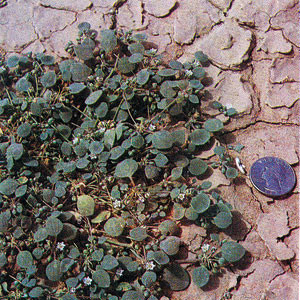
Inkweed, Drymaria p. is toxic. Photo by New Mexico State University.

Inkweed, Drymaria pachyphylla is toxic. Photo by New Mexico State University.

One other thing: It has a relative, Drymaria pachyphylla (dry-MAiR-ee-a pak-ee-FIL-uh) also called the Thick Leaf Drymaria. It is poisonous. Fortunately it looks a lot different, usually growing in a small rosette just a few inches across. It’s native range is Texas through the southwest. It often poisons livestock. Avoid it.

Green Deane’s “Itemized” Plant Profile

IDENTIFICATION: D. cordata: Annual herb with slender, smooth stems to about a foot long, frequently rooting at the nodes. Leaves roughly heart shaped, opposite, very short stems. Veins in leaf palmate from the base (the veins go out like five fingers from the bottom end of the leaf, clearly seen on the underside.) Flowers on long stalks; 5 sepals, petal 5, deeply 2-lobed, shorter than the sepal, white; 3 stamen, style divided into three below the middle.  Does NOT have milky sap. If you have a plant you think is chickweed and it has milky sap you have the wrong plant

TIME OF YEAR: During the cool weather in warm climates, spring and summer in more temperate climates. Far more distributed around the world them most official maps show, Florida to Nepal to Africa.

ENVIRONMENT: Likes sun and moist soil, a pesky weed to cultivated areas and lawns around the world.

METHOD OF PREPARATION:Leaves usually used raw in salads.  Has a tender, mild flavor. As it is also an herbal medication, don’t eat a truck load at a time.  (Also see chickweed elsewhere on this site.)

HERB BLURB

Abstract:

Different extracts of Drymaria cordata Willd (aerial parts) were tested for antibacterial efficacy against Staphylococcus aureus ATCC 29737, Escherichia coli ATCC 10536, Bacillus subtilis ATCC 6633, Bacillus pumilis ATCC 14884 and Pseudomonas aeruginosa ATCC 25619. The effects produced by the extracts were found to have significant activities against all the organisms being tested and the effects so produced were compared with those of chloramphenicol. The methanol extract was found to be the most effective.

Abstract:

The methanol extract of Drymaria cordata Willd, was investigated for its effect on a cough model induced by sulfur dioxide gas in mice. It exhibited significant antitussive activity when compared with the control in a dose-dependent manner. The antitussive activity of the extract was comparable to that of codeine phosphate, a prototype antitussive agent. The D. cordata extract (100, 200, 400 mg/kg) showed 11.6%, 31.6% and 51.5% inhibition of cough with respect to the control group.

Abstract

A novel anti-HIV alkaloid, drymaritin (1), and a new C-glycoside flavonoid, diandraflavone (2), along with eight known compounds, torosaflavone A, isovitexin, spinasterol β-D-glycoside, p-hydroxybenzoic acid, p-hydroxybenzaldehyde, cis-p-coumarate, methyl 5-hydroxy-4-oxopentanoate, and glycerol-α-lignocerate, were isolated from Drymaria diandra. Drymaritin (1) exhibited anti-HIV effects in H9 lymphocytes with an EC50 value of 0.699 μg/mL and a TI of 20.6. Compound 2 showed significantly selective inhibition on superoxide anion generation from human neutrophils stimulated by fMLP/CB with an IC50 value of 10.0 μg/mL.

{ 45 comments }