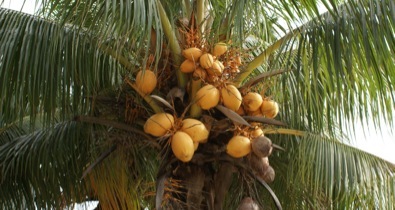
Maturing Coconuts

Coconut, An Equatorial Palm

Popular media and commercial production have made the coconut a common cultural item, even if you live thousands of miles away from where it grows. More so, the coconut is at the heart of nutritional controversy.

What could be controversial about coconut? The answer is coconut oil. It is a saturated fat in an age that tries to condemn saturated fats. Thus an oil that was once used in a multitude of products was banished to the economic hinterlands for several decades. However, advocates of the nut say the oil is a short-chain saturated fat, not like saturated fats from animal products, and thus, not harmful but actually extremely healthy and a disease preventative. This writer falls on the healthy side of the debate. I eat a lot of coconut and use the oil as my standard “hot” cooking oil along with olive oil, my “cold” oil. To date, now 70,  my blood lipids are excellent (and no, I am not a vegetarian but rather a low-carbing ..ah… meat-atarian.) I think I am the only person my age not taking statin drugs. In fact, I take no medications and work on keeping it that way.
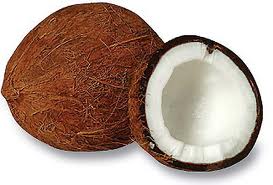
Coconut from the store, husk removed

What moved me over into the coconut camp was the work of Dr. Mary Enig, a lipid researcher. She wrote one time that you could see a study done on coconut oil in which the data showed it was healthful yet the study’s conclusion would say it was not. I thought that rather silly if not doubtful until one day I read several reports exactly like that including a meta analysis. The reason given was that if the researchers wanted more research funds they had to have a summary conclusion that agreed with the nutritionally politically correct stance of their era, read anti-coconut. But enough of food politics and my fat opinion, what of the coconut palm?

It is found in tropical climates, from about 26 degrees north and south of the equator. It likes humidity so does not take well to warm desserts. It is common in south Florida but is also reported in isolated areas in South Carolina, California, Texas, Hawaii and in Puerto Rico. They can be found almost up to central Florida but look a bit ratty from the cooler winters.
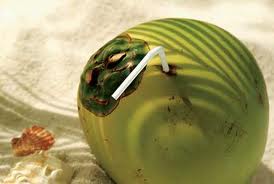
Coconut in husk, drilled for sipping

Coconuts are probably native to the southwest Pacific. From there they found their way to Africa and from there to the New World. Another theory is that it came from Southeast Asia. In either case coconuts were first written about around 60 AD, in Africa, in an area or town called Rhapta (and here is why language is so important to botany.)  The natives there used coconut fibers to build their boats, actually sewing. In Greek “raftis” is a tailor and “rafto” to sew, a word that is similar in Arabic. The Portuguese were the first outsiders to see the boats sewn and from there the coconut spread.  Also, the coconut floats and the palm is salt tolerant, so it moved itself around the world as well.

Coconuts came to Florida by accident. On 9 January 1878, the ship Providencia wrecked off-shore at what is now Palm Beach carrying 20,000 coconuts. Unexpectedly liberated, the coconuts floated ashore and found Florida to their liking. They sprouted enmasse on the beach. That is how Palm Beach got its name (though Coconut Beach would seem more appropriate.)
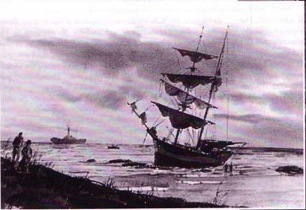
The Providencia run around off now Palm Beach, Florida

The Providencia was a 175-ton square rigged brig. It was going from Havana to Cadiz, Spain. By all accounts the weather was excellent, the day pleasant, and it was never ascertained exactly why the ship wrecked where it did. Fortuntely it was carrying a lot of wine and cigars so a party soon developed on shore which reportedly lasted two weeks. A steamer later picked up the crew and took them to Key West which at the time was a large city in comparison.  It is speculated the crew wrecked the ship for insurance purposes. One of the first local residents to reach the ship was William Lanehart, see picture below left. He later bought the wreck and content for $20.80. A multitude of coconuts were collected and sold for 2.5 cent each to local residents. That tells me if he sold 100 coconuts he more than paid for the ship.
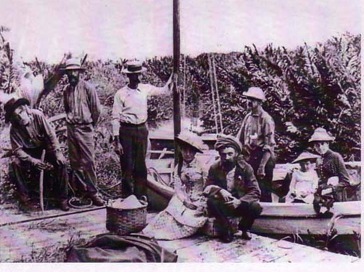
Coconut Collectors

Left is an early photograph of those who came to the Providencia’s “rescue.”  Second from left, Hiriam F. Hammon, a homesteader of the Palm Beach tract in 1873 containing 163 acres which is now just south of Royal Palm Way. He was one of the first settlers to reach the wreck of the Providencia (upper right.) Third from left, leaning on the sail boat mast, is George W. Lanehart. Standing in the boat is Richard B. Potter, MD, the first physician to settle in the Palm Beach area. The bearded man in the foreground is William Lanehart who bought the wreck. He homesteaded a tract that is the present day area of Vita Serena on Claredon Ave. He was also one of the first settlers to reach the wreck and spoke with the captain. (Photos courtesy of the Historical Society of Palm Beach County.)

A valuable tropical food and resource, the coconut has a fibrous outer husk covering a hard woody shell. The white meat (called copra) inside of the shell can be shredded and used in baking. It can also be eaten raw. When young it is very soft and hardens as the nut matures.  The meat can also be pressed for oil for use in cooking or baking. The nut often contains  “coconut milk.” Fresh coconuts aren’t that difficult to find in the wild but require a particular technique to open. Before the coconuts are formed, the spathe can be tapped for its sap which is rich in sugar and Vitamin B. It can also be fermented.

It takes a coconut about a year to reach maturity and collecting them off the tree can be a challenge. Picking them up off the ground is a better solution (around hotels with coconuts they are removed so they don’t injure guests when they fall.)  Harvesting off the tree is done by climbing with the help of a rope ring round the feet or ankles. Or you can use a ladder, depending on your insurance coverage. On reaching the top, you tap the nut in the lowermost bunch to test maturity. A hollow sound is better. Drop the nuts to soft ground or lower by rope. They are difficult to open in their natural husk.

If you opt to get a coconut from the grocery story, always shake them and buy the one that sloshes the most. It’s the freshest. You can tell by the sound. Once home I drill a little hole through the bottom, turn the nut over on a glass and drill another small hole through one of the three “eyes.” That drains out the “milk” actually coconut water which I enjoy then and there. I take a sledge hammer and crack the shell, opening it. Then with a DULL serving knife I pry the meat away from the shell. You’re all set. I like to slice the meat thin, sprinkle it with a little salt and roast until brown… it has a great flavor, close to bacon. Incidentally, raw coconut and scotch compliment each other extremely well. I’m surprised no one has made a formal drink out of the two flavors. Add 87% dark chocolate and heaven is upon you.

The thick outer husk is a source of a tough fiber called coir used to make doormats and brushes. The leaves are used in some areas for roofing thatch and basket weaving. If you burn the coconut shells expect small bursts of shooting flames. Apparently there are little pockets of oil in the shell and they ignite like gas jets spewing three-inch noisy flames, quite a surprise if  you are not expecting it.

Botanically the coconut is Cocos nucifera, KOE-koase noo-SIFF-er-uh. Cocos comes from the Greek word Kokkos, which means grain, particle or (contemporarily) coffee bean. Nucifera means nut bearing.

 Green Deane’s “Itemized” Plant Profile

IDENTIFICATION: Palm, 90 to 100 feet, single, slender trunk, bulge at the base with trunk usually curved or leaning. Leaves terminal rosette, feather shaped, 10- to 20 feet long, four to six feet wide, flowers, small, pale yellow, plume-like clusters. Blooms all year. Fruit, oval, 8 to 15 inches long, thick fibrous husk, green when young, brown when mature.

TIME OF YEAR: Year round

ENVIRONMENT: Humid tropical areas, salt tolerant  within 26 degrees of the Equator

METHOD OF PREPARATION: Numerous, nuts off the tree can be split on sharp object. Liquid is refreshing but can be laxative, immature meat eaten with spoon out of shell, mature chunks as are or grated. Can be boiled for oil. Removing tip of flower cluster will produce sap (neera) for making a sugar syrup also suitable of wine production.  Terminal bud edible but taking it kills the tree.  Spongy fluff that fills sprouting coconut is edible raw or sliced and toasted.  Spathe is tapped for sap.

HERB BLURB

Among many applications coconut water, which is sterile,  can be used as an intravenous fluid
{ 3 comments }

Chrysobalanus icaco: Multi-Colored Fruit

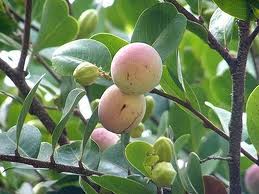
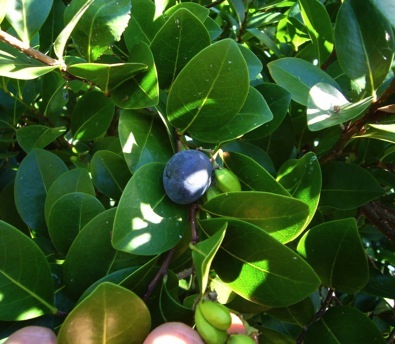
Coco-plums are three quarters patriotic: They can be red, white, or blue ( and yellow.)

Actually, the “blue” is deep purple and the yellow more a cream. Trees near the shore tend to have light colored fruit that is round whereas a variation inland tends to be oval and red to dark purple.

White cocoplums can be pure white or have a pink blush

Look for the coco-plum in cypress swamps, low areas, tree islands, beaches, sand dunes, canals, riverside, oceanside thickets, hammocks, by lakes, ponds and in landscaping.  In reference to landscaping, don’t confuse it with the Natal Plum which also has an edible fruit but the Natal Plum is covered with intense thorns.

The Coco-plum has been introduced to tropical areas around the world.  In Florida it is found from the center of the state south. In the wild it grows up to 30 feet tall, but can be trained into a compact hedge as well.

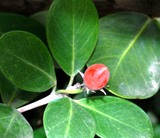
Red coco plum, note round/oval leaves

Opinions vary on the value of the fruit. Some think the pulp tastes like astringent sweet cotton. I have always found it soft and sweet. Some will say the blue tastes great and the white tastes bad, where as I have found them to taste the same.  It’is made into jams and jellies. In Cuba it’s manipulated into a sweet preserve that’s served in Havana restaurants as a sobremesa or dessert. The large kernel removed from its shell is edible raw or cooked. Some think it has the faint flavor of almond. To me it tastes like granola. Many think the kernel is far better when the fruit and kernel are both pierced so the juice of the pulp is allowed to seep into the kernel.

The botanical name is Chrysobaloanus icaco (crease-oh-BAL-ah-nus eye-KAY-koh. In botanical accounts that haven’t a clue “Chrysobaloanus” is interpreted to mean “Golden Apple.”  In more informed but polite reports it is “golden acorn” which is getting closer to the truth. It really means “golden glans” (or the end of human penis.) Carl Linnaeus, the fellow who started giving plants scientific names, was the original dirty old man. The barnacle got the same name as well, Balanus. Icaco, the individual species name, is the modern version of Hicaco which was what the plant was originally called in Taino on the island of Hispaniola. It is said eye-KAY-koh, in the Roman, but  eye-KAH-koh is also common.

The oil in the kernel can be substituted for almond oil. The seed is about 21% oil by weight. In fact, the seeds can be strung on sticks and burned like a candle. The oil can also be used to make candles, soap, and axle grease. The kernels (and leaves) can also be used to make a black dye that helps fibers resist decay.

The Coco-plum has has many native medical uses (see Herb Blurb below.) The leaves and bark have been used to treat dysentery and diarrhea, diabetes, bladder problems and kidney issues. Tea from the leaves can make mice hypoglycemic.

With all that said, there is a second Coco-plum, Chrysobaloanus icaco var. pellocarpus (pel-oh-KAR-pus) meaning dark fruit with translucent spots.  The pellocarpus lives inland where it’s wet, and has smaller, dark purple fruit. New growth is reddish or yellow.

Green Deane’s “Itemized” Plant Profile

IDENTIFICATION:

Both a shrub to 30-foot tree, leaves alternate, egg-shaped though variable, indented at tip, 1.5 to 3 inches long, leathery, glossy, new growth can be yellow green or reddish. Flowers small and white, in clusters. Fruit white to yellow to red to purple, thin skinned.

TIME OF YEAR: Spring to fall but usually a large crop in late spring and another in late fall.

ENVIRONMENT: Mainland, keys, near the coast or hammocks, inland near bodies of fresh water

METHOD OF PREPARATION: Fruit and kernel raw and or cooked. Made into jelly, jam and syrup. Can be canned.


HERB BLURB

Chrysobalanus icaco; Plasmid pUC 9.1; Escherichia coli; Genotoxic potentiality of aquerous extract prepared from Chrysobalanus icaco L. leaves. .

Abstract:  Plants have been related to our lives, being used as medicine, regardless of scientific evidence of side effects. This work analyses the toxicological effects of Chrysobalanus icaco L. aqueous extract, used in different pathologies. It was studied through: (i) alteration of plasmid pUC 9.1 topology; (ii) survival of bacterial strains submitted, or not, to previous treatment with SnCl2; (iii) transformation efficiency of E. coli strain by the treatment with the plasmid pUC 9.1. In (i), the treatment of the plasmid resulted in DNA single-strand breaks (SSB). A decrease of the lethal effect induced by SnCl2 in presence of the extract was found, while no C. icaco bacterial survival reduction was observed. The transformation efficiency of the plasmid was also reduced. Results suggest that the extract could present a potential genotoxic effect, as demonstrated either by the induction of SSB in plasmid or in transformation efficiency experiments. Finally, it presents an antioxidant action.

Chrysobalanus icaco L. extract for antiangiogenic potential observation. Alves De Paulo S, Teruszkin Balassiano I, Henriques Silva N, Oliveira Castilho R, Coelho Kaplan MA, Currie Cabral M, da Costa Carvalho MG. Instituto de Biofisica Carlos Chagas Filho, Laboratorio de Controle da Expressao Genica, Universidade Federal do Rio de Janeiro, Centro de Ciencias da Saude, Bloco C, Cidade Universitaria, CEP 21949-900, Rio de Janeiro, Brasil.

Angiogenesis is an important process in several physiological situations and it is also implicated in the development of some diseases such as diabetes and cancer. This study investigated the antiangiogenic potential of Chrysobalanus icaco methanol extract in the chicken embrionary tissue. Clinical trials for cancer treatment using drugs based on this mechanism are already in progress. Chorioallantoic membrane model (CAM) of chicken embryos, with C. icaco methanol extract in plastic diskes was used. The results showed an average of 44% angiogenesis inhibition in CAM areas with the plant extract compared to the controls. The data indicate that C. icaco methanol extract reduce the formation of new blood vessels in chicken chorioallantoic membrane.


{ 10 comments }

Coontie is toxic in its natural state

Zamia Floridana: Making Toxins Edible

This plant is included here in case 1) society falls apart; 2) You live in Georgia or Florida and need starch desperately or 3) someone wants to trade this starch with you. The plant is the Coontie and it can kill you. It can also sustain you. Don’t be surprised that it is toxic without processing. Many foods are. Tapioca comes to mind as do cashews, and pokeweed.

When there were few people and a lot of Coontie it was not only a major source of starch (flour) for local Indians in Florida but it was a commercial product with at least eight businessmen producing it for about a century, from around 1836 to 1925. One such mill sat at the corner of now Southwest 104th Street and US1 in Miami.  One mill processed up to 15 tons per day. Harvesting and urban sprawl  brought the Coontie to the edge of disappearing.

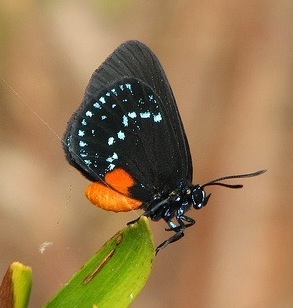
Eumaeus alata

In the fossil record, the Coontie family –Cycads — the clan goes back to the dinosaurs, some 325 million years or so experts say. They were the dominant plant species. The Coontie is the only member of that family in the United States. They are slow growing taking three decades to reach a five-pound weight. Coontie are fertilized by two beetles and they are the only place the brilliant Eumaeus alata butterfly, left, lays its eggs.  (Listen to this bureaucratic nonsense: The butterfly was thought extinct by 1965 thus by governmental thinking it cannot be protected even though it is in reality very rare and almost extinct. Because it was not thought to be around it was not and is not covered by endangered species laws. Said another way it is not on the protected list because they thought it extinct and now that it is not it can’t be put on the protected list…  Yes, that is totally irrational but there it is.) Coonties are now a common native landscape plant, replacing the natural population. Thus it is quite common if one needs to find it. Clearly this is not a plant you eat for the fun of it. It is a staple when one really needs it and time is not an issue. Time?

Coontie requires processing that includes leaching and fermentation. Interestingly, fermentation and or the action of enzymes on a food is common and makes a few non-edible foods edible. Many native populations crushed the seeds of the Prunus clan to make them edible after “curing” gets rid of harmful chemicals. The seeds of the Chickasaw Plum are an example as are sloes.

Here is an except from: Starch Making: A Pioneer Florida Industry By Mrs. Henry J. Burkhardt: No date was given.

“Mr. Mettair’s mill was probably a replica of those 1870 mills where no doubt, he had worked as a young man. His grinder was a log of pine, turned to be exact, and spiked diagonally with nails for grinding. The coontie roots were soaked over night and after grinding were fed into a hooper or deep box and from there put through a strainer rubbed constantly with running water. It was washed for two hours, the starch dropping to the bottom where a hole at what was called “starch level” drained away the water…. The wet starch was packed into barrels to be washed again three times, while stirring and settling. It was allowed to reach the bubbling stage in fermentation for then all dirt and sugar came out. The residue from this “yellow contie” was cooked and fed to the pigs, making another useful by-product. William Mettair, the oldest son, and inventor of the family, in 1904 devised a revolving strainer which eased the manual labor, resulting as well in a purer product. The finished starch was spread out on canvas driers and kept broken up until completely dry, before it was packed into barrels for shipment. It required one ton of coontie root to make 200 pounds of starch through this process.”

And another account:  Daily National Intelligencer,  Washington, on Thursday, February 25, 1836. Original donated to Fort Lauderdale Historical Society.  The following text is exactly as it appears in the original: From the Charleston Courier, sketches of the peninsula of Florida by Dr. Strobel:

“As we approached New River, the land upon our right consisted of the same sandy pine barren as I have already described. The Indian arrow root, called coonte, is found here is great quantities. We landed, and collected several roots, which were very large, weighing several pounds. This is the Indian’s principal bread stuff. It is met with in most of the pine barrens in this section of Florida, but it grows in such profusion in this neighborhood, that they come from considerable distances to procure it. Mr. Cooley …  was engaged in the manufacture of this article, and had brought it to great perfection.

“The following is the manner of preparing it: A sufficient number of roots being collected, they are peeled, washed, and grated, in the same manner as potatoes, and thrown into large tubs of water. After remaining in soak for a certain length of time, the water is stirred and strained: by this process it is greed of the feculent matter. The coarser portion, thus separated, may be given to hogs, whilst the finer portion, which passe through the sieve, is allowed to settle. The farina, which is almost insoluble in cold water, subsides at the bottom. The water is drawn off, and the yellow portions which remain on the top are removed. The white arrow root, which from its specific gravity, is found at the bottom, is collected, and repeatedly heated with fresh water, until it becomes perfectly pure and white, of a granular, glistening, crystalline appearance. I am inclined to think that , when thus prepared, it is very nearly, if not quite equal, to the Bermuda arrow root, not only as a starch, but also as an article of diet.”

Dr. Strobel was where Ft. Lauderdale is now and in fact Coontie production created the city. In 1836 the Indians basically attacked all such processing places between there and St. Augustine (makes sense since it was their food staple.) They killed everyone but Mr. Coolie mentioned above who was away at the time. In response Major William Lauderdale and his Tennessee Volunteers built a fort where the city would one day be. The rest is spring break history.

And here is a University of California report:

“The plant parts contain central nervous system toxins [cycasin] which must be removed before consumption.  To make flour, the roots are first chopped into pieces.  They are then pounded with a mortar and pestle.  The pulp is then washed with water and the starch is allowed to settle to the bottom.  Then the water is drained and the remaining paste is left to ferment for several days.  At the end of the fermentation process, the starch is set in the sun to dry.  When dry, the powdery, cornmeal-like flour is then baked into bread.”

No, I haven’t tried it. But, if I come across a Coontie marked for destruction I might.  But consider: One of DeSoto’s men died from poorly prepared coontie bread and Union soldiers in the Civil War in Florida also died from eating coontie bread… though come to think of it that could have been intentional.  The wash water, by the way, is toxic.

There are actually several species of “Coonties” in Florida, or not. The botanists cannot agree.  The scientific name for the Florida Coontie is Zamia floridana ( ZAY-mee-uh flor-rid-DAY-nuh) or Zamia furfuracea (ZAY-mee-uh fer-fer-AH-see-uh) or  Zamia integrifolia  (in-teg-ree-FOH-lee-uh) or  Zamia pumilia (ZAY-mee-uh  POO-mil-uh) though latter might be from  the Dominican Republic.  Zamia means “pine nuts” because the fruiting bodies of the Coontie resemble pine cones. Fufuracea means mealy or with scales, integrifolia means leaves undivided, floridana of Florida, pumilla small or dwarf.  The Zamia chigua (ZAY-mee-uh CHEE-gw) of Central America has been used for food as well. Chigua is the local name of the plant. Coontie is from the Creek (Seminole dialect) word kontí  (KOON-tee)  and means “white root” or “white bread.”  Cycads come from the Geek word kyklas and means “palm.”

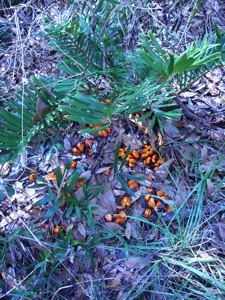
Coontie seeds are toxic like the root

For pollination the Coontie cones provide food the beetles Pharaxonotha zamiae and Rhopalotria slossoni.  The seeds are a source of food for mockingbirds, blue jays, and small mammals.  Butterfly larvae feed on the leaves.  Eumaeus (YOO-mē’us ah-LAY-tuh) was the faithful swine herd of Odysseus , and altata (ah-LAY-tuh) means winged. Winged Swine Herd… well, a butterfly has to be called something. See photo above right.

Coontie is protected from collection from the wild. I think that would exclude cultivated plants and if society fell apart. The orange outer layer of the seeds is also toxic to touch (having the same toxin as the roots and leaves.) They are considered not edible. However, there is one report that if the seeds are peeled of the orange coat, ground, and leached like the roots they are edible. I would not bet my life on it. Toxicology expert Dr. John Kinsbury says they are thought to be toxic for humans.

Green Deane’s “Itemized” Plant Profile

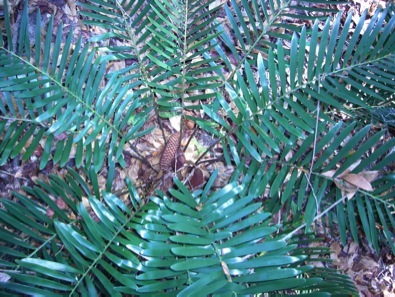
IDENTIFICATION: A fern-like evergreen, shrub, one half to 1 yard in high with a thick sometimes branched, trunk that is either very short or underground. Dark green fronds grow from the top of the trunk, 2 to 13 pairs of stiff, leathery leaflets.  Green to dark reddish brown cones grow on stalks, from the center of the top of the trunk.   The red to red-orange seeds are not edible and are toxic to touch.

TIME OF YEAR: When ever the trunk  is large enough to have a large amount of starch. Reduction is 10 to one. One hundred pounds of Coonti produces 10 pounds of processed starch.

ENVIRONMENT: Rich, moist, well drained soil, hammocks and pine lands. Prefers some shade.

METHOD OF PREPARATION: Extensive: Must be cleaned, peeled, mashed, washed, settled, fermented then dried or used as a mash in soups et cetera.  The seeds are not edible and are toxic to touch. A blue-green algae on the roots is natural and a symbiotic relationship with the algae providing nitrogen for the Coontie. The roots are 38% starch and 6% protein. With the processed starch the Seminoles made a thick gruel called “sofkee.”

{ 17 comments }

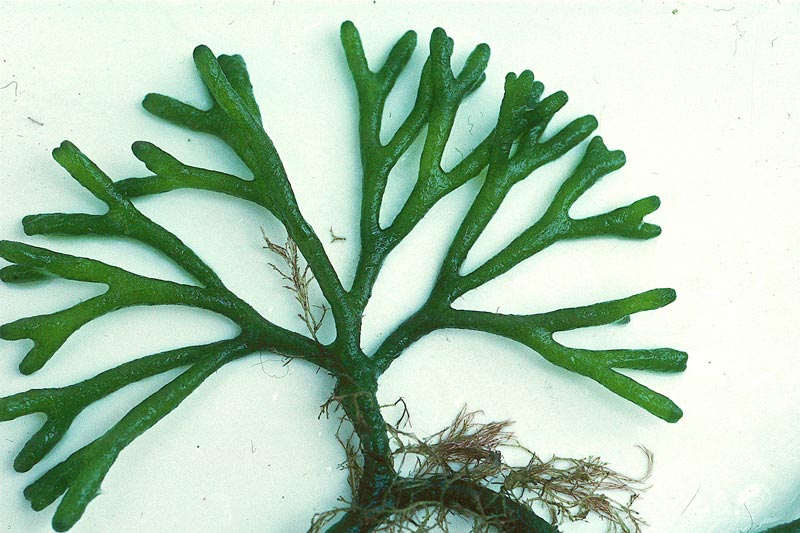
Codium is a non-commercial seaweed that is never cook because it turns mushy.

Codiums: Edible around the world

Oceanographers like to call Codium a minor seaweed because it is not commercially exploitable. Yet where it is found around the world it is eaten. It is also considered one of the most invasive species in the world. So, there’s food near you.

One species, Codium fragile ssp. tomentosoides, was first reported in Holland in 1900. In the century since it has spread throughout Europe. It’s now found along the shores of Britain, Australia, New Zealand, the Mediterranean and North America  It was first reported in North American in 1957 on Long Island,

Many Codium species are fleshy and have a soft texture. This leads to such common names such as “sponge weed”  “rats’ feet” or “dead man’s fingers.” They are found often in the the intertidal zone on rocky shores but are also common on beaches and around found around Florida and the Gulf Coast.  Raw Codium has an earthy flavor, much like oysters, and is full of vitamins and fatty acids.  It sells for about $7 a pound, wet.

In the Hawaiians Islands Codium, after being throughly washed,  is eaten raw, often with tomatoes. It is never cooked or blanched because it becomes soft and disintegrates from the heat. In Japan it is preserved in salt.

The Codiums include  C. muelleri, C. tenue, C. formosanum, C. intricatum, and C. papillatum. Pictured are C. reediae, C. fragile, C. isthmocladium, C. edule, C., tomentosum, and C. decorticatum.

Codium is the favorite food of some sea slugs, snails and sea urchins. It is often found on beaches after a storm still attached to little pebbles or shells and some think that is how some beaches get the pebbles and shell build up.

Codium Salad

4 cups Codium, well cleaned

1 small sweet onion

1 medium tomato

1/4 cup soy sauce

2 teaspoons wine vinegar

2 teaspoons sugar

1/4 cup sherry

1 teaspoon black pepper

Mix dressing ingredients and pour over chopped onions. Just before serving, chop the tomatoes and Codium and toss with dressing. Garnish with slices of tomato. Chill and serve.

Green Deane’s “Itemized” Plant Profile

IDENTIFICATION: Codium is pale to dark green or olive green, very bush-like appearance, with many branches arising from a disk shaped holdfast. Branches are cylindrical,  resembling fingers. When submerged, Codium branches feel soft and “fuzzy” When washed up on beaches and or during the winter hairs are lost and the branches become coarse. Codiums can grow up to four feet and can wash up on beaches as a whole plant  or in small pieces, particularly after storms.

TIME OF YEAR: Year round, grows in spring and fall

ENVIRONMENT: Two feet to 200 feet, in northern climates in tidal polls near low tide, southern water on reefs, washed up on shore.

METHOD OF PREPARATION: Usually raw, wash well and check local news for any harmful algae blooms. If cooked it disintegrates. Can be preserved in salt.

{ 6 comments }
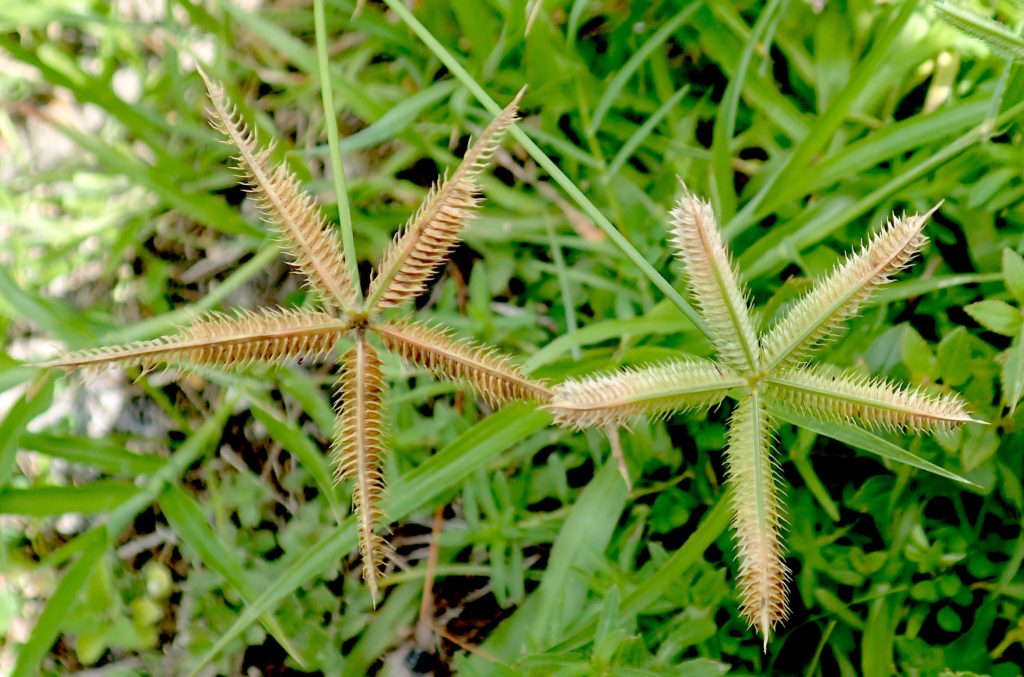
Non-native Crow-Foot grass is easy to identify. Photo by Green Deane

Non-native Crow-Foot grass is easy to identify. Photo by Green Deane

Dactyloctenium aegyptium: Staple Grain

Grasses can be a pain in the …ah… grass…

First, books about grasses are few and incredibly expensive. Next, grasses are hard to identify, often minute differences tells one species from another, and the language can be a bit of a challenge. Here is a partial description of the Crowfoot Grass:

FLORETS: Fertile florets appressed to rhachilla. Fertile lemma gibbous; ovate in profile; 2.6–4 mm long; membranous; keeled; three-veined. Lemma midvein scaberulous. Lemma lateral veins obscure. Lemma apex acute, or cuspidate; muticous, or mucronate. Palea one length of lemma; two-veined. Palea keels wingless, or winged; narrowly winged. Apical sterile florets resembling fertile though underdeveloped.

Did you get that?  I call it Helicopter Grass, all the “fingers” are on the same plane like a helicopter’s rotor. The seeds are on the underside, like teeth on a comb.

Crowfoot grass, Dactyloctenium aegyptium (dak-tie-lok-TEE-nee-um ee-YIP-tee-um) is a

Crowfoot Grass Seed Heads

traditional food in Africa and highly nutritional. I like it as a trail side nibble but in season it is not difficult to collect enough for a side dish for one or two people or larger amounts for storage. It’s about the size of table salt grains though golden in color. I eat it raw or cooked. It has the texture of sand, but tasty, edible sand.  It is an extremely versatile grain and can be cooked as it, roasted, milled et cetera. I eat it raw on the trail but I also like to mix it with some water and olive oil, cook for about 10 minutes or until the water is evaporated and enjoy. Raw or cooked it has about the same flavor and texture.  I suspect it is not a popular food because of its size and texture, which of course is significantly changed if milled into flour.  As flour is by far its best use, in my opinion

The only problem I’ve had with Crowfoot Grass is that while long it grows “up” only about a foot and can get dirt in with the grains. To harvest, I simply tug at the seed heads. If they let go, they

Crush by hand

are ready, if not leave them because when green the seeds are not ready to eat. I separate the grain from the hulls by rubbing the seed heads in my hand. Rub them a lot. I pick  or screen away the larger chaff and then gently blow away the rest, leaving a pile of gold/orange grain. Do not eat the grass itself (as opposed to the seeds.) In hot weather the grass itself can be toxic like Sorghum.  Also it is reported that its roots can be chewed like sugar cane. I do not know. I have not tried it. You’re on your own with that one. I would not try the root in hot weather.

Dactyloctenium is from Greek and means finger and little comb, referring to the “flower”

Sift seeds through a screen

spreading like fingers and the seeds lining up like teeth on a comb.  Aegyptium, of Egypt.  Greeks would say it with one more syllable than the Latin: ah-ee-YIP-tee-um. There are 14 members in the genus.

On the plus side there are few toxic grasses in North American, though Sorghum is one (the leaves, not the seeds or the sap.)  Some grasses are distinct, however, and crowfoot grass is one of them. It’s easy to spot and there are no look alikes.

In my video about Crowfoot Grass I mixed one ounce of seed flour with one ounce of white flour, a teaspoon of sugar, a quarter teaspoon of salt, half a teaspoon of baking powder, tea teaspoons of olive oil and about a quarter cup of water.

Green Deane’s “Itemized” Plant Profile

IDENTIFICATION: Spreading, creeping and mat-forming grass, roots at the lower nodes. The flower head has two to seven spikelets — usually five or six — on the tip of the stem. Seed head looks like a crow’s foot, each plant can have 60,000 seeds.

TIME OF YEAR: Fall in all areas, when the top separates easily from the stem. Ranges from Maine to California. While seeds can be collected when ripe never eat the grass itself in hot weather.

ENVIRONMENT: Heavy, damp soil to dry, sandy arid soil

METHOD OF PREPARATION: Used like any grain, but because of its size and texture better used as a flour.  I eat them raw on the trail or boil them for a few minutes.  Green seeds are not edible but can be bruised and used as a fish stupefier. Do not eat unripe seeds.

{ 10 comments }