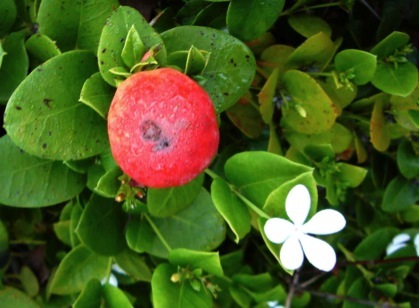
Natal Plum fruits nearly year round

Natal Plum: Incredible Edible Landscaping

A good reputation is hard to maintain when your closest relative has a reputation for killing people. That’s the public relation situation for the Natal Plum.

There are few foraged fruits that can match the Natal Plum in sheer deliciousness. Yet, it is a member of one of the most deadly plant families along side its cousin the Oleander, which makes headlines by fatally poisoning the unknowing and the suicidal.
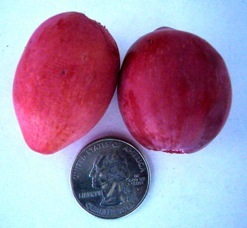
Fruit is flecked with bits of latex

Officially known as Carissa macrocarpa (kuh-RISS-uh mack-roe-KAR-puh) the Natal Plum is part of the Dogbane family. The botanical name for that family is Apocynaceae which is Greek for “keep it away from the dog” meaning it kills them easily. It does us, too. Nearly all parts of the Natal Plum are poisonous, like the Oleander, except for the red-ripe fruit. They taste like a slightly sweet cranberry with the texture of a ripe strawberry — some say like a sightly unripe cherry. It’s surprising that someone hasn’t concocted a commercial fruit juice that tastes like the Natal Plum. If they mixed it with some orange juice it could be Natal Naval… lot of marketing possibilities there.

As for the Oleander, it is one of the deadliest shrubs in Florida, not the deadliest plant but certainly in the top three. It’s commonly used in landscaping along highways because it can tolerate heat and all the heavy metals and exhaust and other transportational effluvia vehicles spew such as rubber, asbestos, motor oil, grease, paint et cetera. Accidental and intentional deaths from Oleander poisoning are common. When you have a toxic relative like that, you can see how good side of the Natal Plum tends to get lost.
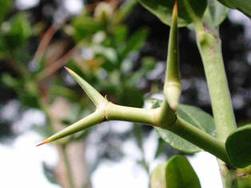
Double thorns help identification

Natal Plum copes well with salty winds, making it a good choice for coastal areas. It grows in mounds two to seven high and as wide. It’s tolerant of various lighting conditions and is a popular landscaping plant. Because of its double spines —a good identification characteristic —it makes a popular security hedge. The Natal Plum in the accompanying pictures came from a vacant commercial lot in Orlando. I drove past it often in the distance and curiosity upon seeing red prompted its discovery.  I’ve also seen it as a landscape plant inside the national Canaveral Seashore Park — across the road from the rangers’ headquarters on a sand dune — and in the dry hills of San Diego, California.
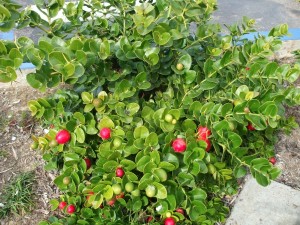
Natal Plums are often used in landscaping

Natal Plums have shiny, deep green leaves and snowy white flowers. Their scent intensifies at night and they bloom for months at a time. The fruit appears in summer and fall, or fall and winter in warmer climates, and at the same time as it blooms. In moderate climates the fruits can appear throughout the year and the ones shown were picked in Orlando, Fl., in early January. But I’ve also picked them in July. The fruit can be eaten off the bush or made into pies, jams, jellies, or even sauces. It is rich in Vitamin C, calcium, magnesium and phosphorus. An analyses shows the fruit’s moisture is 78.45%; protein, 0.56%; fat, 1.03%; sugar, 12%; fiber, 0.91%; ash, 0.43%, and ascorbic acid 1 mg per 10 mg in weight…. meaning it is 10% vitamin C. That makes citrus look anemic.

Natal Plum seeds

There are  6 to 16 seeds in each fruit and each is about the size of one flat instant Quaker oat. Some references say they are toxic, but Professor Julia Morton — the first and final authority in Florida — says they are “not objectionable when eaten” and she writes the entire ripe fruit can be eaten as is. I eat them seeds and all and seem to be no worse for it.  A ripe fruit is one that is plum red and slightly soft to the touch. No peeling is necessary. Halved or quartered and seeded, it is suitable for fruit salads, gelatins and as topping for cakes, puddings and ice cream. One word of caution: Don’t cook the fruit in an aluminum pot. Stewing or boiling causes flakes of edible latex to leave the fruit and adhere to pots. It can be removed by rubbing with oil. Don’t like eating plant-made latex? Then also avoid fresh figs because they have it as well.
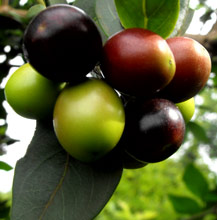
Carissa edulis, only ripe fruit is edible

Carissa edulis, only ripe fruit is edible

There are at least three other Carissas with edible fruit. C. bispinosa grows to 10 feet and has repeatedly forked spines.  One to two seeds, native to South Africa. Carissa carandas is a native of India, a sprawling or climbing shrub. Ripe fruit turns from wine red to black, lots of latex. Carissa edulis is often spineless, or with a few simple spines. Fruit red to reddish purple.

Carissa comes from the Sanskrit word “corissa” the local name of one the the species. Macrocarpa is Greek for large fruit. Carissa macrocarpa is called the Natal Plum because it is native to the Natal area of South Africa north to Mozambique.  The most common name for the plant outside of English is ‘num-num.’ The Zulu call it amatungulu —a marketing nightmare. Among others Africans, the fruit is called noem-noem, with the pronunciation starting with a clicking sound on the ‘N’.

The recipes are from  *The Rare Fruit and Vegetable Council Cookbook, by the Rare Fruit and Vegetable Council of Broward County, Inc., Davie, Florida (out of print) and

**Caloosa Rare Fruit Exchange Cookbook, Lois Sharpe. (The exchange still exists but their cookbook may not.)

Carissa Fruit Soup*

1¾ cups apple juice or cider

¼ cup sugar

2 tablespoons cornstarch

4 inch stick cinnamon, broken

4 whole cloves

Stir the above ingredients in a saucepan. Cook over medium heat, stirring constantly, until boiling. Reduce heat and cook until clear, stirring constantly. Remove from heat and add:

¾ cup orange sections

¾ cup grapefruit sections

½ cup seedless grapes

1 cup seeded, halved Carissa

Cover and chill overnight. Remove spices and stir well before serving cold. Makes 6 servings.

Carissa Pie*

1 pint Carissa (sliced crosswise)

1 tablespoon flour

1 tablespoon margarine

½ cup sugar

½ cup water

pastry

Slice well-ripened Carissa into a deep, buttered, baking dish. Mix flour with sugar and sprinkle over the fruit. Dot lightly with margarine. Pour water over the mixture. Top with pastry, slit to allow steam to escape and bake at 450° for ten minutes, then at 425° for 20 minutes until fruit is cooked and pastry is brown. Serve hot with Carissa Sauce flavored with lemon juice or with vanilla.

Carissa Sauce*

Rinse fruit, cut in quarters. Take out seeds retaining pulp. Measure ½ cup sugar or sugar substitute to each cup cut carissas. Over low heat, cook the Carissa and sugar (no water added) until fruit is soft. Use as a sauce similar to cranberry sauce. For jellied sauce, add 2 tablespoons of water for each cup of Carissa. Cook until fruit is tender. Strain juice through jelly bag or a double layer of cheesecloth. Add to ½ cup sugar for each ¾ cup juice. Cook until thickened.

 Carissa Bread**

2 cups flour

1½ teaspoon baking powder

1 cup sugar

½ teaspoon salt

½ teaspoon baking soda

1 egg, well beaten

½ cup orange juice

2 tablespoons shortening, melted

2 tablespoons hot water

1½ cups carissa, seeded and chopped

1 orange rind, grated

½ cup chopped nuts

Sift together flour, baking powder, sugar, salt, and soda. Add egg, orange juice, shortening, and hot water. Stir only until flour is moistened. Fold in Carissa, orange rind and nuts. Bake at 350° in greased and floured loaf pan for 45 minutes. Yield: 20 servings.

Carissa Hors D’oeuvres

Wash and drain fresh, ripe fruit. Split, remove seeds, and put on ice until shortly before serving. Stuff cavities with low-fat cottage cheese or light cream cheese. Place on a bed of shredded lettuce.

Jellied Carissa Salad*

1 tablespoon unflavored gelatin

½ cup cold water

1½ cups boiling Carissa juice or juice and pulp

½ cup sugar

¼ teaspoon salt

2 tablespoons lemon juice

1½ cups chopped celery

Sprinkle gelatin on cold water and let stand 5 minutes. Dissolve sugar, salt, and softened gelatin in boiling Carissa juice. Allow to cool and add lemon juice. When mixture begins to thicken, add chopped celery. Turn into a mold and chill. When firm, turn the mold onto a bed of shredded lettuce and garnish with light mayonnaise, if desired.

 Carissa Salad*

1 pound Carissa

1 cup water

1 cup sugar

4 teaspoons gelatin

½ cup cold water

½ cup chopped celery

½ cup diced apples

½ cup pecans

Cook Carissa in one of cup water until tender, strain and add sugar. Moisten gelatin in cold water. Add to sugar and Carissa. Stir until dissolved, then add celery, apples and nuts. Chill in the refrigerator and serve on lettuce.

Green Deane’s “Itemized” Plant Profile

IDENTIFICATION: Much branched evergreens, dense and rounded, wide canopy, sharp, branched spines, broken stem produces milky sap. Thick, glossy, dark green, opposite leaves, leathery texture. up to three inches. Waxy white, star-shaped blooms, two inches in diameter, five petals, borne in dense sprays, very aromatic.

TIME OF YEAR: In the right climate, it blooms and fruits all year. Heaviest fruiting in spring and summer.

ENVIRONMENT: Drought tolerant, can endure salty soil, salty winds and heat. Likes full sun but can tolerate some shade. Because of these qualities it is used — despite it spines and toxic foliage — as a landscaping plant, most often for for businesses.

METHOD OF PREPARATION:  Only the ripe fruit is edible, raw or cooked. The rest of the plant is very toxic. Watch out for the spines.
{ 82 comments }

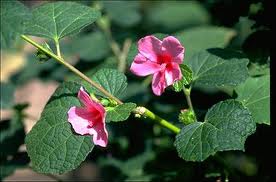
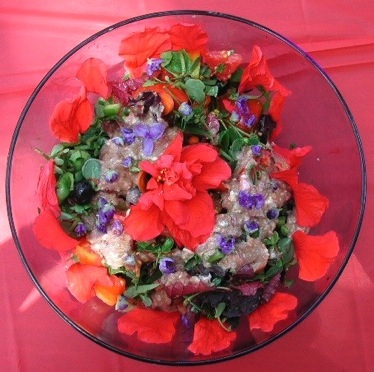
A true back yard salad, a hibiscus blossom is the center piece and decorations around the edge. The light blue flowers are tradescantias. (See Pocahontas entry) There are also bits of deep red H. acetosella leaves in the salad as well along with purslane (see omega 3 fatty weed entry.) The dressing is blackberry yogurt with balsamic vinegar and olive oil

Lunch Landscaping: Hibiscus

Rose of Sharon, Hibiscus syriacus

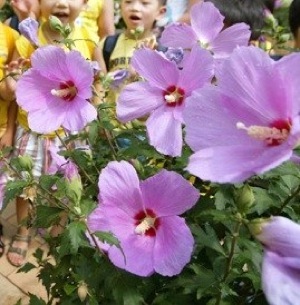
My mother’s favorite flower was the Rose of Sharon, which of course didn’t even go in one of my ears and out the other when I was a kid. But now that she’s passed (at 88) and I like plants I pay more attention. The Rose of Sharon is Hibiscus syriacus (high-BISS-kuss seer-ee-AY-kuss) meaning “slimy from Syria.” It’s a mallow family member and besides mom’s favorite it happens to be the national flower of South Korean, fitting since the flower is an Asian native. (They first thought it came from Syria, hence the name.)

The False Roselle, Hibiscus acetosella

In Korean, H. syriacus is called mugunghwa, which is a variation of the word mugung, meaning “immortality.” H. syriacus is also called the Rose of Althea, which is from Greek meaning “truth.” Actually, hibiscus is also a Greek word. More on that in a moment. H. Syriacus is a flower that has prompted folks to be poetical for a long time. And regardless of what it is called, the hibiscus is a mallow and people have been using plants in the mallow family for a very, very long time.

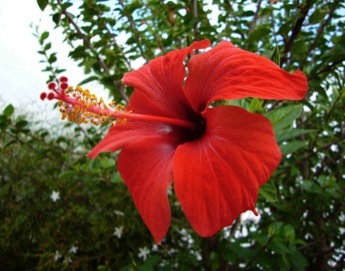
Mallows are quite consistent in their signature flower: Five separate petals with the male and female parts fused together like a frilly spike in the center, typified by the top left picture of a hibiscus taken in Greece at the cave of St. John, on Patmos. Some part of a Mallow is usually mucilaginous, meaning slimy. Crush almost any part of the plant and rub it between your fingers, they will be slimy or sticky.

Hibiscus at the Cave of St. John on Patmos, Greece, photo by Kelly Fagan

The medicinal properties of the wet-footed low-growing marsh mallow were mentioned by Horace, Virgil, Dioscorides and Pliny (and from whence where the original marshmallow of peanut butter sandwich fame came from.) The Egyptians and the Chinese used the mallow. It was even mentioned in the Bible, book of Job, 30: 3-4: “For want and famine they were solitary; fleeing into the wilderness in former times desolate and waste. Who cut  up mallows by the bushes, and juniper roots for their meat.”

Turk’s Cap,  Malvaviscus penduliflorus

Pythagoras, the Greek philosopher and mathematician, advised against eating the marsh mallow because it was, in Greek theology, the first messenger sent to earth by the gods to show their sympathy with the short lives of mortals. Thus eating mallow would dishonor the gods. The word mallow itself comes from the Anglo Saxon word Malwe. That came from the Greek malakos, for soft. Even Shakespeare mentions mallows, in The Tempest. Gonzalo is saying “Had I plantation of this Isle, my lord…” when he is interrupted by Antonio and Sebastian saying: “He would sow it with nettle-seed. Or docks or mallow.”

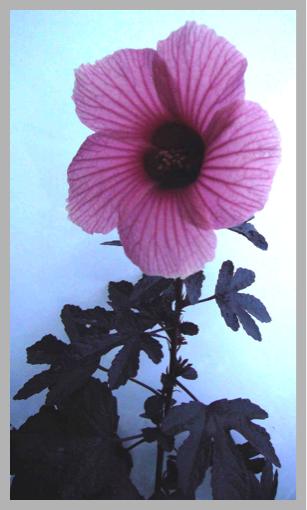
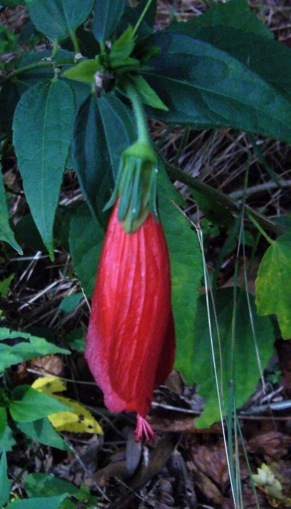
The most common form of mallow most folks see these days is the hibiscus, and that’s what is pictured on this page. It’s a very common landscape shrub in warm areas and at least one species— Malvaviscus arboreus (mal-vah-VIS-kus ar-BOR-ee-us) the tubular flower (right)  —has escaped cultivation and naturalized. It is also called Malvaviscus penduliflorus.

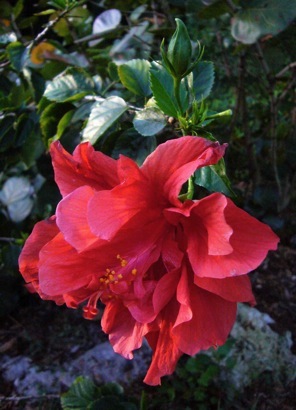
Double Red, a Hibiscus rosa-sinensis cultivar

I usually put hibiscus flowers in salads. They don’t have any flavor but they are pretty and add texture. The leaves of some hibiscus are edible as well, such as pink hibiscus with red leaves on this page, upper right. Called the False Roselle, its Latin name is Hibiscus acetosella (hye-BISS-kus uh-set-o-. SEL-luh.) As mentioned, hibiscus means hibiscus or slimy or sticky, and acetosella means “a little sour.” Besides the flowers of the H. acetosella, I use the young leaves for salads and stir fry. A close relative, H. sabdariffa (hye-BISS-kus sab-duh-RIF-fuh) is the real roselle and is also known as the “Florida Cranberry” the “Cranberry Hibiscus” and the Jamaican Sorrel, thought the latter strikes me as recent and nescient.  A tart juice can be made from its fat calyxes and it’s something of a tradition in the West Indies.  Many posters on the internet get these two hibiscus mixed up, but there is no need for it. The False Roselle ( H. acetosella) resembles a small red maple where as the Cranberry Hibiscus (H. Sabdariffa) has lance-shaped, green leaves. They look quite different in leaf shape and color.

Caesar Weed, Urena Lobata

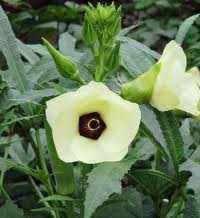
Better known members of this family today are okra and cotton. Cotton is the only mallow with proven toxic properties. While refined cottonseed oil is common — the basis for Crisco shortening (the names comes form Crystalized Cotton Seed Oil) in its raw state it reduces potassium in the body and increases infertility. Oddly it is also often used to pack smoked oysters.

Blossom of the common okra

As for okra many folks don’t like its viscus texture but it brings up the origin of words. Viscus and hibiscus come from the same Greek word, “iviscos” which means hibiscus and has come to mean thick or sticky as in a viscous fluid.  The base word in Greek is EE-vis, a marsh wading bird still found in English as Ibis.

While the nutritional value of the H. acetosella (the pink one with the red leaves) is not known, here is the nutritional breakdown of a close, edible relative:

Flowers (Fresh weight) Water: 89.8 Protein: 0.06 Fat: 0.4 Fiber: 1.56 Calcium: 4 Phosphorus: 27 Iron: 1.7 Thiamine: 0.03 Riboflavin: 0.05 Niacin: 0.6 Vitamin C: 4.2

Fruit (Dry weight) Calories: 353 Protein: 3.9 Fat: 3.9 Carbohydrate: 86.3 Fiber: 15.7 Ash: 5.9 Calcium: 39 Phosphorus: 265 Iron: 17 Thiamine: 0.29 Riboflavin: 0.49 Niacin: 5.9 Vitamin C: 39,

Leaves (Dry weight) Protein: 15.4 Fat: 3.5 Carbohydrate: 69.7 Fiber: 15.5 Ash: 11.4 Calcium: 1670 Phosphorus: 520

One mallow is a famine food, the Caesar Weed, see an article elsewhere here on the Caesar Weed, Urena lobata. Also edible is the leaves of the Abelmoschus manihot.Two final nibblettes: Some times marsh mallows are called cheeses That’s because the flat, round, seed pod of the marsh mallow looks something like cheese. And, the mineral malachite is named after the mallow because its green color is similar to the mallow green.

Green Deane’s “Itemized” Plant Profile

IDENTIFICATION: The leaves are alternate, simple, oval to lance shaped, often with a toothed or lobed. The flowers are large, obvious, trumpet-shaped, with five or more petals, ranging from white to pink, red, purple or yellow. The fruit is a dry five-lobed capsule, containing several seeds in each lobe.

TIME OF YEAR: Can bloom year round in warm areas.

ENVIRONMENT: H. acetosella prefers most well-drained soil. It cannot grow in the shade. It requires moist soil.

METHOD OF PREPARATION:  Flowers and young leaves of the H. acetosella can be eaten raw, chopped leaves an be added to stir fries.

{ 29 comments }

Lemon Bacopa, a misnamed edible native with a bitter relative

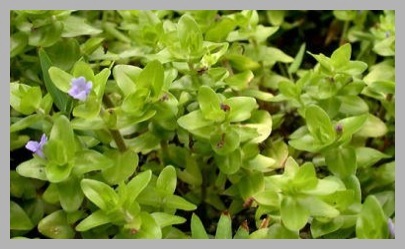
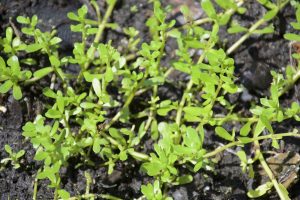
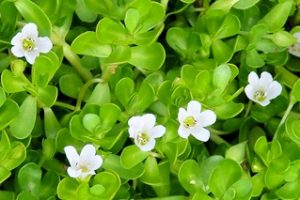
Fragile Lemon Bacopa that smells like lime

Call me cranky, but I think Lemon Bacopa has the wrong name.

And, since it is wrongly named and no one comments on that, it also makes me think that those who talk about the plant have never met it in person. It is difficult for me to believe that anyone who has ever smelled the plant would call it “lemony.” One writer did say it smelled like Eucalyptus, which I don’t agree with, but at least he smelled it and agreed it was not “lemon” in odor.

Lemon Bacopa clearly smells of crisp, fresh limes, which is far more fruity than lemons. The tea it makes tastes like limes. Chew a little. It tastes like lime. Rub it on you. People will call you “Limey.” It should be called Lime Bacopa.

One doesn’t see “Lime Bacopa” in the wild too often. It’s usually one of those thing you notice while looking for some other plant, but there it is, forming a thick patch of succulent looking little plants, smelling of LIME when you step on them.  What one does find far more often is its cousin, Bacopa monnieri, (buh-KOH-puh mon-ee-ER-ee ) which looks quite different, but with no LIME aroma, or lemon odor or eucalyptus ordor for that matter. In fact, the non-scented Bacopa monnieri, doesn’t even smell green.

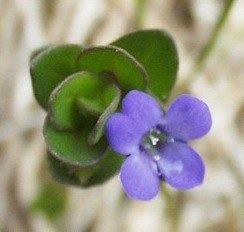
Also known as Blue Water-hyssop, the LIME Bacopa can be found in coastal states from Maryland to Texas, though I have always found it inland in semi-wet places, like wet ditches next to dry roads through low woods or shady fields. It likes it wet and can grow and flower totally submerged. This is probably why it is a big hit with the aquarian crowd. Personally, I’ve never  seen it in an aquarium, but then again, I’m not a fish nor do I raise them. I do eat them, however. I’ve never seen Lemon Bacopa submerged, or even standing in water. I’ve always found it in damp, rich-soil swales, creating a dense mat.

Bacopa caroliniana

For such a little plant it has a long nomenclature history. It’s botanical name is Bacopa caroliniana (buh-KOH-puh  kair-oh-lin-ee-AY-nuh.) The species name means “from Carolina”  “Bacopa” is the Latinized name the aboriginals Indians called it in what is now French Guiana. However, the story does not end there. It is also called the Blue Hyssop. It got that name because a close relative, the B. Monnieri, is called the Water Hyssop. It got its “hyssop” name from a plant in the Bible that had nothing to do with water at all….. now doesn’t that make sense….

In the Bible a plant was called esov or ezon. The Greeks 3,000 years ago called it ussupos (said EE-see-pos.) In Old English it became ysopo, ysope, ysop, isop and then hyssop.  Esov was probably Origanum syriacum, or Syrian oregano, which, incidentally, is often mixed with sumac berries (see the article on Sumac.) The Syrian oregano has been collected in bundles since Biblical times as incense to anoint and purify alters. That practice was carried over into the various forms of Catholicism but not as bundles of incense but the holy water sprinkler priests carry, called a hyssop. Hyssop went from a bundle of spice to a water sprinkler to the name of a plant that likes water.  Now you know. But, how did they get from a plant that grows in dry areas in the Middle East to one that grows in damp areas in the New World as far as naming goes? The Syrian oregano was associated with the calming of ritual. The water hyssop was known for its calming effects and was the called Herb of Grace. So it got the term “hyssop” as did its cousin the Blue Hyssop, or Lime Bacopa. Monnieri honors Louis Guillaume le Monnier, 1717-1799, French botanist and royal physician to Louis XV.

To make “lemon” bacopa tea crush a few leaves  little and put it in hot water.

Research shows Bacopa monnieri can resolve memory problems. Photo by Green Deane

I mulled a long time whether to include Bacopa monnieri on the site as it is more a medicinal herb than a wild edible. It has such good research behind it leaving it out would seem to be a disservice. Basically Bacopa monnieri — Water Hyssop — promotes the growth of nerve endings. It also interacts wtih dopamine and serotonergic systems and is not only anti-inflammatory but an antioxidant (a good reason to take it other than when you are exercising. Taking antioxidants, for example, after weight lifting can reduce the effects of the lifting.) In a double blind Australian study they gave 65-year-olds with cognitive and executive disfunction 300 mg of dried Water Hyssop for three months. They had dramatic and permanent improvement. There was no change after five weeks so long-term use seem necessary.

Bacopa monnieri can have four or five petals.

Research in India and elsewhere also shows Water Hyssop improves memory in adults without memory problems. I personally know people it has help in regards to getting their memory back to being reliable and far less failures of short-term memory. Water Hyssop has also been shown to improve memory and hand-eye coordination in children ages six to eight. Taking Bacopa monnieri extract for five months also prevents epileptic seizures in some people. And animal studies show it reduces stress. Side effects seem to be limited to an upset tummy if taken on an empty stomach. So, why haven’t we heard of Bacopa monnieri? Pharmaceuticals can’t make huge profits off it and despite the research the medical community essentially ignores it. Sold as Bacopa it is found in health food stores, or, in warm areas of the world you can find it in damp spots.

Green Deane’s “Itemizing” Plant Profile Lemon Bacopa

IDENTIFICATION: Small, creeping, three to six inches high, forms patches, blue flowers, lime scent when leaves are crushed… some say lemon. …  rough to the touch.  Leaves half inch long, alternate around stem, flowers can  also be white, four or five petals

TIME OF YEAR: Year round in Florida, flowers all year.

ENVIRONMENT: Likes it wet but seems to grow better when not underwater. Likes full sun but can tolerate some shade. I’ve always seen it in damp but not flooded swales. It can also probably be found in aquarium stores and can be bought over the internet. But, make sure it was raised in wholesome water.

METHOD OF PREPARATION: Tea: Fresh leaves in hot water.

 HERB BLURB

The Bacopa caroliniana and Bacopa monnieri have “brahmine and bacco-side.” These have been used as nerve tonics regarding mental disorders. They have also been used for psychosis.


{ 7 comments }

Cultivated they're "Sunchokes" wild they're Jerusalem Artichokes

There used to be a huge patch of Jerusalem Artichokes here in Central Florida beside the Interstate. Now they’re under a new exit ramp, and that was the only place I saw them in Central Florida although they grow in northern Florida and almost all of North America except New Mexico, Arizona and Nevada.

In fact, my mother as a kid in northern Vermont used to tell about coming home after school in the fall and stopping in the kitchen only long enough to grab a salt shaker. Then she and her two brothers would run out and dig up Jerusalem Artichokes and eat away. She did it because her mother did it and her grandmother did.

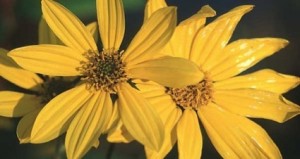
Large yellow blossoms, sand paper leaves

Of course, Jerusalem artichokes have nothing to do with Jerusalem or with artichokes, being in the sunflower family. They are quite easy to raise and one fascinating element about them is their carbohydrate is “inulin.” Diabetics can eat it without affecting their blood sugar.  When the plant was first discovered by Europeans they called it Girasole, the Italian word for turning to the sun, which some in the family do. Over time Girasole got mangled into Jerusalem. Recently they have been called sunchokes, a more fitting and sorter name.

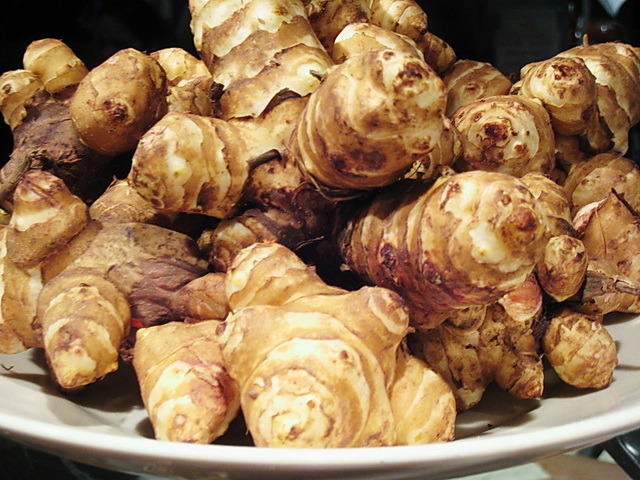
The artichoke part of the Jerusalem Artichoke’s name comes from the taste of its edible tuber. Samuel de Champlain, the French explorer, sent the first samples of the plant to France, noting that its taste was similar to an artichoke. The word artichoke comes form the Arab phrase Ardi-Shoki which means “ground thorny.” The roots are very lumpy. The scientific name is quite easy to sort out: Helianthus tuberosus. (hee-lee-AN-thus  tew-ber-OH-sus.) Helianthus means sunflower and tuberosus means having tubers.

Jerusalem artichokes are about 80% water, 15% protein, 1% fat, 60% inulin, 4% fiber and 5% ash, 0.099% phosphorus, 0.023%, 3.4 mg iron with traces of aluminum, chlorine, iodine, magnesium, potassium, sulphur, zinc, vitamins B and C.

Jerusalem artichoke root is also used to produce a spirit called “Topinambur” “Topi” or “Rossler.”  Topinambour is the French word for Jerusalem Artichokes and comes from a tribe of Brazilian Indians who were taken to France about the same time as the root.

Green Deane’s “Itemizing” plant profile

IDENTIFICATION: Large, gangly, multi-branched plant to 10 feet tall, rough, sandpapery leaves and stems. Many yellow flowers.  Leaves ovate, broadest below the middle, 5-10 inches long. Flower 3-4  cinches across with 10-20 bright yellow petals

TIME OF YEAR: Showy blossoms in late summer and early fall. Pick tubes two weeks after flowers fade.

ENVIRONMENT: Almost any soil but the softer, fertile and friable the better. Grow your own! By some from the grocery story and plant in spring, even in pots.

METHOD OF PREPARATION: Raw or cooked or pickled. Tedious to clean, and overcooks easily.  Excellent grated raw into salads, boiled lightly similar to potatoes, will make make French fries and creamy soup. Can be roasted but eat immediately after cooking as they grow mushy in a few minutes.

{ 57 comments }

Glorifying Morning Glories

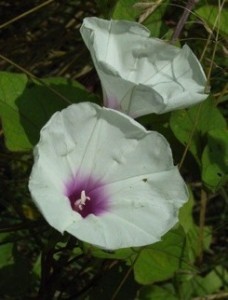
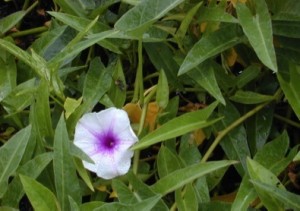
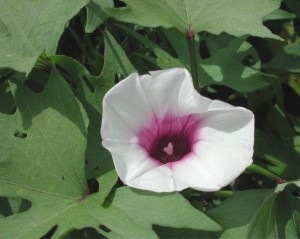
Three of the pictures below are are not of the same Ipomoea. It’s three different species, but that should tell you something. When you see a Morning Glory species with a large, white blossom and a ruby throat it is worth investigating. Large white Morning Glories flowers without ruby throats are worth investigating, too. Other color blossoms are more iffy.

A word of warning:  There are several edible and several inedible Morning Glories and impostors. They can all be easily sorted out so do your homework. When you find a possible edible take a picture and research it!

Ipomoea pandurata, Wild Potato Vine

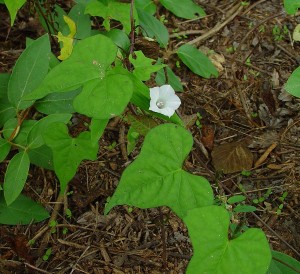
Ipomoea pandurata (eep-oh-MEE-uh  pand-yoor-RAY-tuh, shaped like a fiddle)  is native to Florida and the eastern half of North America. It has a large root that can be eaten if cubed and boiled in at least two changes of water. Never eat it raw. It is also called Wild Potato Vine and “Man of the Earth” because it can create huge roots. Younger and smaller is better. Young roots can also be roasted but they will be on the bitter side.  Boiling twice is the preferred method, then roast the boiled cubes if you like. Usually straight down deep from where the vine goes into the ground you will find the root. Yard-long roots weighing 25 pounds are possible. But, they get more acrid the older they get so if you can find an big old one you might want to let it be and look for a smaller younger one nearby.

I looked for I. pandurata for many years before I found one, being constantly misled by the iffy Alamo Vine. My friend and teacher, Dick Deuerling spoke of the I. pandurata often but all I ever saw was the very common Alamo Vine.  Then one day while on the Orange County Bike Trail near Chapin Station there it was (such moments are important and remembered.) Now I see them often. Leaves are heart-shaped.

The I. pandurata has two similar looking plants. They have white flowers as well. The key to sorting them out are the leaves and flower size. The aforementioned Alamo Vine (Merremia dissecta) has small white flowers with a ruby throat and very dissected leaves that are shaped like fingers on a hand, read palmate. While not edible per se the Merremia dissecta is not totally with out some good features. It has been used as a condiment and for medicinal needs. Leaf extracts have an almond flavor from amygdalin, a cyanide precursor also called natural laetrile. Needless to say it can be toxic stuff if handled poorly either as a flavoring or a medicine. I offer no instruction on that. Crush a leaf and smell it. If you smell almonds you have the M. dissecta. That said, the young roots of a relative, Merremia dissecta var. edentata, are cooked and eaten but it only grows in central South America. The M. dissecta edentata leaves are not toothy and the flower’s throat is not ruby. The name Merremia may be from the name Miriam, meaning Mary, or Virgin Mary plant, said me-REE-mee-uh. Dissecta is said dy-SEK-tuh and means dissected. Edentata, e-DEN-tay-tuh, is toothless.

Ipomoea aquatica, Water Spinach

Our next Morning Glory on the white and ruby line up is Ipomoea aquatica, (eep-oh-MEE-uh a-KWA-ti-ka, water loving.) It’s a native of China called “water spinach.” If you do find it, depending where you live, you’re expected to report it because it grows aggressively. Where fresh water doesn’t freeze, such as Florida, it is colonizing the waterways. In northern areas, winter keeps it in check.

There are two versions of I. aquatica, narrow leaf and wide leaf, both are edible. And actually they come in two colors. The “green” version has green stems and white flowers with red throats. The “red” version has purple-tinged stems with pink or lilac flowers with red throats. They both grow only in water, or very damp soil. The vines, with milky sap, can reach up to 70-feet long (the state of Florida says only nine feet.) Shoots and leaves are the edible parts. You will not find this in dry areas.

Recognized as a potential problem in Florida since the 1950s, I. aquatica has been introduced into the state several times since 1979 by various Asian communities.  It is raised as a vegetable in Florida under strict conditions and only for out-of-state sale. It is also cultivated in Texas, Hawaii and California. In the United States it is found in the wild in (mostly central west) Florida, Hawaii and Puerto Rico.

Should you find it do your best to stop its spread by devouring said. It’s the civic thing to do. It can be eaten raw when found in wholesome water. Otherwise, it should be cooked. The leaves are 48% carbohydrates, 24% proteins, 13% ash. They are rich in minerals and a good source of  vitamins A, C and E. It is a major food crop and vegetable in the Orient. The roots are sometimes eaten. Like other members of this family, they are toxic to horses.

Ipomoea batatas, the Sweet Potato

Our third similar Morning Glory is the common cultivated Sweet Potato, Ipomoea batatas (eep-oh-MEE-uh  bah-TAY-tas.) As we already know the root is edible but so are the leaves, cooked like a green. There’s a huge variety of them you can raise. More so, in the winter time if you have a sunny window, you can put a root in partial water and will will grow greens for you through the winter. The Sweet Potato is mistakenly called yams.. well… that’s not originally true. More than a century ago the marketing decision was made to call Sweet Potatoes “yams” because true yams, of the Discorea genus, were widely eaten. That moved into common language and now, wrongly, the Sweet Potates are sold as yams and true yams are sold as yams, but rarely canned in this country. To make things worse in other countries the root of the edible  Oxalis tuberosa, is also called a yam.

Another white and red combo is rare so no picture, Ipomoea macrorhiza (large root) a perennial vine from large tuber. The rare night-flowering morning glory is found in coastal areas of the southeastern US. It was presumably introduced from the Yucatan by aboriginal inhabitants before Columbus. Found on Indian shell middens, large roots were cooked, might be edible raw. Plant has attractive crinkled foliage and large white to pale pink flowers which bloom at night like moonflower, which is up next.

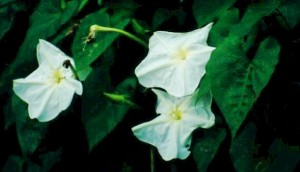
Ipomoea alba, Beach Moonflower

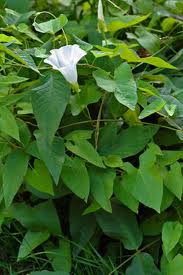
We keep the large white flower but abandon the ruby throat. We have two examples which are very similar. The first is Ipomoea alba (eep-oh-MEE-uh AL-buh, white) a night-blooming morning glory with a very fragrant, luxurious flower. Its sepals are mucronate ( that is having a fine point often rising abruptly at the tip.) Note it is a white flower without any color in the throat — okay a little yellow maybe — though it has a five-star like greenish wrinkling or folding on the top of the blossom, technically called midpetaline bands. The leaves are heart-shaped. Nicknamed, Moonflower, the young leaves and fleshy calyces are edible when cooked. They can be boiled or steamed. They can also be dried for later use.  Seeds edible when young. Incidentally, it takes the flower about a minute to open. It is also sometimes called Calonyction album. The raw leaves can be used like soap. Looking nearly identical is the Ipomoea tuba, (eep-oh-MEE-uh TOO-bah

I. tuba, aka Beach Moonflower, has has thicker leaves than the I. alba and likes a coastal environment, such as mangrove swamps. It is used the same was as I. alba. I. tuba is found from about St. Petersburg Fl. south on the west coast of Florida. To help identify it from the I. alba where their range overlap the sepals of the I. tuba are NOT pointed but are round and blunt.  Incidentally the white sap of the I. alba and I. tuba might cause dermatitis and was used in the early rubber-making process. “Tuba” in Dead Latin means trumpet. Ipomoea macrantha (ma-cra-ANN-tha, large flowered)  not pictured, also looks similar to I. alba and can be used the same way as I. alba.

Ipomoea lacunosa, Whitestar Potato

Do you remember the first Ipomoea in this article, the I. pandurata, the Wild Potato Vine? The Whitestar Potato is similar except small white flowers and heartshaped leaves.  The cooked root of the Ipomoea lacunosa, was eaten by American Indians in central and eastern North America and California. Also consumed were the young roots of the Ipomoea leptophylla , boiled or roasted. Roots over three-years-old were not eaten. I. plummerae (which has grass-like leaves) was another cooked root food of the Amerindians.

Calystegia sepium, Hedge Bindweed

The Hedge Bindweed (Calystegia sepium) has small white flowers often without a red throat. It has triangle shaped leaves and climbs counter clockwise. The bindweed stalks, young shoots and root are edible cooked, green parts steamed or boiled, roots boiled. However, it can be purgative so regular eating of said is not recommended. The name is from the Greek kalyx (calyx) and stegon (cover), referring to the bracts that conceal the calyx, pronounced kal-ee-STEE-jee-uh or kal-ee-STEG-ee-uh.  Sepium, SEE-pee-um, of the hedges. The blossoms can also have a pinkish tinge.

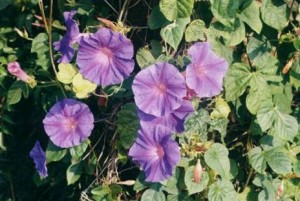
Ipomoea violacea, Morning Glory

The Ipomoea violacea (vye-o-LAY-see-uh, violet) is a bit of a chameleon, it can range in color from white to blue under cultivation (aka Ipomoea tricolor) but in the wild it tends to be violet. It’s used the same way as the I. alba, that is young leaves and fleshy calyces are edible when cooked. They can be boiled or steamed. They can also be dried for later use.  Seeds edible when young, cooked. Raw leaves can be used like soap. This is the Morning Glory of drug culture fame. The raw seeds have a little amount of a crude form of LSD.

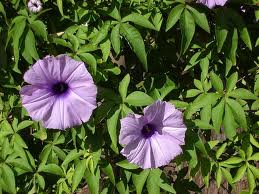
Ipomoea cairica, Mile a Minute Vine

 Ipomoea cairica, (KY-rik-uh, from Cairo) is naturalized from Africa. Called the Mile-A-Minute-Vine it has edible roots and stems though they are slightly bitter and both are slightly cyanogenetic.  Its flowers range from violet-purple to light pink to white with a pink  or red throat. The leaves while called ivy-like look more palm-like to me with deep lobes of five to seven. Roots were boiled, or, grated then roasted, no doubt to drive off the cyanide. The fruit of the I. cairica (holding the seeds) is used as a soap, just crushed against the skin and water applied. It creates a lather.  Animals known to eat the plant raw include giraffes, goats, rabbits, guinea-pigs, and pigs. It is apparently toxic to horses.

Ipomoea pes-caprae, Railroad Vine

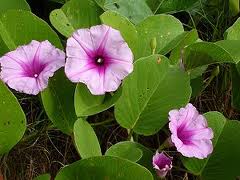
Ipomoea pes-caprae (goat foot) or Railroad Vine, Beach Morning Glory and Goat’s Foot Morning Glory, is often found on the sandy seashore. Its cooked roots, stems and leaves can be eaten in small amounts as a famine food. It is extremely common and usually the only Morning Glory found along the eastern shore of Florida, literally on the beach. One of its claims to fame is that it can reach 100 feet long or more.

Ipomoea quamoclit, Cypress VIne

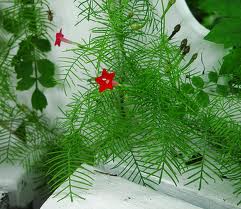
According to Kew Gardens also eaten are the cooked leaves of the Cypress Vine, Ipomoea quamoclit (KWAH-moe-klit, the Mexican name),  though they may make you sleepy and are cyanogenic. They definitely must be boiled. Leaves of the Ipomoea obscura (ob-SCUR-ah, dark) are eaten either in soups or as a cooked vegetable, and leaves of the Ipomoea involucrata are eaten cooked like a green. (in-vol-yoo-KRAY-ta, a reference to its bracts.)  Some subspecies are more forgiving on the gastrointestinal track. On the other side of the world the Ipomoea digitata (finger-like) has edible oblong tubers and leaves when cooked. It is not found in the Americas.

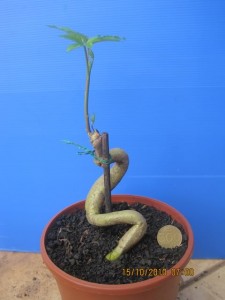
Ipomoea digitata, Vidhari Kand

There are several hundred species in the Morning Glory group and it is suspected that most of them have edible leaves and other parts. But don’t guess. Check out your local species with an expert.

Seeds of the I. tricolor, I. pandurata, I. nil, I. violacea and I. tuba have been used for their hallucinogenic properties. In the state of Louisiana the I. tuba became illegal in 2005 to cultivate for any purpose other than ornamental. A close relative of the Ipomoea is the Jicama, which has toxic seeds. All part of that plant above ground have high amounts of rotenone, a fish killer.

The genus name, Ipomoea, is mangled Greek via Dead Latin. Ipo is often said to come from Ips and means worm but that’s just linguistic illiteracy among botany professors. To say it means “worm” is stretching it. The basic word is Ipo which means below, beneath or under. Homoios is perverted via Dead Latin as well. The basic word in Greek is omoio not homoios. It means “similarity.”  Ipomoea means “resembling underground” as in the sprawl of a root, or perhaps the tunnels of a worm.  Batata is going to take some explaining:

When Columbus landed on Haiti the natives there, the Tainos (Arawaks) called the root “batatas” which literally means potato. The Spanish changed that to Patatas. When the Spanish later saw the white potato they called that Patatas as well. That changed in English to potato. So, the white potato was named after the Batatas and became potato but now in English we call Batatas the Sweet Potato. And worse, of course, is calling the Sweet Potato a yam, which it is not. Yams are from a totally different family, the Dioscorea.

{ 28 comments }