Rhynchophorus cruentatus: Raw or Fried?

Here’s what you’re looking for: A palm or plametto that is dying. The growing tip is dead, bent or otherwise distorted. Maybe it was hit by lightning making it vulnerable. But you want to find a palm that is on its way out. It is in that dying top you will probably find the only species of Palmetto Weevil in the United States, Rhynchophorus cruentatus, of the greater Curculio clan just like the acorn and pecan grubs. Look at the base of the growing fronds, or wounds and cuts, late spring into the summer. The young heart leaf will pull out easily and show signs of tunneling.  Don’t forget to check deceased palms as well.

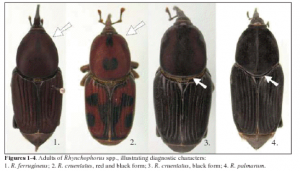
The local palm weevil, R. cruentatus, are the two in the middle, the mostly red version and the mostly black version. The extreme left is R. ferrugineus and the extreme right R. palmarum

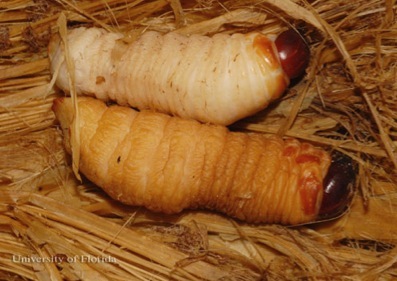
Also called Grugru (GREW-grew) in South America because it makes a clicking noise while feeding, the grub eats the pith of palms and sugar cane. It’s the largest weevil in North America — up to nearly two inches — and its grub is considered a prized food. In fact while most insects on a piece of property are not considered private property, Palmetto Weevil grub in some parts of the world are considered private property, just as we consider our trees private property.

While the primary food source for the weevil is transplanted, stressed or damaged Cabbage Palms — Sabal Palmettos — it will infest Saw Palmettos (Serrenoa repens) Canary Island Date Palms, Washington Palms, Royal Palms, Coconut Palms, Bismarck Palms, even some healthy ornamental palms. It ranges from the coastal plains of South Carolina through the Florida Keys, and west into coastal Texas. Reports of said in palmy areas of the US southwest and California are now in question.

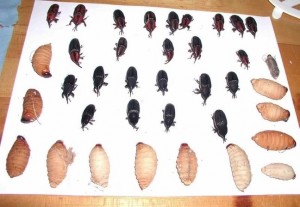
Grubs and beetles from an infected palm in Merrit Island, Fl

Its pest status in Florida is in flux — getting worse — and some palm imports have been banned because they are known to carry the weevil. If you are inclined to raise them yourself, for food purposes of course, telling no one because the state might get upset, the larvae thrive best on a combination of canned pineapple, oats, sucrose, molasses, brewers yeast, Wesson’s salt, and vitamins. Larvae can be put into sugarcane for pupation to continue your brood. Also eaten are R. palmarum, R. phoenicis, and R. ferrugineus. (the latter variation “schack” is the famous Sago Palm grub of New Guinea and environs.) They are consumed raw or fried. If you are going to fry it, the usual procedure — inhumane as it sounds — is to slice or crack the grub partway open midway around part of the middle. This is to keep it from exploding while cooking.  You can also just roast them next to an open fire. They can weigh up to six grams each. Nutritionally the grubs are three to seven per cent protein and ten to thirty per cent fat. At least one scientific study also says the adult Palmetto Weevil was eaten by Amazonian Indians, but no particulars were given (Edible Invertebrates among Amazonian Indians: A Critical Review of Disappearing Knowledge. Paoletto and Dufour)

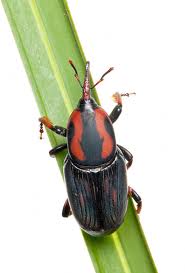
Palm weevil, red version

Fossil records suggest that the Palmetto Weevil was present in Florida during the Pleistocene about 1 million years ago. At any rate it is considered a native and there are two versions, a mostly red and a mostly black. The Palmetto Weevil ranges from one to nearly two inches long. It is found not only in the coastal southern United States but also Argentina, Belize, Bolivia, Brazil, Colombia, Costa Rica, Cuba, Dominica, Ecuador, El Salvador, French Guiana, Grenada, Guadeloupe, Guatemala, Guyana, Honduras, Martinique, Mexico, Nicaragua, Panama, Paraguay, Peru, Puerto Rico, St. Vincent, Trinidad, Tobago, Uruguay, and Venezuela.

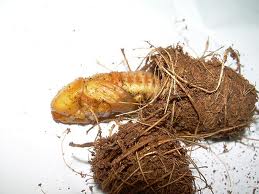
Palm weevil pupa in broken cocoon

Worldwide there are ten species of Rhynchophorus that feed on palms.  The R. ferrugineus and R. palmarum are essentially found in most warm areas around the world where there are palms, particularly the Mediterranean. You might call them… Med-weevil… Rhynchophorus (rhin-KOH-for-us) is Greek meaning “snout bearing” and cruentatus (krew-en-TAT-us) is Latin for blood-colored.

{ 12 comments }

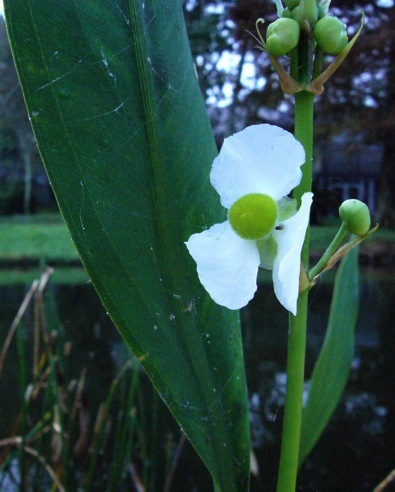
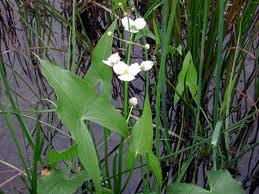
Blossom and leaf shape help to identify the Duck Potato with potatos

Sagittaria Lancifolia: Duck Potatoes, Wapato

Artificial grass is not grass. Non-dairy creamer contains a dairy product. And ducks don’t eat duck potatoes. Humans do.

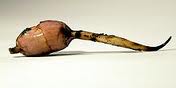
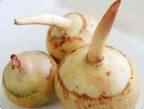
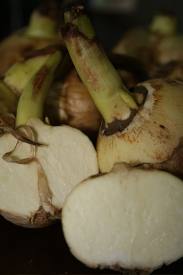
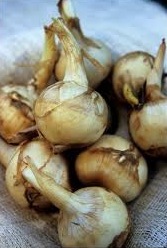
Duck potatoes are acually corms

Oh, ducks may eat one by mistake from time to time, just like they might eat a piece of grass artificial. And if you’d like know, non-dairy creamer has sodium caseinate, a product made from milk. Don’t believe me? Read the label. But ducks still don’t eat duck potatoes for the most part. However, people do and have presumably done so for thousands of years

Cut off the sprout before cooking

Duck potatoes are chestnut-size tubers — corms really — found around the shallow-water plant like numbers on a clock. Their family name, Sagittaria, (saj-ee-TAR-ee-uh ) means “arrow” and describes the leaves of a lot of members in this family. Look up your local version because they vary. They are found in non-desert North America.

Peel after cooking

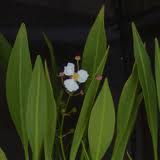
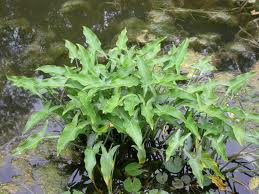
Locally three are found: Sagittaria latifolia  (lat-ih-FOH-lee-uh) — wide leaf, shaped similar to a delta; Sagitaria lancifolia (lan-sih-FOH-lee-uh) — lance leaf, think spear point, the one pictured on top; and Sagittaria  graminea (gram-IN-ee-uh) — grass-shaped leaves, more along the lines of cattails. Generally the bigger the leaf in structure, usually the larger the potatoes. The S. latifolia tends to have the best “duckies.” The S. lancifolia and S. graminea really don’t have potatoes per se but the ends of the stalk are edible like lower cattail stalks and has starch.  There is also a grassy one that grows underwater that we aren’t too interested in: Sagittaria kurziana.

Once cooked, use like potatoes

Sagittarias are aquatic but they don’t go for deep water. They’re waders not swimmers and so are we. Shuffle around a plant with your feet to loosen the tubers which then float to the top, a technique that still works, as does a small rake. Just keep raking in the same spot because the tubers are at varying depths in the mud. Pulling the plant up usually doesn’t work. Native Americans would also raid muskrat middens where the water rat had packed them. One often reads about native raiding muskrat rents but not beaver dens. That’s because the muskrat, like the otter, builds its den in the bank and the beaver creates his own little island paradise.

Sagittaria latifolia, the one with the potatoes

Duck potatoes, also called Arrowhead, Watato or Wapati, or Katniss, can be eaten raw, should you be in a survival situation. But, they’re bitter and don’t taste good. A little cooking, like a little wine at closing time, can make all the difference in the world. Boiled or roasted for about a half hour, they become worth getting wet for again (just remember to cut off the sprout before cooking and peel after cooking.) Once cooked, they can be used like potatoes. They can also be dried and ground into powder for soups and bread.

Sagittaria lancifolia, usually without potatoes

Besides being part of the staple of Indian life, duck potatoes were also the entre and dessert for Lewis and Clark on their famous expedition. According to their diaries, Duck Potatoes and elk were their main fare while they were on the Columbia River, now in present day Oregon.  Sometimes Lewis and Clark, who lived off the land, would be without food and were forced to eat their work animals. Other times they literally had to club game animals out of the way. I’ve seen that in some parts of the world with rabbits, particularly northern Scotland and railroad tracks. Incidentally, if all you had to eat were rabbits you would die from lack of saturated fats. 

And by now I know you are just anxious to know why don’t ducks eat duck potatoes? They do eat the seeds but not the potatoes. Why? Size mostly. By the time the potatoes are available they are too big for most ducks to be interested in. They should have been more correctly named Swan or Goose Potatoes. Geese can swallow golf balls, but then of course, they would lay eggs with dimples…. Actually, in some places duck potatoes are known as Swan Potatoes. Incidentally Sagittaria are not environmentally totally “green.” They release methane into the atmosphere, their own little global warming contribution, another reason to reduce their population propagation by proper gastronomic preparation.

If by chance you want to try duck potatoes and you don’t want to get wet or risk misidentifying the plant you might try your nearest Asia market. They sometimes carry them in the New Year. Elsewhere internationally, Sagittaria were introduced to Australia a while ago — first noticed in 1959 — and are now considered a noxious weed. Where are the aborigine foragers when you need them? Again, if one has enough of them to make them a noxious weed then one also has enough for several banquets. Eat The Weeds.

Other edible parts of the Sagittaria include young unfurling leaves and stalk. Boil them like any green. The flower stalks before the blossom are also a tender tidbit, again, boil them. Lastly, the lateral tips of the growing rhizomes are also edible, raw or cooked. The petals of the white blossoms are edible raw. They are delicat. Light. A little minty. Sweet.

Arrow Arum

WARNING: The Sagittaria latifolia has some resemblance to the Arum, which is toxic. However, the Arum leaf is veinless nor does it blossom the same way. More so, if you bite into an unprepared Arum root you will know you have erred significantly. It burns.


Jerky and Duck Potatoes

A recipe with flavors from the past:

1 pound  beef jerky or dried buffalo

1 cup hominy grits soaked overnight in a lot of water

1 large onion chopped

1 pound cooked duck potatoes

salt and pepper to taste

Break the jerky up into one-inch pieces and put in a heavy, lidded pot.  Drain the hominy, add to the jerky, along with the onion. Cover with water, bring to a boil. Simmer, covered, until the hominy is tender, about 2 hours, add water if necessary. Last 20 minutes add cooked duck potatoes, adjust liquid to how you like your stew. Salt and pepper to taste.

Green Deane’s “Itemized” Plant Profile

IDENTIFICATION: Height to three feet above water, can grow to six feet under favorable conditions. Arrow or lance-shaped leaves, two to four inches wide, long separate stalk with large three petal blossom, one to two inches wide.

TIME OF YEAR: Blooms throughout the year in warm areas, sets potatoes year round, best in fall, grow like a fan out and around the base of the plant. Pulling up the plant will not looses the potatoes, work the muck to get them.

ENVIRONMENT: Shallow water of swamps, ditches, lakes and streams. Make sure the water is not polluted.

METHOD OF PREPARATION:  “Potatoes” edible raw but bitter, boil or roast for 30 minutes, then eat or use like potatoes.  Young leaf and stalk boiled, flower stalk boiled, rhizome tips raw or cooked. Blossom’s white petals edible raw.

{ 17 comments }

Yes, this is about eating grubs. Deal with it.

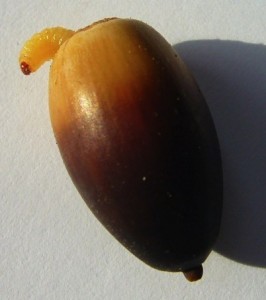
Flexible, the grub squeezes out of a small hole.

Without the expertise of Charles E. Williams and the Michigan Entomological Society, Department of entomology, Michingan State University, this article would not be possible.

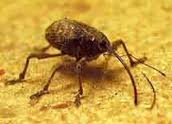
Over 100 species of insect feed on North American nut trees, including acorns. The most common acorn insects are weevils, genera Curculio and Conotrachelus, or long snout and short snout. The long snout weevil has a snout as long as its body or longer. The short snout weevil has a snout that is one-half the length of its body, or shorter.  Both feed off corns and lay eggs that later become edible grubs.

Grubs are legless, buttery tasting, and chewy

The long snout weevil drills a hole in the acorn then lays her eggs. The short snout weevil finds a cracked acorn and lays her eggs through the crack. Both are quite successful. The legless grub-like larvae hatch from the eggs in a few days to a couple of weeks and there can be several larvae in each acorn. They go through a five stage growth development and eventually grow large enough to chew their way out of the acorn.  They squirm out, drop to the ground, dig in, make a cocoon, and pupate for one to five years before emerging as adult insects.

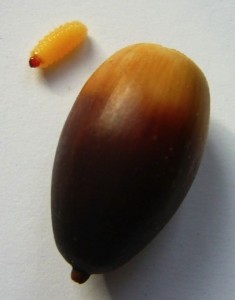
The cavity in the acorn is then used by the Acorn Moth to lay her eggs. Those turn into a caterpillar, long, skinny, with six short legs on front, and usually pupate in the acorn. What you are looking for is what you see above left and right, a short, legless grub that is tan colored and fat in the middle. No Legs. Raw acorn grubs taste mild and surprisingly a bit chewy like a piece of fat. Cooked they are soft and buttery. But, you have to cook them over low heat if you fry them. They explode within a second if you put them in very hot fat.

Mama beetle looks for a hole to lay eggs or drills one

Grubs are also nutritious containing protein, fat, minerals and vitamins. In fact, in Australia 10 finger-large witchetty grubs meets all the daily calorie and nutrition requirements of an adult.

You can use grubs directly for fishing or put them in a bucket of sawdust or the like where they will make cocoons and live for one to five years, fresh bait when you need it. You can also store them in the frig. Whether you tell anyone looking for a snack in yoru frig that they are there is your call.

As for finding grubs in acorns the peak season is in September follow heavy rains in August. That can vary depending on where you are and also if other nuts are involved. If you want to read more about weevils here’s an informative article by the insect experts at the University of Kentuck.

{ 22 comments }

Collecting Acid Bactar: Making Vinegar

You might not want to read this, but here is the nitty gritty on vinegar: All  vinegar — even the stuff you buy — got its start from the dirty feet of manure-loving flies, and it gets worse. Vinegar is the sewage of bacteria eating alcohol. And alcohol is the sewage of yeast eating sugar. Of course, we can clean up the nouns and verbs, skip the manure part, and say vinegar is made from alcohol and alcohol from sugar. Sounds nicer, doesn’t it.

Many years ago I was making a lot of wine and beer. Florida allows an individual to make a generous amount of beer and wine for personal use without running into legal issues.  With so much wine I thought about making real vinegar. When most people say they make vinegar what they mean is they  put spices et cetera into commercially produced vinegar. I wanted to make my own vinegar, from scratch so to speak. As it comes out, that is easy or a bit of a challenge, depending on how you want to do.

Here’s the easy way to make malt vinegar: Buy a six pack of beer with no preservatives, go to a wine supply store and buy a few ounces of mother, dump the mother into the warm, flat beer, put in a warm dark place, and soon you will have more vinegar and mother than you will ever need. Mother reproduces forever as long as you feed it so you need to only buy a vinegar mother once. I did that for a couple of years. Got to know how the mother behaved, looked and reproduced. And since it came from a lab where the acid bactar was bred for vinegar production, the product was consistent all the time.

The only problem was everyone else with the same mother was getting the same vinegar. I wanted a mother all my own, a strain of acid bactar that no one else on earth had (in theory.)  That meant I had to 1) collect it 2) make it into vinegar and 3) keep doing that until I found an acid bactar flavor I liked.  You should know that both yeast and acid bactar can “throw” bad flavors, so not all wild yeasts or wild acid bactars will produce good wine or vinegar. When you collect from the wild, it is the luck of the draw. You might get a great mother the first try or it may take persistence.

In hindsight part two and part three, making and testing, were easy. It was part one that was the most difficult initially, collecting the acid bactar. I followed all the advice I could read back then — no internet in the Dark Ages, BC before computers — and failed completely. No wine or beer I ever set out ever collected one bit of vinegar bacteria. Ever. I tried for nearly a year and got absolutely nowhere. It was a complete failure. I put the project in the someday pile.

At the same time I moved to a place that had some property and was organic gardening intensely. I started to have a significant problem with moths and the like that come in the warm Florida nights and lay caterpillar eggs. I read of a natural trap one could make so I made one. I few weeks after I hung up the moth trap I looked inside and noticed it had worked very well; a lot of dead moths and other insects. I also noticed something else: Some vinegar mother.  What I had failed to find intentionally was accidentally delivered unto me. I was just fortunate to recognize it when I saw it.

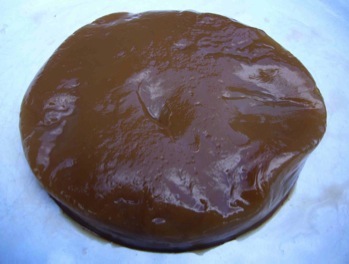
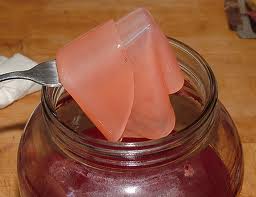
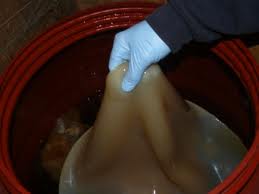
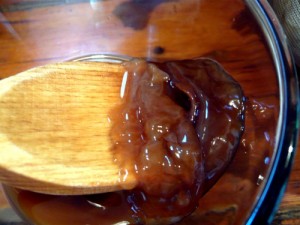
Sometimes it can look disgusting

I not only cleaned and kept that mother, I started another trap, then another. Of the three strains I got, one was weak, that is it made a very mild vinegar. One tasted awful, and one was good. I’ve had that third mother more than 30 years. Maybe it’s time to find some more since I have moved a second time and might have even more interesting acid bactar is this area.

I refined my mother traps and ingredients as I went along and never failed to get a mother. This is the only place that I know of —until Internet copied, of course — on the internet where you can learn how to make a mother trap:

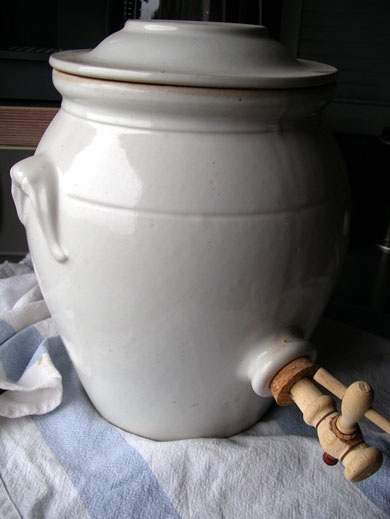
The classic vinegar pot for home production


Once the weather is warm — read the insects are active — get a one or two liter/quart plastic soda bottle. Two liter/quart is easier to work with later on. Into it pour a cup or two of sugar, and two cups of water. Also drop in one banana peel, all of it, when you’re done eating the banana of course. Add a splash of vinegar for aroma, a teaspoon will do but the vinegar is not necessary. Leave the top off the bottle. You can stretched a small piece of cheese cloth with an elastic over the opening if you like but it is not necessary. That reduces the number of bug bodies but you want big enough holes for the vinegar fly to get through.  Hang the bottle in the shade.  (If you put it on the ground the ants and animals find it too soon.) An out-of-the-sun house eve is good or a tree. Between two and six weeks after you hang it up you should see some phlem-like cloudiness in the liquid. That is the acid bactar forming a mother. Sometimes it can happen in as little as two weeks. Also, if you live where it rains a lot, you also should hang it somewhere in the shade where it won’t fill up with rain water. (What happens is the wild yeast on the banana peel turns some of the sugar into alcohol which is food for the bacteria that drop off fly feet. If you don’t have a banana peeling some raisins or organic apple peelings will work or wild grapes.)

Because the bright daytime environment is not the best for the acid bactar, the mother probably won’t be a hard mother (hard like some of the stuff you cough up when you have a chest cold.) Now you have two choices. What I used to do was cut open the bottle, fish out some loose mother, remove as many bug parts as I could, and put that mother in a new alcoholic non nitrate-medium in a warm dark place. Dark is important.  However, all you really have to do is strain the liquid though a paper filter or the like and use the juice to start the mother. It has the bacteria in the liquid. Either way in the new medium the bacteria will form a hard mother in a few weeks that will float on the top of the liquid while turning the liquid below into vinegar.

The difficult part is finding untreated wine to make into vinegar. It’s less of a problem with beer. Neither can have any preservatives or be treated to get rid of bacteria. It is not so much a problem with beer in that many beers have no preservatives. Wine is a different issue. You either have to make your own without any sulfides et cetera or buy it that way, often in health food stores called chalice wine. Of course, you could make homemade apple cider — another article here — or make some beer. Either works well.

I intentionally made six-pack batches (about one gallon) of malt vinegar with my new-found mothers. It was cheap and easy to use one particular beer (Miller’s) so that way I could compare the flavors the acid bactar were throwing without having to contend with different flavors of beer. It takes about three months to get a real good zip to the vinegar. Then you bottle it and drop in some sulfide to kill the bacteria, or heat it to 140F but no hotter than 160F. Or not do that. You can use vinegar with live bacteria in it. But it will eventually get cloudy in the refrigerator or elsewhere.

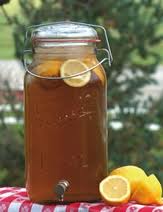
I found the easiest containers to make one -gallon batches of vinegar in are the ice tea containers with a spigot on the bottom.  Then you drain off your vinegar and bottle it.

Collecting and making vinegar is far more iffy than wine making but there is great satisfaction in making your very own vinegar. If you have any questions, email me and I’ll answer them if I can. GreenDeane@gmail.com


{ 111 comments }

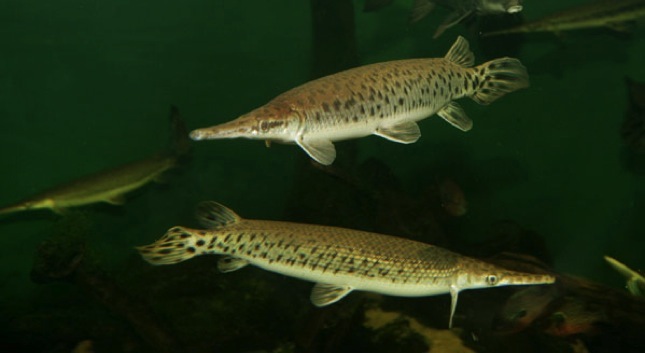
Gar fish eggs are toxic to mammals, but the rest is edible

 Eating Gar, a Taste of the Primitive

There are two things you need to know about the Gar. The first is that it is very edible, really. The second is that its eggs are toxic to mammals and birds.  I could end the article right there but there’s a lot more to say about the Gar.

This is a primitive, well-armored beast, well-designed to eat anything that does not eat it. There are four species of Gar in the genus Lepisosteur. There’s the short nose gar, the long nose gar, the spotted gar, and Florida gar. Three other edible Gars are now in a different genus Atractosteus, the alligator gar, the cuban gar, and the tropical gar. They all put up a great fight when caught and can grow to several hundred pounds. They can be taken by bow, net and hook, though local laws vary. Let’s say you have caught a two foot gar. Now what?

There are two fish that are very easy to cook. One is the Pompano. It has no scales, has only large bones, a very small pocket to clean, and it’s frying-pan flat. Pompano was designed to be eaten. The next most easy fish to cook is the gar. How, you may ask, is that armor-plated beast easy to cook? Simple. You do virtually nothing to it except cook it whole. Yep, you don’t even clean it. Prop it upright next to a fire, or in your oven, and cook away. When it’s done let it cool just a little then pull the scales off, and eat the backstrap meat under the scales. Do not eat any eggs or the meat around any eggs. Read eat high off the hog, ah, fish. It’s the mesolithic way.

If that does not appeal to you, then what? Well, you can cut the head and tail off, gut the fish, and then put it whole on the grill or by a fire. Again, to get at the backstrap meat, pull a cooked scale off and dig in. If you have an ax you can also just cut the whole fish in to vertical steaks then clean the skin and entrails off and away from each semi-circle steak.

If you are inclined to clean the gar and get filets you tackle it from the top down, not the bottom up. You do, however, need the right tools. Usually tin snips, a filet knife and a hatchet. You are going to cut the back of the gar so it opens up like the cargo bay doors of the space shuttle.

First wrap a rag around the fish’s bill. It makes a handy grip. Next don’t forget the scales are sharp enough to cut you. You start by making a hole behind the head. Then put the tin snips in the hole and cut down both sides of the head. You don’t have to cut all the way around the fish, just two vertical cuts down to the cutting board. Then you cut with the tin snips straight back to the tail, and again, two vertical cuts.

Now using your fingers or a knife, or pliers, peel the hide away from the meat. Once you have the skin peeled back take your knife and slice along the back bone and ribs, away from the backbone, creating two long filets.  Gray meat near the loin is stronger flavored and you might want to feed that to the cat. Some Cajuns like to make a horizontal cut at the tail then work the machete towards the head cutting off a strap of skin and scales, then fillet the backstrap off that side of the fish. If you want to cook the entire  fish, you can continue to cut around the ribs and remove the entrails quite easily whole. Again, don’t eat the eggs.

Gar flesh is not flaky like most fish, nor is it fishy flavored either. It has the texture of chicken but does not taste like chicken. In fact, is closer in taste to alligator than chicken.  Older gar flesh can be soaked overnight in salted water to moderate any strong flavor. You can fry the fillet, or boil them as mentioned below, or put the meat through a grinder twice and make patties out of them, spiced as you prefer. Eat hot.

A lot of people will tell you the gar is a trash fish but that is a product of grocery stores. Before stores had ice and fish markets gar was an esteem local fish for dinner. Only with refrigeration and the modern fish market with species caught thousands of miles away did the gar lose its prime place. It also lost favor as sport fishing came into being because it was too easy to catch. Now think about that, a delicious fish that is too easy to catch. Personally I have caught more gar than I ever counted. When I first moved to Florida I fished nearly every day. It was not at all unsual for me to catch at least one meal every day, and that often included Gar.

About that armor plating, called ganoid scales, which are enamel-covered bone and not overlapping. Native Americans used the scales as arrow heads.  They also used the scaled skin to make protective breast plates. Even European colonists used the skin of the gar. They put it on the cutting edge of their crude plows to protect the blade.
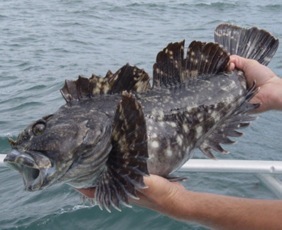
Eggs of the saltwater Cabezon are also toxic to humans

The toxicity of the eggs has been viewed as real and as a wives tale, the latter because there isn’t much research on the issue even now. Ken Ostrand, lead author of Gar ichthyootoxin: its effects on natural predators and the toxin’s evolutionary function. Southwestern Nat., 41:375-377., 1996 has said the toxin has yet to be identified. They believe it is a protein of some kind and might be an algicide or fungicide. Apparently the eggs are not toxic to other fish which would be unusual as other fish are the most likely predators of Gar. The question is why would the toxic eggs offer no protection to the most likely predator of Gar since fishes would be the most likely predators on gar eggs (not chickens, as some studies have used, and certainly not humans). In other words, why would egg toxicity evolve if it offered no protection against the most likely predators? It may just be chance that the eggs cause sickness in birds and mammals. Or, as Ostrand suggested, converting the eggs to pellet form to feed to chickens, or even force-feeding raw eggs to mice, might involve changes in the biochemistry of the eggs which could cause an unnatural response.

Below are two toxicity reports from 2010, and they are remarkably similar in that the children got ill first and basically threw up. The adults took much longer to get ill but then lost fluids from both ends. Everyone recovered.

Cleburne County family survives bitter experience with gar eggs

HEBER SPRINGS – Not all fish eggs create caviar; some can be downright dangerous. A Cleburne County family discovered this after becoming violently ill upon eating the eggs of a long-nosed gar on April 5.

The eggs of some fish species are processed into expensive caviar, and fried fish eggs are a spicy appetizer in Indian cuisine. Even bluegill eggs can be deep-fried and served. But the eggs of all gar species are extremely toxic and should be avoided.

“My husband Darwin (Aaron) and brother-in-law Russell (Aaron) had gone spearfishing in Greers Ferry Lake and had gotten one gar,” said Tiffany Aaron. “My husband had heard that gar were good to eat, and we’ve always been a family that’s up for trying anything once.”

Mrs. Aaron said Darwin, Russell and her 10-year-old son, Carson, ate the gar and its eggs at about 8 p.m. that evening. Carson was the first to get sick, and began vomiting by 1:30 a.m. Russell became ill by 3 a.m., and Darwin followed suit at 5 a.m.

“The men were the only ones who had eaten the eggs, so I got online to find out more,” said Mrs. Aaron. “That’s when we found out they were poisonous.”

Carson was taken to Baptist Health Medical Center in Heber Springs where he was put under observation.

“My biggest question was what should we expect or watch for,” said Mrs. Aaron. “But the ER doctors didn’t have any experience with this sort of poisoning, and the Poison Control Center didn’t have any information. The one thing the doctors could tell me is that it was fortunate that my son began vomiting as quickly as he did to get the toxins out of his system.”

Lee Holt, an Arkansas Game and Fish Commission Fisheries Management Biologist conducting research on alligator gar, was contacted for more information about the type of toxin contained in gar eggs.

“I made a lot of calls to gar experts I knew from my research,” said Holt. “Our main concern was the type of toxin. There was one mention of it possibly being cyanide-based. The doctor at the emergency room explained that treatment for cyanide poisoning can be just as harsh as the toxin, so we needed to make sure before (Carson) was given any treatments.”

Holt said he found out that it was a protein-based toxin, so the harsh treatments could be avoided.

All three men recovered from the episode, but the effects of the poisoning lingered for three days.

“As it turns out, there’s so little information on the subject that researchers at Nicholls State University in Louisiana are conducting follow-up interviews about the family’s ordeal.”

A second report is undated but happened before the above news story.

“I came across this page [the above article] when I was searching for the toxin in gar eggs responsible for the severe illness my son and I encountered after consuming them. I caught and cleaned a 2′ long gar in Laplace, LA. My Filipino mother-in-law who is visiting cooked the eggs. My son had 2-4 spoonfuls mixed with rice, I had 1/2 a plate or so at about 9pm.

At about 3 a.m., I awoke to my son vomiting in the bed. We cleaned him up, and 5 min later again and again for about an hour or so followed by dry heaving. After all was “out” of him, he went to sleep.

I awoke at 7 a.m. with a slight stomach ache, ran to the bathroom, where I did not leave until 10:30 a.m., violently vomiting, severe diarrhea, sweating profusely, cold, followed by so much dry heaving I thought something would implode. At about 10;30 or so, exhausted and semi delusional, I staggered to my bed covered in sweat, laying there freezing and… the only way I can explain it… hallucinating. In my sleep until 3 p.m. that evening, I had just crazy dreams.

I awoke at 3 p.m. feeling a lot better, but still kind of “off”. Here I am the day afterward, and I still don’t feel 100%…I just feel weird, is the only way I can put it. My little boy is OK though complaining a little that his stomach felt “different”. It was one of the worst sicknesses I’ve had. I read on this post that it might be a “old wives tale”, but this needs to be put to rest. The eggs of garfish are extremely toxic and should never be consumed by anyone! I can speak from experience.”

Gar Lobster

Put some crab boil spices in water according to direction. Put in chunks or nuggets of gar (or put in cheese cloth and put in the water.)  Let it boil for five minutes (or more depending on the amount of fish. You want it done.) Turn off the heat and let it sit for as long as you boiled it. Drain the meat. Dip each nugget in butter. It tastes like lobster. Another quick way is to dip the nuggets in mustard then fry. Yum.

Gar age: How to guess the age of the gar you caught by maximum length: Long nose – 22 years, 72 inches; spotted – 18 years, 44 inches; short nose – 13 years, 32 inches.) Incidentally gar may be protected in your area to check with local laws first.

{ 29 comments }