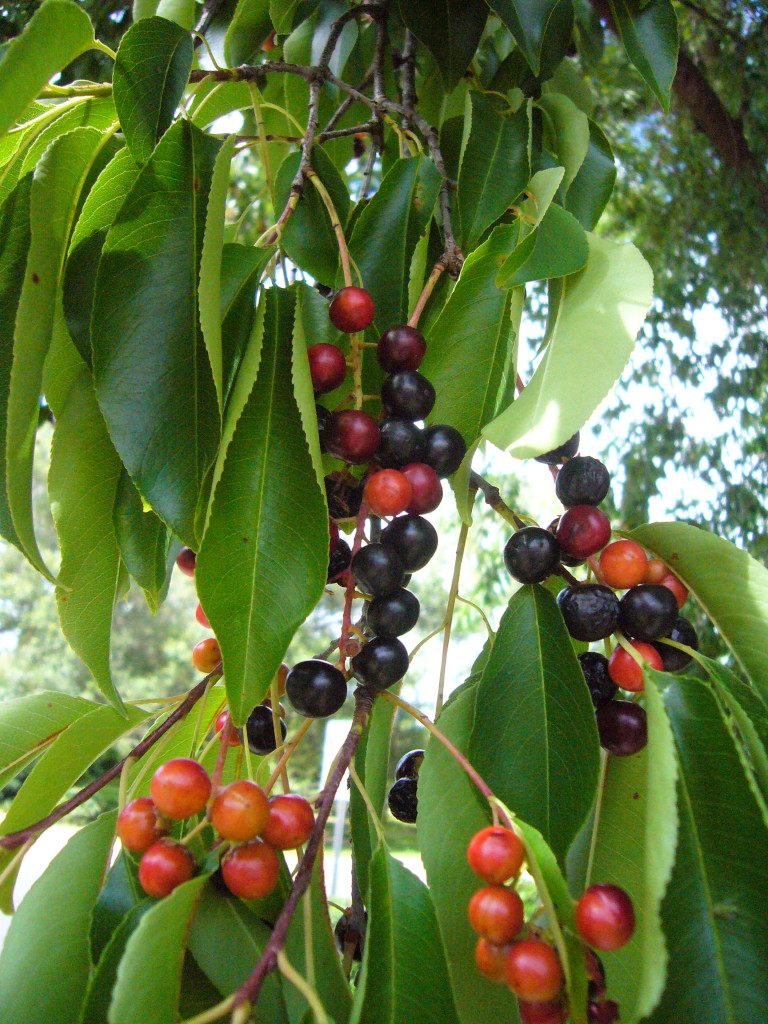
Black cherries are a combination of sweet and bitter. Photo by Green Deane

Black cherries are a combination of sweet and bitter. Photo by Green Deane

Prunus serotina: Better Late than Never Cherry

Think of the Black Cherry as a chokecherry with some of the choke removed… some…

Not a 100 feet from the house I grew up in there was a stand of chokecherries (Prunus virginiana, PROO-nus  vir-jin-nee-AY-nuh.) It was always a challenge to put in perspective their abundant beautiful cherries with their sharp astringent taste. Of course fermentation helped that a lot and chokecherry wine was a favorite of mine. Fortunately the Black Cherry does not throttle you as much as the chokecherry, but it grabs a little. In between those two is the pin cherry.

Here in central Florida the most common edible cherry we see is the Black Cherry, Prunus serotina (sair-OTT-ih-nuh) though it grows throughout the eastern half of North America, lower parts of New Mexico and Arizona then south into Mexico and beyond. It has been naturalized in Europe. It’s easy to identify. Look at the back of several leaves. On other than a new leaf the mid-rib underneath will have hair on either side near the stem, blond when young turning rust colored to black when old then dropping off. See photo below.
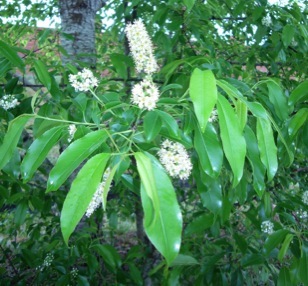
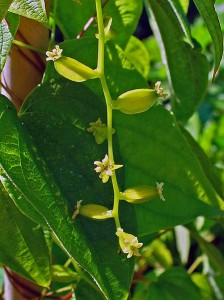
Blossoms are racemes, or spikes of fruit ripening from one end

Florida is the end of its Black Cherry’s range. Often its leaves are more lance shaped here than usual and can resemble the pin cherry (Prunus Pennsylvania) which does not grow this far south. So if you’re in Florida and you see a bird picking a little cherry it’s an odds on favorite to be the Black Cherry. Unlike the chokecherry, the Black Cherry is a favorite native tree. It has been used for food, woodworking and landscaping. Its inner bark has been concocted for centuries to make a cough syrup. While the Black Cherry makes a fast-growing attractive landscape tree, it is sometimes skipped over because it drops cherries and formal gardeners often don’t like that, though the birds and animals do.
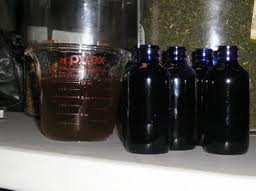
Homemade cherry cough syrup

Black Cherry fruits are important food many birds and mammals.  Numerous songbirds feed on Black Cherries as they migrate particularly farther north in the fall. Among the birds who favor the Black Cherry are the American robin, brown thrasher, mockingbird, eastern bluebird, European starling, gray catbird, blue jay, willow flycatcher, northern cardinal, common crow, waxwings, thrushes, woodpeckers, grackles, grosbeaks, sparrows, and vireos.  Black cherries are also important in the diets of the ruffed grouse, sharp-tailed grouse, wild turkey, northern bobwhite, and greater and lesser prairie chicken.  Animals that like the fruit include the red fox, raccoon, opossum, squirrels, rabbits and bears. White tail deer eat the leaves and twigs. Clearly a tree to watch if you want to see wild life.
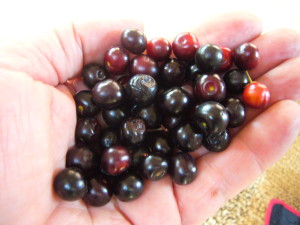
Usually the berries are made into wine a jelly. Photo by Green Deane

Usually the berries are made into wine a jelly. Photo by Green Deane

While the fruit is popular the leaves, twigs, bark, and seeds are poisonous to cattle, horses and man. They contain a cyanogenic glycoside that breaks down during digestion creating hydrocyanic acid… better known as cyanide  Most of the livestock poisoning comes from eating wilted leaves, which are more toxic than fresh leaves.  It is estimated that more livestock are killed from eating Black Cherry leaves than from any other plant. This is a case in which browsing animals do not sense it it is bad for them. Oddly, deer don’t have a problem with Black Cherry leaves, twigs or shoots.

The fruit of the Black Cherry has some 17 antioxidants, including anthocyanins, queritrin and isqueritrin. It is also a rich source of melatonin. The fruit contains Vitamin A, B complex vitamins, Vitamin C, calcium, magnesium, iron, phosphorus, potassium, sodium and traces of copper, selenium, zinc, and cadmium.
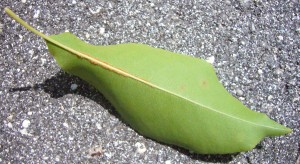
Leaves of the black cherry have hair along the main stem, white to dark brown. Photo by Green Deane

Leaves of the black cherry have hair along the main stem, white to dark brown. Photo by Green Deane

There is some debate whether the cherry stones are edible by man after preparation. In some Native cultures the Prunus genus seed kernels were pounded. The mash was made into cakes and allowed to dry for a couple of days. Then they were cooked. With some species this gets rid of the glycoside and makes the seed edible. If you experiment, you are absolutely on your own. I recommend you DON’T try it and don’t sue me if you do. Nothing you eat of any cherry should ever have the aroma or taste of almonds (or to some noses, maraschino cherries.)  Any time you have an almond aroma or taste in association with cherries that is cyanide. It can kill you. Avoid it.

In the spring of 2001 hundreds of foals in Kentucky where mysteriously miscarried or stillborn. The problem was traced to Eastern Tent Caterpillars which had fed on the Black Cherry trees in the horse farm region. The caterpillars concentrated the toxic cyanide compounds in their feces which then contaminated the bluegrass eaten by pregnant mares. A spokesman for the University of Kentucky Agriculture Department said: “The unusual weather pattern could have caused the cyanide levels in the trees to be higher…” The university recommended that horse breeders restrict access to pastures when caterpillar populations are high. I can remember seeing our horses sometimes eating a few fresh leaves of the choke cherries… a few, one mouthful usually, not two.

Prunus is the Latin name for plum trees which comes from the Greek word  “prunos” meaning plum or cherry. Serotina is Latin “serus” (late) – late maturing fruit. Oddly, the Black Cherry, native to North America, has become an invasive species in Europe because a soil-borne pathogen — Pythium — in the soil in North America that is not present in Europe. That pathogen limits the tree’s range.

Green Deane’s “Itemized” Plant Profile

IDENTIFICATION: Leaves alternate, simple, 2 to 5 inches long, oblong to lance-shaped, finely serrated, very small glands on stem, dark green and lustrous above, paler below; usually small hairs along the leaf mid-rib. The flower is small, white in hanging, narrow racemes 4 to 6 inches long, late spring. Fruit is a dark purple round drupe, nearly black when ripe, 1/3 inch in diameter, bitter-sweet taste. Bark smooth with  short, narrow, horizontal lenticels when young; when older nearly black, breaking up into small, rough, irregular, upturned plates resembling potato chips or corn flakes. Young twigs have an almond-like odor when broken. Crushed leaves smell cherry-ish. The tree is oval in shape. DO NOT CONFUSE WITH THE COMMON BUCKTHORN WHICH LOOKS SIMILAR BUT HAS CURVED VEINS IN THE LEAF AND TWO SEED IN THE FRUIT. THE CHERRY LEAF VEINS ARE STRAIGHT AND IT HAS ONE SEED. If the leaf you have has only a few soft spines around the edge it is the very toxic cherry laurel (Prunus caroliniana.)  It has blue/black hard fruit when and is NOT edible. That species also has two glans on the underside of the leaf near the base of the stem.

TIME OF YEAR: Fruit matures in June in Florida, late summer farther to early fall farther north.

ENIRONMENT: A pioneer species, it will move into old fields, abandoned railways and the like. It likes cool areas best which is why it has stopped southward at the temperate/subtropical line in flat Florida. In Mexico south it is found at cooler, higher elevations. It absolutely will not grow in the shade. This is a tree you will find in full sun.

METHOD OF PREPARATION: Free of their stones, the fruits can be made into jellies, jams, pies, wine and liquors. It is used for flavoring in soda and ice cream. A cough syrup is made from the inner bark. You can cook the cherries with their stones and then separate. Throw the stones away.
{ 41 comments }

Spice, worm killer, Epazote has it all

Mexican Tea, Dewormer: Epazote

Here is my dedication to being comprehensive: I am going to write about a plant I do not like.

Why don’t I like Epazote? Because it smells intensely like varnish to me, and while I don’t mind varnish smelling like varnish, it is hard for me to get past that odor in food. Acorn grubs I can eat but not Epazote. Yes, there are those who sing its praise such as New York City’s wild food teacher Steve Brill.

Chenopodium ambrosioides (ke-no-POE-dee-um  am-bro-zhee-OY-deez) is the malodorous cousin of Chenopodium album (AL-bum) better known as Lamb’s Quarters. C. ambrosioides is as rank as C. album is mild. It’s hard to believe they are related plants, and perhaps why C. ambrosioides has been renamed about a

Some smell varnish, others citrus

dozen times. Chenopodium ambrosioides, by the way, means ‘resembles Ambrosia’ (ragweed.) That should give you some idea of what it smells like. Its second name, is Teloxys ambrosioides, (tel-OX-ees ) (Greek telos [τέλος] “end, purpose” and oxys [ὀξύς] “sharp, acidic, acute”)  means…”sharp-ending leaf.” That name change would be a good one if it sticks. The C. album does have a leaf shaped like a goose foot. C. ambrosioides is not shaped like a goose foot but does have a leaf ending in a sharply defined point.  A third botanical name is Dysphania ambrosioides, Dysphania (dis-FAY-nee-ah) is Greek from dysphanis for “obscure,” referring to the inconspicuous flowers. Frankly, if the gods like this plant it is time to be an atheist.  Oh, and they don’t make a tea out of it.  In this case, the word “tea” is used to mean an infusion, not a pleasant drink. Up until about 1940 the oil of this plant was the main oil used to treat internal worms in man and beast, dogs in particular. It was sometimes called “Baltimore Oil” after a company in that city that processed much of it. I bet that was a pleasant place to work. Modern treatments replaced C. ambrosioides oil but it is still used in many places.

Purified oil made from C. ambrosioides is very toxic. Little is known, however, about the toxicity of fresh and dried plants or how  toxic reactions occur. Signs of toxicity include salivation, increased heart rate and respiration, changes in blood chemistry, and convulsions. Oil of C. ambrosioides can cause skin reactions, and it is dangerous to inhale. The dose that gets rid of parasites is close to the toxic dose. I’m not sure I want that in my refried beans, even if it does reduce gas.

What is somewhat surprising is references to Epazote where it is native pull no punches. It is the called the stinking weed, smelly and all that. But, northern civilizations where it is not native call it lemon-ish or citronella-ish, refreshing et cetera. I think there is something drastically wrong there, but then again, my nose is Mediterranean not Scandinavian.

Unmistakably smelling of spar varnish, it is a common spice in Mexican cooking. Epazote (EP-ah-zoht) is from Nahuatl, the Aztec language, and means skunk sweat or skunk dirt. By now it should be rather clear that this plant has an odor issue.  One does not need to cultivate Epazote in Florida, or buy it. Epazote grows quite happily nearly everywhere. I might have a different view of Epazote if I had tried it cooked sometime. But, I also don’t have internal worms and I really don’t want to find out if the line between Mexican spice and Mexican worm killer is thin. I will let a chef convince me in Some dish of his choosing.

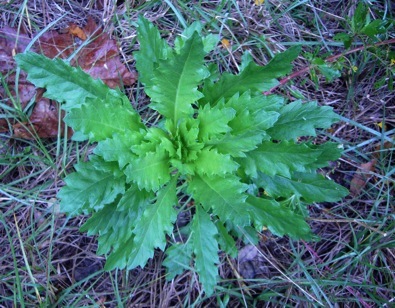
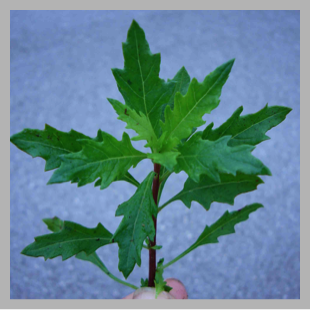
Similar looking: The composite “fireweed” Erechtites hieracifolia when young can resemble the C.ambrosioides and while the fireweed is edible, it is not too palatable. But in its favor Fireweed does not smell of varnish but more like celery oil. Also if I remember correctly Fireweed is a bit hairy and the goosefoot food of the gods is not.

All of that said, there is a new potential use for the smelly food of the gods. A study in August 2007 showed it is effective against the protozoa that cause Leishmaniasis, a fly-carried disease which effects 12 million people in 88 countries. This may lead to new drugs to treat the disease.

Green Deane’s “Itemized” Plant Profile

IDENTIFICATION: An herb to that grows to a height of 40 inches or so. The leaves are lance shaped and toothed, flowers are small and green, seeds very small and green when fresh and black when dry. The plant has an extremely strong odor that should remind you of cleaning paint brushes or perhaps citrus. Some people have an instant allergic reaction to the plant so approach cautiously.

TIME OF YEAR: In Florida, year  round, grows tall and rank through the year.

ENVIRONMENT: Waste ground, dumps, fields, railroads, roadsides, trails, abandoned fields.

METHOD OF PREPARATION: Leaves, flowers and unripe fruits; the latter have the strongest flavor. Said to be best used when fresh but dried can be used as well.   It is used fresh in soups, salads and meat dishes. The most common usage is, however, in bean dishes, where it’s strong anti-flatulent powers are praised. Young leaves are better than old leaves, and the seeds are edible, too.

{ 25 comments }

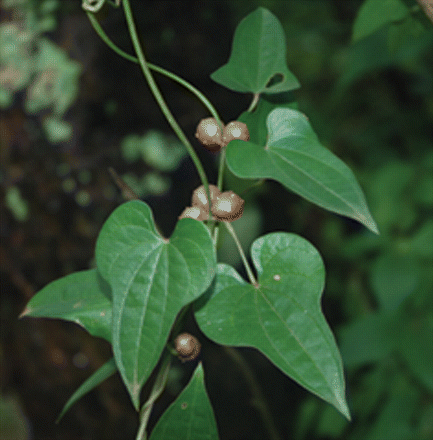
Dioscorea polystachya, Yam C, note the small air bulbils

Dioscorea Polystachya: Yam C

Just like Rambo movies, there is Yam A, Yam B and, yes, a Yam C, the Chinese Wild Yam or the Cinnamon Vine yam, either way we get Yam C, botanical name,  Dioscorea polystachya aka D. oppositifolia (Dye-os-KOH-ree-uh or in Greek thee-oh-skor-REE-uh)   [op-os-i-ti-FOH- lee-uh].  Dioscorea oppositifolia only grows in India, where I presume it is eaten. D. polystachya is the one growing in North America. D. oppositifolia is called by some websites D. batata. Regardless, the accepted name for now for the Chinese Yam is Dioscorea polystachya

In some ways Yam C (Dioscorea polystachya) resembles both Yam A and Yam B (Dioscorea alata, D. bulbifera.) It would almost seem to be a composite. And, yes it has a very edible root and air potatoes. It’s fairly easy to identify, if you know how your three yams differ.  A review:

Yam A, Dioscorea alata, (uh-LAY-tuh) the winged yam, has a very square stem, stem edges can be tinged in purple, it twists lower left to upper right (Z-twist) its leaves are in pairs and more arrow shape than heart-shaped. Its in-the-air bulbils are cylindrical or misshapen lumps, dark brown. The vine can grow to 50 or 60 feet.  Its underground root should be cooked once. Its in-the-air bulbils are considered edible but not too palatable. Yam A is, officially, in three southern states and Puerto Rico.

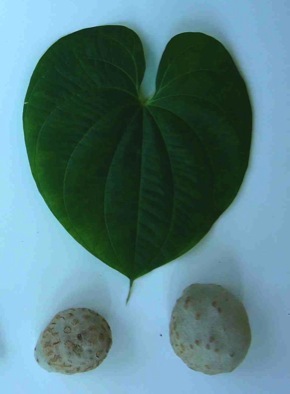
Yam B, Dioscorea bulbifera, (bul-BIFF-er-ah) the “air potato vine” has a thick round stem, green. It twists lower right to upper left (S-twist)  its leaves are round-shaped heart and singular, alternating. The vine can grow to 80 feet. In-the-air bulbils are round, either tan and smooth, or dark brown with tan pimples. Its underground root needs to be cooked twice, or more and then try carefully. If still bitter discard. Its bulbils are generally not considered edible. Read more about that in the specific article on Yam B. D. bulbifera is in five southern states, officially, and Puerto Rico.

Yam C, Chinese Wild Yam, or Cinnamon Vine, the Dioscorea polystachya. Its deeply lobbed leaves can be round-heart- to  sword-handle shaped to arrow-heart shaped, but to me they resemble a cartoon outline of a rat’s head, with a long nose, large ears. Better still, they resemble the leaves of the Smilax bona nox.  Its leaves

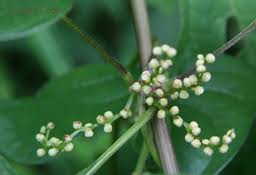
Multiple flower spikes of Yam C, the Chinese Yam

can be opposite on the lower stem, alternating farther up, or arranged in a whorl of three. The vine is round like the D. bulbifera but wiry, it twists lower left to upper right, Z-twist, like the D. alata, to 15 feet. If it blooms its flowers smell of cinnamon. Its leaf margins, petioles, and stems can be tinged reddish purple.  The root should be cooked. Some authors say it can be eaten raw but with so many varieties possible that would not be advised.  Its in-the-air bulbils, often pea size sometimes to golf ball size, are edible and can be cooked up like little potatoes. Each vine produces about 20 bulbils a year. Rats like them, and other small animals. New leaves have a bronze tint which keeps it from being confused with the similar looking Morning Glory. In northern climates D. polystachya is the only local yam.

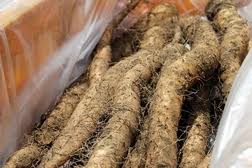
Roots of Yam C are usually cooked

Yam C, came to the United States as a food and an ornamental crop in the 1800s.  In a 1970 survey it was not reported escaped from cultivation but by 1986 was reported root loose and fancy free. Unlike Yam A and Yam B, Yam C, the D. polystachya, apparently gets around. By 2002 it was reported in 24 states from Vermont south to Florida, west to Illinois and Texas. It’s also been reported in two more since, Wisconsin and Arizona, putting it in 26 states as well as Washington DC, but not Puerto Rico.  In Texas it has become a naturalized “noxious weed.” That title might change if food prices keep rising. In Tennessee it is a Rank-1 Severe Threat Species.  It is becoming an increasing problem in southern Ohio where it is controlled by intense mowing. It is also a favorite ornamental, so your first sighting of Yam C might be inside in the middle of winter in a container.

One-year-old roots weigh about 3 ounces, two-year-old roots, a pound. The root, in good soil, can grow up to three feet long and weight up to five pounds.  Its flavor is between a sweet potato and a regular potato. It is 20% starch, 75% water, 0.1% B1, and has 10 to 15 mgs vitamin C. The most common use is cooked like a potato. The Japanese prefer it raw. However, varieties can differer and I do not recommend you eat it raw. Cook it, or experiment with it raw very carefully.

Yam C, Dioscoria polystachya, is also called the aforementioned D. oppositifolia but I am not convinced they are exactly the same plants which is why I do not recommend the D. polystachya be eaten raw. Dioscorea honors Pedianos Dioscorides, a Greek physician of the first century AD whose book on medicinal herbs Materia Medica was the standard for nearly 2000 years.  Polystachya means many flower spikes. Batata is a Caribbean native word for “potato” and oppositifolia means opposite, as in the leaves. Remember, D. polystachya in North America, D. oppositifolia in India.

Green Deane’s “Itemized” Plant Profile

IDENTIFICATIOIN: Dioscorea polystachya:  ”Chinese Yam, Cinnamon Yam Vine.’ Large  lance-shaped leaves, opposite on lower or young stems, alternating higher up, can have whorls of three, climbs from lower left to upper right. In-the-air bulbils pea to golf ball size, usually smaller than larger. Long, skinny underground root to five pounds.

TIME OF YEAR: Fall. In Florida vine dies December through February making locating difficult unless you mark it.

ENVIRONMENT: Yams do well in sun or partial shade and prosper with ample rainfall. They require good drainage, and therefore, are often planted on mounds or ridges. This one likes to be watered.

METHOD OF PREPARATION:  Underground roots, cooked peel, then sliced or mash, bake or chill it and use in a “potato” salad.  Some reportedly use it raw. Proceed with caution. Try a very little first and wait a day. In-the-air bulbils cooked, usually boiled like potatoes.

 HERB BLURB

Externally the raw root has been used to speed up healing because it contains allantoin, a cell proliferant.  Leaf juice can be used to treat snake bites and scorpion stings.

28 Feb. 2006: Abstract: ”A water extract as a viscous solution was obtained from the yam Dioscorea opposita tuber mucilage tororo, and its functional properties were demonstrated. The protein content was about 280 g/mL extract, and the main protein bands with an MW of 33 kDa without 2-mercaptoethanol (2-ME) and 31 kDa with 2-ME were detected by SDS-PAGE. The water extract possessed high antioxidative activity and scavenging activities against superoxide anion and hydroxyl radicals. However, it showed no inhibitory activity against angiotensin I-converting enzyme. The yam tuber contains relatively high contents of vitamins, different micro- and macroelements, enzymes, and dietary fibers. The yam D. opposita tuber will be increasingly regarded as a health-promoting food.”

{ 21 comments }

Dioscorea bulbifera, the infamous Air Potato

The “Cheeky Yam, or Yam on the Lamb

Yam B, Dioscorea bulbifera,  is definitely second best to Yam A, Dioscorea alata. Why is Yam B, the D. bulbifera second best? For two reasons. It requires more work to prepare it to eat, and doesn’t grow as big as D. alata. Let me tell you right now I have dug up one (1) Yam B tuber, but not from lack of trying. Despite decades of looking I’ve only  found one.  Forager emeritus Dick Deuerling, has however. He’s the author of “Florida’s Incredible Wild Edibles.”  Dick was a stickler for taxonomy so when he says he dug up a D. Bulbifera tuber,  not a D. alata tuber, boiled it twice and ate it, I believe him.  I’d ask him to do it again but he died in his 90’s more than a decade ago. I remember that July in 2013 because I had to go to three funerals.

The yam in question, D. bulbifera, ((Dye-os-KOH-ree-uh or in Greek thee-oh-skor-REE-uh))  is the green scourge of Central Florida, ….and South Florida, ….and North Florida…. watch out Georgia here she comes…. It was sent to a researcher in Orlando in 1905 as a possible ornamental and food crop. He reported it would be a dangerous plant to Florida but didn’t kill the plants he experimented with. A little over a century later it now carpets many parts of the state.

That D. bulbifera can be an attractive ornamental is attested by tourists mistakingly taking it home to plant. That it was a potential food crop is debatable. While there may be one species of D. bulbifera there are many varieties. I have noticed, for example, that some have smooth tan round in-the-air bulbils (probably Asian backgound) and others have dark brown bumpy round in-the-air bulbils with tan pimples (probably African background.) What variety was sent to Orlando was not recorded. An Australian version does put on a large root.

D. bulbifera’s underground root is always referred to as toxic but also eaten in some places. How’s that for ambiguous?  And it gets worse, the …. in-the-air bulbils… wrongly called “air potatoes” apparently vary in toxicity, some edible some not. While the bulbils are constantly called toxic by authorities rumor persists they are edible (with special preparation.) In fact I had a visitor from Brazil a couple of years ago while I had some D. bulbifera bulbils (Asian: Smooth and tan) on my desk. He said his mother cooked them all the time. I asked him to ask her how she does it. (Crushes, dries, bakes, leaches then uses.) On the other hand Dick had two friends boil D. bulbifera in-the-air bulbils and had to go to the hospital (Asian or African not known.)  To make matters worse some writers make no linguistic distinction between the above ground in-the-air bulbils and below ground (in the dirt) roots compounding the confusion by calling them both “tubers. ” And technically the underground tubers are not roots but rather “adventurous stem material.”

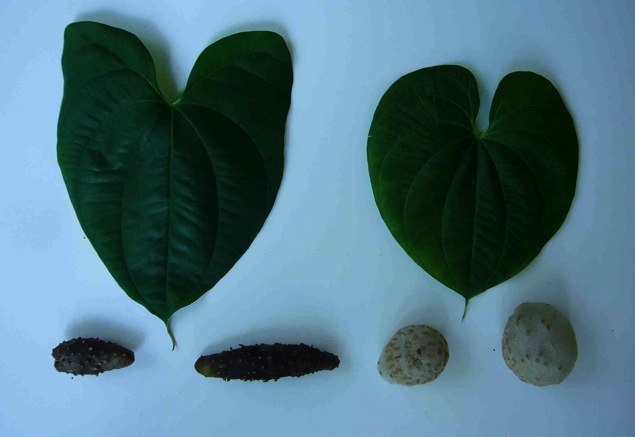
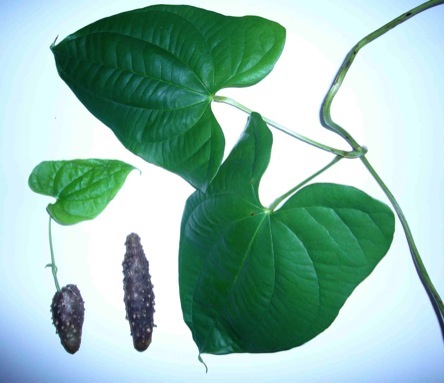
Yam A, the Alata on our  left with in-the-air bulbils, on the right is Yam B, with in the air-bulbils. No root is shown.

The D. bulbifera has large round ball to heart-shaped leaves and a round stem. It climbs at eye level from your lower right to upper left (called the S-twist) and has in-the-air bulbils that are round, brown and lumpy (African) or round smooth and tan (Asian) hence the nickname “air potato vine.”  And to add to the confusion, Yam A, the Dioscorea alata, (uh-LAT-tuh) has dark brown bulbils as well but they tend to be 1) cylindrical and or 2) very misshapen, neither round or cylindrical, L-shaped, Y-shaped, or a lumpy lump.  D. Bulbifera’s in-the-air bulbils are, to my knowledge, always round regardless of color. D. bulbifera can grow a root about the size of a softball (occasionally to a basket ball,) but apparently does not grow a large root too often if rarely in Florida. That would explain why I have only found one. In fact, I became so frustrated with the D. bulbifera, Yam B,  I put it on the back burner, the way in the back, for over a decade.

Many years later I became a fan of Ray Mears, a British bush crafter. I ordered some of his DVDs and one of his books about wild edibles in England. Unexpectedly, the Dioscorea bulbifera came up. One of Mear’s episodes was about the Aborigines in Australia. They dig up two kinds of yams, one called “long yam” and one called “cheeky yam.” They steam roast them for a couple of hours then eat the “long yam” immediately but not the cheeky yam.” They grate the cheeky yam then leach it in a flowing stream overnight. Then they eat it. No botanical name was given for either yam. But when I was reading his book Mears happens to mention in passing there is one non-edible yam in England. Then he said it is similar to the one the Aborigines eat in Australia,  the D. bulbifera.  Well, as one might expect, that caught my attention. I was beginning to think my friend Dick was the only one who ever found a D. bulbifera root to eat but apparently the Aborigines had found them, too. Alas, we don’t know what varieties.

Researching yams again, this time with the internet, I discovered the “long yams” the Aborigines eat are, Dioscorea transversa. The D. transversa (trans-VER-sa)  like the D. alata, twists when it grows, lower left to upper right, he Z-twist (as does Yam C, the Dioscorea polystachya mistakenly called D. oppositifolia.) The D. bulbifera, however, twists lower right to upper left, the S-twist. By now I was getting the idea that readily edible yams at eye level climb from your lower left to upper right. Z-twist, then behind. The ones that twist the other way, S-twist, need special preparation or are not edible at all. That may seem like a small observation but it took about a dozen years to sort out.

So I do know two things. Dick has eaten the D. Bulbifera undergound root and I have eaten the D. Alta’s underground root. In Dick’s book he says he boiled the root twice to get rid of the bitterness. Then, after peeling, he used it just like cooked potato. In Australia, to remind you, the Aborigines roast it for a couple of hours, grate it, and then leach it overnight in a flowing stream. I know Dick’s method works for Yam B found here in Florida. I don’t know if the Aborigines’ method would work with Yam B’s here.

And what of the bulbils? The bulbils of some D. bulbifera are reported as edible but they require special preparation as mentioned above. Just boiling will not do it. Often their preparation is peeling, sun drying (read long term chemical decay, not short term in an oven) then boiling. Another report is they are soaked then boiled. As third says they are cooked with lye, a method used with some horse chestnuts. A fourth says none of them are edible anyway.

My suspicion is there are different varieties of D. bulbifera and some may be edible in-the-air bulbils. What we do know is that even where they are eaten they are cut open to see if they turn brown quickly. Those that are are not used. And, in some places even after being careful in selecting the Yam B in-the-air bulbils and preparing them the are fed to a dog first to make use.

As a final note of confusion, there is a native Dioscorea in England, the Black Bryony (Dioscorea communis or Tamus communis). It is know as toxic, especially it’s red bulbils/berries. Whether a properly prepared root is edible is unknown. We do know cooking the root changes its chemical makeup, reducing its raphides (calcium oxalate crystals.) The internet also wrongly includes it in the cucumber family.

Green Deane’s “Itemized” Plant Profile

IDENTIFICATION: Dioscorea bulbifera:  ”Air potato vine.’ Large heart-shaped leaves, alternating, stem round,  climbs from lower right to upper left. Bulbils usually tan, round and smooth, Asian, or  round and dark brown with light  dimples, African. Underground root roundish, can be lumpy and distorted when grown in hard soil.

TIME OF YEAR: Fall, September to December. For two months the vine dies back making locating difficult.

ENVIRONMENT: Yams do well in sun or partial shade and prosper with ample rainfall. They require good drainage, and therefore, are often planted on mounds or ridges.

METHOD OF PREPARATION:  Undergound roots, should you find one:  Boil in two changes of water, peel, then slice or mash it, or bake it or chill it and use in a “potato” salad. Make sure it has absolutely no bitterness. I consider the in-the-air bulbils of the D. bulbifera as not edible. If they are it involves considerable process using multiple cooking methods.

{ 53 comments }

Dioscoria alata, yam whose root is most prized

The  Dioscorea Dilemma: Which ones are edible, and what parts?

One wouldn’t think wild yams would be hard to sort out. It only took me about a dozen years.

I’m not talking about anything related to the sweet potato. That’s the Ipomoea family. I’m talking about real yams, in the Dioscorea family. Like many imported plants into warm climates, the Dioscorea (Dye-os-KOH-ree-uh or in Greek thee-oh-skor-REE-uh) have become an invasive weed. And as you know, the motto here is eat the weeds. Let’s see if we can sort them out. There are three escaped yams locally. I call them Yam A, Yam B and Yam C.

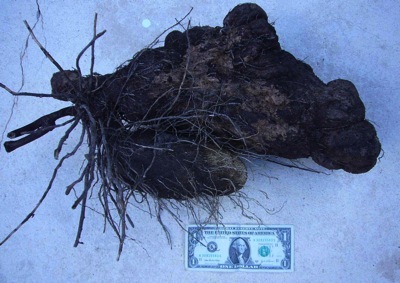
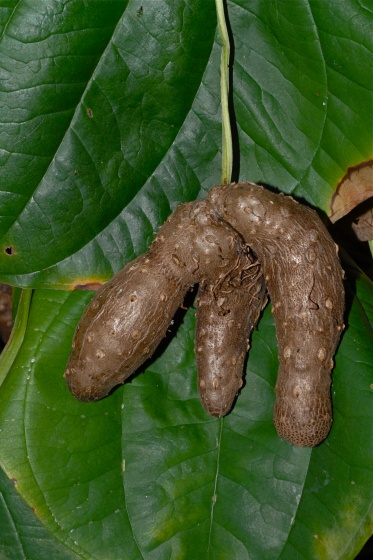
The Root of the D. alata, Yam A grown in hard soil

The most common yam in the South is, unfortunately, probably the least edible, Yam B, the Dioscorea bulbifera — B for bulbifera (bul-BIFF-er-ra.)  It was first sent to Orlando in 1905 as a possible ornamental and food crop. The fellow who got the D. bulbifera concluded it was dangerous to Florida but didn’t eradicate while he had the chance. It has since escaped and become a scourge of the countryside. I have not personally proven its edibility. I have a separate article elsewhere on this site called “Yam B: The Bulbifera.”  Yam C is the Chinese Yam or the Cinnamon vine yam. It’s botanical name is Dioscorea polystachya (mistakenly called D. oppositifolia.) It is covered in a different article as well. Yam C: The Chinese. This article is about Yam A, Dioscorea Alata — A for Alata uh-LAY-tuh. It is also called the Winged Yam because its stem is very square.

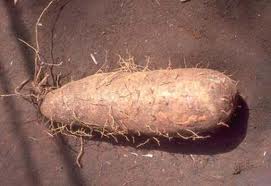
D. alata, Yam A, under cultivation in soft soil

Yam A, or the winged yam, is also called the “water Yam” the “great yam” the “lesser yam,” and the “purple yam” among others.  It’s not born free anywhere in the world but is a product of cultivation that has escaped into the wild. Researchers think it was an intentional hybridizing of two wild yams by man some 8,000 years ago. So while Yam A, the D. alata, is found in the wild, it is not a wild yam.

Under cultivation, varieties of D. alata  are the most common yam in the world.  It has an underground root that can grow upwards of 7.5 feet long and a 136 pounds (the known record is 180 pounds.)  When cultivated it can grow long and uniform. In hard soil, or in old age, it can be lumpy and malformed. Young roots tend to be solid and straight, older roots tend to branch out. Boiling (or roasting) of the root makes it edible. It got to Africa from Asia around 1,500 B.C. and probably came to the Americas with slaves by the 1700s. By the 1950s D. alata was the most common Yam in the state. The D. bulbifera did not take over for a few more decades.

Above ground differences betwen Yam A, the Alata, and Yam B, the Bulbifera

At first glance Yam A, the D. alta, and Yam B, the D. bulbefera, look quite alike but they have several differences. D. alata’s leaf is an arrow-shaped heart (think arrow-Alata)  D. bulfiera is a ball-shaped heart (think ball-bulifera). The D. alata leaves grow in pairs particularly near the growing end of the vine where as young D. alatas can have one leaf instead of leaves in pairs, the D. bulbifera singly. The D. alata has a large, very square stem with edges tinged in purple, the D. bulbifera has a slight round green stem. The D. alata has bulbils that are dark brown with a variety of shapes, the D. bulbifera has bulbils that are lumpy round and tan (from Asia I think) or round and brown with tan pimples (from Africa I think). Incidentally, D. alata bulbils soaked 4 hours in water germinate three weeks faster than non-soaked bulbils.

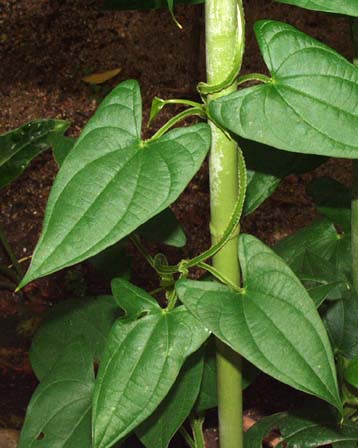
The so-called Z-twist goes from our lower left to our upper right at eye-level

The D. alata, when climbing at eye level, twists from your lower left across the surface nearest you to your upper right, the so-called Z-twist. The D. bulbifera twists from your lower right across the surface nearest you to your upper left, the S-twist. I am beginning to think the way of the twist is the first sign of a prime edible yam. Ignore books that say a vine twists clockwise or counter clockwise if they don’t provide you the perspective of the viewer. Depending whether you are looking down or up the same twist can be called clockwise or counter clockwise. If you are looking down at a D. alata it looks to go counter clockwise. If you’re looking up at the D. alata it appears to go clockwise. I have two books that describe its twist in different directions because of the perspective.

Once you learn to tell the differences the D. alata  (as well as Yam C, the Chinese Yam) are fairly easy to spot among their prolific relative, the D. bulbifera. Yam A and Yam C (the Chinese Yam) leaves give them away even at a distance since they grow in pairs. The D. bulbifera has alternating single leaves so from a distance if you see single leaves like a series of steps in a stairs you know it’s not the one you want.  As for availability… along one bike trail I traverse, for one mile all the trees are draped with Yam B. But, there are three patches of Yam A. Yam C is in very isolated pockets.

D. alata’s air bulbils are NOT round and are NOT tan

While the D. Alta has a reputation for being buried very deep that has not been my experience. I usually find the large root within a few inches of the surface. When grown in soft soil the D. alata is long and tubular, when growing in hard soil it will be lumpy and distorted. Old roots can also be lumpy and banched. The largest I have found to date is 8.2 pounds after washing, and that is the norm. Young roots are best used like potatoes, older roots while edible have a different texture, can be fried after boiling or make a good flour. The vine usually puts on one tuber per season but can produce as many as three. Thus the older root can be lumpy but have a younger, well-formed root attached, as the top picture shows.

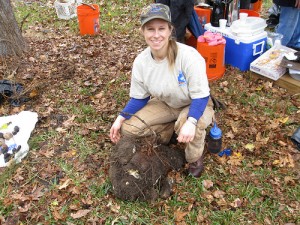
Sassycrafter and a 30-pound D. alata root

When under cultivation the D. alata is usually left to cure for a week after it is dug up, but that’s not necessary, and it will store for several months. The vine also go into a dormant period. Here in Florida that is about Christmas to St. Patrick’s Day. During that time the vines die back. If you want to dig them up during that time you should mark them earlier in the season. The U.S. Department of Agriculture reports the bulbils of the D. alata are edible cooked but not as palatable as the roots, and my friend, Maribou, has tried them. I, personally, have not gotten around to eating them. It’s on my list of plant things to do.

Dioscorea was named after Pedianos Dioscorides, Greek physician of the first century AD whose book on medicinal herbs Materia Medica, was a standard work until recent times. Alata means winged. Bulbifera means bearing bulbs. Polystachya, many stakes, or blossom spikes.

D. villosa roots are famine food and birth contol, best avoided

For the record, among the semi-edibles yams one might see are: Dioscorea villosa, (vill-LOE-suh) whose roots might be a famine food but with a price. This was the yam from which the first birth control pills were made. There has been some speculation that the Mayans suffered a loss of their maize crop and had to eat D. villosa, causing a fertility drop in their population they could not recover from. (It twines lower right to upper left, the S-twist.)   There are also native Florida yams, but they are rare and have no “bulbils” Dioscorea floridana and Dioscorea quarternata. The native plants are only infrequently seen in north and west Florida hammocks and flood plains. Villosa means shaggy; floridana, Florida; quarternata, four leaves from one place; polystachya many spikes. The word “yam” comes from a west African language and means “something to eat.”

Approximate yam nutrition per 100g: 103 calories; sugars (g)  23; Proteíns (g) 1; Fiber (g) 4; Vitamin B1 (mg) 112; Vitamin B2 (mg) 32; Vitamin C (mg) 17; Salt (mg) 9; Potássium (mg) 816; Cálcium (mg) 17; Phosphorus (mg) 55. It does not have any iron, fat, vitamin A, and no vitamin B3.

Green Deane’s Itemized” Plant Profile

IDENTIFICATION: Dioscorea alata:  Winged Yam. Large arrow-shaped leaves, opposite, stem with four definite sides, edges of the sides often tinged in purple. Stem climbs from lower left to upper right. Bulbils dark brown, round or cylinder, lumpy, mishapen. Underground root similar to a sweet potato in shape when grown is soft soil, lumpy and distorted when grown in hard soil. Can be up to 136 pounds.

TIME OF YEAR:  Fall, September to December. For two months the vine dies back making locating difficult.

ENVIRONMENT: Yams do well in sun or partial shade and prosper with ample rainfall. They require good drainage, and therefore, are often planted on mounds or ridges.

METHOD OF PREPARATION:  Underground roots only: Usually fresh young yam is peeled, cut up and boiled like a potato. Older yams can be pounded into a sticky elastic dough called pounded yam or yam fufu. To make a flour from the D. Alata root slice the underground tubers to a thickness of about quarter inch. Parboil the peeled slices. Dried them in the sun to reduce the moisture content. The dried slices are then ground to flour and sieved to make a uniform texture. Otherwise, the boiled yam can also be used like potatoes.   IF ANY YAM TASTES BITTER, DON’T EAT IT.

{ 78 comments }