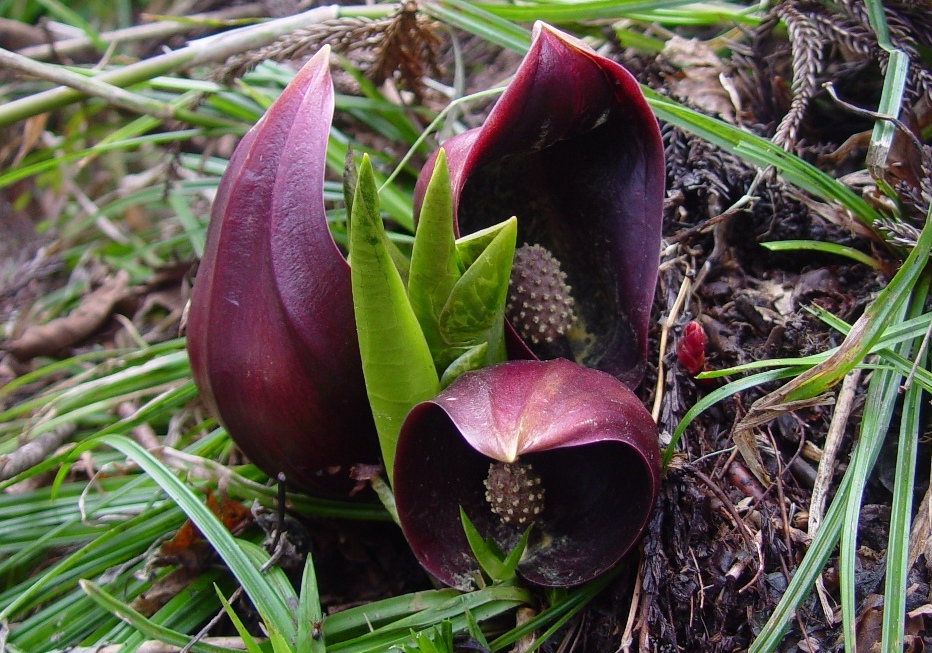
Skunk cabbage in springtime

The first eight years of my formal education was spent in wooden, one-room school houses without running water. The 7th and 8th grade-school house was in the center of Pownal, Maine. There was a large pine-covered hill behind it to the southeast no doubt over a granite ledge, and a gully to the north of it. There I saw skunk cabbage and trilliums in early May, both of which smelled like Budweiser beer (which is an adult, hindsight observation as neither of my parents drank.)  On the first school day in May we kids would hang a May basket on the teacher (one Arlene Tryon) and disappear — meaning we left the school grounds for a few hours, usually going to the nearby state park which required going across the aforementioned gully which had a lot skunk cabbage and trilliums.
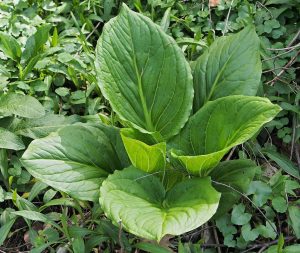
Young skunk cabbage. Photo by Derek Ramsey

I was in that particular school house in the early 60’s including November 22nd 1963 when Kennedy was assassinated. A decade earlier Professor Merritt Fernald of Maine and Harvard was writing about skunk cabbage and apparently there was some ethnic controversy about it. He wrote on pages 118 and 119 of Edible Wild Plants of Eastern North America “The roots of skunk cabbage have had a repute among the eastern Indians as a source of bread, in regions where the plant thrives the roots are abundant but difficult to dig; and obviously, for many reasons, only an enthusiast will try to secure them. It is probable that drying or baking before final use will dispel the acrid properties, as in Peltandra and Arisaema, but our own experience show that three weeks of drying is insufficient to dispel the peppery quality. The bread made from the flour dried for three weeks is palatable, having a suggestion of cocoa flavor, but a few minutes after it has been eaten the mouth stings with the peculiar burning and puckering sensation familiar to all who have tasted the fresh root of the Jack-in-the-Pulpit. One average root gives about half a cup of flour.
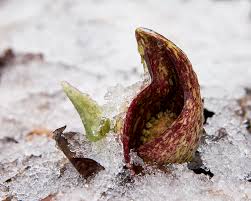
Skunk Cabbage tolerates northern  weather.

“A more available food is found in the “cabbage” or young tuft of leaves, which in spite of inevitable prejudice on account of the odor of the bruised plant, makes not wholly unpalatable vegetable. During boiling no trace of the characteristic, disagreeable odor is given off, but the cabbage should be cooked in several waters to which has been added a pinch of baking soda. Serve with vinegar and butter or other sauce. Our Italian immigrants often make use of these greens which, if prejudice were forgotten, might abundantly serve a large population. Our experience indicates that the plants vary, sometimes being quite mild, sometimes peppery. If one is in luck he will cook only the former.”

Fernald goes on to warn to not mistakenly collect the White Hellebore or Indian Poke (Veratrum viride) which grows in the same environment and is a “violent poison.”  As for the skunky Trilliums the cooked leaves are edible but the roots are highly emetic and the berries questionable. Also know that governmental nutritional information offered on the Internet supposedly for “skunk cabbage” is actually that of a totally different plant “swamp cabbage” which is from a palm tree (sabal palmetto.)

Symplocarpus foetidus was coined by controversial British botanist Richard Anthony Salisbury nee Markham (1761-1829) and is from the Greek σνμπλοκη symplokee for “connection” and καρπος  carpos for “fruit” referring to the ovaries connecting into a compound fruit. Foetidus is from Dead Latin meaning foul smelling. 

Green Deane’s “Itemized” Plant Profile

IDENTIFICATION: Low growing, foul smelling to three feet tall growing.  Roots are fleshy, tuberous, two inches long and an inch through,  dark brown on the outside, white or yellowish inside. The aroma is similar to that of hops or a skunk.

TIME OF YEAR: Early spring, February in the southern end, end of spring northern end.

ENVIRONMENT: Swamps, wet woods, by streams, and or other wet, low areas, gullies.

METHOD OF PREPARATION: Dried leaves later boiled in changes of water, roots long-term dried edible. None edible raw. The roots are between one and three feet down, older ones have ring-like wrinkles. 
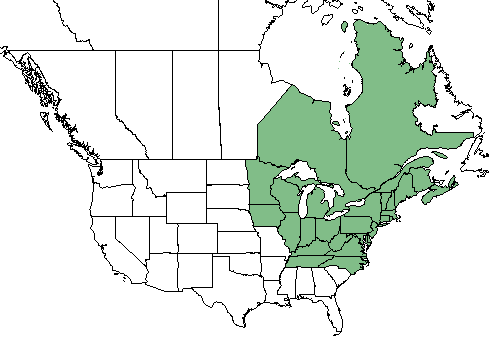
Distribution of skunk cabbage in North America


{ 2 comments }

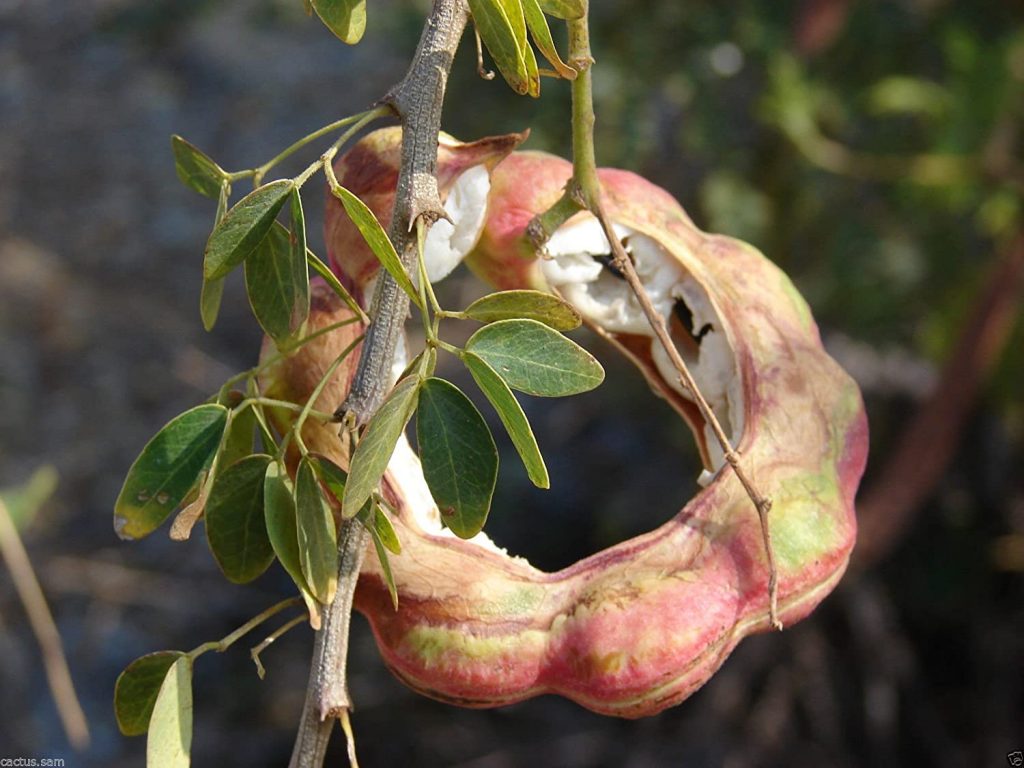
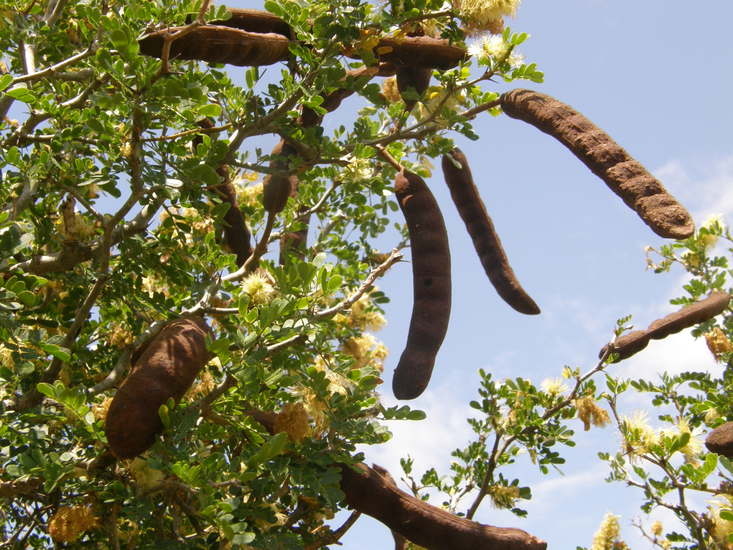
Texas Ebony seed pods. Photo by Wynn Anderson

A lifetime ago I used to fly to Dallas Texas in an executive jet from Orlando. It was a 150-minute flight take off to touch down. One could see the Mississippi river for 40 minutes. One of the first things you notice in Texas is the plants are different and things tend to be named Texas this or Texas that even if it is just a thistle. Thus that the Texas Ebony is not an Ebony is no surprise and could easily be called the Mexican Ebony. It is edible no matter what its name is. 

The seeds are toasted, young pods are cooked like a vegetable. The seed coat was used for a coffee substitute. It also has edible relatives: P. lobatum has seeds that are edible raw or cooked. Young flowers, leaves and fruit are eaten. The seeds are a source of starch. The seed and aril of P. dulce are eaten and the seeds produce a useable oil. (See a separate entry for P. dulce, aka Camachile.) 

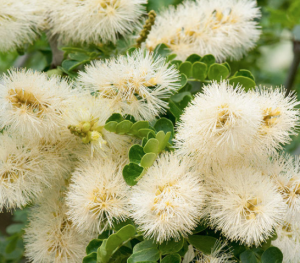
Texas Ebony blossom.

The seeds of E. ebano are about 35% protein which is comparable to legumes though they are larger than chickpeas. Carbohydrates in 100 grams (before processing) are 29.36 grams, fat 28.16 grams but fiber quite low, 0.51 grams per 100 grams. That’s all about 500 calories. Cooking increases the available protein by some 12% and reduces anti-nutrient phytate 35% and protein inhibitors 96% overall increasing the nutrition. The most common amino acids are leucine, lysine, valine, isoleucine and treosine.    

Originally Pithecellobium flexicaule it is now Ebenopsis ebano. As that is mostly Greek it can be translated in several close ways. Pithecellobium flexicaule is easy: Monkey’s Earring with Bent Stem. Ebenopsis ebano has more possibilities because of -opsis. That’s often translated into “view” but the original Greek means more like a spectacle, something impressive you would see on stage or the like, something that makes you go “wow!” So I’d say Spectacular Black Ebony.  That’s better than Monkey’s Earring with Bent Stem. 

Green Deane’s Itemized Plant Profile

IDENTIFICATION: A large tree to 50 feet, trunks up to 10 feet in circumference, branches very spiny and zig-zag at every node, dark green foliage, white to yellow fragrant flowers starting in May or June creating four to six inch pods. Hardy down to 25F, perhaps lower.

TIME OF YEAR: Pods in fall. 

ENVIRONMENT: Well-drained clay, loam or sand. Full sun. Very drought tolerant.

METHOD OF PREPARATION: Seeds cooked, young pods boiled. 

{ 1 comment }


Camachili is closely relayed to the “Texas Ebony.”

Camachile, Guamuchil

Pithecellobium dulce

I was teaching in an eclectic park one day when the visiting aunt of a student recognized a tree from back home on the other side of the world. She knew it as camachile which is actually a native of Mexico where it is known as guamuchil. 

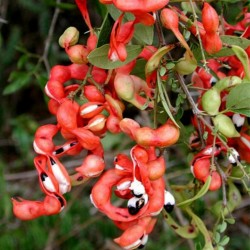
This huge, thorny tree has a multitude of names and is in the same genus as Texas Ebony. And like the Texas Ebony it has edible fruit. The most commonly consumed part is the aril around the seed. Livestock like the fruit and leaves. 

The arils is commonly eaten.

The aril, which is 60% of the pod, contains per 100 grams 78 calories, 3.0% protein, 0.4% fat, 18.2% total carbohydrate, and 1.2% fiber. It has 13 mg of calcium, 42 mg phosphorus, 0.5 mg iron, 19 mg sodium, 222 mg potassium, 15 mg beta-carotene equivalent, 0.24 mg B1 (thiamin) 0.10 mg B2 (riboflavin) 0.60 mg B3 (niacin) and 133 mg ascorbic acid more than twice your daily need. The essential amino acids are 143 mg of valine per 100 grams, 178 lysine, 41 phenylalanine, and 26 tryptophan.

Per 100 grams of seeds it has 17.7 grams protein, 17.1 grams fat, 41.4 grams starch, and 7.8 grams fiber. On alcoholic extraction, the seeds yield a saponin, a sterol glucoside, a flavone, and lecithin. The fatty acid composition of the seed is 24.3% saturated acids, 51.1% oleic, and 24.0% linoleic. Another analysis shows 0.3% caprylic acid, 0.3% caprinic, 0.3% lauric, 0.8% myristic, 12.1% palmitic, 6.9% stearic, 3.1% arachidic, 13.1% behenic, 4.9% lignoceric, 32.2% oleic, and 26.0% linoleic. 

The tree is not only native to Mexico but is found through Central America to Colombia and Venezuela. Introduced into southern Florida, Cuba, Jamaica, Puerto Rico, and St. Croix. It’s an invasive weed in Hawaii. 

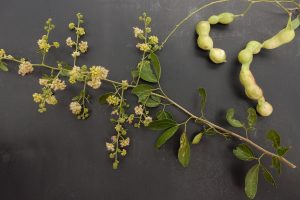
Everything starts green.

Pithecellobium means Monkey’s Earring, dulce is sweet. Guamuchil is from the Nahauti name cuauhmochitl. It is related to P. lobatum, (lobes) which has several edible parts as well. According to Cornucopia II from page 153, P. lobatum “seeds are eaten raw, boiled, salted or cooked with coconut milk or oil. Young leaves, flowers and fruits are eaten. A delicacy called amping is made by pounding the cotyledons one by one in the shape of cakes which are sun dried. The emping is fried in coconut oil, sprinkled with salt, and eaten at the rice table. Seeds are a source of a starch.” 

Green Deane’s Itemize Plant Profile

IDENTIFICATION: A large, almost evergreen tree that grows up to sixty feet or more in height, it has a broad crown (to thirty feet across) and a thick truck (more than a yard through.)  At the base of each leaf is normally found a pair of short, sharp spines. Reproduces easily from seeds or cutting, used for hedges, grows quickly. Makes a lot of smoke when burned. Not a good nitrogen fixer. 

TIME OF YEAR: Flowers in your dry season.

ENVIRONMENT: Tolerant of drought, heat, poor soil, salt, sand and shade.

METHOD OF PREPARATION:  The aril is edible raw or cooked, the high-protein seeds are eaten raw or often mixed with curry and have an edible green oil. Fruit is made into a drink. 

{ 2 comments }

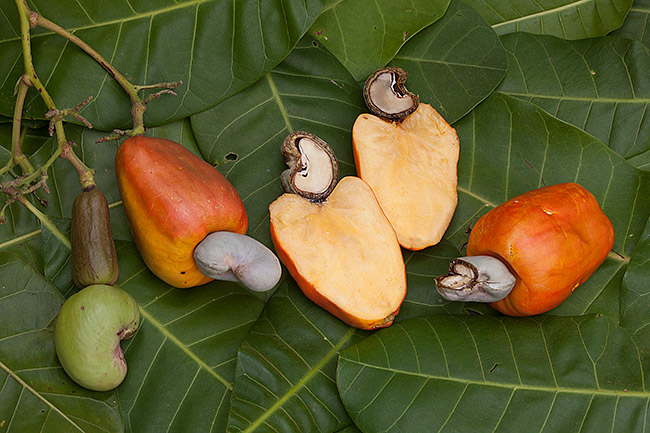
The edible cashew “apple” an aril is the largest part of the fruit.

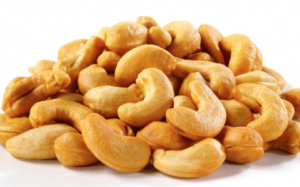
Cashews are high in potassium.

The Cashew belongs to a rather toxic group of plants, all closely related and some of which we eat: Poison Ivy, Poison Sumac, Mangos, Brazilian Pepper, Pistachios, and Cashews. While the cooked cashew “apple” and roasted nut are edible the shell’s jell is extremely toxic. Mother Nature does not want you eating those nuts and protects them mightily. Not surprisingly the tree itself looks mango-ish. Many people get a poison ivy like rash from touching mangos. They can, however, usually eat mango if someone else peels it. Like the Ginkgo tree, if you don’t  clean up Cashew debris it can leave a toxic litter. We used to visit one often in my foraging classes until Hurricane Irma destroyed it.  

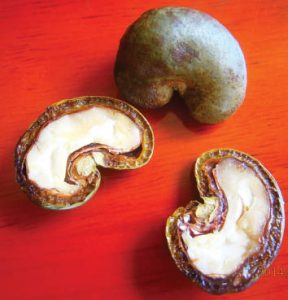
Nature protects the nut with a caustic brown jell.

The Cashew apple, which can be eaten raw but is safer processed, has per 100 grams 124 mg of potassium, 67 mg of phosphorus, 10 mg calcium, 49 mg vitamin C, 2 mg iron, 3.2 mg fiber, 53 calories and 23 mcg beta-carotene.  The unsalted cashew nut contains 583 calories, 14.85 grams of protein, 47.96 grams fat, 31.71 grams total carbohydrate, 2.9 grams fiber,  548 mg potassium, phosphorus 475 mg,  magnesium 252 mg, calcium 44 mg, sodium 16 mg, iron 5.82 mg, zinc 5.43 mg, copper 2.153 mg, selenium 11.3 mcg  B1 (thiamine) and B2 (riboflavin) 0.194 mg each, B3 (niacin) 1.358  mg, B6 (pyridoxine) 0.248 mg, B9 (folate) 67 mg, choline 59.2 mg, Vitamin E 1.24 mg, Lutein+zeaxanthin 22 mcg, vitamin K 37.2 mcg and  in a separate study 7 mg ascorbic acid. 

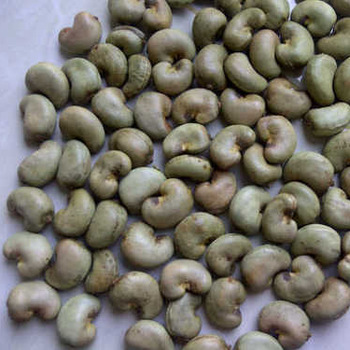
Raw cashews are extremely toxic topically.

Cashew trees are planted for three reasons:  They look attractive– make a good shade tree if you clean up under them —  and produce edible parts (with proper preparation.) The tree, which is native to northern Brazil, has large leaves and pretty pink blossoms. Like the Podocarpus there is an aril then a seed on the end. The cashew “apple” is a swollen part of the stem rather than the ovary. It can be yellow to red, is high in vitamin C, juicy and slightly acidic. Rather than eaten out of hand — the “apple” can make the mouth feel fuzzy — it is often used with other fruits and juices via blending. The nut is in a kidney-shaped double shell with a caustic brown liquid between the outer shell and the inner testa that will quickly burn your skin or mouth. The cleaned nut is edible raw but roasted is better and that can reduce allergic responses. Eating them raw is dangerous and difficult because of the caustic chemicals and allergies to the parts that are processed away. After drying the unshelled seeds are soaked for a few days in water. The seed is cooked in oil (210 C) for two minutes then cooled in water. Then they are shelled, dried, and the papery coating — the testa — is removed. The shells with nuts inside can also be fried in an open pan but that is more iffy in that the shells can squirt the bad jell. The smoke is also toxic, don’t breath it in. Another method for the brave is to freeze the shell/nut and shell it while frozen peeling away the acidic jell. Wear heavy gloves and goggles. Work fast. Know that cashew production is the source of questionable labor practices where they are produced.  

Cashews have a burning liquid between the nut and the shell.

Young cashew shoots can be eaten and the “apple” cut in to pieces, blanched, dried, then cooked like a vegetable. In fact it is far more popular where they grow than the nuts. The “apples” also dry well and can be made into jam or wine. They can also be feed to livestock — minus the seed. The “apple” contains five times more vitamin C than an orange and more calcium, iron, and B1 than bananas, avocados or citrus. They are also a good source of magnesium, phosphorus and copper. Cashews bloom in winter so you have to have a warm winter.

Botanically the tree is Anacardium occidentale, Anacardium is Greek with a Latin ending that means heart-shaped — referring to the shape of the aril. Occidentale means western (usually European.) Native to tropical America from Mexico and the West Indies to Brazil and Peru. It has few pests or diseases. 

Green Deane’s Itemized Plant Profile

IDENTIFICATION:Spreading evergreen perennial tree to fifteen tall; leaves simple, alternate, obovate, hairless to eight long, six inches wide, pointed or notched, not teeth, short petiolate; flowers numerous in terminal panicles, six to eight long, male or female, green and reddish. The cashew-apple is shiny, red or yellowish, pear-shaped, soft, juicy, six to eight inches long, two to four inches wide; seed surrounded by a hard shell oily, said oil is poisonous causing allergenic reactions in some. 

TIME OF YEAR: Fruits in wet weather, three months from flower to fruit. 

ENVIRONMENT: Grows in almost any soil but does not tolerate salt or frost. 

METHOD OF PREPARATION: Apple edible raw better cooked, seeds processed. 

{ 2 comments }

Morels Meanderings

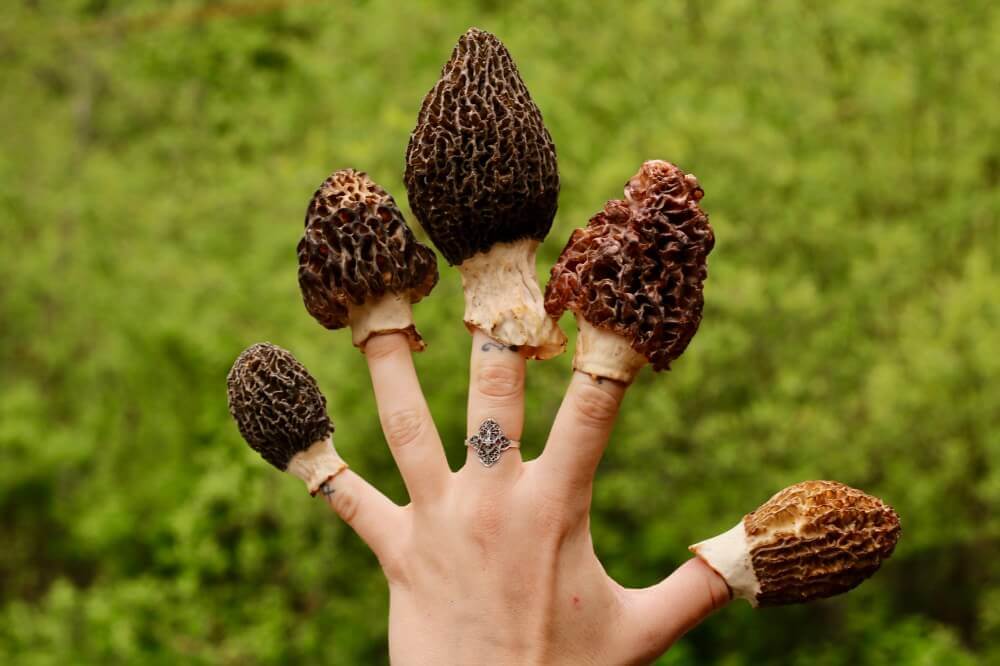
A reminder that morels are hollow. Photo by Modern Forager.

Morels are perhaps the most foraged and prized fungi in North America. There are folks who forage for nothing but Morels and grew up doing so with their parents. They are esteemed in Europe as well so it was natural for immigrants to America to look for morels and continue the foraging tradition. Morels are so coveted that hunters not only do not reveal their “patches” but give out disinformation. Several states require you to be certified to pick them even for private use. 

Morels need cool soil to reproduce.

There are some 50 species between North America and Europe. In North America 14 new species were announced in 2012 bringing the total to 19 (when previously they thought there might be five or so species.) The species names are in flux because it’s first come first served. For example: If a species in Europe and North American has the same name and it’s decided they are two different species the first one gets to keep the name, the second one has to be changed. And of course not everyone will accept the evidence they are different thus the naming tempest grows. We just call them Morels…  

A dried ounce of morels (28.4 grams) has: 84 calories, 8 grams of protein, 12 grams of carbohydrates, 2 grams of fat, and 4 grams of fiber. it has 59 RE of vitamin A, 1 mg of vitamin C. B vitamins are: B1 (thiamin) 00.3 mg, B2 (riboflavin) 0.64 mg, and B3 (niacin) 2.50 mg. Potassium is 490 mg, phosphorus 339 mg, calcium 33 mg, sodium 10 mg, and iron 8.72 mg.

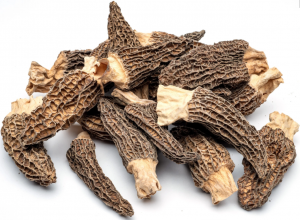
Morels dry well.

The nutrition for fresh morels follows but remember they always must be cooked. A 100 grams has: 31calories, 3.12 grams protein, 0.57 grams fat, 5.1 grams carbohydrates and 2.8 grams of fiber. There’s half a gram of sugar and it is glucose. No vitamin A or C but there is 206 IU of vitamin D with 5.1 mcg of D2. B vitamins are B1 (thiamin) 0.069 mg, B2 (riboflavin) 0.205 mg B3 (niacin) 2.252, B5 (pantothenic acid) 0.44 mg, B6 (pyridoxine) 0.136, and B9 *folate) 9 mcg. The mineral line up is: Potassium 411 mg, phosphorus 194 mg, calcium 43 mg, sodium 21 mg, magnesium 19 mg, iron 12.18 mg, zinc 2.03 mg, copper 0.625 mg, manganese 0.587 mg, and selenium 2.2 mcg. 

This wondrous species does not get into the deep south. During my training to be certified to sell mushrooms one of the things we learned was Morels need ground temperatures of about 55 F for some 11 days for to reproduce. That never happen in warm areas. But they like my cousin’s farm in South Carolina. 

The genus Morchella might be from a German word for mushroom “morchel” in the Dead Latin feminine form.  Morel is also from Dead Latin and means brown.

 Green Deane’s Itemized Plant Profile

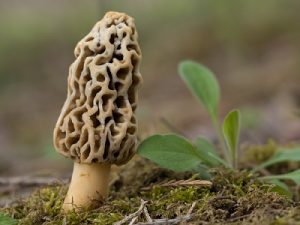
IDENTIFICATION:  Large fruiting body with a distinct head that is thimble-like or sponge-like and has a pitted surface, usually on a short stem, color ranges rom blonde to dark brown. The honey-combed cap has irregular holes and attaches directly to the stem. Inside there is a hollow cavity that runs from the top of the mushroom down the stem to the bottom.  

ENVIRONMENT: Forests (hard and soft woods) old orchards, open ground, drive ways, under hedges… where ever they want. 

TIME OF YEAR: May is the target month but they can show up in summer fall and winter. In spring look in warming weather after a cold spell. 

METHOD OF PREPARATION: Must be cooked.  Raw morels can cause digestive issues.

{ 0 comments }