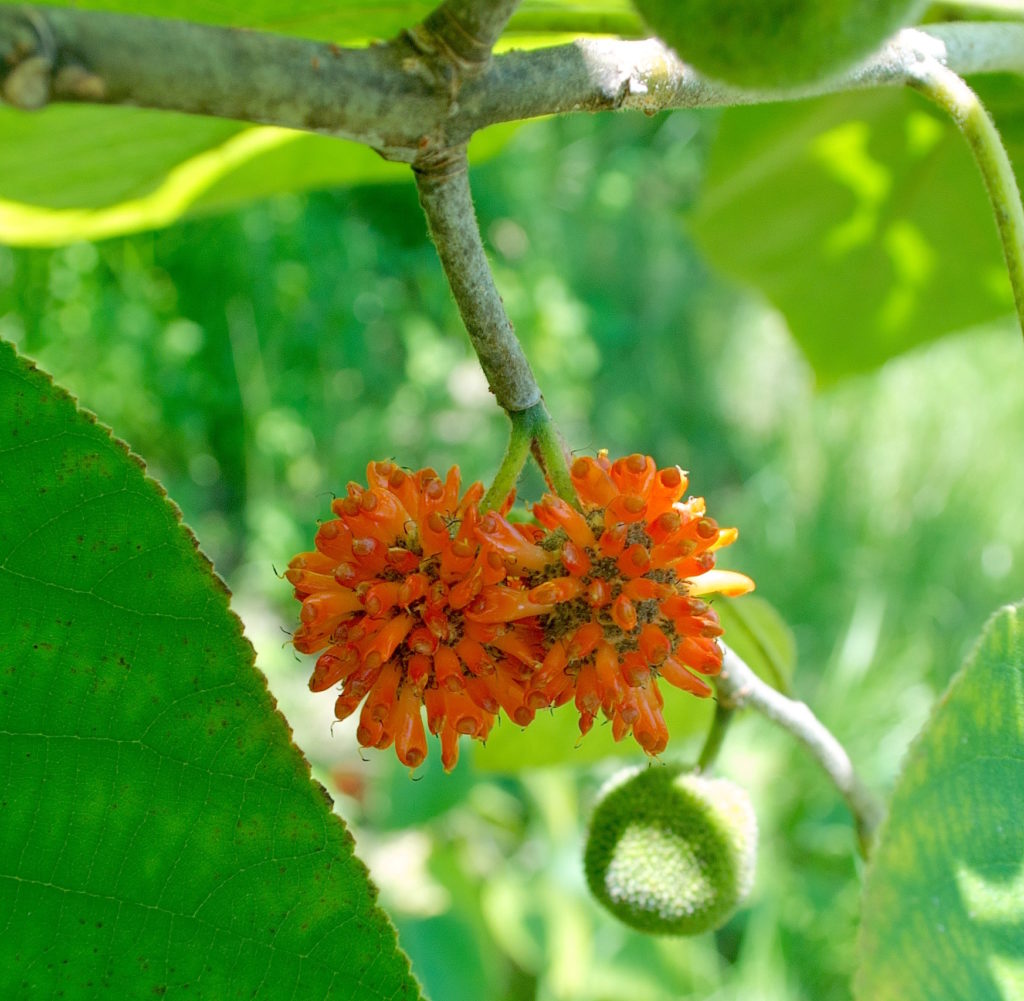
The orange pompom fruit of the Paper Mulberry. Photo by Green Deane

The orange pom-pom fruit of the Paper Mulberry. Photo by Green Deane

Broussonetia papyrifera: Paper Chase

If you are a forager, you will be told two things constantly: One is that the plant of your admiration is “poisonous.” Sometimes they are, often they are not. The other thing you will hear is that a particular species is a “trash tree.”

When I first asked about this species I was told by a knowledgeable botanist that it was a trash tree though at the time he did not know what species it was. Over the years I wondered about its identity. It resembled a basswood tree but wasn’t one. It was certainly prolific, growing in hursts everywhere, often in low spots or gullies and ditches. I watched it for several years but it never seemed to fruit. While it did form colonies I also saw an isolated tree now and then. I presumed it could either fruit or reproduce by cuttings and the like. In hindsight, compounding the issue is that a young tree’s leaves look very different than a mature tree’s leaves. Indeed, it was a lone young tree near a bike trail that got me on the track of solving the identity of my mystery tree.

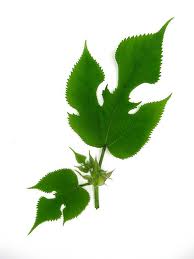
Young Paper Mulberry leaves

What I discovered was that while it might be an invasive species it is far from a “trash tree.” Know as the Paper Mulberry, the Broussonetia papyrifera  (brew-soh-NEE-she-uh pap-ih-RIFF-er-uh) has been used for thousands of years to make paper and cloth. Young leaves are edible cooked — chewy — and in the right climate it produces orange pom-pom-like fruit. The tree, with extra large leaves, soft on one side, rough on the other, is also a common source of woodland toilet paper.

Native to the cooler regions of Asia they were taken to the Pacific Islands for paper and cloth. Someone had the bright idea of taking only sterile male clones to control their proliferation plus the male trees produce the better bark for cloth and paper. However, they can clone themselves by runners. Big mistake. The Paper Mulberry was in Florida by 1903 with someone also introducing female trees as well. With males and females being able to clone plus seeds from the female the species went gangbusters.

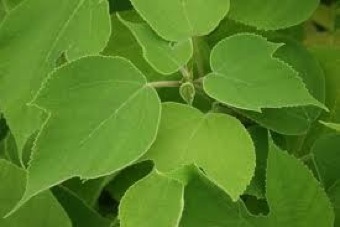
Mature mulberry leaves

Two things compounded my identification and appreciation of the Paper Mulberry. The first, already mentioned, is that the leaves of the young Paper Mulberry look very different than the adult. They are palmate and very indented, resembling an ornamental, Chinese pitchfork. Older leaves are very large mittens with one or two lobes looking like left or right thumbs, double thumbs or no thumbs.  The second issue was the species is from a temperate climate. Florida is not temperate. In my sub-temperate area they never fruit. Eighty miles north of here they do fruit but in years of watching they’ve never fruited locally (They might, however, if we have an exceptionally cold winter producing the necessary chill hours.)  It took tid bits of observations over many years to finally sort out the species’ identity.

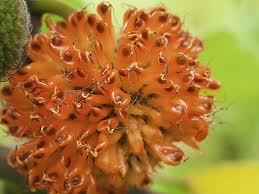
To call the fruit an orange pom-pom is actually quite accurate. It starts out as a green ball about the size of a large marble on the end of a two-inch stem. The ball is pitted much like a Bread Fruit, which it is related to, and the Osage Orange. Then the ball grows white hairs which  eventually make the orange pom-pom part, which is edible. The ball is not edible as far as I know. The fruit is sweet, juicy and fragile. It does not travel well and is best eaten on the spot.  Fruiting starts around April and ends by the end of June.  Young leaves for food are steamed though they do have a texture issue. You can also chop them up and boil them as well. The larger leaves can be used to wrap food in for cooking.

At one time the Paper Mulberry was grouped with other mulberries, and is closely related, but was given its own genus Broussonetia named after Pierre Maria August Broussonet (1761-1807) a professor of botany at Montpelier, France.  In the US the tree can be found From Massachusetts south to Florida, west to Nebraska, Oklahoma and Texas.

Green Deane’s “Itemized” Plant Profile

Ripe fruit

IDENTIFICATION: Paper mulberry is deciduous with milky sap to 45 ft. (15 m.). Twigs hairy reddish brown, on young trees zebra striped, older trees tan, smooth, furrowed. Wood is soft and brittle. Leaves are hairy, lobed or mitten-shaped, alternate, opposite or whorled along stem. Leaf edge sharply toothed, base heart-shaped to rounded with pointed tips, upper leaf surface is rough feeling. Separate male and female flowers in spring. Male flower clusters are elongate, pendulous, 2 ½ to 3 in. Female flowers globular about one inch in diameter. Fruits orange to reddish purple.

TIME OF YEAR: In Florida April to June, summer in northern areas, February to April in warmer climates.

ENVIRONMENT: Open sunny fields but also low areas such as ditched and gullies. Grows very fast and can be fruiting within 18 months.

METHOD OF PREPARATION: Fruit out of hand (orange parts only.) Young leaves steamed or boiled. Bark can be used to make paper and cloth (tapa).  The fruit (grown in Thailand) is very high in calcium, potassium and magnesium. It also has trace amounts of arsenic (0.62 ppm) as many foods do.  Deer like to nibble on the leaves.


{ 81 comments }
loquats

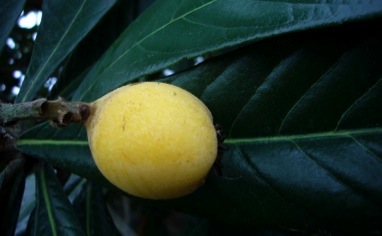
The fruit ripens from tart to very sweet

Lovin’ Loquats: Eriobotryae Japonicae

Long before there were couch potatoes there were couch Loquats.

Loquats are homebodies. Most people who live beyond the growing range of the Loquat usually have never eaten a fresh one, having to settle for canned representatives. Loquats just don’t travel well. They bruise easily and loose their freshness quickly, much like a rose, its distant relative. From the tree to the kitchen is almost the maximum distance they will endure. Tree to tummy is the best. The state of Florida says they will keep several weeks in the refrigerator, but my experience is by then they look like large, lumpy raisins.
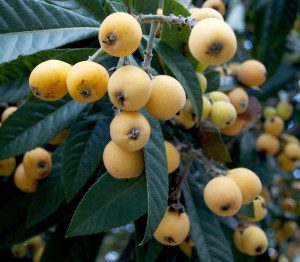
Loquat season can be six to eight weeks long. Photo by Green Deane

Loquat season can be six to eight weeks long. Photo by Green Deane

Although called the Japanese Plum, the Loquat is not native to Japan nor is it a plum. It’s extremely popular in Japan and has been cultivated there for at least 1,000 years. Despite the name, the Loquat is actually from southern China, where in Cantonese it is called Luh Kwat (hence Loquat.) Translated that means “reed orange” or “rush orange” or in other words it likes to grow where it is wet. That seems more poetic than true because here in Florida they grow where ever a bird drops the seed, wet or dry, hence they have become naturalized. If you have a Loquat tree, you will have dozens of Loquatlings. By the way, at least  four different species of fruit-eating bats also do their best to spread and fertilize Loquat seeds.

In Mandarin Loquat is called “Pipa”  because its shape resembles a musical instrument, the Pipa, which is pot-bellied like lute.  In Japan the same mind set held sway and Loquat is called Biwa, after the musical instrument of the same shape. Pipa/biwa, too close for pentatonic or verbal chance.
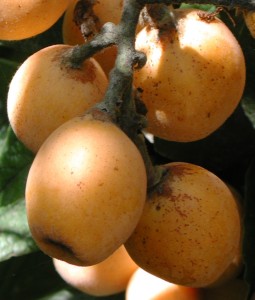
Loquat are ripening

Loquat are ripening

The Loquat fruit is more like an apricot than a plum. It’s one of those inexplicable linguisticism that in English we refer to Japan’s apricot-like fruit as a “plum” but their plum –ume—we call a Japanese apricot, which it is not. That does not make a lot of sense. It makes you wonder if a couple of pages of an early botany book book were transposed. Incidentally, the kumquat and the Loquat are not related botanically, but both share an origin in old Chinese names.  Kumquat means “golden orange.”

The Loquat tree is unusual in that it blossoms in the fall or early winter, and fruits in early winter or spring.  Its blossoms were used to make perfumes in the 1950s. The quality of the perfume was said to be outstanding, but the yield was low and not commercially viable. Some individuals suffer headache when too close to a Loquat tree in bloom, the aroma from the flowers sweet and penetrating.
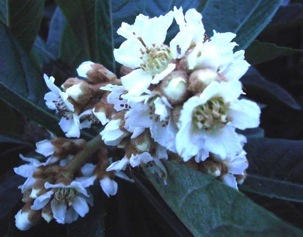
loquats

Loquats can bloom in the fall or early winter

My Loquat tree blossoms around Christmas and I have edible fruit by St. Valentine’s Day or St. Patrick’s Day. It varies.  Loquats were introduced to Florida in 1867 and the tree fruits as far north as South Carolina. The wood is pink, hard, close-grained, and medium-heavy. It is good for making rulers and bokkens. Bokkens? In Japanese martial arts the practice sword — the bokken — was often made of Loquat wood because it was hard but also brittle, perhaps a realistic substitute for swords which then could be brittle. Legend says a wound caused by a Loquat bokken will not heal and the victim will die. There is no report of what happen to wounds caused by a Loquat ruler in the hands of an old-fashion teacher, of which I had several.
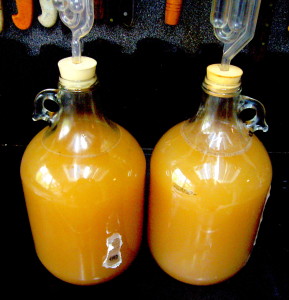
You can make a soft, sweet wine from loquats. Photo by Green Deane

You can make a soft, sweet wine from loquats. Photo by Green Deane

I planted my Loquat tree some 15 years ago and it has been fruiting heavily for seven years. Following the suggestion of local experts, the tree is pruned to resemble a bowl, which increases production, up to 300 pounds of fruit a season. The sweet/tart yellow pear-shaped fruit is a sign of winter, eh, or spring, depending upon which cultivar you have. Many recipes are included below, or just use apricot recipes. Botanically in the same family with apples, pears, peaches, nectarines et cetera, the Loquat‘s scientific name is Eriobotryae japonica (air-ee-oh-BOT-ree-uh juh-PAWN-ih-kuh). Japonica means Japan and Eriobotryae is bastardized Greek — read Latinized Greek — meaning “woolly bunch of grapes.”  Loquats grow on thick fuzzy stems in a cluster like grapes. There is no controversy that the fruit is tasty. The slippery seeds, however, are another issue.

Like many pome members of the rose family, the seeds contain small amounts of cyanogenetic glycosides. That’s almost as bad as it sounds.  Said another way, in the gut this can make minute amounts of cyanide that the body can tolerate. This is also known as amygdalin or laetrile, also called B17, a controversial alternative medicine treatment for cancer, usually obtained from apricot pips. This would all be an almost dismissible interesting factoid if all we did was spit the seeds out, or occasionally let an ingested whole seed go on its merry alimentary way. But, then there is flavoring with the seeds, roasting the seeds, and lastly, Loquat grappa, which is made from the seeds. I should say, Loquat grappa is homemade. I know of no commercial Loquat grappa. There are some Loquat-flavored liquors but they have a different taste profile completely. They taste like Loquats. Loquat grappa does not taste like Loquats.

Loquat grappa is made by soaking Loquat seeds in vodka or grain alcohol for one to six months and then adding sugar water to the infusion. The longer you let it sit, the darker and stronger flavored it becomes. The odd part is Loquat grappa made this way has a very strong cherry flavor and aroma. Is Loquat grappa poisonous?  That is a good question. Certain Indian tribes would leech cyanic glycosides out of seeds of related plants then eat the ground up seeds. If the glycosides can been leached out by water, then one would think vodka, which is half water, would leech it from the seeds to the vodka, and alcohol is a good solvent. Then again, it might not be chemically possible. If the toxin is an oil — an acid — it might not mix with water or alcohol. Perhaps a chemist will let us know. I can volunteer some Loquat grappa for science.  So while some toxicity would make sense in some amount, it is an unknown.  I’ve never seen more than four ounces drank at a time. It seems to be tolerated at that level, producing only expected effects.  I make two “fifths” a year of it and it lasts until the next season.  If you follow either of the Loquat grappa recipes included below and make your own, you’re on your own: No guarantees or promises of safety included. Consume sparingly. Oh, adding a section of cinnamon bark to the final grappa bottle adds some very nice flavor.

That said, the non-bitter roasted seeds are reported to be tasty — I’m not sure I would eat one but there are people who do, apparently — and some folks put a few seeds in the cavity of a chicken before roasting to impart a nice flavor. The roasted seeds when ground are said to be a good substitute for coffee. (I think I’ll pass on that, for two reasons: One is the debatable safety of the seeds. The other is every seed coffee extender or substitute I’ve ever had is awful, including the queen of substitutes, roasted ground persimmon seeds. )

Besides amygdalin, the seeds also have lipids, sterol, b-sitosterol, triglycerides, sterolester, diglycerides and compound lipids; and fatty acids, mainly linoleic, palmitic, linolenic and oleic. Amygdalin is also in the fruit peel, but slightly. The leaves possess a mixture of triterpenes, also tannin,  in addition, there are traces of arsenic. (Arsenic And Old Loquat?) Young leaves contain saponin. The leaves and seeds are also used in Chinese medicine, as is the fruit, which has vitamins A, B, and C. The Loquat is still one of the most popular cough remedies in the Orient, and is the ingredient of many patent medicines.

One other warning: Do not eat a green, uncooked Loquats. They taste awful and there is one case on record of several stupefying a five-year old for two hours.  Loquat pie made with greenish, not-quite-ripe fruit, however, supposedly taste like cherry pie….

Recipes:

Loquat Grappa

Soak one to two quarts of clean, whole Loquat seeds in a tight jar with a quart of vodka for one to six months. At the end of soaking time, drain the now flavored vodka and split it evenly between two fifth bottles. On the stove create sugar water by mixing equal parts of sugar and water. Heat until the sugar is dissolved. Top off each fifth with the sugar water. If you want it less sweet use less sugar, or more vodka.


Loquat wine

4 lbs fresh loquats

2 lbs granulated sugar

1 tsp acid blend

1 gallon water

1 crushed Campden tablet

1/2 tsp pectic enzyme

1/2 tsp grape tannin

wine yeast and nutrient

Wash fruit and remove seeds. Chop the fruit finely or roughly in a blender. Pour fruit over half the sugar, crushed Campden tablet, tannin, yeast nutrient, and enough water to total one gallon in primary, stirring well to dissolve the sugar. Cover with cloth. After 12 hours, add pectic enzyme and recover. After another 12 hours, add wine yeast and recover. Stir daily, adding half the remaining sugar after three days. Ferment on pulp another four days, stirring daily. Strain through nylon jelly bag and squeeze well to extract juice. Pour remaining sugar into juice, juice into secondary, and fit airlock. Siphon liquor off sediments into clean secondary after 30 days, topping up as needed. Repeat racking every 30 days until wine clears (3-4 additional rackings). Rack once more and taste. If satisfied with sweetness, bottle the wine. If too dry, add stabilizer and sweeten to taste, adding up to 1/4 cup sugar dissolved in 1/4 cup water.  Age


Here is a second Loquat grappa recipe from the internet.

Dry 200g of Loquat seeds in sun for a week. Put in a bottle with 400g spirit grain alcohol, a piece of lemon rind and a piece of vanilla bean. Keep covered in sun for 1 month, shaking it occasionally. Prepare syrup of 300g sugar and 300g water. Boil, then when cool mix with spirit, filter and bottle. Keep to season at least two months before drinking.

And, Loquat Jam

1 kg loquats, seeds removed but fruit not peeled

200 ml water

Finely grated rind and juice of 2 lemons

Simmer fruit in water till soft. mash well or put it through the blender. add juice and rind and sugar; boil rapidly till a little sets on a cold saucer. Bottle and seal.

More Loquat Jam

Wash, remove seeds, and blossom ends from whole ripe fruit. Run through food chopper and measure pulp. Barely cover with cold water. Cook until tender and deep red. Add 3/4 cup sugar to 1 cup of Loquat pulp. Cook until thick, stirring constantly. Pour into hot sterilized jars and seal with sterilized lids. It is best to cook small batches of no more than 5 cups of fruit pulp in one kettle.

Loquat Jelly

With Pectin

5 lbs. ripe loquats

1 cup water

1/2 cup lemon juice 1 package pectin

5-1/2 cups sugar

Gather Loquats when full size. Wash, remove seeds, and blossom ends. Barely cover with cold water. Simmer covered for 15 minutes Cook slowly until pulp is very soft. Strain juice through jelly bag. Measure 3-1/2 cups Loquat juice and lemon juice in a large kettle. if more juice is needed, fill last cup or fraction of a cup with water. Add pectin. Stir well. Place over high heat and bring to boil, stirring constantly. Add the sugar and mix well. Continue stirring and bring to full rolling boil. Boil exactly 2 minutes. Remove from fire and let boiling subside. Skim carefully. Pour into hot sterilized jelly glasses, leaving 1/2-inch space at top to cover at once with melted paraffin. (Or pour into hot sterilized jars and seal with sterilized lids.)

Loquat Jelly

No Added Pectin

Gather Loquats when full size. Wash, remove seeds, and blossom ends. Barely cover with cold water. Cook slowly until pulp is very soft. Strain through jelly bag. Drain and cook until juice is thick then add an equal amount of sugar. Boil rapidly to jelly stage. Pour into sterilized jelly glasses, leaving 1/2-inch space at top to cover at once with melted paraffin. (Or pour into hot sterilized jars and seal with sterilized lids.)


Spiced Loquats

For three pints of sweet pickles, wash three pounds of firm loquats and remove the stem and blossom ends; do not peel them. Drop them into the pickling syrup given below and cook until tender. Remove the fruit. Pour remaining syrup into sterilized jars. Fill almost to overflowing with the hot syrup and seal at once.

3 cups sugar

1-1/2 cups water

1-1/2 cups cider vinegar

1 tablespoon whole cloves

1 tablespoon whole allspice

2-inch stick of cinnamon

Combine sugar, water, and vinegar in a large kettle. Tie the spices loosely in cheesecloth and add. Boil 10 minutes. Put in fruit and cook gently until tender. This syrup may be used for apricots, peaches, pears, apples, crab apples, plums, loquats, and kumqats


Loquat Chutney

Use the kiwi fruit chutney recipe, but substitute peeled, seeded loquats for kiwi fruit


Blanched Loquats

To peel loquats for sauce and fruit cup, blanch by pouring boiling water over loquats to cover. Add 1/4 cup lemon juice to each quart of water. Cook over low heat about 5 minutes, just until skin loosen. Drain and reserve liquid. Cool, peel, halve, and seed loquats (remove seeds).


Loquat Sauce for Ice Cream

Combine two cups juice from blanched loquats with two cups sugar. (see Blanching above) Bring to boil, cook over medium heat until syrup spins a two-inch thread when dropped from a spoon (230 degrees to 234 degrees Farenheit on candy thermometer), about 20 minutes. Cool completely. Add two cups peeled, halved, seeded loquats. Chill, then serve over ice cream. Makes about three cups sauce.


Sugar and Spice Loquats

Sprinkle seeded (peeled if you want) fruit with granulated sugar. Mix cream cheese with powdered sugar and cinnamon and put in cavity. Top with a cut piece of strawberry.


BLOG NOTE: I have made the follow pie without seeds and it it is quite tasty.

Loquat Pie

8  cups loquats

1/2 cup water

1 cup sugar

3 tablespoons flour

1/4 teaspoon salt

1/8 teaspoon ginger

1/8 teaspoon allspice

pastry for a double crust pie

Stem, wash and cut up loquats, leaving a few seeds for flavor, (When the pie is baked, the seeds taste almost like nuts and are really very good).  Cook the loquats in water, covered, for about 10 minutes or until almost tender.

Combine the sugar, flour, salt, ginger and allspice.  Stir in the loquats.  Cook, stirring, until thickened.  Remove from the heat and cool.

Pour into a pie plate containing the bottom pie crust.  Cover with the top crust and prick with a fork or put a few cuts in the top crust to allow steam to escape while baking.

Bake at 450 degrees “F” for 10 minutes, then reduce the heat to 350 degrees “F” for another 45 minutes.

Cool and serve..  With Vanilla bean ice-cream, and a light rum sauce..

__________________________________________________________________

The following recipes come from Marian Van Atta, whom I knew in the early 80’s. She had a newspaper column called Living off the Land. She looked home-spun and back to nature long before it was posh, a portly Mom Nature. She has a book, also available at Amazon: “Exotic Foods, a Kitchen and Garden Guide.” Here is the link: http://www.amazon.com/exec/obidos/ASIN/1561642150/californirarefru


Fresh Loquat Relish

1 cup of loquats, cut in half and seeded

2 or three calamondins (quartered and seeded)

1/4 cup honey

1 tablespoon lemon juice

1/2 cup raisins

Put all ingredients in a blender and chop for a minute or so. Put in a covered jar and store in the refrigerator. Will last at least a week.


Martha’s Loquat Pie

3 cups loquats, seeded and sliced

3/4 cups sugar, less if fruit is very ripe

2 tablespoons flour.

Mix loquats, sugar and flour together. Put in unbaked 9-inch pie crust. Cover with top crust and slash for steam vents. Bank at 400 degrees for 10 minutes. Reduce to 350 degrees. Bake until crust is browned, about 35 more minutes.


You can also dry Loquats. Cut in half, remove seeds, prick skin with fork, dry accordingly.


Loquat Food Value Per 100 g of Edible Portion

Calories 168

Protein 1.4 g

Fat 0.7 g

Carbohydrates 43.3 g

Calcium 70 mg

Phosphorus 126 mg

Iron 1.4 mg

Potassium 1,216 mg

Vitamin A 2,340 I.U.

Ascorbic Acid 3 mg


Green Deane’s “Itemized” Plant Profile

IDENTIFICATION:

Evergreen large shrub or small tree, rounded crown, short trunk, woolly new twigs. Leaves alternate, simple, 10-25 cm long, dark green, tough, leathery, toothed edge, velvety-hairy below.

TIME OF YEAR:

Culitvars vary, some fruit in spring, some fruit in late summer or fall.

ENVIRONMENT:

It likes heat and full sun,  will survive said if watered. Naturalized in many areas.

METHOD OF PREPARATION:

Yellow fruit raw or cooked, seeds can be used to make a cherry-flavored liquor.

{ 60 comments }

The Teaberry Shuffle

I saw Gary Vickerson eat an earthworm I found near a Checkerberry plant. Personally I preferred the Checkerberry.

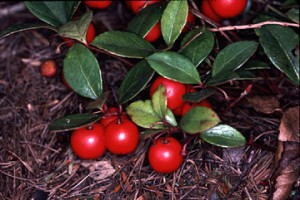
Checkerberries stay red under the snow.

Before I go any further let it be known the Checkerberry is also called — in English — Johnny Jump Ups, Wintergreen, Teaberry, Boxberry, Mountain Tea, Canadian Mint, Deerberry, Leatherleaf, Groundtea, Groundberry, Hillberry, Mountainberry, Patridgeberry, Grouseberry, Spiceberry, Redberry Tea, Wax Cluster and Ivoryberry.  The Ojibwa called it Winisbugons …  “Dirty Leaf” … and the French la Petit te du bois, “The Little Tea of the Woods.”  Its scientific name is Gaultheria procumbens, ( Gol-THAIR-ee-uh  proh-KUM-benz) named after Jean Francois Gaultier a court physician in Quebec. Procumbens means trailing but not rooting, nearly flat on the ground.

Back to Gary: I was about to start high school and Gary was less than half my age. He ate the worm, dirt and all, and laughed about it. No threats. No bribe. No “dare ya.” He just looked at it then ate it. Oddly, he was the only kid in that family of six who turned out all right.

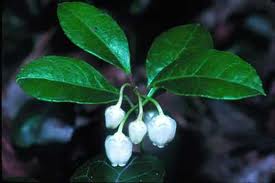
Checkerberry in blossom

The checkerberries grew on a low hillside between our houses, which were about a half a mile apart through the woods. It was probably just one checkerberry because it is their habit to send roots everywhere and pop up everywhere giving the impression of a patch when it is but a single individual plant. Every year I marveled how they were the first plants to bear fruit after the snow left. It wasn’t until years later that I learned the berries overwintered under the snow and are already there when the snow melted. At any rate I looked forward to them every April or so. In large fields of dead brown grass the verdant wintergreen and its red berries were easy to spot. Perhaps the birds had the same idea. And if I couldn’t find a berry, I’d chew on the leaves, lightly wintergreen with a slightly bitter after taste.

At one time it was very popular as tea, hence the name Teaberry but people have forgotten how to make Teaberry tea. While its leaves and branches can make a mild tea through normal drying and seeping in hot water there is a better way: Ferment the leaves in warm sterile water for a few days until they begin to bubble. Then use those leaves for tea, either wet from the fermentation vessel or dry them. And while it makes an excellent tea, it is a tea containing methyl salicylate… so think of it as a pleasant aspirin. Given the choice of an aspirin a day or a cup of checkerberry tea I’ll take the original.

Man is also not the only forager of checkerberries. They provide food for squirrels, chipmunks, deer mice, grouse, partridges, bobwhites, turkeys, fox deer and bears.

One next to last thing: Why was the plant named after Jean-François Gaultier?  He was the king’s official physician and naturalist assigned to Quebec, or New France as it was known then. He arranged for fort commanders to collect plant specimens for him, a task I am sure they enjoyed. In 1749 Gaultier and a botanical friend, Swede Pehr Kalm, rummaged around the plants of Québec City and Kalm named the checkerberry after Gaultier.

Gaultier, by the way, was more than a mere dilettante doctor cum tree hugger. He shipped plants to France every year. His 1749 manuscript lists 134 species, many of which he was the first to mention including four different species of pine. He also set up the first weather station in Canada and kept a log from 1742 to 1756. Not just interested in plants, he sent minerals and preserved animals back to France for the scientists of the day. His main interest, however, was the medical properties of plants. He even managed to write the history of maple sugar… talk about a sweet job.

Green Deane’s “Itemized” Plant Profile

IDENTIFICATION:

Alternate leaves, simple, evergreen, oval to elliptical, 1 to 2 inches long, tiny teeth, stiff with a wintergreen odor when crushed, leaves cluster at tip of plant; dark shiny green above, paler below often with black dots. Flower small, quarter-inch, white, urn-shaped, hanging from short stems in mid to late summer. Fruit is red, round, 1/4 to 1/2 inch through, hanging beneath leaves, mild wintergreen taste, ripen in late summer, can last through winter. To six inches high.

TIME OF YEAR:

Berries fall or spring, under the snow if you can find them.  Leaves year round, eastern North American down to northern Georgia.

ENVIRONMENT:

Sandy soil in northern fields and cool damp woodlands

METHOD OF PREPARATION:

Berries out of hand, leaves as tea, fresh, dried or fermented.

HERB BLURB

Comparison of Oral Aspirin Versus Topical Applied Methyl Salicylate for Platelet Inhibition

David A Tanen, MD, Medical Toxicologist, Department of Emergency Medicine, Naval Medical Center San Diego, San Diego, CA

BACKGROUND: Oral acetylsalicylic acid (aspirin) is the primary antiplatelet therapy in the treatment of acute myocardial infarction and acute coronary syndrome. Methyl salicylate (MS; oil of wintergreen) is compounded into many over-the-counter antiinflammatory muscle preparations and has been shown to inhibit platelet aggregation locally and to be absorbed systemically.

OBJECTIVE: To assess the ability of topically applied MS to inhibit systemic platelet aggregation for patients who are unable to tolerate oral drug therapy.

METHODS: A randomized, prospective, blinded, crossover study was conducted in 9 healthy men, aged 30–46 years. All subjects ingested 162 mg of aspirin or applied 5 g of 30% MS preparation to their anterior thighs. There was a minimum 2-week washout period between study arms. Blood and urine were collected at baseline and at 6 hours. An aggregometer measured platelet aggregation over time against 5 standard concentrations of epinephrine, and a mean area under the curve (AUC) was calculated. Urinary metabolites of thromboxane B2 were measured by a standard enzyme immunoassay. Differences in and between groups at baseline and 6 hours were tested by the Wilcoxon signed-rank test.

RESULTS: Baseline platelet aggregation did not differ significantly between the 2 arms of the study (median AUC [% aggregation*min]; binominal confidence intervals): aspirin 183; 139 to 292 versus MS 197; 118 to 445 (p = 0.51). Both aspirin and MS produced statistically significant platelet inhibition; aspirin decreased the AUC from 183; 139 to 292 to 85; 48 to 128 (p = 0.008) and MS decreased the AUC from 197; 118 to 445 to 112; 88 to 306 (p = 0.011). No significant difference was detected between baseline and 6-hour thromboxane levels for either aspirin (p = 0.779) or MS (p = 0.327).

CONCLUSIONS: Topical MS and oral aspirin both significantly decrease platelet aggregation in healthy human volunteers.


{ 17 comments }
asdsdfdsf

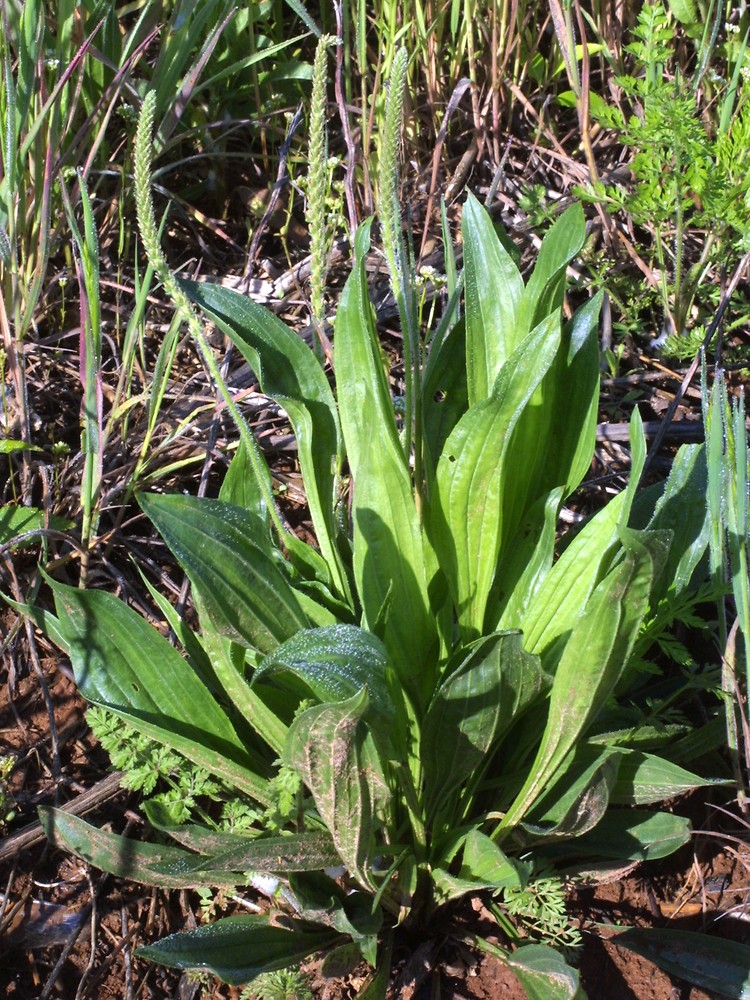
Plantago lanceolata, photo by Green Deane

White man’s Little Foot: Dwarf Plantain

Plantagos To Go   

When I was about 10 a bee stung my left hand while I was being a pest in the garden with my step-father. My hand began to swell and I started to complain, to put it gently. My step-father picked a large Plantago major leaf, chewed it up, and stuck the green glob on the sting. I can’t recall if it eased the pain but I never forgot the moment.

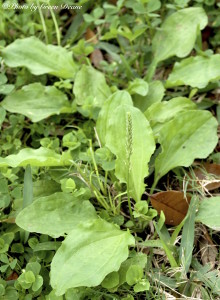
Plantago major, (plan-TAY-go MAY-jor) a native of Europe (photo lower left) has been used for food and medicine for a long time. While Plantagos are used the same way I am going to write about its little cousin that’s always under foot, the Dwarf Plantain or Plantago virginica, (plan-TAY-go vur-JIN-nick-uh) which is native to North America. It’s found in most US states excluding the northern Rocky Mountain states. We’ll also look at the P. major, as well. Both are edible, in fact, I have not read of an non-edible plantain.

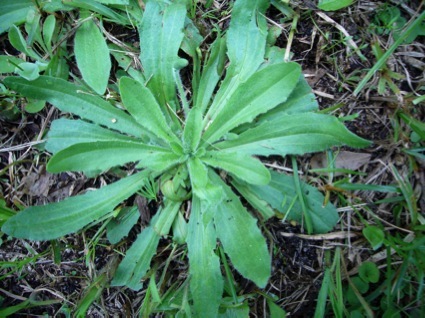
Plantago virginica, toothy leaves and fuzzy

Getting used to a skinny gray green hairy P. virginica  leaf takes time, especially if you’re used to the larger, round, greener, smooth P. major. The P. major is sporadic here in Central Florida, but the P. virginica is quite common but seasonal. I could seed the entire south with the P. virginica in my little lawn alone. And speaking of seeds, the bulking agent psyllium is the husks of a plantago seed. That does need to be qualified slightly. The husk are an insoluble fiber, the seed a soluble fiber. If you order said make sure you know which (or both) you are getting.

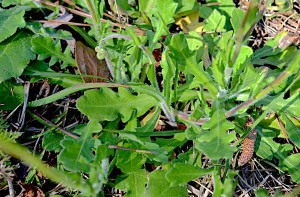
As I write it is three quarters of the way through February (there is an full eclipse of the moon tonight, which will date this article.) The local plantains are still in the rosette stage, just starting to send up spikes that will eventually bear seeds. The leaves are mild in flavor now and though it takes a lot of them to make a side dish for one, they are tasty. Later in the season, as with most greens except the Tradescantias, they will grow rank. Plantagos also grow coarse, one of the problems with eating P. major which can be quite fibrous. Fiber is also an element of identification. If you carefully break the lower stem of a Plantago where it meets the rosette, several elastic cords will remain attached. You’ll find three cords to five cords. Other plants — some fleabanes, see photo below right — have cords as well so that is not the sole means of identification.

I think several references on the internet misidentify P. virginica, calling it Plantago lanceolata, or the English Plantain, which one also sees in Florida.  That the P. virginica is hairy and has points on its leaves and the P. lanceolata (lan-see-oh-LAY-tuh) does not seem to be overlooked.

Another point to make: The Plantagos are dicots even though they don’t look it. They are visual exceptions to the rule until ones looks very closely. Monocots (unicots) are plants that come out of a seed with only one leaf — mono is Greek for only or alone. They have a rhizome (a horizontal root) instead of a tap root (a vertical root.)  Dicots (dio is Greek for two) come out of the seed with two leaves, send down a tap root, and have leaves with veins that branch out. The Plantagos look like monocots but they are dicots. The entire family has some promising medical properties. A study reported in the 30 October 2007 edition of the American Journal of Chinese Medicine demonstrated P. major had tumor inhibiting capacity in lab rats. A tea from the leaves is good for lung congestion and hay fever. As for the name…

Plantago major, native to Europe.

Plantago major, native to Europe.

Native Americans called the P. major the “white man’s foot” because they notice where ever he went the plant soon showed up. That is quite intuitive, here’s why: Plantain and Plantago both go back to the same Greek word, platus, which means wide, and from which we get “plateau” in English. That is also why some Greek writers think the philosopher Plato had large gluts, he was called Plato because he was wide in the butt. Platus became Planta as in plantar warts. Plantago is a derivative of planta. Plantago became Plantagin in Dead Latin, Plantein in Old French, Plauntein in Middle English and Plantain in modern English. Then P. major came to the new world to have native Americans call it “white man’s foot”…kind of where it started out. It would seem diverse humans think alike. More so, the story doesn’t end there.

Just as P. major invaded North America from Europe, P. virginica is now invading the Orient, having been introduced to eastern China in the 1950s and is spreading to other nations from there, Korea in 1994. One might say that it is spreading by “occident.” The only solution is eat the weeds. See recipes below.

Oak Leaf Flea Bane

Oakleaf Flea Bane

As mentioned above, many folks confuse Oakleaf Fleabane for the Dwarf Plantain.  It shows up about the same time, has furry leaves with teeth, and worse, fibers in the stem like plantagos. But it is more lumpy than toothy and it does not have leaf veins that look parallel.  Don’t eat it but you can put the leaves in your pet’s bed to reduce fleas. I have had people tell me they ate oakleaf flea bane by mistake. As they told me that clearly they survive the consumption.

Lastly, if you find a really huge Plantago major with red at the base of the stem it’s probable the native Plantago rugelii, still useful.

Green Deane’s “Itemized” Plant Profile

IDENTIFICATION: Plantago virginica: Leaves  in a rosette, spatulate to oblanceolate or obovate, lightly hairy above and below, lateral veins start at the base of the leaf down the blade, parallel to midrib, shallow occasional tooth on leaf. Stems tall, erect, solid, multiple from the base, not branched. If you have a plant that looks like Plantago major but the bottom of the stem is purple you have P. rugelii.

TIME OF YEAR: Greens in spring, seeds in summer

ENVIRONMENT: Unused fields, pastures, waste ground, lawns, likes full sun

METHOD OF PREPARATION: Young leaves raw in salads, cooked as greens or in soups and stews. Remove fiber in older leaves. Seeds are edible and keep you regular.

HERB BLURB

Herbalists say Plantagos have been used for inflammation of the skin and applied to soars. Fresh leaves are applied whole or bruised. They contain an astringent and help stop minor bleeding. They can also be rubbed on nettle and bee stings.


The first recipe was created by Wildman Steve Brill.

Roasted Plantain Chips

Unlike the banana-related plantain chips of the supermarket, this wafer-thin chips are made with the leaves of the unrelated common plantain. They’re great, and it took Steve only 26 years of downplaying this plants food value to discover how to prepare it properly, using a method his wife uses for kale.

2 cups young common plantain leaves, or kale

2 tsp. sesame oil

1/2 tsp. fennel seeds, ground

1/2 tsp. caraway seeds, ground

1/4 tsp. powdered ginger

1/2 tsp. salt

A dash of hot sauce

1. Stir all the ingredients together

2. Spread onto 3 cookie sheets covered with non-stick mats (or oiled

cookie sheets) and bake about 6 minutes, or until very lightly browned

and crisp, in a preheated 425 degree oven. Stir occasionally, being

careful not to let the leaves burn

And from Christopher Nyerges we have two recipes:

Plantain Soup

3 cups of diced plantains

4 cups of milk or water (milk from powdered milk works as well)

2 eggs

1/2 cup flour, wheat or potato

1 turnip

1 Jerusalem Artichoke

Salt and pepper to taste

Dice the plantains, remove any fibers. Simmer the diced plantains in the milk or water. Chop up the turnip and Jerusalem Artichoke and add to the liquid. In a separate cup add water or milk to the flour to get a non-lumpy consistency, then add to the soup. Separate the eggs and whites, beat separately, add separately to the soup, stirring constantly. Salt and pepper to taste.

Stuffed Plantain Leaf

1 pound ground beef, or the like

2 cups cooked rice

1 clove of garlic

2 lettuce leaves or the like

1 egg, beaten

Boil or steam the plantain leaves, remove any fibers, set aside the leaves. Cook the meat, add the cooked rice and other ingredients. Cook until tender. Place a tablespoon or so of the mixture on each plantain leaf and fold the leaf around the mixture. Place on a baking dish, bake 15 minutes 325, or just enough to warm them up. Salt and pepper to taste.

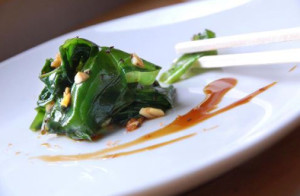
Plantago Side Dish by Pascal

Plantago Side Dish

Plantago Side Dish

This is a winner! Broadleaf Plantain leaves boiled for 4 minutes in salted water then placed in ice water right away. Seasoning: 1 tablespoon sesame oil, 1 tablespoon soy, 1 garlic clove and, in my case because I didn’t have sesame seeds I used roasted white sage seeds. Mix and let rest for 5 minutes. Super yum! The plantain has a bit the texture and transparency of a seaweed.

Editor’s note: In this recipe Pascal used Plantago major.

{ 48 comments }
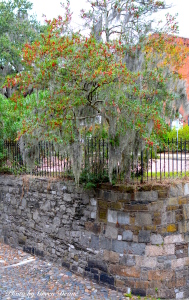
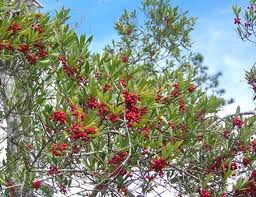
A holly fruiting in December along Bay Street in Savannah, Georgia. . Photo By Green Deane

A holly fruiting in December along Bay Street in Savannah, Georgia. . Photo By Green Deane

Holly Tea With Vitamins A & C

Ilex cassine, Dahoon Holly

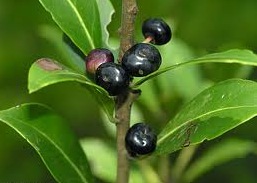
This time of year in the South — late fall, early winter —some of the hollies are so scarlet with berries that even the tourists can spot them while doing 85 on Interstate 95, if they bother to look. The hollies, usually Ilex cassine, resemble red torches beside the roadway. Their brilliant berries are food for woodland creatures. You are not a woodland creature, so leave the berries alone. However, the leaves of some hollies can be carefully made into a tea, with or without caffeine. The leaves also have vitamin A and C and are packed with antioxidants.

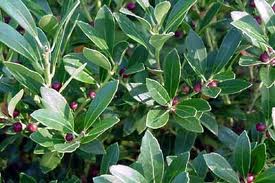
Ilex glabra, the Gallberry

The often-preferred holly for decaffeinated tea is the gallberry, Ilex glabra (EYE-lecks GLAY-bruh) which means smooth oak. Why oak? Well, it’s a bit of a linguistic fudging. There is a European oak tree that resembles the holly and it was called … in Dead Latin, Ilex, or the Holly Oak. So when hollies were being named, their leaves were like the holly oak so Ilex became their genus name even though hollies are not oaks. It’s just one of those things one can expect from a dead language only fossilized academics like, whereas the older Greek, still spoken, is doing well and is not misnaming plants. Also called the Inkberry — because of its non-edible black berries, and the Bitter Gallberry — dried gallberry leaves taste exactly like orange pekoe tea, except, as mentioned, without the caffeine. But, now a bit of qualification:

Ilex vomitoria, the Yapoh Holly

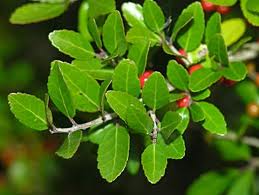
The Yaupon Holly, which has the highest caffeine content of any plant in North America, is called Ilex vomitoria  (EYE-lecks vom-ih-TOR-ee-uh.)  Yeph, it means what you think it mean: vomiting oak but we know it is really vomiting holly… still not pleasant.  Native  used to make an every-day caffeinated drink from its young leaves and twig tips. However, for solemn ceremonies they would boil up an intentionally strong brew only for the men to drink. The fellow who could hold the concoction down the longest was entrusted with important missions. Osceola means “yaupon singer” meaning he could hold the stuff down the longest, which brings me back to gallberry.

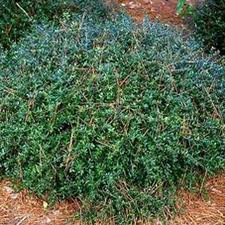
Ilex nana, a dwarf I. vomitoria

To make gallberry tea, just collect some leaves, air dry or dehydrater dry them (that’s important) then roast them in a slow oven until golden, then crush. Pour hot water over them, let them seep for two minutes, and enjoy. Unfortunately, while that tea tastes just like regular tea, and has no caffeine, it does not like me. I seem to be the only one but it is the first plant I’ve run into that causes me problems. If I drink Gallberry tea within 40 minutes I have to go pray to the porcelain god.

Traditionally Yaupon was processed differently. The leaves were kiln dried then powdered in mortars. Some of the powder was put in a bowl and cold water poured over it and allowed to sit a few minutes. Then hot water was added. Some writers say the ceremonial brew was made from green Yaupon that were used fresh, read not allowed to dry. Roasting, however, does increase the availability of the caffeine.

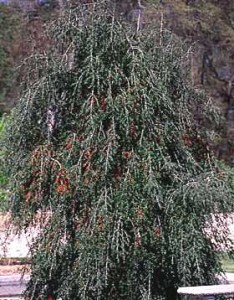
Ilex pendula, a weeping I. vomitoria

Dr. William A. Morrill, a plant PhD, wrote in 1940 there are two ways to make holly tea. One is to boil the cured leaves like coffee, not seep them like tea. (Cured means oven dried or steamed.) But, of the Yaupon, he said the best holly tea was to use an equal mix of chopped brown dry roasted and steamed green leaves (remember you must dry them first, then roast or steam.)  I got his information from a crumbling, out-of-print book that used to be in the Orlando Public Library. Only you and I know it. While Yaupon Holly tea does have a lot of caffeine it is practically free of tannin, which reduces bitterness considerably. It is also full of antioxidants which are good for you.

The form of I. vomitoria that has the most caffeine is the Weeping Holly or Ilex vomitoria var. “pendula.”Feeding” it nitrogen also increase the amount of caffeine.  The ornamental holly, Ilex nana (EYE-lecks NAH-nuh) is a female dwarf version of the I.

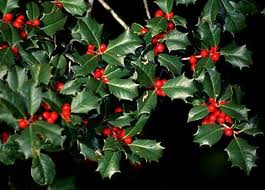
Ilex opaca, American Holly

vomitoria. Ilex schiller/schilling is a male dwarf version of the Ilex vomitoria. A tea of either made from dried leaves is caffeinated. Of the two, here in the South the dwarf versions is the most commonly encountered. As a landscape plant they are actually much easier to find than the parent Ilex vomitoria., depending on where you live.  The Yaupon holly was a very popular drink into the late 1800s. Why it fell from favor is not known though coffee might have had something to do with it. In the 2009 Journal of Economic Botany an article recommended Yaupon become a commercial crop again, especially considering its high levels of antioxidants.

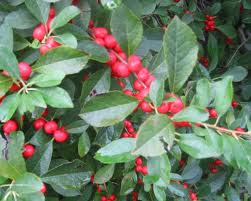
Ilex verticillata, Winterberry Holly

If your dwarf holly has black berries (and is not the Ilex glabra) and grows upright (pencil like) then you have Ilex crenata, a common northern landscape holly. I don’t know if that is consumable.  Two other hollies, however, make good tea without caffeine: the American Holly, Ilex opaca ( EYE-lecks oh-PAY-kuh) and Ilex verticillata, (EYE-lecks ver-ti-si-LAH-tuh.)

The American Holly was a popular tea during the American Civil War.  Interestingly, the American Holly and the English Holly were used to clean chimneys because of their stiff, toothy leaves. Holly branches and leaves were tied together into a large bundle then attached to the middle of a long rope. The rope was fed down the chimney and the bundle pulled up and down until the chimney was free of soot and other deposits.

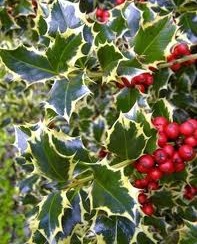
Ilex aquifolium, English Holly

The Dahoon Holly is the full-sized tree used most often for landscaping. It’s very leafy and with lots of berries. American Holly is the one found most often in Christmas wreaths with curly, pointy leaves.  If the wreath hasn’t been sprayed, you can recycle it in your tea cup. And, while holly tea is fine and dandy — for most, he says with envy — let me remind you: Don’t eat the berries. They are mildly toxic to an adult. Twenty to 30, however, is a lethal dose for a small child. I have seen hollies planted in landscaping around primary schools here in Florida. Now ain’t that brilliant. The Dahoon Holly, Ilex cassine (EYE-lecks kuh-SIGH-nee) makes a tea without caffeine but it is the least recommend of them all.  It can cause headaches and can be laxative.

Ilex coriacea the Large Gallberry

One little aid in identification of all hollies including the gallberry: They will have at least three or more points or “tooths” on the leaves, minute in the gallberry, like tiny, tiny, soft thorns, makes it kind of look like the Boy Scout salute. If you take a very close look at the gallberry picture, you can see the points on the leaves. All hollies have them, sometimes obvious, sometimes very muted and rudimentary, but there none the less. The Dahoon Holly will have toothless leaves and leaves with teeth though those with teeth the teeth are usually on the upper part of the blade.

The English Holly, or European Holly, Ilex aquifolium, (EYE-lecks a-kwee-FOH-lee-um) found in Europe, is a common landscape plant in the United States and is naturalized in Ontario and the pacific coast California to Alaska. You’ll know it when you see it, it looks like the American Holly

Yerba Mate, Ilex paraguariensis

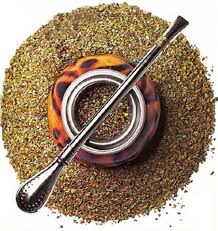
except it often has an edging of yellow or white around the leaf. Its leaves have been dried for tea, the roasted berries used as a coffee substitute (doubtful and be cautious) and the berries are also used to make a brandy. Ilex latifolia leaves are made into tea in Asia, the seeds into a coffee. The jury is out on Ilex cornuta (EYE-lecks kor-NOO-tuh.) The Chinese have a lot of herbal applications, the tea is supposedly a contraceptive for women, and whether the berries are edible or not is iffy. I mention it because the Ilex cornuta var Bufordii is a common landscape plant sold at home do-it-yourself stores in Florida. Yerba mate, the most common drink is South America, is made from the Ilex paraguariensis. ( EYE-lecks para-gwar-ee-EN-sis)

One more thing…there is another gallberry holly, called Ilex coriacea  EYE-lecks kor-ee-uh-KEE-uh.)  It has reddish twigs and the leaves have little spines on them, whereas the gallberry has dimples usually. The I. coriacea grows much larger — a small tree to fifteen feet is possible —and there are some reports the berries are edible, hence the nickname Sweet Gallberry. Gray’s Manual of Botany says the berries are “in an axil, soft and pulpy when ripe, dropping in autumn, said to be edible.”  While I have seen the Sweet Gallberry in north Florida near the headwaters of the Santa Fe River  it has never had any berries on it for me to try.

 Cassine is from an American Indian name for a plant with similar fruit. In early writings both the Dahoon and the Yaupon were called CassineOpaca means shady because the plant can grow in some shade. Verticillata means in a whorl and coriacea means leathery.  Cornuta is bearing horns or spurs, usually the flowers. And aquifolium means …. holly-like leaves… THAT certainly took imagination.

Incidentally, gallberry is considered a quality and consistent source of bee nectar in Florida and is the top third or fourth producer of honey. If a bee can like it, maybe you can, too.

Keying out Ilexes in Florida:

Group One

Leaves thin, membranous

Leaves evergreen, entire or rarely denticulate, fruit dull purplish
to black, plants of south Florida only ….. Ilex krugiana

Leaves deciduous

Leaves pubescent on most of the upper surface, margins serrate
Leaf blades elliptic with a rounded leaf base, 6-9 cm long….. Ilex amelanchier
Leaves smooth on the upper surface, margins crenate to serrate
Leaf blades oblanceolate to ovate, 2-6 cm long, margins crenate ….. Ilex decidua
Leaf blades elliptic to ovate, margins serrate to crenate
Leaves with conspicuous veins, flowers and fruit appear singly or
in clusters up to 3, in the leaf axils….. Ilex verticillata
Leaves without conspicuous veins, flowers and fruit appear
clustered from spur shoots ….. Ilex ambigua

Group Two

Leaves coriaceous, evergreen
Fruit red to yellow, Leaf blade with sharp pointed teeth, these are usually regularly
spaced ….. Ilex opaca
Leaf blade entire, crenate or serrulate, Leaf blades with a rounded apex ….. Ilex vomitoria
Leaf blades with a sharp, pointed apex
Leaf blades 1-4 cm long and usually less than 1.5 cm wide,
margins entire, tip sharp pointed ….. Ilex myrtifolia
Leaf blades generally longer than 4 cm and wider than 2 cm,
may have a few teeth at the tip or with a single sharp
point ….. Ilex cassine
Fruit black
Leaves crenate, leaves often cupped, 3-5 cm long
….. Ilex glabra
Leaves with a few small teeth, leaves somewhat cupped, 4-7 cm long
….. Ilex coriacea


{ 27 comments }