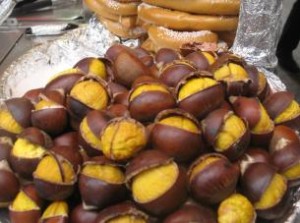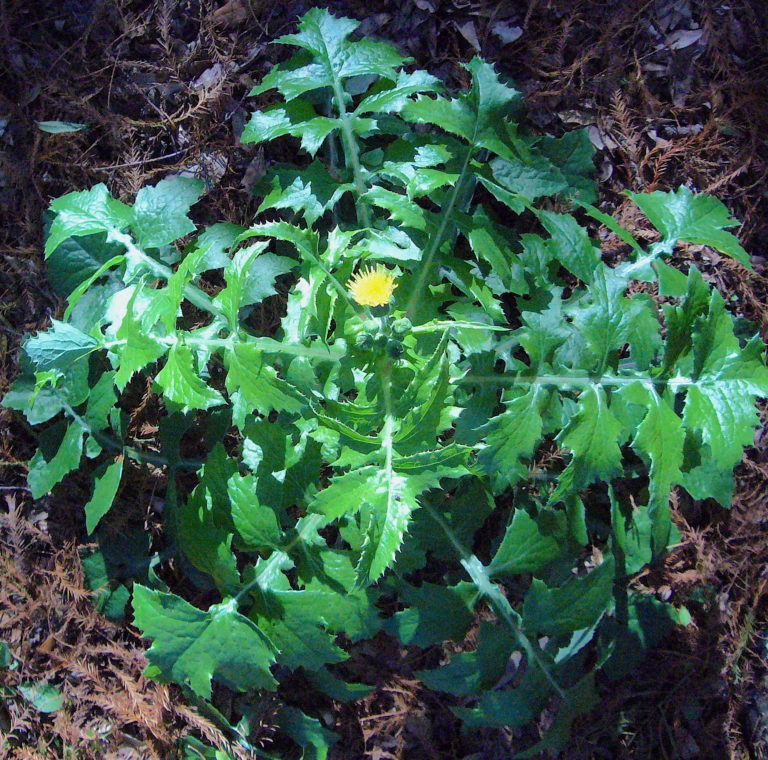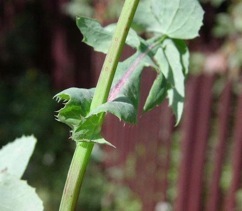
Sow Thistles can turn purple as they age. Photo by Green Deane

Sonchus: Sow Thistle, In A Pig’s Eye

Starting in  mid-January in Florida, later north of here, two of three local species of sow thistles invade my lawn in great number. They are so good they’re worth all the complaints about my untraditional lawn. I can’t eat them fast enough. In fact, right now I am having a bowl with homemade butter, salt and pepper. I threw a couple of plants that were a little too old into the pot but they weren’t too bitter. That bitterness is caused by their white sap.

You cannot eat most plants with white sap (or white berries.) That is one of the general rules of foraging for wild food, besides that and never eating anything wild without positive identification and verification it is edible. There are three or four common exceptions to the white sap rule: Figs, Ground Nuts, Sow thistles and various Wild Lettuce.

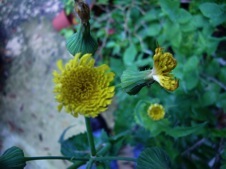
Typical Sonchus blossom

There’s a huge variety in sow thistles, from having few or no prickles to having a lot, from a foot high to six feet high, from green to purple, especially older plants. Young sow thistles can just be tossed in the herb pot, where as some older leaves need to be trimmed of the thistles, which is a point of culinary departure. Really old leaves are bitter and not that much fun to eat even if they are edible. Frankly if you have to trim spines off sow thistles you’re better off leaving them alone. Young and tender leaves is a good rule to follow particularly with the rougher species. When young their flavor resembles lettuce and as they age more like Swiss chard. When old they are just bitter. I try to harvest them between four and 12 inches high.  The young stalks peel and cooked are excellent, too. The young root is also edible when cooked but tends to be woody.

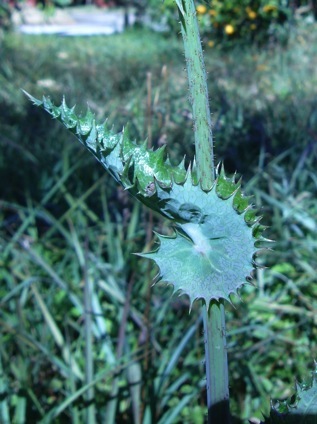
Sonchus asper leaf and stem. Photo by Green Deane

The three common ones are Sonchus oleraceus, (SON-kus oh-ler-AY-see-us ) Sonchus Asper (SON-kus ASS-pur) and Sonchus arvensis (SON-kus ar-VEN-sis.) They are respectfully the common sow thistle, the spiny sow thistle and the field sow thistle. The Oleraceus has green leaves with a bit of blue, Delta- arrow-shaped end lobes and distinctly pointed lobes where it clasps the stem. The asper has spiny round lobes where it clasps the stem. It also has a lot of spines. It’s the one that can require trimming. The arvensis has more lance shaped leaves, lobes can be irregular, and soft small spines. It is the softest of the three with a tactile feel closer to a wild lettuce.

Sonchus blossom as the insect sees it, photo by Bjørn Rørslett – NN/Nærfoto

As for the sow thistle’s botanical name: Sonchus is the ancient Greek name for the plant and means “hollow” referring to the plant’s hollow stem, a point of identification.  Although grazing animals (and butterflies) actually prefer the Sonchus to grass farmers rant about the plant because it’s a weed amongst their crop.  It is sad to say but a lot of agri-business is not green, or perhaps not so in the United States. In southern Italy Sonchus invades crops there but they have the good sense to pick it and serve it with spaghetti. Oleraceus means it is edible or cultivated.  Asper means rough, and arvensis of the cultivated field.

Sonchus oleraceus leaf and stem

Sow thistles got their name because they were fed to lactating pigs. (Remember the old heuristic way of thinking? If you want to see like a hawk eat hawk eyes. If you want mama pigs to nurse better feed them plants with white sap.)  Anyway, the white sap of the thistle was assumed to be good for nursing sows. As it turned out, pigs love them, as do rabbits which is why they are sometimes called Hare Thistles (they are not true thistles, however, which is another genus altogether. True thistles always draw blood their spines are so sharp. You can read about them here. )

As you can assume, sow thistle is found literally around the world. In Greece, it is used in winter salads, and has been for thousands of years. Pliny wrote that before Theseus went to meet the Bull of Marathon, he was treated by the old woman Hecale (e-KAH-lee in Greek) to a dish of sow thistles. The ancients Greeks considered sow thistle wholesome and strengthening — maybe the Bull of Marathon should have eaten some. Modern Greeks call it Zohos. In New Zealand, Sonchus is called “puha” and is frequently eaten, particularly by the Māori who also used the sap as a gum.  A very nice blog on the  Māori  and the Sonchus can be read here.

Again, young and tender is usually better when it comes to cooking wild greens. Here are some sow thistle recipes from ‘The Essential Hedgerow and Wayside Cookbook’. Incidentally, young Sonchus asper may seem prickly when raw but its soften when cooked (unless you picked them way to old.)

BUTTERED SOW-THISTLE

1 or 2 handfuls sow-thistle leaves – young

Butter or oil

Beef stock or water

Ground nutmeg – pinch

1 tsp. flour

Salt and pepper


For this recipe the young 2- to 4-inch leaves of common sow-thistle

[Sonchus oleraceus] are best and when the leaves are not bitter.

Other sow-thistle species may need their spines trimming off and

may be bitter to the taste requiring some preparatory boiling.


Heat some butter or oil in a pan and add the leaves. Stir thoroughly to

coat the leaves. Add a good slug of stock or water, reduce the heat to a

simmer and cover. Cook for about 5 to 10 minutes. Add a pinch of nutmeg,

the flour and some seasoning. Stir everything, then add another knob of

butter and melt into the sow-thistle over a low heat.

Serve.


STIR-FRIED SOW-THISTLE & PORK

½-1 cup pork meat – shredded / sliced

Light soy sauce

Corn flour – pinch

Water

White wine or dry sherry

Sugar – pinch

Salt and pepper

Sows thistles


Begin by slicing the meat into pieces about 2 inches long and 1/10th inch thick. Set aside. Next, make up a marinade from the remainder of the first group of ingredients, using a splash of soy sauce, slugs of water and wine, seasoning and pinches of corn flour and sugar. Mix together well in a bowl and then add the sliced meat. Stir thoroughly so that all the pieces are

coated and leave for 30 minutes. Heat some oil in a frying pan and fry the ginger for a couple of minutes, stirring to prevent burning, then add the spring onion. Stir for a minute, then add the meat. Stir-fry until the meat begins to cook. Add the sow-thistle leaves and continue frying for another 3 or 4 minutes, stirring to prevent burning and distribute the heat.

Green Deane’s “Itemized” Plant Profile

IDENTIFICATION: Plants have milky sap. S. Oleraceus tall with stemless lobed leaves that point past the stem. S. asper prickly-edged stem-less green leaves that wrap around the stem, dandelion-like blossoms more or less arranged in a flat top manner. S. arvenis similar to both but can be very tall.

TIME OF YEAR: In northern climates spring, summer and some times autumn, in the South December through April.

ENVIRONMENT: Lawns, fields, vacant lots, waste areas, parks

METHOD OF PREPARATION: Young leaves in salads, tend to be bitter, older leaves boiled for 10/15 minutes.

{ 49 comments }
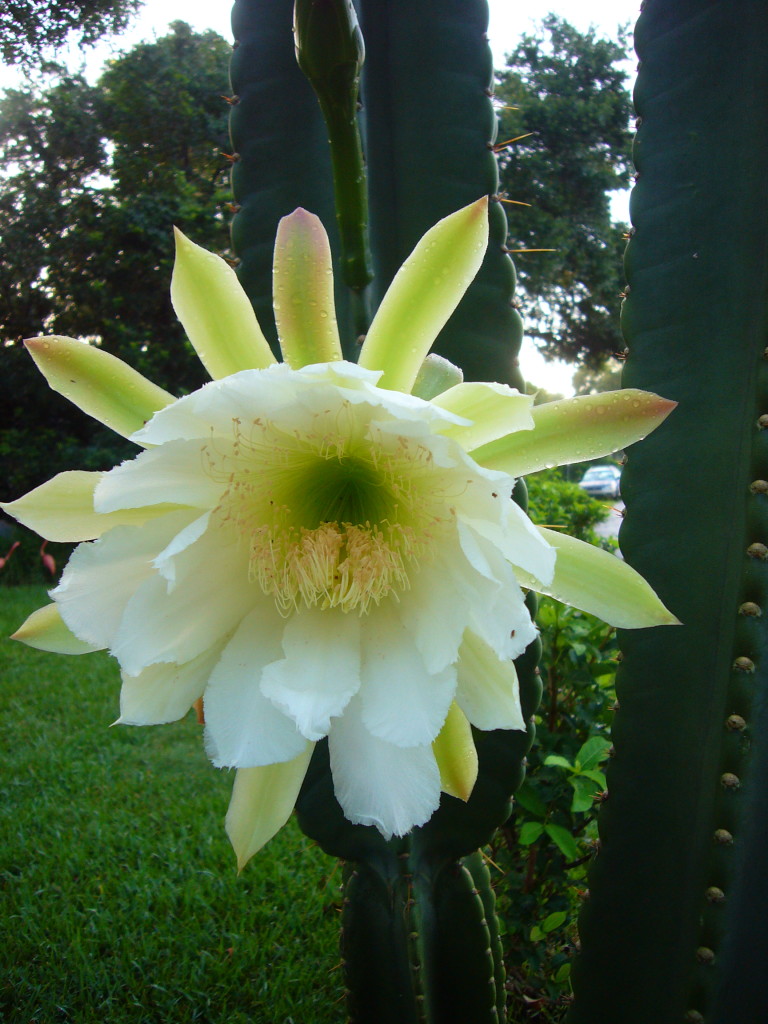
Cereus blossom at night

Cereus blossom at night. Photo By Green Deane

Getting Down To Cereus Business

There are three things irritating about Cereus other than their spines: 1) several botanical names for the same plant; 2) which species do you exactly have, and 3) how you pronounce “Cereus.”

DNA testing may indeed be reducing crime but it is increasing cactuses, or at least changing their names. Many “cereus” are no longer cereus, among them C. undatus, C. pentagonus, C. robinii and C. keyensis, or as they are now known Hylocereus undatus, Acanthocerus tratragonus, Pilosocerus polygonus, and Pilosocereus robinii.  Do those name changes clear things up? … Thought so….

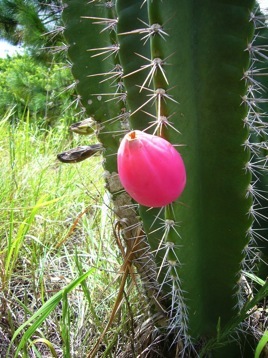
Cereus fruit in late summer, early fall. Photo by Green Deane

The last three are found only in southern Florida or the Keys and are endangered. Just know they are sprawling, usually three sided, and fruit’s pulp is edible raw if you are starving, just spread the seeds around. Also endangered in Florida is the C. eriophorus var. fragrans, C. gracilis var aboriginum, C. simpsonii and C. deeringii. The H. undatus  (aka C. triangularis & tricostatus)  is naturalized up to coastal central Florida and planted inland, such as at Mead Gardens. It is a commercial crop called “Dragon Fruit.” Also eaten is Cereus giganteus, known more famously by its common name, Saguaro Cactus. (Now that Cereus is called Carnegiea gigantea.)

The fruit of cactus are used in similar ways. The Saguaro Cactus is a good example. It was a staple of the Papago and Pima Indians. They harvested the fruit in July. The fruit can be eaten fresh or dried. When dry they can be pressed into cakes. The juice was used to make moonshine and the seeds ground into a buttery paste. The fruits are also eaten of the C. hexagonus, C., jamacaru, C. pernambucensis, and the C. peruvianus, the latter is perhaps the most common ornamentally grown cactus in the world, if it really exists at all, as a species. An explanation is required.

While many cactus are sold with the name C. peruvianus some people aren’t even sure it really exists as a species and might actually be one or two other species, or some hybrid. The Cereus above has nine spines where as most pictures show them with seven. One Cereus with nine spines is C. jamacaru, but its fruit is oblong and the one above is not. Tis a puzzle. Fortunately, all Cereus fruits are all edible so which one you have is academic (though practical as some have spines and other do not.)

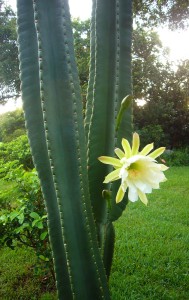
Some Cereus are free standing, others climb trees. Photo By Green Deane

Some Cereus are free standing, others climb trees. Photo By Green Deane

The pronunciation of the genus is also something of a puzzle. You can find SEE-ree-us (like serious.) Or KEE-ree-us, and one British plant dictionary even has KAY-ree-us, which is surprisingly linguistically the most accurate. Most sources cheat and say it comes from Latin or Latin and Greek. But they stop there. The original base word was κερἰ (keri) said ke-REE and means wax (think candle as in the shape which is why some call them candlestick cactus.)  When the Romans took a Greek word beginning with a “K” they wrote it with a  “C” which then often gets mangled into an  “S” sound… KEE-ree to SEE-ree.  As the plant is shaped like a candle the genus was called Cereus, so you can call it “SEE-ree-us or KEE-ree-us depending upon your Latin or Greek temperament though it is usually said SEE-ree-us. (Also see “Catus, don’t be spineless.”)

Green Deane’s “Itemized” Plant Profile

IDENTIFICATION: Stems creeping, sprawling or clambering, branching profusely, or straight up to 30 feet or more, thick; tough with age, wavy. One to three spines on adult branches , .5 to three inces long, grayish brown to black, spreading; skin deep green. Flowers large, night blooming, scented; greenish yellow or whitish, rarely tinged rose. Fruit oblong to oval, two to four inches long, one to two inches thick, red with large bracteoles, pulp white, seeds black.

TIME OF YEAR: Bloom and fruits mainly in August and September

ENVIRONMENT: Can be found on the ground or growing on trees and walls and the like

METHOD OF PREPARATION: Ripe fruit is often chilled and cut in half so that the flesh can be eaten with a spoon. The juice makes a cool drink. A syrup from the whole fruit can be used to color pastries and candy. The unopened flower  bud can be cooked and eaten as a vegetable. The seeds can be eaten as is or ground up and used as flour. Fruits can also be made into preserves.  Pulp food value is water, 92.20; protein, 0.48-0.50; carbohydrates, 4.33-4.98; fat, 0.17-0.18; fiber, 1.12; ash, 1.10%.

{ 14 comments }
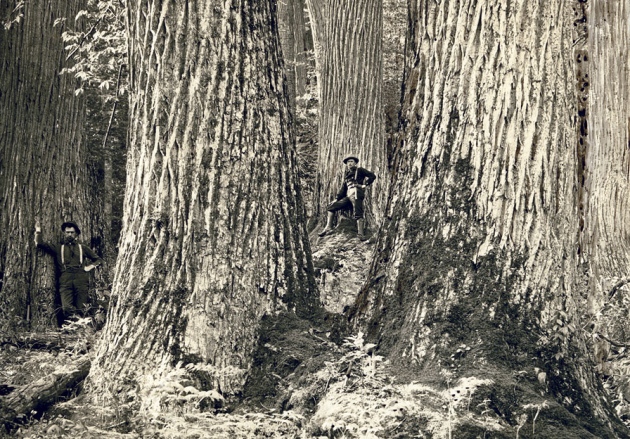
Before the fall: American chestnuts in the Great Smokey Mountains of North Carolina in 1910.

American chestnuts in the Great Smokey Mountains of North Carolina in 1910.

Chestnuts have done more than just disappear from the landscape: They have dropped out of our lives save for a token appearance at Christmas.
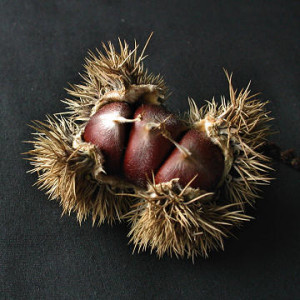
Chestnuts, not flat and round side.

Chestnuts, note flat and round side.

Whether in Eurasia or North America chestnuts were a major staple. Long before the cultivation of wheat entire European populations lived off chestnuts as later populations would depend on potatoes. In North America in the Appalachians Mountains one out of every four trees was a Chestnut (Castanea dentata) which the native relied upon heavily. Chestnuts grew to towering heights often supported by a trunk that had no branches until to 50 to 70 feet up. They had boles six feet through and 22 feet around. Prior to 1900 it was the wood most houses, barns and caskets were made of. All of the original telegraph poles were chestnut as were railroad ties. So what happened?
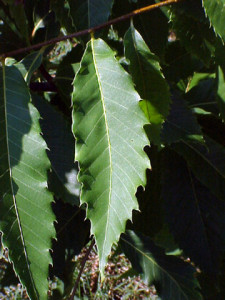
Chestnut leaf has large teeth

Chestnut leaf has large teeth

In Europe the chestnut (Castanea sativa) became viewed as poor people’s food. Why? Because chestnut flour has no gluten and won’t rise when you make bread with it whereas wheat flour takes readily to yeast. Thus the poor had to eat what they called “downbread.”  A staple that sustained marching Greeks in 400 BC to nearly all Italian farmers in the 1800s simply became in time ignored. Then in North America a chestnut blight was  noticed in 1904 in the Bronx zoo, New York City. Forester Hermann Merkel, who discovered the infection, took a sample to the New York Botanical Garden across the street. There mycologist William Murrill identified the disease, Cryphonectria parasitica, aka Endothia parasitica. Within a few decades it wiped out some four billion trees leaving by 1950 only a few isolated pockets mostly in northwest United States. Like the invasive species the Water Hyacinth, the blight was probably introduced in 1876 when a lot of Japanese plants (and Asian pathogens) were imported to America for centennial celebrations.
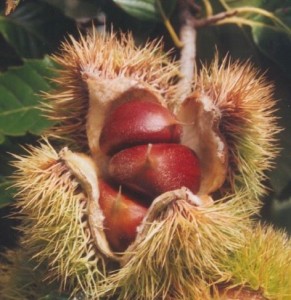
Also note point on the bottom of the nut.

Also note point on the bottom of the nut.

With the blight the chestnut moved into the reference notes of history. However there has been a breeding program with remains of North American chestnuts with the Chinese Chestnut  to create a 94% American Chestnut that is immune to the disease. It has worked successfully so far in Virginia and a few other areas. In another generation we might begin to know how successful that program is. The restoration website is the American Chestnut Foundation. When you consider it will take certainly a century or much more to bring back the chestnut this is a group of dedicated, unselfish folks with a long-term view. One plan is to plant resistant chestnuts on land made barren by strip mining.
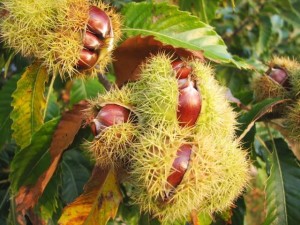
Europe now provides most of the "sweet" chestnuts.

Europe now provides most of the “sweet” chestnuts.

While our edible chestnuts sold at Christmas time come from Europe — which did not suffer the blight — Native Americans made much use of the native chestnut. The first record of them made in North America by a European comes from 1539 by Spaniard Rodrigo Ranjel, secretary on the DeSoto Excursion. He noted Chestnuts trees were similar to the ones back home and mentioned seeing them used in a village near Florida’s Santa Fe river. Thomas Harriot in 1590 said of the Algonquians in North Carolina: Chestnvts there are in diuers places great store: some they vse to eate rawe, some they stamp and boil to make spoonmeate, and with some being sodden they make such a manner of downbread as they vse their beanes.”

Polymath and plant guy Thomas Harriot

Polymath and plant guy Thomas Harriot

The now-famous Captain John Smith of Pocahontas fame wrote in 1612 the Virginia Powhatans boiled chestnuts for four hours making a “both broath and bread for their chiefe men or at least their greatest feasts.”  B. Romans wrote in 1775 the Creeks had for food “dry peaches and persimmons, chestnuts and fruit of the chamaerops” (palm fruit.)  Merritt Fernald of Harvard (b.1873) probably referring to the Cherokee, said “the nuts were cooked in their corn-bread, or, when roasted, were used like coffee.” We also know the Cherokee boiled the nuts, pounded them with corn (or berries) and wrapped the mixture in a green corn husk to be boiled. Several native nations made bread out of the chestnuts.  While the chestnuts don’t have much oil (2%) it was used as a gravy.
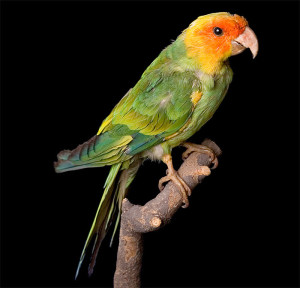
Carolina Parakeet

Carolina Parakeet

Man was not alone in his use of the chestnut. Woodland creatures like them such as squirrels, mice, bear, deer, turkeys and rabbits. In Australia and Tasmania where European chestnuts thrive kangaroos, wallabies and possums can be a problem. The American chestnut was also food for two now extinct birds, the Carolina Parakeet and the Passenger Pigeon. Incidentally, the Carolina Parakeet (Conuropsis carolinensis) was probably only one of three birds toxic to eat and the only one in North America. Like the other two toxic birds, the Hooded Pitohui and the Ifrita kowaldi, both of Papua, New Guinea, it is because of diet. The two New Guinea birds eat toxic insects which makes them toxic. The Carolina Parakeet was known to eat the toxic seeds of the Cocklebur. John Audubon himself reported cats died from eating the parakeet.

Scored and cooked chestnuts

Scored and cooked chestnuts still in their shells

Chestnuts are the only cultivated and consumed nut that has vitamin C, about 40 mg per 3.5 ounce serving. They have a similar protein content as beans and similar carbohydrate amount as wheat, which is about twice that of a potato. Chestnuts also have a high amount of sugar if they are allowed to ripen (also called curing.) Just-ripe chestnuts are low in sugar but as they cure their starch changes to sugar as much as eight percent. Curing takes three days to two weeks at room temperature depending upon the size of the nut. During this time the nutmeat shrinks some and the texture changes. Half water, they dehydrate quickly when picked which also lends them to long-term storage if dried properly. Average calories per fresh 3.5 ounce serving is 180. Eating a lot of them can cause gas. Edible or “sweet” chestnuts can also be eaten raw anytime but are usually eaten after curing and cooking.  Before the American chestnut was wiped out it was a major cash crop with families taking wagon loads of them to trains in October for market in major U.S. cities.
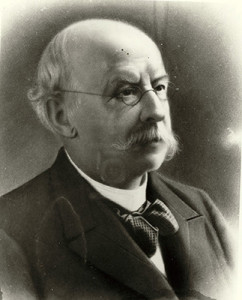
Dr. Francis Porcher

Dr. Francis Porcher

The Native Americans also used the chestnut (Castenea dentata) medicinally. They used it for cough syrup, to treat sores, bleeding after childbirth, to relieve itching, for heart disease, colds, rheumatism, whooping cough, stomach troubles, fever, headaches, blisters, chills even as a baby powder. Francis Porcher, the well-known civil war doctor and botanist, reported in 1863 that the roots are astringent. He said a tea made from the root was good for diarrhea. When boiled in milk it was good for teething. He also said a decoction of the related chinquapin bark could be used like quinine. Chestnut trees had such a high amount of tannin that in 1900 they provided more than half the tannin used in the American leather industry.
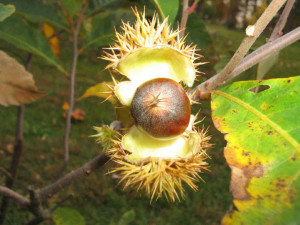
Dwarf Chinkapin

Dwarf Chinkapin

There are several “Castanea” species in North America besides the chestnut. How many exactly is debatable because plant characteristics and name changes. Potentially there are the Dwarf Chestnut or Bush Chinquapin, Castanea pumila, also called Castanea alnifolia and Castanea nana. The Ashe Chinkapin, Castanea ashei also called Castanea pumila var. ashei. There is the Florida Chinkapin, Castanea floridana, the Alabama Chinquapin, Castanea alabamensis, the Ozark Chinquapin, Castanea ozarkensis, Castanea neglecta (which might be a hybrid between C. dentata and C. pumila) and “Castanea paupispina” which like the C. neglecta does not seem to have a common name. In fact, I doubted C. paupispina existed because I never saw it referenced any place except Wikipathetica. A learned reader wrote to tell me it is Castanea paucispina — spelled with a C not a P and is a variation of C. pumila in Texas. The misspelling on Wikipathetica has been copied throughout the internet. The proliferation of names is caused in part because the number of prickle density varies on the  C. pumila vary leading to naming variations as different species.  Castanea davidii, Castanea seguinii, Castanea mollissima and Castanea henryi are from Asia, Castanea creanata, Japan
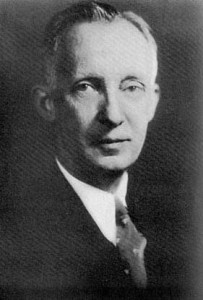
William Willard Ash

William Willard Ash

Closely related to the American Chestnut, damage to the Chinkapins from the blight varied from at least some to badly. To my knowledge all of them have edible nuts but avoid those endangered. I’ve been fortunate enough to see one growing in North Carolina. Besides being spelled Chinkapin and Chinkquapin there is no great agreement on identification. C. pumila, for example, has also been called C. alnifolia, C. floridan, C. nana, and C. ashei. The Ashe Chinquapin a la Castanea ashei, is named for William Willard Ashe, 1872-1932, a prolific plant collector. He entered the University of North Carolina at age 15 in 1891.  During his career Ashe wrote some 167 articles and named 510 species (including a couple after his wife, Margaret Henry Wilcox, Crataegus margaretta and Quercus margaretta.)
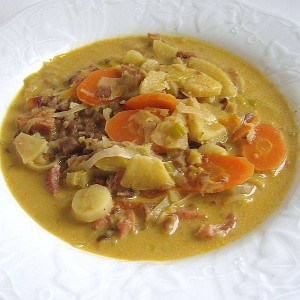
Chestnut Soup

Chestnut Soup, recipe below

In early writing the chestnut is also called an “acorn” and is related to the Beech and the Oak. How the species got its eventual botanical surname “Castanea” is a bit of a linguistic conundrum. The American version was named after the European one. European chestnuts grew east of Greece — Pontus Greece now the western Black Sea area of Turkey — and were imported west to Greece in ancient times. There is a Kastania in Thessaly, Greece, which is the agricultural heartland of that nation and where the famous Meteora monasteries are located (churches on rock pinnacles.) Kastania has soil unlike most of Greece, rocky but acidic thus favorable to the chestnut. It was planted there and the town probably picked up the eastern name of the tree. It stuck with the town and the tree. The Greeks call the nut κάστανο  (KAH-sta-no) and the tree καστανιά (kah-stah-nee-AH.) Note the shift in accent from the beginning to the end. The Bretons called it Kistinen, the Welsh, Castan-wydden, the Dutch, kastanje, and the French chataigne. Kastania in Greek became Castanea (kas-TAN-nee-uh) in Dead Latin (note the accent now in the middle.) Dentata (den-TAH-tah) means teeth because the leaves have large teeth. The English word “chestnut” also comes from the Greek word. Chestnut came from “chesten” which came the Middle English “chesteine”. That was from Old French “chastaigne” (with an S) which came from Dead Latin “castanea” which came from the Greek “kastania.”
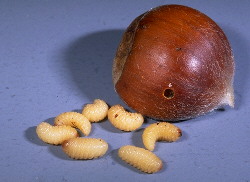
Chestnut Weevil Larva

Chestnut Weevil Larva, photo Ric Bessin

One interesting — some might say almost interesting — aspect of the chestnut blight was to make chestnut weevils nearly extinct. Without their preferred food Curculio sayi Gyllenhal and Curculio caryatrypes Boheman (small and large chestnut weevils) were close to being no more. But, folks started planting Chinese Chestnuts and saved the insects’ day. Like the weevils that infect acorns and palms they are edible raw or cooked. If you don’t want to find weevils in your chestnuts one thing you can do is soak the unopened chestnuts in 140 F. water for 30 minutes killing off the weevil eggs and or larvae. Picking up the fallen chestnuts immediately and cleaning up debris around the drip line of your chestnut tree are also important.
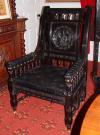
Longfellow's Chestnut Chair

Longfellow’s Chestnut Chair

As one can imagine such an important tree made its way into much literature. Most famous is Longfellow’s The Village Blacksmith published in 1841. Under the spreading chestnut tree the village smithy stands… Longfellow, of Portland Maine, was the descendant of one Steven Longfellow who was a blacksmith and moved to Portland in 1745. The poem, however, was about Longfellow’s neighbor in Cambridge, Dexter Pratt. Years later an armchair was made from the very tree that shaded Pratt and presented to Longfellow. Stained black, it has a brass plaque that reads:  “This chair made from the wood of the spreading chestnut-tree is presented as an expression of his grateful regard and veneration by the children of Cambridge.”

Henry Wardsworth Longfellow c. 1855

Henry Wardsworth Longfellow c. 1855

The chair is carved with chestnut leaves and blossoms while the seat rail is engraved with lines from the poem. I’ve been to the Longfellow house in Portland, growing up not 20 miles away. It’s in the up part of town but what they don’t tell you is it used to be down on the waterfront about a half a mile away where an iron fitting company named Thomas Laughlin, established 1836, used the real location to store products. There is a plaque there now, a rather sad stone stump closeted by a chain link fence in a drab industrial compound. Longfellow was not the only name of note to mention the Chestnut. Henry David Thoreau of Walden Pond, clearly a sensitive man, didn’t like throwing rocks at a chestnut to knock down its nuts. His journal entry of 23 Oct. 1855 says:

Henry David Thoreau, a chestnut nut

Henry David Thoreau, a chestnut nut, c 1856

“Now is the time for chestnuts. A stone cast against the trees shakes them down in showers upon one’s head and shoulders. But I cannot excuse myself for using the stone.  It is not innocent, it is not just, so to maltreat the tree that feeds us. I am not disturbed by considering that if I thus shorten its life I shall not enjoy its fruits so long, but am prompted to a more innocent course by motives purely of humanity. I sympathize with the tree, yet I heave a big stone against the trunks like a robber—not too good to commit murder. I trust that I shall never do it again. These gifts should be accepted, not merely with gentleness, but with a certain humble gratitude. The tree whose fruit we would obtain should not be too rudely shaken even. It is not a time of distress, when a little haste and violence even might be pardoned. It is worse than boorish, it is criminal, to inflict an unnecessary injury on the tree that feeds or shadows us. Old trees are our parents, and our parents’ parents, perchance. If you would learn the secrets of Nature, you must practice more humanity than others. The thought that I was robbing myself by injuring the tree did not occur to me, but I was affected as if I had cast a rock at a sentient being with a duller sense than my own, it is true, but yet a distant relation. Behold a man cutting down a tree to come at the fruit! What is the moral of such an act?”  Thoreau wrote more about the chestnut than any other tree in his journal.

By now you know there are European Chestnuts, and there were American Chestnuts. There are also “Horse Chestnuts.” Just to make things confusing the British call the edible chestnut the “Sweet Chestnut” where as the Horse Chestnut is just called Chestnut. They should have been consistent and called the Horse Chestnut the “Bitter Chestnut.”
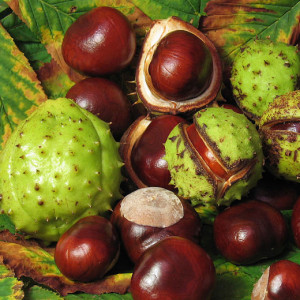
Toxic Horse Chestnuts

Horse Chestnuts

And what of the Horse Chestnut? Should the issue ever arise don’t confuse sweet chestnuts with bitter Horse Chestnuts. The latter is a different genus altogether. And while there are reports that Horse Chestnuts, Aesculus hippocastanum (ES-ku-lus hip-o-kas-StAY-num) native to Greece, and Aesculus indica (ES-ku-lus IN-dick-ka) native to India, can be made edible I would do so cautiously. From India one report says: The seeds are dried and ground into flour… This flour, which is bitter… Its bitterness is removed by soaking it in water for about 12 hours. The bitter component gets dissolved in water and is removed when the water is decanted. Other references vary. One reverses the process by soaking the seed, drying, then grinding. Another just says boil the seeds for a long time. Removing the bitterness is important because the chemical(s) destroys red blood cells in humans.

What bothers me is that both Horse Chestnuts aforementioned — Greek and Indian — are not native to North America. They were planted ornamentals. Yet we are told by many reports that the American Indians ate them. It is possible but one would think the natives would have preferred the native chestnut that was not bitter and did not require processing. I think the writers are confusing Horse Chestnuts with Buckeyes which are native and in the same Aesculus genus. We have at least one authoritative report that the Indians on the west coast of America did indeed eat the seeds of  Aesculus californicus (yes seeds, not nuts. Chestnuts have nuts but Buckeyes and Horse Chestnuts have seeds, a distinction perhaps more important to botanists than foragers.) According to Professor Daniel Moerman they pounded the seeds, leached them, then boiled them into a mush, eating it with meat. Others tribes roasted the nuts then ground them. The report from the Kashaya (Pomo) is quite specific:
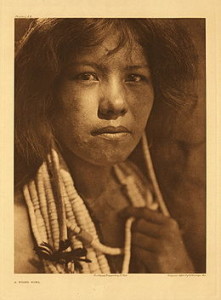
(Kayshaya) Pomo girl; c. 1924, by Edward S. Curtis

(Kashaya) Pomo girl; c. 1924, by Edward S. Curtis

“Boiled nuts eaten with baked kelp, meat, and seafood. Nuts were put into boiling water to loosen the husk. After the husks were removed the nutmeat was returned to boiling water and cooked until it was soft like cooked potatoes. The nutmeat was then mashed with a mortar stone. The grounds could be at strained at this stage or strained after soaking. The grounds would be soaked and leached a long time to remove the poisonous tannin. An older method  was to peel the nuts and roast them in ashes until they were soft. They were then crushed and the meal was put in a sandy leaching basin beside stream. For about five hours the meal was leached with water from the stream. When the bitterness disappeared it was ready to eat without further cooking.”

At any rate unprocessed Horse Chestnuts are bitter. Edible chestnuts are sweetish. Edible chestnuts lay on their side. They essentially have a flat side and a round side and a pointed bottom. They are somewhat pyramidal. Horse Chestnuts are nearly round and sit vertically on their round bottom.  In their shell edible chestnuts look like green sea urchins, horse chestnuts like green, spiny puffer fish.
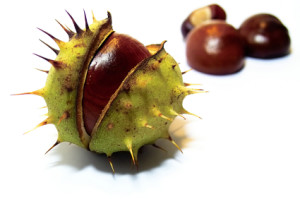
Horse Chestnuts might have medical uses for edema.

Horse Chestnuts might have medical uses for edema.

Unprocessed — and perhaps even processed — Horse Chestnuts will make you sick. Symptoms are vomiting, loss of coordination, stupor sometimes paralysis. Few fatalities are reported. There’s about 17 reported poisonings per year in the United States caused by Horse Chestnuts.  Juice from Horse Chestnuts, however, makes a good fabric bleach. Grind 20 seeds into 1.5 gallons. Let seep, stir then settle. Pour off the water using it for bleaching. Horse Chestnut starch was also used to make acetone during WWII. Now do you see why you should not eat Horse Chestnuts?

Hungarian Cream of Chestnut Soup or Gesztenye Leves

Ingredients:

  • 12-14 ounces cooked and peeled EDIBLE chestnuts, finely chopped
  • 4 tablespoons butter
  • 2 parsnips, peeled and thinly sliced
  • 2 carrots, peeled and thinly sliced on the diagonal
  • 2 apples, peeled, cored, quartered and thinly sliced
  • 2 leeks, white part only, thinly sliced
  • 2 teaspoons sweet or hot Hungarian paprika
  • 1/2 pound julienne-sliced leftover ham
  • 5 cups chicken stock
  • 1 1/2 cups whipping cream

Preparation:

  1. If using fresh chestnuts: Score the bottom or round side of one pound of chestnuts with an “X” and bring to a boil in a large saucepan of water. Reduce heat and simmer 30 minutes. Cool slightly and peel. Let cool completely before chopping finely. They can have the texture of soap.
  2. In a large saucepan or Dutch oven, melt butter and saute parsnips, carrots, apples and leeks, stirring occasionally, for about 10 minutes or until vegetables are almost tender. Mix in the ham, chestnuts, paprika and cook for one minute. Stir in the stock and bring to a boil. Reduce heat and simmer, uncovered, 20 minutes.
  3. In a medium bowl, whisk together cream and egg yolks. Temper this mixture with a few ladles of hot soup broth, whisking constantly. Then pour the tempered cream-egg yolk mixture into the soup, whisking constantly for one minute or until soup has thickened. Season to taste. Serve with sour cream, if desired.
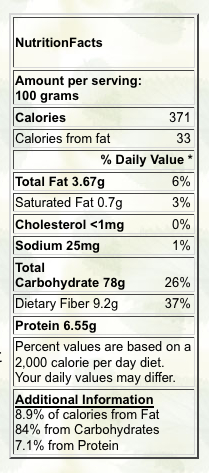
Chestnut Nutrition

Chestnut Nutrition

{ 28 comments }

 Pindo Palm: Jelly, Wine and Good Eats

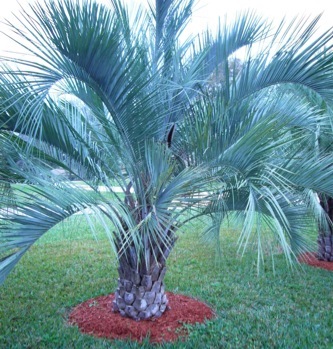
Pindo Palm, Jelly Palm

Cemeteries remind me of Pindo Palms. They are a common landscape plant in Florida cemeteries, and public parks as well. In fact, they are a very common landscape plant in southern climes and most owners are glad to give you the fruit and surprised to learn they are edible.

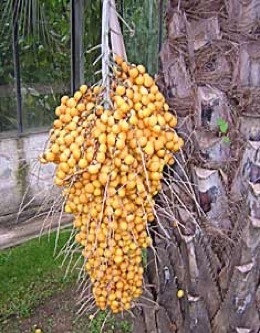
Banana yellow, sometimes with a rose blush, they are sweet and tart at the same time. Pindo Palms are also  lost fruit. They were once the stable of every southern yard that didn’t dip below 12º F degrees or so. Now it’s considered a palm that creates a mess on lawns. Indeed, one of the common complaints about the Pindo Palm is that it produces too much fruit… Think about that:  Only a nation with yards of decapitated grass and an obesity epidemic would think  a plant produces too much food.

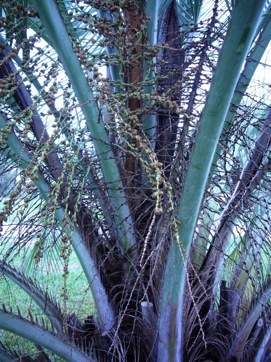
Look for short spines on each side of the frond

The fruit of Pindo Palms are often called palm dates and were used to make jelly — hence Jelly Palm — because they contain a good amount of pectin. That same pectin makes for a cloudy wine, the other common use and name for the plant, Wine Palm. Its botanical name is Butia capitata (BEW-tee-uh kap-ih-TAY-tuh.)  Butia is a Portuguese corruption of an aboriginal term meaning “spiny.” Capitata is Latin, meaning “with a dense head” referring to the seed heads. The name Pindo comes from the town of Pindo in southern Brazil where the palm is native. Its common local name is Yatay. It’s habitat is grasslands, dry woodlands and savannas of South America. It ranges across northern Argentina, southern Brazil, Paraguay and Uruguay. Besides Florida, it’s a popular landscape plant throughout the Gulf and southeastern Atlantic coastal regions and northern California, places that are subject to only occasional frosts.  It is reported in isolated microclimes in North Carolina, Washington DC and British Columbia.

Ripe Pindo Palm fruit

When I was a foreign exchange student teaching in London back in the Dark Ages BC (before computers)  I took a trip to Cornwall and the Scilly Islands. I still have pictures of Pindo Palms growing there. I suspect the fruit of the B. capitata was made into jelly more often than pies et cetera because eating it is similar to eating sugar cane, in that it is tasty but very fibrous.  Some people can swallow the fiber and have no tummy problems, in others it can upset stomachs. So, chewing the fruit and spitting out the fiber is accepted practice. Try only one at first, they don’t agree with everyone. One writer said they have a “terrific taste that starts out like apple and transforms to tart tropical flavors as it tantalizes the tongue.” To me they taste like a banana and a nectarine put together. Of course, once you have juice from the palm many things can be made from it and no southern home should be without a jelly palm. They are inexpensive, hardy, showy and bountiful. Incidentally, the seeds are about 45% oil and are used in some countries to make margarine. The kernel tastes intensely of coconut. The core of the tree is also edible, as like the cabbage palm, but that also kills the tree so reserve that for palms only slated for development execution.

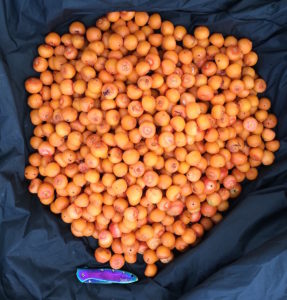
This Pindo Palm fruit will be used to make wine. Photo by Green Deane

This Pindo Palm fruit will be used to make wine. Photo by Green Deane

cv fgt

Green Deane’s “Itemized” Plant Profile

IDENTIFICATION:An evergreen tree growing to 20 by 12 feet, a long spike of green fruit — see upper right — turning yellow then dropping, ripe fruit very fragrant. Note the spines on the fronds in the upper right picture.  Fronds are very long.

TIME OF YEAR: Evergreen, fruits in late spring in Florida.

ENVIRONMENT: Landscape plant that likes full sun,sandy well-drained soil but needs moisture, grows fuller if in partial shade.

METHOD OF PREPARATION: Fresh  fruit off the tree, juice made into jelly and wine. The best fruit are usually the ones you fight the ants for. Also the flavor and sugar content can vary from tree to tree.

 Pindo Wine

Pindo Wine is very tropical, takes a long time, and can have clarity issues because of the natural pectin.

About 1.2 kg of ripe pindo fruit

1 Campden tablet

1.2 kg sugar dissolved in 1 liter boiling water and cooled

½ tsp tannic acid (optional – slightly alters the taste and lightens the color of the wine)

½ tsp yeast nutrient

general purpose winemaking yeast

For wine: Cover the fruit with water then use clean hands and rub out the seeds. Mash up the fibrous fruit pulp. Add crushed Campden tablet and leave, covered for 24 hours. Make up the wine starter. Add the pectinase dissolved in a little water and leave for several hours. Add the sugar syrup, tannic acid and yeast nutrient and make up to 5 liters. Add the yeast. Stir 3 times per day for 6 days before sieving into a demijohn. Rack and add sugar as necessary. A final specific gravity of about 1.020.

Pindo Jelly

One would think it would be easy to make jelly out of the fruit of a plant called the “jelly palm.” The answer is yes and no. It is called the jelly palm because the fruits, in a good year, have enough natural pectin to make jelly, barely. So, one should add pectin. The other issue is the seeds. You can cook the fruit with the seeds still in them but I think that can impart a woody flavor to the jelly and reduce its ability to jell (I think cooking the seeds release some of the edible oil and that affects the process.) On the other hand, cutting the fruit off the seed is a chore. Friends make the job go quicker.  You can cut the pulp off or try to rub the seed out, your choice.

Since three cups is the standard for Sure Jell, start with six cups of ripe fruit. Cut and scrape as much fruit as you can off the seeds. One would like to say cut the fruit out but it hangs on so tenaciously to the pulp you really have to cut the fruit off the seed. Starting with six or more cups should yield you three cups of cleaned fruit. When you have three cups, cover with three cups of water. Bring to boil and cook until you have about 3.5 cups of infused juice. Yes, measure it. When you have those 3.5 cups, filter the juice and make jelly per the recipe on the box for three cups, adding two or three cups of sugar, depending upon taste. Of course, you also don’t have to filter it, and can use three cups as is, the texture and clarity will be slightly affected, but it is just as wholesome.

{ 97 comments }


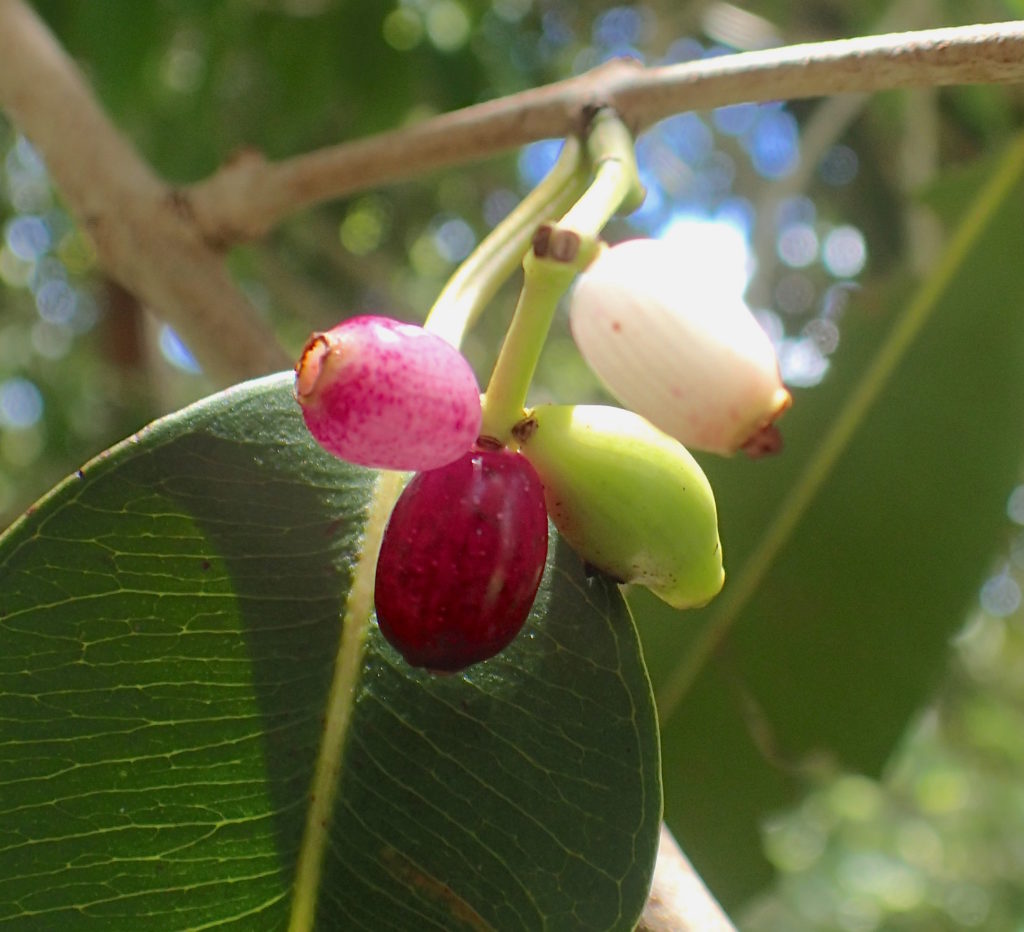
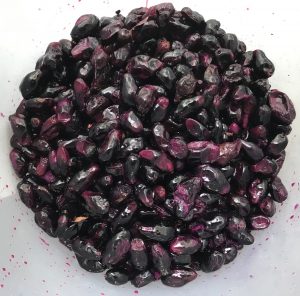
Jambul, species Syzygiym cumini, ripens from white to dark purple. Photo by Green Deane.

Jambul, species Syzygiym cumini, ripens from white to dark purple. Photo by Green Deane.

Syzygium: A Jumble of Jambul

The Jambul tree makes you wonder what people were thinking.

For a half a century or so the United States Department of Agriculture brought into Florida many species the state now considers problem plants.  Jambul is one of them. It was introduced into south Florida as a shade tree, not once but three times, 1911, 1912 and 1920. It took 71 years for the species to become a naturalized pest and now a century later full-grown specimens can be found in the warm south of the state to central Florida. Not bad for a tropical tree.

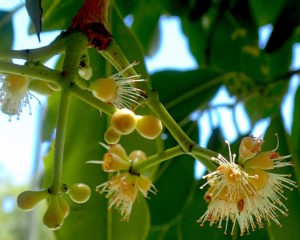
Jambul blossom in July. Photo by Green Deane

Jambul blossom in July. Photo by Green Deane

The species has been introduced into most warm areas of the world. However, in Hawaii it probably got there by migrating mynah birds and was first recorded on the islands in 1870. That state is trying to eradicate it. Jambul was also cultivated throughout the Caribbean and got to Puerto Rico in the 1920s, where it’s naturalized as well. Because of its later introduction there it is one of the few genera in the Caribbean that is not used much in local folk medicine (though very present in native India medicine.) As a forager there is little I can do about the genus except my civic duty and eat as many of its fruit as possible to reduce its spread. Actually there are at least two species of Syzygium naturalized in Florida, the S. cumini that bears dark purple fruit, above, and S. jambos, below, which has white to red fruit. Both species are called the Jambul tree (jam-BULL.)

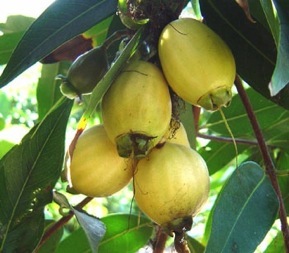
Jambul, species Syzygium jambos

A native of south Asia and Australia Jambul produces food, wood products, and materials for folk medicine. The dark fruit of the S. cumini tastes and smells like a ripe apricot but looks like a stretched black olive, very juicy and because of tannins puckery like a chokecherry. The S. jambos has pearish-shaped fruit that ranges from white to green to yellow to red. Its flavor is more like an apple/green pepper cross with a rose scent and a slightly bitter aftertaste. It’s skin is thin, waxy, and the hollow core contains a small amount of inedible fluff.

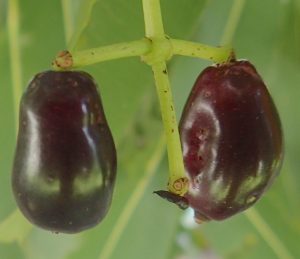
Ripe Syzygium cumini fruit. Photo by Green Deane

Ripe Syzygium cumini fruit. Photo by Green Deane

Jambul fruit, which are high in vitamins C,  can be eaten out of hand or made into sauces, tarts and jams. They make a good fruit sherbet, syrup and squash. They can be made into vinegar, wine or distilled, one native spirit being “jambava.” It is also a good honey tree. Harvesting of fruit in its native range is in summer or early fall. Here in Florida it tends to be in spring to summer.  The leaves make good livestock feed and oil in the leaves has been used to scent soaps and perfumes. The bark yields a brown dye and has tannin for leather making. The wood is very durable to water. It’s used used to make beams, rafters, telephone poles, oars, ship masts, boats, and water troughs, among many more uses.

Terminal leaves are always in pairs. Photo by Green Deane

Terminal leaves are always in pairs. Photo by Green Deane

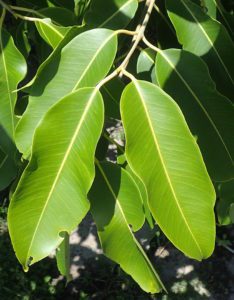
Often planted as a windbreak, the S. cumini trees can reach full height in 40 years, which in their native rage is near 100 feet. In Florida it is half that.  It can have a crown 18 to 40 feet wide and often has multiple trunks radiating from near the ground.  The Jambul can also grow in wet and dry areas as long as it has sun. The bark on the lower part of the tree is discolored, rough textured, cracked and flaking; young bark higher up is smooth and light gray. The paired, opposite leaves have a hint of turpentine when crushed. The evergreen leaves are two to ten inches long, one to four inches wide, oblong in shape, oval or elliptic, can be blunt or tapering to a point at the tips. The leaves start out pinkish then mature leathery and glossy, dark green above, light green below. Each leaf  has a yellowish midrib. The S. jambos tends to be shorter, perhaps 45 feet at best in its native range, its leaves are more lance shaped, and the bark a smooth gray.

Medicinally the seeds of the Jambul have been used to control blood sugar levels and the leaves and bark high blood pressure. Incidentally, we regularly used another member of this genus, S. aromaticum. Its dried flower buds form the spice we know as “cloves.”

Jambul Fruit being made into wine. Photo by Green Deane

As is often the case the botanical name is Greek perverted by Dead Latin. Syzygium is said to refer to the tree’s paired leaves, one also sees “twin” leaves. The base word, however, is zygos (zi-GHOS) the yoke. A person’s spouse in Greece is called my Zizigos (ZEE-zee-ghos) my yoke mate. So the Greek speaker would be strongly tempted to pronounce Syzygium as see-ZEE-ee-yum. Anglicized Latin would have it sizz-ZYE-gee-um.The species name cumini, said KOU-mee-nee, is from the Greek kyminon (KEY-mee-on) or in modern Greek Kymino (KEY-mee-no) meaning the spice cumin.  Jambos (jam-BOS) is the Malaysian name for rose-apple though it comes from Sanskrit’s Jambudvīpa, which means rose apple land.

Green Deane’s “Itemized” Plant Profile

IDENTIFICATION: S. cumini is a tree to 50 feet, S. jambos smaller, both often multiple trunks, bark on the lower part of S. cumini is discolored, rough textured, cracked and flaking, young bark higher up is smooth and light gray, bark on S. jambos smooth and gray. Paired opposite leaves have a hint of turpentine when crushed. The evergreen leaves of the S. cumini are two to ten inches long, one to four inches wide, oblong in shape, oval or elliptic, can be blunt or tapered to a point at tips, leaves of the S. jambos more lance shaped. Leaves start out pinkish then mature leathery and glossy, dark green above, light green below. Each leaf has a yellowish midrib.

TIME OF YEAR: Summer and fall in native range, late spring and summer in Florida area.

ENVIRONMENT: Likes sun, can tolerate wet and dry conditions, does not tolerate freezes unless full grown then iffy.

METHOD OF PREPARATION: Fruit out of hand, or use as any fruit as jelly, sauce, syrup, wine, spirits and vinegar.

{ 20 comments }