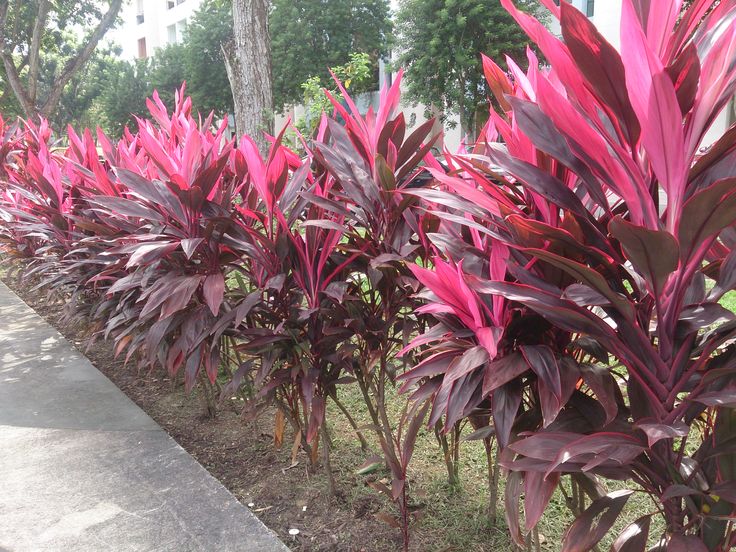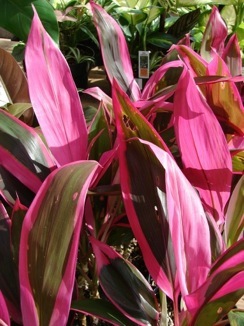
Ti was once raised for food, now it is a common ornamental.

Cordyline fruticosa: Food, Foliage, Booze

Simply called Ti (tee) Cordyline fruticosa spent most of its history with humans as a food, a source of alcohol, or a medicine. Now its foliage is in demand with many showy cultivars.  Ti is probably native to southeast Asia and Papua New Guinea. It was carried throughout much of the Pacific by Polynesians who used the starchy rhizomes for food. An outdoor ornamental in warmer areas of the Earth today Ti is found naturalized in eastern Australia and many of the larger tropical Pacific islands including the Hawaii.  It’s a common potted plant in cooler climates. The point is you should be able to find it nearly everywhere, often with other people taking care of it for you. And if you are so inclined you can even make a Hula skirt out of it.

“Scarlet Sister” is a popular variety

Boiled roots taste like molasses and were used to make a beer that was reported to cure scurvy (but modern references to its nutrition are scarce.)  Some say the Hawaiians learned to distill Ti beer into a stronger brew from convicts in Botany Bay, Australia. Young leaves are used as a potherb. Older leaves are used to wrap food, make clothes, rain capes and for thatch. Ti leaves are to wrap foods for grilling, steaming or baking. Dried leaves should be soaked to soften before using.

One word of caution. Don’t confuse the Ti with the Dracaena. Ti leaves have a petiole (stem) arching out from the trunk or branch. Dracaena leaves clasp the trunk or branch.  Dracaena will also burn your mouth and hands.

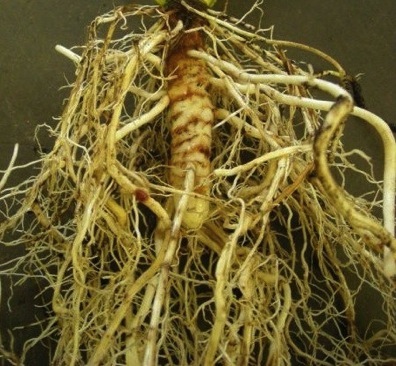
Two species are regularly reported as food sources. C. fruticosa and C. australis. Cordyline (kor-dih-LYE-nee) means club-like, referring to the look of the roots. Fruticosa (froo-tee-KHO-sah) means fruit.  Australis (oss-TRAY-liss) means southern.

Green Deane’s “Itemized” Plant Profile

Starcy roots are usually baked

IDENTIFICATION: Cordyline fruticosa is an evergreen shrub with a strong trunk which does not usually branch, 10 feet in height. Also a small house plant with colorful foliage, leaves 15-30 inches long, 4-6 inches wide, varying in color from shiny green to purple, red, yellow, purple and white. In mature plants, the leaves are tuft-like in appearance on the top of the stems, leaves along the stems with young pants. Flower fragrant, usually yellow or red, berry-like red fruit

TIME OF YEAR: Year round

ENVIRONMENT: Partial shade to nearly full sun, moist soil. Like humidity. Prefers water without Fluoride.

METHOD OF PREPARATION: C. australis: Young leaves and shoots eaten raw or roasted. Roots eaten or brewed after cooking. C. fruticosa. Roots cooked for food and brewing, young leaves cooked as a potherb. Also used to wrap food. The roots were slow roasted for days to get a molasses-like syrup which was then used for alcohol production. One way to use the leaf is to wrap food in it then cut the center rib out leaving two smaller wraps then cook (such as steam.)

This original article was first written in July 2011 by Green Deane.


{ 7 comments }

Waxy White Indian Pipes

Monotropa was almost a monotypic genus. Instead of having one species in the genus there were two: Monotropa uniflora and Monotropa hypopithys. Now they are two genera, Monotropa andHypopitys.

Most references to the Monotropas are medicinal but Merritt Fernald in his publication “Edible Wild Plants of Eastern North America” mentions the Monotropa uniflora as barely edible. He writes on pages 305-306: “So far as we are informed, the only person who has reported upon it is Prest, who states the fresh plant is almost tasteless but that when parboiled and then boiled or roasted it is ‘comparable to asparagus.’ Our own single experiment was not gratifying in its result.”
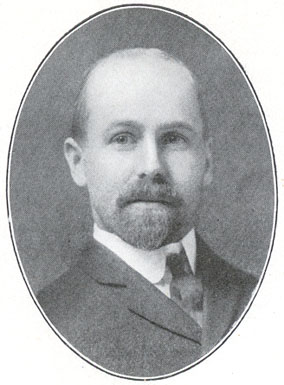
Professor Merritt Fernald

That’s not promising. Fernald was the main botanical man of his age. Born in Orono, Maine, he was soon at Harvard and never left becoming the expert in eastern North American flora. He published the above book in 1943. Fernald died in 1950 two weeks shy of his 77th birthday. His book was republished in 1958. I own a copy. Nearly 40 years later in 1996 it was reprinted virtually unchanged. In the introduction, written during World War II, Fernald echoed some sentiments now familiar to us: “Nearly everyone has a certain amount of the pagan or gypsy in his nature and occasionally finds satisfaction in living for a time as a primitive man. Among the primitive instincts are the fondness for experimenting with unfamiliar foods and the desire to be independent of the conventional sources of supply. All campers and lovers of out-of-doors life delight to discover some new fruit or herb which it is safe to eat, and in actual camping it is often highly important to be able to recognize and secure fresh vegetables for the camp-diet; while in emergency the ready recognition of possible wild foods might save life. In these days, furthermore, when thoughtful people are wondering about the food-supply of the present and future generations, it is not amiss to assemble what is known of the now neglected but readily available vegetable-foods, some of which may yet come to be of real economic importance.”
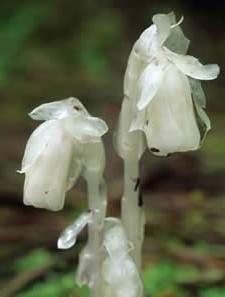
The blossoms turn down until seeding then the blossoms turns upright.

Fernald thought little of the Monotropa uniflora and by accident or intent left out of his book’s bibliography who Prest was. That struck me as a challenge. I accepted. I eventually found a W.H. Prest who was the author of Edible Plants of Nova Scotia circa 1904-1905. He seemed a likely candidate. Experiment Station Record, Volume 23, United States Office of Experiment Stations, Agricultural Research Service, says on page 668 that Prest’s plant list was: “…a popular description of plants which have little commercial value, but which may be used for food in case of necessity.” More digging filled the name out to Walter H. Prest, of Bedford and Halifax, Nova Scotia. And it wasn’t much of a publication, just notes. They were included in the Proccedings of the Nova Scotian Institute of Science, Volume 11. Prest was a dues-paying member and participating fellow. On page 413 Prest gets to the Monotropa in note 67 (of 77) the first and only entry under “Parasitic Plants.” He writes:

Monotropa uniflora L. Indian Pipe, locally “Death-Plant.” White semitransparent stalk 2 1/2 in. to 5 in. high, with highly organized flower of five petals, without smell, stalk with thin transparent scales or leaflets, tender and almost tasteless. Parboil, then boil or roast, comparable to asparagus. In dry or moderately dry soil in thick woods, June to August. Generally distributed and abundant.”

Like Fernald, as far as I can tell Prest’s reference is the only reference to Monotropa uniflora’s edibility and perhaps the original that everyone now quotes via Fernald. At least we know Fernald copied it faithfully.
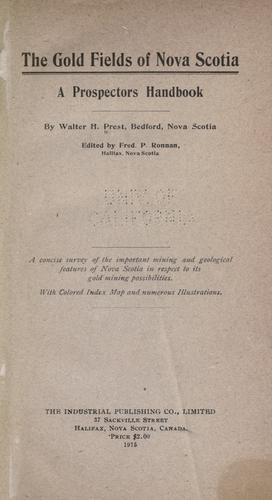
Prest’s Gold Mining Book

As for Prest, more than a century ago on page 387 of the proceedings introducing his list he wrote: “These notes on edible wild plants of Nova Scotia are the result of my early experience in the backwoods, and are offered with the hope that they may prove of benefit to those whom business or accident may lead temporarily beyond the reach of the resources of civilization.  While some of the wild fruits here mentioned, such as the blueberry and cranberry, are of commercial value, others are included because they may assist in sustaining life at a critical time. While lost in the forest persons have perished through a want of knowledge of the resources which nature has bounteously provided in many sections at certain seasons of the year. As these resources are more animal than vegetable, the latter class has been much neglected. Therefore, the result to a lost man, unprovided with weapons or the means of snaring, trapping or catching game of fish, might be perhaps serious. I propose, therefore, to tabulate these edible plants, so far as known to me, and describe as freely and popularly as possible, all that have come under my personal notice….”

That’s another voice reaching across time about food. The next question would be who was Prest and what were his credentials? There might be an answer.

 I don’t like articles with “holes” in them, missing bits of information whose absence irritates the reader. Call it the journalist in me but I wanted to know more about our single referencer. As far as I can tell he was Walter Henry Prest, born 1856 in Spry Bay, Nova Scotia, to Edward Isaac Prest and Ann Elizabeth McKinley. He married Maude Tuttle and died in Halifax in 1920. Prest — which is a variation of Priest — got out in the woods because
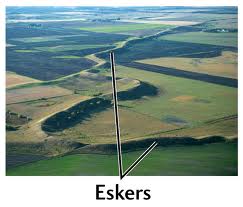
Eskers were once tunnels that rivers flowed through under glaciers

he collected plants and was either a geologist or a gold prospector or both. He’s probably the author of “The Gold Fields of Nova Scotia: A Prospector’s Handbook” Halifax: Industrial Publishing Company, (1915). His original list of plants was published in 1901 in a small 23-page volume shared with another author on a different topic: Phenological observations in Nova Scotia and Canada, 1901 ; 2. Labrador plants (collected by W.H. Prest on the Labrador coast north of Hamilton Inlet, from the 25th of June to the 12th of August, 1901.) As mentioned earlier Prest was a member of the Nova Scotian Institute of Science and a year before he died read at least one paper there on the 12th of May 1919 “On The Nature and Origin of the Eskers of Nova Scotia.” An ekser is a long narrow winding ridge made up of layers of sediment and marks where there used to be a flowing tunnel through a glacier. Some are hundreds of miles long. That’s also where plants grow above the barren rock and where animals den.

Now we have a more complete picture of our forager. Prest had scientific grounding with a foot in geology, a foot in botany and some peer review. And if he knew about prospecting he was also out in the wilds a lot. Whether a long time without asparagus makes Monotropa uniflora as palatable as asparagus is another issue.
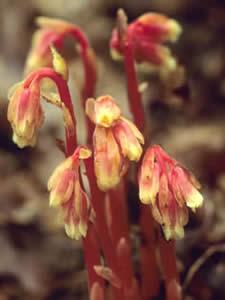
Hypopitys lanuginosa aka Monotropa hypopithys, Pinesap

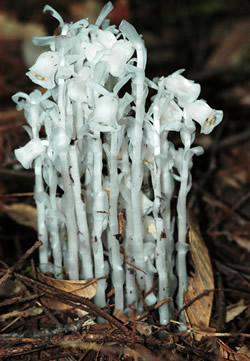
The chlorophyll-less plant is widely distributed throughout most of North American and only absent from the southwest, intermountain west and the central Rocky mountains. Distributed yes but not commonly encountered. I see it now and then and never paid it much attention until I received an inquiry. It lives off fungi that get their energy from trees.  Monotropa means “once turned” (the blossom turns before releasing seed) and uniflora means “one flowered.” The entire plant is waxy white. The other species in the genus is a bit of an issue.

Monotropia hypopithys,  also called Pinesap, has the same growth pattern but instead of white it is yellow to gold and hairless in the summer, red and hairy in the fall. Dr. François Couplan in his book “The Encyclopedia of Edible Plants of North America” says on page 192 that M. hypopithys “is reported to be edible raw or cooked. It  contains two glucosides, one of which yields by hydrolysis an essential oil containing methyl salicylate. The plant is antispasmodic and expectorant.” Sound more like medicine than food to me. It has also been renamed Hypopitys lanuginosa (lan-oo-gih-NO-suh) the latter meaning “wooly” or “downy.”

Now for a deep linguistic dive: There is also a spelling issue, hypopithys or hypopitys. Books favor with the “H” and the Internet without, which suggests to me the books are right. More so, hypopithys/hypopitys is said to mean “under pines.” Carl Linnaeus, who named the species, always used hypopithys as did Fernald, above, when Fernald rewrote and expanded Gray’s Manuel of Botany, which I have. As mentioned, I think there is something wrong in either the spelling, the translation or both. Then again, timing could also be an issue.
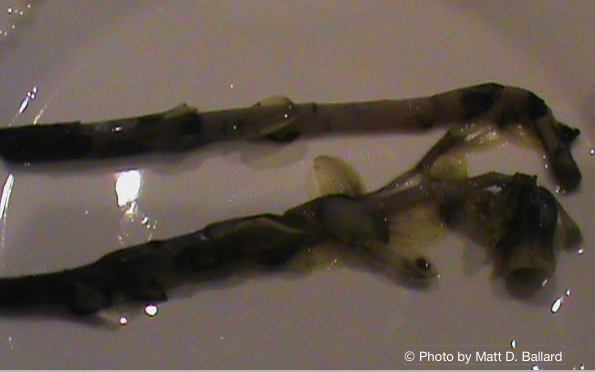
Boiled 15 minutes and still tasted bad

In Greek, modern or ancient, it is difficult to find the “H” sound associated with pines. Written language, after all, just reflects what people say. In Ancient Greek one word for pine was pitus, PEE-tus and one can see how that could be written in Dead Latin as pitys. No “H” as in hypopitys (high-poh-PIE-tees.) I would agree that means “under pines.” However, there was a wood nymph in Greek mythology named Pithys. Wood nymphs were called that because they stayed in the woods, also where Indians Pipes are found, only in the woods. Hypopithys (high-POH-pith-eez) with an “H” would mean “under wood nymphs.” Linnaeus knew his Latin and Greek and consistently used the “H” in hypopithys. He was also the original dirty old man with a gutter sense of humor (you should read what naughtisms some of those botanical names translate into.)  I suspect hypopithys, under wood nymphs, was the original naming, not as it has become referred to, hypopitys, under pines. Thus I think we had first the right spelling and the wrong translation; hypopithys, under wood nymphs mistranslated as under pines. Now we have the wrong spelling but the right translation of the wrong spelling, hypopitys, under pines and translated as under pines. Having read a lot of and about Linnaeus I think hypopithys, under wood nymphs, was more his frisky style.
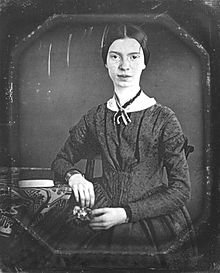
Emily Dickenson, age 17

Both species are reported to be edible but because of the rarity of edibility reports and definite glucosides in the second species I would be careful. There might be a reason why only Prest says they are edible though he died nearly 20 years after writing that. 

I should also note the pale plant also drew the attention of Emily Dickinson, pale poet and closet romantic. In 1882, four years before Dickinson died, her neighbor, Mabel Loomis Todd, painted a watercolor of Indian Pipes as a gift to Dickinson. Todd, by the way, was quite unusual for her day. Mold-breaking, she was also the first non-Asian woman to climb Mt. Fuji, in Japan, something I never got around to doing when I live there.
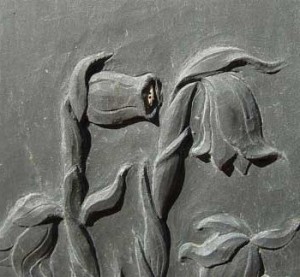
Watercolor to gravestone

In a thank you letter to Mabel, Emily said, “That without suspecting it you should send me the preferred flower of life, seems almost supernatural… I still cherish the clutch with which I bore it from the ground when a wondering child, and unearthly booty, and maturity only enhances the mystery, never decreases it.”

In 1890 the same image of the Indian Pipes appeared on the cover of the first posthumous edition of Dickinson’s poems. The image was also reproduced on Mrs. Todd’s gravestone in Wildwood Cemetery in Amherst, Massachusetts, 1932.

 Green Deane’s “Itemized” Plant Profile: Indian Pipes

IDENTIFICATION: Monotropa uniflora: From 10 to 30 centimeters. The entire plant is a translucent, “ghostly” white, sometimes pale pinkish-white and commonly has black flecks. The leaves are scale-like and flecked with black on the flower stalk (peduncle). As the Latin epithet uniflora implies, the stem bears a single flower. Upon emerging from the ground, the flower is pendant (downwardly pointed). As the anthers and stigma mature, the flower is spreading to all most perpendicular to the stem. The fruit is a capsule. As the capsule matures, the flower becomes erect (in line with the stem). Once ripened, seed is released through slits that open from the tip to the base of the capsule. The plant is persistent after seed dispersal. By the way, when the plant is unfertilized the “blossom” face down. When fertilized they point up.

TIME OF YEAR: Flowers from early summer to early autumn

ENVIRONMENT: Mature, moist, shaded forests in thick leaf litter.

METHOD OF PREPATION: Monotropa uniflora, parboiled, roasted or boiled. Monotropa hypoythis reportedly raw or cooked. Again, be wary of glucosides.

This original article was written by Green Deane in 2011.

{ 23 comments }


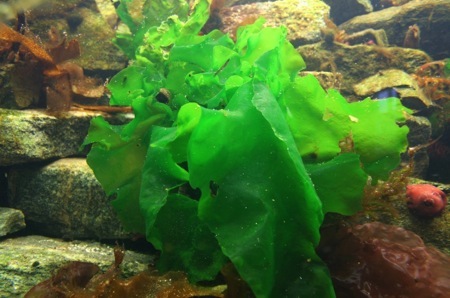
Sea Lettuce, Ulva lactuca

Ulva: Sea Soup & Salad

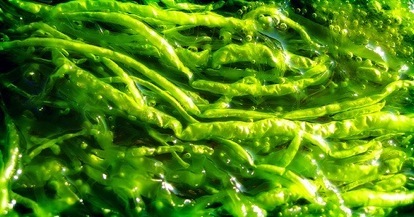
Ulva is the greenest seaweed you will ever see from shore, or in the sea for that matter.

Ten species, all edible, are found around the world in cool water. Ulva (ULL-vah, rhymes with hull) is commonly found on intertidal rocks, in tide pools, on reef flats, growing on shells, piling, pieces of wood, other seaweed or free-floating. It also favors areas of fresh water runoff that are rich in nutrients (particularly nitrogen) such as the mouths of rivers, streams and run-off pipes (the latter not the wisest place to harvest food.)  Ulva can grow profusely in those areas and it is one of the most commonly encountered seaweeds. Here in Florida it is most often seen on jetties at low tide.  In fact, there has been a decades long breeding program in the state to develop a variety that can be commercially grown in warmer waters.

Despite looking flimsy Ulva is quite strong for leaves only two cells thick. Think if it as wet wax paper with some resistance. Despite that it can easily be harvested, in or out of the water. Its most common use is to add it to soups and salads. Nutritionally Ulva has 87 mg of iron per 100 gram portion and 700 mg calcium per 100 gram serving. U. lactuca is made of 15% protein, 50% sugar and starch, less than 1% fat. It is also high in protein, iodine, aluminum, manganese and nickel and contains Vitamin A, Vitamin B1, Vitamin C, sodium, potassium, magnesium, calcium, soluble nitrogen, phosphorous, chloride, silicon, rubidium, strontium, barium, radium, cobalt, boron, trace elements, ash, fiber and the kitchen sink…

Ulva intestinalis, also edible.

Commonly called Sea Lettuce or Green Laver, it can also used as a substitute for nori (see Porphyra) a seaweed used in sushi. Ulva should be washed well then use or as an option soak it in water for two hours before using to moderate the flavor. Besides soups and salads it can even be toasted over charcoal. When toasted it add yet another flavor to soups and salads. Ulva can be store for two or three days in the refrigerator or frozen for six months without loss of flavor.  Further Ulva can be dried and used as a powder. When its blades (leafs) are dried they darken and are brittle. It should be air-dried or pressed into thin sheets. Drying in the sun is best though you can also use an oven. And in the end, if you don’t like it, Ulva can be used as animal fodder.  Personally, I like it.  A restaurant in Port Canaveral, Florida, used to serve Ulva fresh in a “seaweed salad” that was quite good. One combination for a seaweed salad is Ulva lactuca, Ulva enteromorpha and Ulva monostroma, known collectively as aonori. In texture and flavor Ulva reminds me of shreaded jelly fish… I know that’s not much of a help but I find it tasty. Ulva is also dried, salted and sold in South America as “cachiyugo.”

The most famous species is Ulva lactuca. In Latin Ulva means “sedge.” In this case Ulva was one of the first plants to get a scientific name and Ulva was used in the sense to mean a swamp grass. As it resembled wild lettuce it got the name given to lettuce, lactuca, which means milk bearing. Wild lettuce on land has a white sap. Generally Ulva is called Sea Lettuce.  Avoid any seaweed, Ulva or otherwise, that has blue-green algae on it.

Sea Lettuce Soup

4 cups chicken stock

2 sheets Ulva

2 eggs

Salt and pepper

½ tsp sesame oil

1 or 2 green scallions

Bring stock to a boil.  Add sea lettuce and

stir.  When sea lettuce is soft, stir in well-

beaten eggs and boil for a few seconds then

remove from heat.   Add salt and pepper to

taste.   Add sesame oil, garnish with onion,

and serve.

Toasted Sea Lettuce

6 sheets Ulva

½ tsp Salt

1 ½ tablespoon sesame oil

Mix salt and sesame oil and rub a thin coat on sea lettuce.  Lay 6 sheets on top of one another, roll them up and let them marinade for 5 minutes.  Unroll and cook each sheet separately in a hot pan over low heat until crisp. Cut sheet into smaller pieces and serve with hot rice.

 Green Deane’s “Itemized” Plant Profile

IDENTIFICATION: Thin, sheet-like, as tufts or solitary blades, shape varies, to one three feet. Blades (leaves) ruffled or flat, small microscopic teeth on edges.  Bright green to dark green, gold edges when reproducing. In some species the blades have holes in them.

TIME OF YEAR: Generally year round.

ENVIRONMENT: Ulva lives attached when young to rocks in the middle to low intertidal zone, and as deep as 35 feet in calm, protected waters. Usually seen in dense colony. It is often offers a hiding place for blue crabs. Older it is free-floating.

METHOD OF PREPARATION: Raw or cooked, in salads or soups, chopped as a relish, a late ingredient to stir fries. Can be dried and added as a power to other foods. Or, chop it up, boil for a half an hour, mix with grated cheese and oatmeal, form into patties and fry. Sea Lettuce fritters. The blades can also be used as a wrap, raw or cooked or for cooking, such as wrapping one around a shrimp before frying.  Ulva can be microwaved on low power for three or so minutes.

 HERB BLURB

Ulva has been used to treat burns and gout. It is a natural source of iodine and is an astringent.


{ 9 comments }

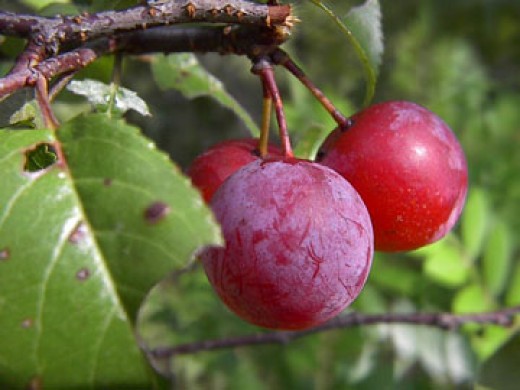
Ripe Chickasaw Plums, locally in May and June. Photo by Green Deane

 Chickasaw Plum: First Springtime Blossom

Every spring, three wild plums put on a show locally: The Chickasaw, the Flatwood, and the American. They burst out in white blossoms and no leaves.

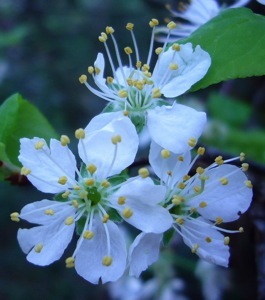
Five petals and many stamen

When in naked bloom they look similar but that’s where the resemblance stops. The Chickasaw and the American go on to produce consistently edible plums whereas the Flatwood’s fruit can range from extremely bitter to sour. Telling these plums apart before they fruit is a bit of a guessing game.

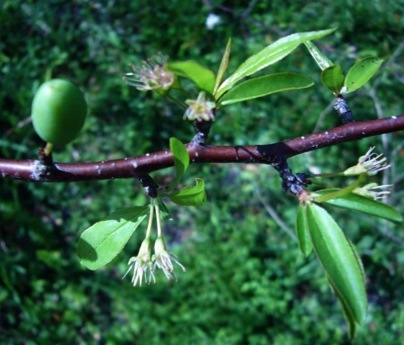
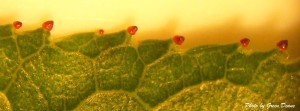
If you have skinny leaves it is either the Chickasaw or Flatwood. If the tips of the teeth on the leaves have yellow or red glands (you’ll need a hand lens) it is the Chickasaw, otherwise the Flatwood. If you have fat leaves with a strong pointed tip, it’s the American though it is not common here. Locally the fruit of the Chickasaw (Prunus angustifolia) ripens to a sweet red in the spring and is gone by early July. It often forms a thicket.

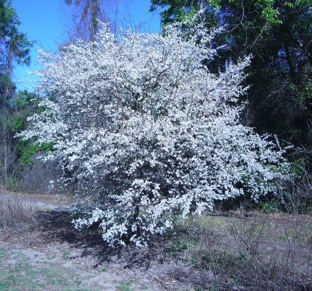
In spring the tree is all white flowers and no leaves. This specimen was remove to widen a bike trail.

The Flatwood (Prunus umbellata) which often stands alone, ripens to black or yellow and can be around through the summer into the fall. The American (Prunus americana) tends to fruit in late summer to early fall and has red fruit. The fruit of the Flatwood often remains amazingly bitter and hard even after months on the tree. Settlers used it to make jellies or fed it to livestock, hence its other common name, Hog Plum though there are several “hog” plums. Native Americans and settlers, however, regularly ate of the American and Chickasaw plums, the latter developing very sweet fruit with a tang. The first foragers used the plums fresh and dried for winter use. Some tribes took out the seed kernels, others didn’t. Let’s talk about that.

The skinny leave has a trough down the middle

Liberated from their shells the sunflower-sized kernels of these plums can create cyanide in your gut. Very small amounts don’t bother us but we are not talking about small amounts. Natives would make cakes out of the kernel mash. Letting the cakes set for a day or so allowed enzymes to work on those chemicals as did subsequent cooking, making the cake edible… or at least that is the explanation experts give. That strikes me as a lot of work for such a small amount of food that’s potentially toxic.  That said they could have been a treat, a flavoring, an essential macro nutriment — oil — to make them worthwhile or a micro-nutriment. Calories are not the only reason to forage. Interestingly several groups around the world discovered on their own how to process the seed.

 In the 1800’s there was great interest in making cultivars out of native plums and by 1901 there were over 300 of them. But mechanization of fruit production in the early 1900’s led growers away from the native varieties though there has been some interest of late to use the native plums again as a high-value specialty crop.

The tips of the teeth will be either red or yellow if a Chickasaw Plum. Photo by Green Deane

The tips of the teeth will be either red or yellow if a Chickasaw Plum. Photo by Green Deane

Besides man the Chickasaw Plum’s fruit is eaten by deer, bear, fox and raccoon. The thorny thicket is valuable for songbird and game bird nesting including the bobwhite and mockingbird. It also makes a good wind break and can be used for erosion control. The plum, extensively used, was taken everywhere by the Chickasaw and it has many local names. While usable, the Flatwood Plum, is not prime foraging food. Its quality can vary from tree to tree, rarely rising to the gustatory level of the Chickasaw Plum. The American Plum was also used by the natives.

The Chickasaw Plum is one of my favorite trail and yard nibbles. As to its botanical name Prunus angustifolia. Prunus (PROO-nus ) is the Roman name for the plum.  Angustifolia (an-gus-tee-FOH-lee-uh) means skinny leaf (see photo directly above.) Umbellata (um-bell-LAY-ta) means like an umbrella for its shape. Americana (ah-mare-ree-KAY-na) means American.  “Chickasaw” is Choctaw for “old” and “reside” or as we might say in English, “the old place.” Incidentally, the Chickasaw Plum is native to Texas and Oklahoma but is naturalized through much of the United States where there are sufficient winter chill hours, such as central Florida north.

The Chickasaw plum and the American plum are closely related and hybridize easily. That means… yep, you guessed it. You can find plums in the wild which display some characteristics of each and can be impossible to identify.

 Green Deane’s “Itemized” Plant Profile

IDENTIFICATION: Chickasaw Plum: Small thorny tree to 25 feet, usually much smaller, flower small, under half an inch, 5 white petals, fragrant; reddish orange anthers, appear in clumps in early spring before the leaves, fruit bright yellow to red, round to oval, 1/3 to 1/2 inch in diameter, flesh juicy small plum, bark first smooth and reddish then with numerous elongated light horizontal hash marks. The leaf has a center troth. The teeth have yellow or red glands on the tip. Some times the fruit can stay green yet ripens to sweet.

TIME OF YEAR: Late spring in Florida, late summer farther north, usually around September. Locally the Chickasaw Plum is done fruiting long before the 4th of July. The Flatwood Plum can have fruit persisting into the fall.

ENVIRONMENT: The Chickasaw forms thickets in open areas, any open space in scrub forest, sandy soil, roadsides, fences, prairies, Pennsylvania west to the Rockies, south south to Central Florida, also California. Easily transplanted or grown from seed. It requires some chilling so won’t grow in South Florida and similar climates. The Flatwood is often a stand alone.

METHOD OF PREPARATION: Chickasaw: Cherry-size plum, out of hand or for jelly, pies, preserves and wine. It makes a tart, bright red jelly.  The Flatwood was used to make jellies or to add to other jellies. It is usually too sour and hard to eat out of hand.

{ 67 comments }

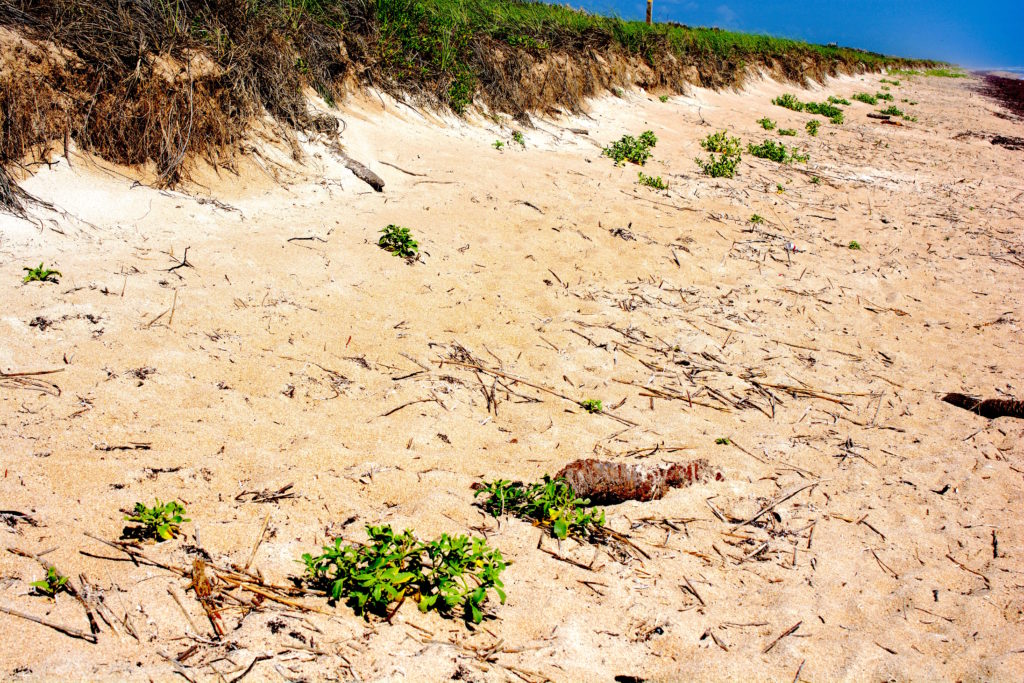
Wild mustards are easy to spot on our beaches. They are between the wrack line and the lift of the dune. (The root is unrelated debris.) Photo by Green Deane

The Cakile Clan: Seaside Edibles

Cakile edentula

Food is where the water is, be it fresh or salt, and one of the waterway foods of North America is Sea Rocket. There are at least five native Sea Rockets and one or two imports.

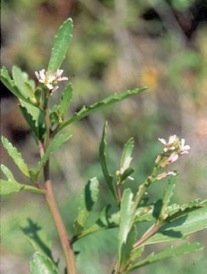
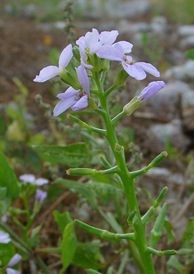
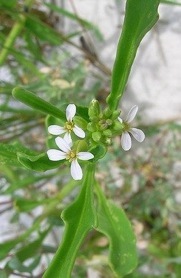
Cakile species are perennial that can grow upright or spread out. They grow close to the coast, often in dunes. Leaves are fleshy, the flowers are typically pale mauve to white, with four petals about a third of an inch in length. They are rather similar to those of the wild radish, that is, the petals have veins whereas mustards petals do not.  Identifying leaves and stems is the way to tell them apart. The leaves are also peppery and have a nose of mustard.

Cakile maritima

The most common is Cakile edentula (kah-KIL-ee e-DEN-tuh-luh.) It can be found from California to Alaska, Louisiana to Greenland and land boarding the Great Lakes. Florida has its own version, Cakile Lanceolate (lan-see-oh-LAY-tuh) that runs from Texas to Florida and Puerto Rico. C. maritima, from Europe, is found on the west coast, California to British Columbia, coastal Texas and Alabama, North Carolina to Long Island.   It is said muh-RIT-tim-muh, Latin, or mar-ih-TEE-muh, British. The point is, if you are near big water, there is a Sea Rocket near you and their ranges overlap. The goal is to learn your local variety or varieties. Not all of the Sea Rockets are used the same though they are similar. So let’s look at these three individually.

Cakile lanceolata

Cakile edentula: Leaves and young stems, raw or cooked. The younger leaves are used in salads, the older leaves are mixed with milder greens and used as a potherb. The flavor is similar to horseradish. The root can be dried and ground into powder. That can be mixed with flour and used to make bread. Said bread is a famine food.

Cakile maritima: (European Sea Rocket) Leaves, stems, flower buds and immature seed pods raw. They can be cooked but cooking makes them very bitter. However, they are rich in Vitamin C. Their root can also be dried and used.

Cakile lanceolata: (Southern Sea Rocket) Leave and steams eaten raw or cooked, has a mustard flavor. Young shoots or tips are excellent.  No report on the root and I haven’t tried it.  Leaves can have an ether taste but I have not encountered it.

Medicinally, boiled leaves have been used to clean persistent wounds.

Cakile is an old Arabic name for the plant. Edentula means without teeth, maritima, of the sea, and lanceolata, lance shaped. Sea Rocket comes from the rocket-shaped seed pods.

Green Deane’s “Itemized” Plant Profile

IDENTIFICATION: C. edentula, low, fleshy, branching beach plant with pale lavender flowers, not heavily toothed or not at all, found on the above the high-tide line of beaches, seed pods angular, succulent young stems and leaves  somewhat like horseradish.  C. maritima has very deeply lobed leaves, shiny, fleshy, green, tinted with purple or magenta, long-lobed, white to light purple flowers, sculpted, segmented, corky brown fruits to an inch long. C. lanceolata has long leaves that can be toothed or not or irregular but not deeply lobed. Pods cylindrical. Flowers white to light purple.

TIME OF YEAR: Mid spring to the autumn depending on climate.

ENVIRONMENT: Found on the above the high-tide line of beaches,  oceans, Great Lakes and local rivers.

METHOD OF PREPARATION: Leaves and stems of all raw, leaves and stems of the C. edentula and C. lanceolata can be cooked.   C. Maritima becomes very bitter when cooked. The root pounded and dried and mixed with flour and baked for a famine food.


{ 8 comments }