World’s Largest Acorn

 Acorn: More than a survival food

The first time you eat an acorn it makes you wonder what the squirrels are going nuts about.  As the bitterness twists your mouth into a pucker it reminds you that animals can eat a lot of things we can’t… unless we modify them.

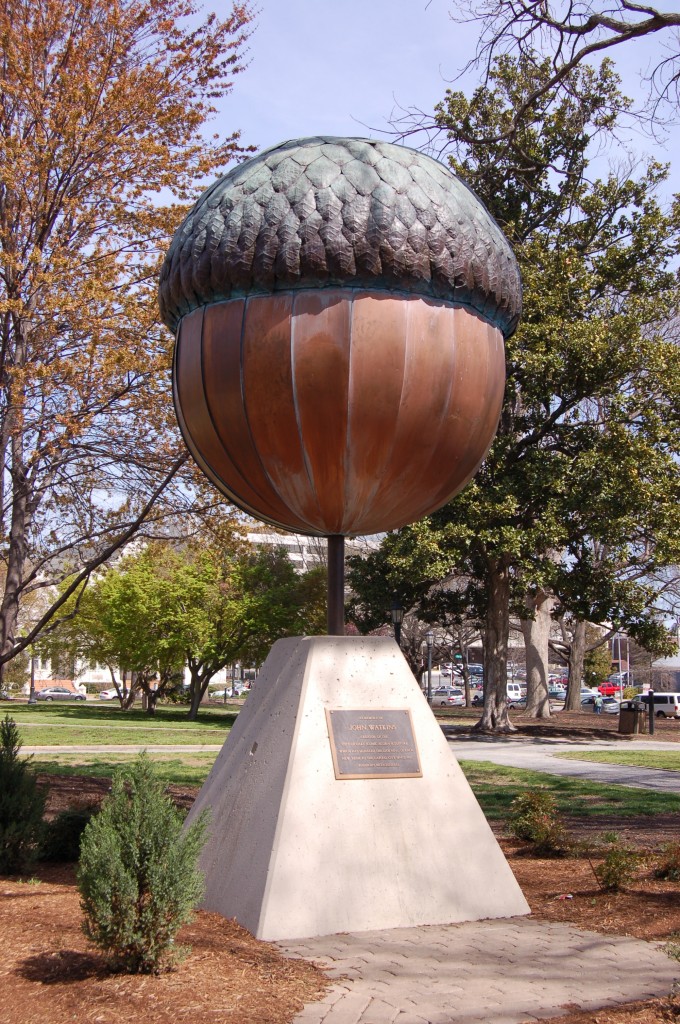
A lot has been written about acorns in foraging publications. I’ll try to say a few things that haven’t been said. Let’s start with that fact that the world’s biggest acorn is in Moore Square Park in downtown Raleigh, North Carolina. Raleigh calls itself “The City of Oaks.” The “Big Acorn” is 10 feet tall and weights 1,250 pounds. I’d hate to meet the squirrel that can carry it away. But, it does remind me of a general rule of thumb about acorns: The bigger the cap on the acorn, compared to the size of the nut, the more bitter the nut will be.
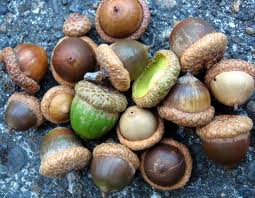
The English word “oak” is some 1,260 years old. In German it was “eih” ending up “eiche.” The Dutch extended it to “eychen” or ” eychenboom.” (I went to school with a “Cossaboom” meaning cherry tree.) Oaks are also mentioned in ancient texts. Greeks of old said “dryas.” Modern Greek say “dris.” It was the preferred tree of Zeus (whom the Greeks call ZEFF, rhymes with Jeff. Zeus is mangled through Dead Latin then into English.)  Those faithful to ZEFF… ah… Zeus… gathered around oak trees. The Celts preferred to knock on oak wood. One variation of their word for oak was “dair, the fourth letter of the Celtic alphabet and part of the name of the city Kildare (which means “Church in the Oaks.”) Often associated with strength, the US military awards gold “oak leaf clusters” for exceptional bravery. Oaks have been a significant part of every culture around them.
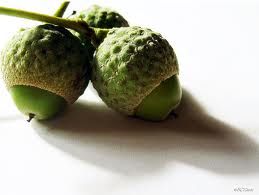
The larger the cap the more tannic acid

The word “acorn” is a combination of “ak” for oak and “corn” meaning seed thus acorn means “oak seed.” The Greeks say velanidi, the Spanish bellota, the French gland, Italians glanda, Portuguese, glande, and in the forgotten fifth romantic language, ghinda in Romanian. Those Romans got around. All the Romantics come from the Dead Latin word for gland, which also lent itself to the medical term for a certain acorn-like part of the male anatomy.  The acorn is also one of the few nuts or fruits that is not directly named in Modern English after the tree it comes from. This is why one does not hear of oak nuts… walnuts, beechnuts, hickory nuts, oak nuts… gland… it could all get rather naughty.
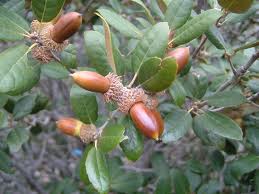
The smaller the cap, the less tannic acid

At least 450 species of oak populate world wide. Some 30 species in the United States have been used for food and oil. The Live Oak is the most prized, not only for food but particularly ship building. Its very long, graceful limbs were ready-made for boat keels and ribs. In fact, the U.S. Navy once had its own Live Oak forest just for boat building. Sold off long ago, the Navy began stockpiling Live Oak in 1992 for restoration of the USS Constitution. It got 50 live oaks from Florida in 2002 of 160 that were cleared for a golf course near Tallahassee. Just as 200 years ago, the trees were selected for their natural curves for the ship. In the white oak family, the Live Oak’s acorns are among the mildest one can collect. Botanically the Live Oak is Quercus virginiana. Quercus (KWERK-kus ) was the Roman name for the tree and virginiana (ver-jin-ee-AY-nuh) means North America and usually where the species was first noticed, such as Virginia. (If you want to get confusingly technical “Ilex” — the genus name for Hollies — also means “oak.” Early botanists thought the Hollies in North America were oaks so they called them Ilex, which was the name of an evergreen oak. When the mistake was found out Hollies kept the oak-genus name and the Oak genus was changed to Quercus.)
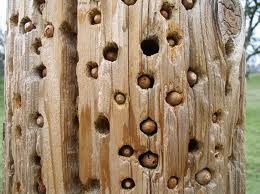
Storing acorns the Acorn Woodpecker way

The seed crop from an oak, the acorns, is called a “mast” which means “food” and putting on a crop of acorns is masting. It is tempting to say it is probably related to the word to “masticate” meaning to chew but it isn’t. Mast came from the Middle English word “mete” meaning meat, which at that time meant any food, and we still use it abstractly in that way, as in “Education became his meat and experience his drink.”  Mete came from the Italian word madere which came from the Greek word, madaros, meaning to be wet. That takes a bit of explaining: Ancient Greeks divided food into two large categories. “Wet” food was food fit for humans and pigs. Dry food was fit for cattle and fowl.  Now you know. How many acorns a tree produces is directly related to the amount of rain in the spring time of the year it is supposed to mast. The more rain the more acorns.

Acorns are quite nutritious. For example, the nutritional breakdown of acorns from the Q. alba, — the white oak — is 50.4% carbohydrates, 34.7% water, 4.7% fat, 4.4.% protein, 4.2% fiber, 1.6% ash. A pound of shelled acorns provide 1,265 calories, a 100 grams (3.5 ounces) has 500 calories and 30 grams of oil.  During World War II Japanese school children collected over one million tons of acorns to help feed the nation as rice and flour supplies dwindled.
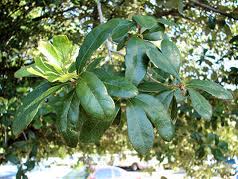
Live Oak leaves have no teeth

Oaks fall into two large categories, those that fruit in one season, white oaks, and those that fruit after two seasons, the black oaks and the red oaks. The latter category can be more bitter than the former. The first category have leaves with round lobes and no prickles at the end of the leaves. The black and red oaks have prickles at the end of their leaves. They also  have scales on the caps of the acorns, hair inside the caps, and a sheath around the nut (which always throws a color even when the tannin is leached out.) Sometimes those in the first category don’t need any leaching, or very little. The rest always do. But first, separate the acorns.
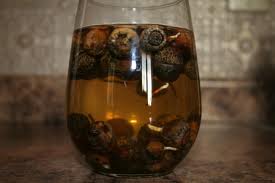
Floaters are bad or have a usable grub in them

To separate acorns dump them into water and remove the ones that float.  Take the ones that sink and dry them in a frying pan on the stove or in the oven at 150F or less for 15 minutes, preheated. Or put them in the sun for a few days. You don’t want to cook them yet, just dry them off and shrink the nut inside making them a little easier to shell. The yield, not counting bad acorns, is 2:1. two gallons of usable acorns in the shell will yield a gallon of nut meat. We must leach out the tannic acid it can damage our kidneys, Most unleached acorns are too bitter to eat without leaching.
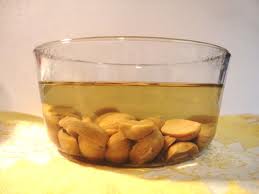
Soaking in cold water, minimal energy and the starch is not cooked

There are three general ways to leach acorns. The least common way is to bury them whole in a river bank for a year, which turns them black and sweet, good for roasting. The other method is to grind them into a course meal and soak several days or weeks (depending on the species) in many changes of cold water until the water runs clear. These will be slightly bland but good for making acorn flour. (Sometimes the leached acorns will be dark but sweet afterwards.) The third way — boiling — is least preferred because if done wrong it will bind the tannins to the starch and they will not lose their bitterness. Also, when you boil the acorns you also boil off the oil with the tannins, reducing  their nutrition. That oil, however, is very nutritious. At this writing it is selling for about $10 an ounce. You can make it for far less. There is actually a fourth method of processing that requires lye but it is not commonly used nor have I tried it.
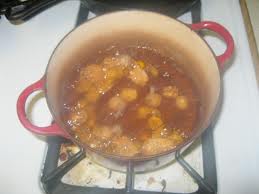
Boiling speeds up the process but cooks the starch

The boiling process requires two pots of boiling water. Put the acorns in one pot of already boiling water until the water darkens. Pour off the water and put the hot acorns in the other pot of boiling water while you reheat the first pot with fresh water to boiling. You keep putting the acorns in new boiling water until the water runs clear. Putting boiled acorns into cold water will bind the tannins to the starch and they will stay bitter. So always move them from one boiling bath to another. Putting acorns in cold water and bringing the water to a boil will also bind the tannin. So it is either use all cold water and a long soaking or all boiling water and just a few hours of cooking. There is one other difference between the two methods.
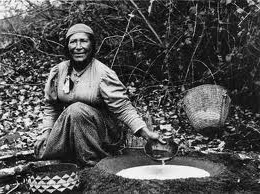
Mrs. Freddie, a Hupa, pours water over ground acorns in a sand basin

The temperature at which you process the acorns at any point is critical. Boiling water or roasting over 165º F precooks the starch in the acorn. Cold processing and low temperatures under 150 F does not cook the starch.  Cold-water leached acorn meal thickens when cooked, hot-water leached acorn meal does not thicken or act as a binder (like eggs or gluten) when cooked.  Your final use of the acorns should factor in how you will process them. If you are going to leach and roast whole for snacking then boiling is fine. If you are going to use the acorn for flour it should be cold processed, or you will have to add a binder.
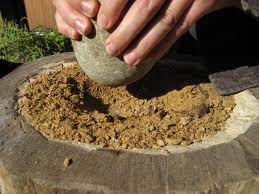
The finer acorns are ground the quicker they leach

Personally, I grind mine in a lot of water to a fine meal, let it set, then strain. I add more water to the meal, let set and strain. I do that until the water is clear or the meal not bitter. That takes a few days to a week. Then I dry it in the sun, unless there are squirrels about, then in a slow oven (under 150º F.)  I end up with a meal or flour, depending on the grind, that will not crumble when cooked.

There are nearly as many variations to leach acorns as there are opinions about acorns. Another way is to put the shelled acorns in water in a blender or food processor and blend them into a milk-like slurry. Put that slurry in a fine mesh bag and then massage that under running water like a faucet. It works very quickly but of course some meal and oil is lost in the process. But it turns hours of leaching into minutes. Of course, leaching them in an unpolluted stream is the easiest way but you can also arrange for a container to leak slowly. Simply put a cloth on the bottom to hold the meal in and fill the container when it is empty, or run the faucet slowly to maintain the leaching. Another ways is to clean out the tank on your toilet and put the shelled acorns in a mesh bag in there. Every flush will remove tannic water and bring in fresh.
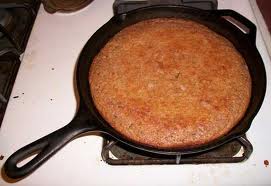
Acorn bread in a classic cast iron pan

Many Native Americans preferred bitter acorns to sweet ones because they stored better. If after leaching there is just a hint of bitterness that can sometimes be removed by soaking the acorns in milk for a while.  The protein in the milk will bind with the tannin in the acorns and can be poured off, if there is just a little. To get oil from the cold-leached acorns, boil them. The oil will rise to the top of the water. Also, charred acorns can be used as a substitute for coffee but really nothing is a substitute for coffee.
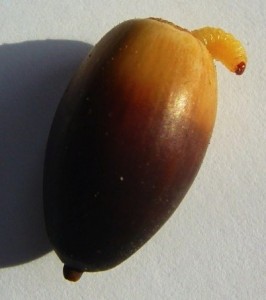
Acorn grubs are edible raw or cooked

Whole leached acorns can be roasted for an hour at 350º F, coarsely ground leached acorns slightly less time.  They can then be eaten or ground into non-binding flour. To make a flour out of your whole or coarsely ground acorns, toss them in a blender or food processor. Strain the results through a strainer to take out the larger pieces then reduce them as well.  Acorn flour has no gluten so it is usually mixed 50/50 with wheat flour.  Since acorn flour is high in oil it needs to be stored carefully and not allowed to go rancid. Remember cold processed acorn flour has more binding capacity than heat processed acorn flour.

Live Oak acorns top the food list for birds such as wood ducks, wild turkeys, quail and jays. Squirrels, raccoons and whitetail deer also like them, sometimes to the point of being 25% of their fall diet. Interestingly, the tannin tends to be in the bottom half of the acorn which is why you will often see a squirrel eat only the upper half of the acorn. Squirrels are also not fools. They will eat all of a white acorn when they find one because it is the least bitter. They will bury the very bitter red and black acorns so over time some of the bitterness is leached into the soil. Raiding a squirrel’s hoard will get bitter acorns.  By the way, acorns shells and unleached nut meat have gallotannins which are toxic to cattle, sheep, goats, horses and dogs.

If you use the boiling method don’t throw away the tannic water. The water has a variety of uses. With a mordant it can be used to dye clothing. The tannic acid also makes a good laundry detergent. Two cups to each load but it will color whites temporarily a slightly tan color. Tannic water is antiviral and antiseptic. It can be used as a wash for skin rashes, skin irritations, burns, cuts, abrasions and poison ivy. While you can pour the tannic water over poison ivy, if you have the luxury freeze the brown water in ice cube trays and use the cubes on the ivy eruption. If you have a sore throat you can even gargle with tannic water or use it as a mild tea for diarrhea and dysentery. Externally dark tannic water can be used on hemorrhoids. Hides soaked in tannic water make better leather clothing. Using the brown water turned hides tan-colored and that is why it is called tanning and from there we get the words tannins and tannic. In traditional tanning methods, whole hides are soaked in a vat of tannin water for a full year before being processed.

Besides dyes paints have also been made from the oaks. It also a dense wood for working and weights 75 pounds per dry cubic foot. The hull of the US warship, USS Constitution, was made entirely of oak, white oak covering over a live oak core. At the waterline she was 25-inches thick. Eighteen-pound cannonballs bounced off the oak, notable in the 1812 battle with the HMS Guerriere. That battle and the subsequent loss of British ships caused the British to issue the order that no ship was to attack the Constitution singlehandedly. The Constitution, as of this writing, is still on duty and berthed in Boston.

Oak trees begin to produce acorns at about 20 years old but usually the first full crop won’t happen until the tree is about 50.  The average 100-year old oak produces about 2,200 acorns per season.  Only one in 10,000 will become a tree.
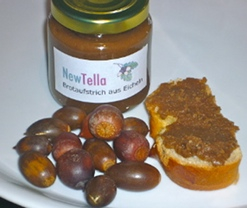
Peter Becker’s “Newtella”

Sprouted acorns are also edible as long as they haven’t turned green. I’ve heard from German forager Peter Becker who has a slightly different view of what to do with acorns.

“What I do to prep acorns for consumption is let them germinate, so the starches turn into malt sugar. I’ve only just developed a new product with acorns to introduce this precious nut to public because acorns are generally considered inedible here in Germany. NewTella is a sweet bread spread just like Nutella, the famous hazelnut creme, except that all ingredients are locally available, it has less sugar and the only fats are from the acorn. The basic preparation is to roast leached, peeled and germinated acorns, boil 1 part acorns with 3 parts of apple juice, when soft process them smoothly, add 20 % sugar with pectin. This bread spread is also a great way to preserve acorns and can be used for cookies. It’s a great way to promote this gigantic untapped resource and jazz up general nutrition.

A few exchanges about Peter’s process is below in the comments. He shells them, leaches them (cold water) and sprouts them before using them to make his NewTella. That helps convert the starch to malt, which is sweet.
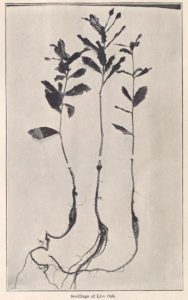
Older oaks with swelling.

What about other parts of the oak? Get ready for some official hearsay… A century ago a pamphlet was published by a W.C. Coker on The Seedlings Of The Live Oak and White Oak.” Coker referenced an article called “The Acorns And Their Germinations” by a Dr. Engelmann in Vol IV, 1880, of the Academy of Science of St. Louis. He in turn was referencing three fellows in South Carolina one of whom, William St. John Mazyck, made the original observation. Englemann wrote: “The structure of the acorns and the germination of the oaks seem to be so well-known, that I did not pay much further attention to it until my interest was excited by the information that the germination Live Oak developed little tubers, well-known to … children and greedily eaten by them….”
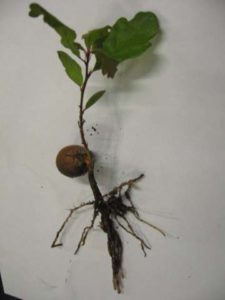
Is this oak seedling creating a starchy swelling that’s edible?

Essentially they write that after the acorn sprouts and sends up a young shoot the root develops a small elongated swelling that is edible. They agreed the swelling contains starch. The question they were discussing was when does the “tuber” form and how long does it last? They suspected it formed before the young shoot developed many true leaves. The swelling persists but grows woody in a few years. The “plate” in the pamphlet (above left) showed older oaks shoots but was used to show the swelling location when younger. One question was why would some species do this and the possible answer was hard times, or if you’re an oak, bad weather. The starchy swelling would help feed the seedling.

Lastly you may have a use for those acorns mentioned above that float when tossed in water. Most of them have a weevil grub in them, the Acorn Curculio. Look for a little 1/32 inch hole. In time that grub will crawl out and burrow into the ground for a couple of years turning into a full-fledged insect. You can use that grub in the acorn as bait for fish. Or, you can let it crawl in to a bucket of dirt or sawdust or a container of oatmeal where it will make a cocoon which you can then open later and use for bait. Store live in the frig. Also, squirrels like the grubs so it is not beyond reason to use them for bait for squirrels. And to answer your question, the grubs are edible by humans raw or cooked.  I like them cooked in butter though bacon fat might do as well. You may also find a little worm with legs in an acorn. My entomologist friends tell me they are edible, too.

Acorn Bread

2 cups acorn flour

2 cups cattail or white flour

3 teaspoons baking powder

1/3 cup maple syrup or sugar

1 egg

1/2 cup milk

3 tablespoons olive

Bake in pan for 30 minutes or until done at 400 degrees.

A far more simple form of acorn bread is to make a thick acorn porridge out of cold processed acorn flour. Take a large tablespoon of the porridge and drop it into cold water. This causes the porridge to contract. Take the lump out of the water and dry.

Green Deane’s “Itemized” Plant Profile

Autum Acorns

IDENTIFICATION: Acorns, small nut with cap. Rough and larger caps belong to the more bitter acorns.

TIME OF YEAR:  Usually late summer, fall, tree do not produce every year.

ENVIRONMENT: Oaks inhabit all kinds of environments.

METHOD OF PREPARATION:  Numerous once leached of tannins.: out of hand, flour, candy.

HERB BLURB

The tannins have been used as an astringent as well as antiviral, antiseptic and antitumor but could also be carcinogenic. The mold that develops on acorns has antibiotic properties.
{ 226 comments }

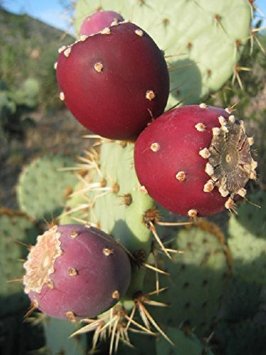
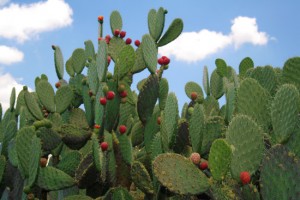
Nopales blossoms will turn to purple fruit. Photo by Green Deane

Nopalea Cochenillifera: Cactus Cuisine

Be brave when you collect cactus.

Of course, good gloves and tongs help. With those tools you can have a very steady and nutritious supply of a tasty wild edible, and not only in warm areas. Cactus grow from Alaska to Argentina, or chilly Canada to chilly Chili, and other parts of the world. People have been eating Nopalea/Opuntia for at least 9,000. It’s not too late to join them.

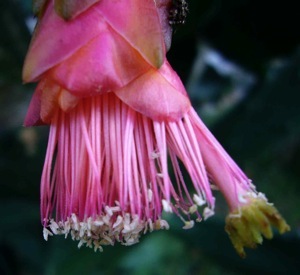
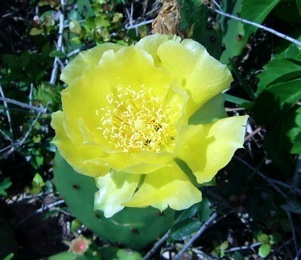
Many flower stamens

For example, Opuntia, the most common of the edible cactuses, is native to every U.S. state except Maine, New Hampshire, Vermont and Hawaii, the four states farthest from its native area, Central America (yes, Opuntia are native to southern Alaska and have become naturalized in Hawaii.)  That said, I seem to remember seeing some growing in southern Maine in the woods when I was a kid, and I can remember the exact spot. So if not native, they did survive there. Some other families of cactus with edible members are Cereus, Hylocereus and Saguaro. There is probably an edible cactus near you. It also might be healthy: A close cousin, Opuntia Ficus-Indica, seems to have good effects on blood lipids. It also has antioxidants and might help in repair of DNA. O. ficus-indica is the cactus most often found for sale in stores.

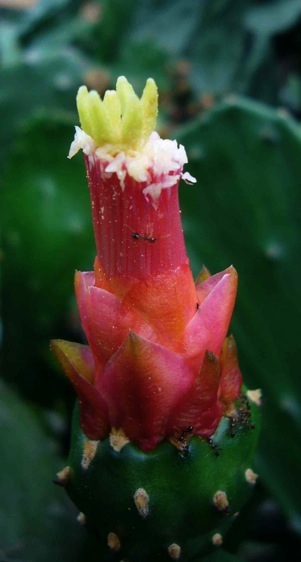
Proflific blossom turn into fruit

Here in Florida there are several kinds of edible cactus. A very common one I have planted in my yard — but can be found growing wild everywhere — is Nopalea cochinellifera, (Noh-PAL–ee-uh koh-ken-ill-EE-fer-uh) also called the cochineal cactus. It was Opuntia cochinellifera (oh-PUN-she-ah  koh-ken-ill-EE-fer-uh) but was given it own genus. It can grow in to a 12-foot tree-like cactus and requires much trimming to keep it in check. Both the fruit and the pads are edible after de-spining. Many references say the N. cochinillifera has no spines but they ar wrong. It has little tuffs stuffed with microscopic needles called glochines or glochids (best remove by a blast of water, and or burning off. Hot wax as last resort or duct tape.)  “Glochis” is a Greek word meaning “the point of an arrow.” If you get one in your finger you’ll understand.

I got my Nopalea 19 years ago the true forager way. I was in Daytona Beach going to their annual Greek Festival. While walking on the sidewalk I saw one pad — technically a cladode. It had broken off a parent plant and lay on the walkway. I took it home, you know, be kind to homeless plants and all that. Now I have several N. cochinillifera and more cactus than the neighborhood can eat.

Besides food, the blossoms of the N. cochinillifera are a wonderful fuschia. They attract bees, butterflies and those rare  little feathered helicopters, hummingbirds. The pear-shaped fruit are ripe when deep red to purple. A large cactus can have virtually hundreds of fruits

Fruit pulp tastes like raspberries.

Harvesting: The best thing to do is spray fruits and pads with water to reduce the amount of glochids. Pick the fruit with heavy leather gloves then wash them again and or burn what spines there might still remain off — a butane torch works well, a candle flame, or a deftly held propane torch. You then peel them for the soft red fruit flesh inside. It can be eaten raw or cooked and has a raspberry like flavor. Just be sure to take the seeds out. They are very hard and can break your teeth. Grind them into flour.  I use often use the cactus fruit to make a salad dressing, especially when I am making a backyard salad. The pads are treated the same way, eat them as is or peeling them and eating the inner part of the pad, raw or cooked. Some say it is an acquired taste but I don’t think the flavor is that far out of the mainstream to say that. Besides everything other than mother’s milk is an acquired tasted. If you can get the spines off you can also eat the outer part of the pad. Just as the Nopalea has a history behind it so to does its name.  Let’s take the species name first.

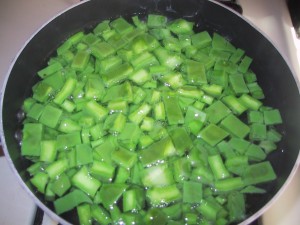
Pads can be used like a vegetable

Cochenillifera in Latin means “cochineal bearing” but is from the Greek word for red, “kokinos.” That’s because the cochineal insect lives off that particular cactus and others in the family. That might be almost interesting except you may have eaten that exact insect at one time, or more specifically, a product produced from their crushed, little dehydrated bodies: Cochineal dye. Actually, only the female cochineal provides the red dye and it takes some 75,000 to make one pound, 155,000 to the kilogram. Sometimes in the wild you will see a Nopalea or Opuntia pad flecked with white gray, or even covered with white or gray cotton. That’s a cochineal condo.  The hard part is each of the scale-like insects has to be harvested by hand, when they are around 90-days old.

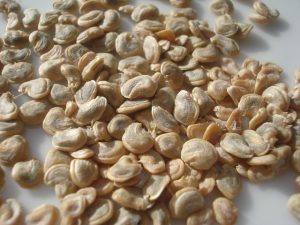
These cactus seeds are tough and need to be ground or roasted.

Until artificial dyes were invented, cochineal dye was the main red dye from food to fabrics. In the 1400s, eleven cities conquered by Montezuma each paid a yearly tribute of 2000 decorated cotton blankets and 40 bags of cochineal dye. During colonial days Mexico had a monopoly on cochineal dye and it was that country’s second largest export after silver. Cochineal went out of favor and flavor when chemical dyes came in but the organic movement and rejection of artificial dyes has brought it back. Cochineal trumps chemicals, as it were. If you use a cosmetic or have eaten a product with any of these ingredients, you have used or bitten the bug: Cochineal extract, carmine, crimson lake (or lac) natural red 4, C.I. 75470, E120, or even “natural coloring” when the product is any shade of red, scarlet or orange. Cochineal is one of the few water-soluble dyes that resist fading.

Cactus with yellow blosoms and pads are edible

The genus name, “nopal” means cactus in Nahuatl, the language of the Aztecs, wrongly reported as “Spanish” for cactus. No, the Aztecs had the word first. Opuntia, however, is very removed from the New World. It is from a Greek word, Opos. Opos is an area near Lokria on the island of Euboea, which is northeast of Athens. The Greeks say the island’s name as EH-via (see how Latin has perverted the Greek it imported.)  Evia is a favorite get away and one end of the island is only about 100 tidal-torn feet from the mainland. In the Opos area, according to Pliny and Theophrastus, there grew a spiny plant. There also grew figs. Figs are one of the few foods with a latex sap that we can eat (see Natal Plums.) That sap was used as rennet in making cheese. Rennet makes the solids in the milk separate from the liquids so it can be made into cheese. The adjective form of the opos is opuntios, meaning “of Opos.” It came to mean fig-shaped. The cactus, which has spines and a fig-shaped fruit (kind of) got named Opuntios. That was then degraded via Latin to Opuntia, and where I get linguistically irritated when it comes to English.  The original word is Greek and is spelled with a T. The T is pronounced as a T, not an S. Yet when you say “oh-PUN-tia” there is always someone around who will try and correct you with “oh-PUN-see-ah.”

Incidentally that cheese-making technique was mentioned in the Iliad and later by Aristotle. It was used well into the 1800s until bacterial ways were found to curdle milk.  The technique was so common it was mentioned in several farming “books” by ancient Greeks and Romans.

Opuntia littoralis was introduced to Mediterranean area long ago and flourishes in its mild climate, such as in the south of France, southern Italy, and Sicily where it is a culinary speciality called ficurinnia. In Greece the fruits are called frangosyka (French figs) or pavlosyka (Paul’s figs). The prickly pear also grows in Malta where it is a typical summer fruit and used to make the popular liqueur, Bajtra. There the opuntia is a common dividing wall between Maltese fields.

Nopales pads with fruit

Nopalea is good for you. There is some lab evidence that it lessens low-density cholesterol, though not reported is whether that was large molecule LDL or small molecule LDL. It’s the small molecule LDL that harms (as of this writing.) The exact nutritional value is not set with several sources giving differing amounts. But, it is low in calories and sodium, high in fiber and vitamin C. It also helps control blood sugar and, according to lab work, reduces the effects of a hangover if eaten before drinking. One word of caution, besides avoiding the spines: Never eat any part of any cactus that has white sap.

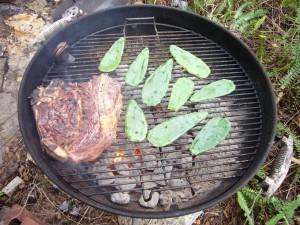
Grilling Steak and Nopales

Below are some recipes, though they are as common on the internet as spines on a cactus. One note of forecaution: Eating ripe opuntia fruits can turn ones urine reddish. Thought you’d like to know rather than it be a surprise.  My two favorite ways of preparing Opuntia/Nopales pads is to pick young ones, brush off the glochids, julienne the pads, and fry in oil. Or, grill them and put them in a sandwich. Delicious. Of course, you can always skip the cactus collecting and give Nopales a try from the can or with commercially harvested pads. Both are found in many supermarkets these days.  And let me be honest, I used to cheat a little. Many times when I was serving a dish of a “wild” food — to a group known to have a few squeamish people in it — I would actually buy the “wild” product in the local market, keeping the receipt. That way if someone said they got sick from the “wild” food it was 1) highly unlikely or 2) the grocer’s problem not mine.

Scrub cactus pads well, remove any spines. Cut around the spiny nodules and remove them, completely. (Not necessary with young thin pads. Use whole) Grill the leaves over charcoal for 10 to 12 minutes per side. Thicker pads take longer. Brush pads with oil occasionally  while grilling. Serve hot.

Cactus Jelly

One to two quarts or so of cactus fruit  (1.5 pounds)

3 cups sugar

1/2 cup lemon juice**

6 ounces liquid fruit pectin    Boiling water

Cheesecloth

Place fruit in a large saucepan or kettle. Cover with boiling water, allow to stand for 2-3 minutes, and pour off water. (This aids in softening stickers of the fruit.)  Peel fruit, cut into pieces, and place in a medium-sized  saucepan. Cover fruit with water and boil at high heat for 5 minutes. Pour boiled mixture through cheesecloth. Drain as  much juice as possible. Discard seeds. Measure juice. Combine cups of cactus juice, sugar , and lemon juice in  large saucepan. Bring mixture to a rolling boil. Reduce heat to medium-high, add liquid pectin, and cook mixture for 8-12 minutes, or until the mixture begins to thicken. Skim off any foam that may have formed. Pour mixture into hot, sterilized, canning jars and seal as usual.  Process jars immersed in a Boiling Water Bath for five minutes to seal the lids.

 Cactus Monterey

1  pound cactus pieces

1 small tomato

1/4 small white onion

1 jalapeno pepper

1/4 bunch cilantro

1/4 cup shredded Monterrey jack cheese (or of choice)

1 teaspoon salt (optional)

4 tablespoons avocado or low heat olive oil

Steam the cactus until softened. Drain the cactus. Lightly fry all the other ingredients except for the Monterrey Cheese. Combine fried ingredients with the cactus and allow to simmer for 15 minutes. Top with cheese before serving.


CACTUS FLOWER WINE by Jack B. Keller, Jr.

  • 2-1/2 quarts firmly-packed cactus flowers
  • 2 lbs granulated sugar
  • 1 11-oz can 100% white grape juice concentrate, frozen
  • 1-3/4 tsp acid blend
  • 1/8 tsp grape tannin
  • 6-1/4 pints water
  • 1 crushed Campden tablet
  • 1 tsp yeast nutrient
  • 1 pkt Champagne wine yeast

Wash the flowers and put in nylon straining bag with a dozen marbles for weight, tie bag, and place in primary. Heat 1 quart water and dissolve sugar. Cool with frozen grape juice concentrate and remaining water and add to primary. Add remaining ingredients except yeast and stir well. Cover primary and wait 10-12 hours before adding activated yeast. Recover primary and stir daily. When specific gravity drops to 1.020, drip-drain bag and transfer wine to secondary. Affix airlock and set aside. Rack after 45 days and again after another 45 days, topping up and refitting airlock each time. If fermentation has finished, wine should be clear or begin to clear, although pollen will continue to settle for another 1-2 months. Rack again 60 days after wine has cleared, top up and reattach airlock. Set aside another 90-120 days to bulk age. Stabilize, sweeten to taste and rack into bottles. May taste after 6 months in bottle.

Green Deane’s “Itemized” Plant Profile

IDENTIFICATION: Nopalea/Opuntia can usually be distinguished by flat, rounded pads that are actually jointed stems. They’re usually covered with two kinds of spines, fixed brittle needles and tiny glochids that stick to you instantly. Blossom vary greatly from bottle brush to rose-like. They are a large family, two genera, so learn your local varieties. Duct tape is good for glochid removal, or hot wax.

TIME OF YEAR: Blossoms in spring or summer in some climes, year round in others, pads edible year round, fruit in season.

ENVIRONMENT:  They grow from northern Canada to southern South America, rainy Florida to dry deserts.

METHOD OF PREPARATION: Young pads are edible whole. Older pads are usually peeled or have spine eyes removed.  The best pads are shiny and not too thick. They get fiberous then woody as they age. The inner flesh of the red fruit is edible having a flavor similar to raspberries. Juice from the inner fruit can be used as is or made into ade or jelly. The hard seeds must be ground before eating. The inner flesh of some pads of many if not most species is also edible, can be sour. If your cactus has milky sap. DON’T EAT IT.  You’ve got the wrong plant.

{ 54 comments }

The semi-annual insanity is upon us.

G.V. Hudson is to blame

It is time for my semi-annual rant and wish that G.V. Hudson had a different hobby. Hudson, a New Zealander, collected insects and was a shift worker. In 1895 he proposed Daylight Savings Time so he could collect insects after work in daylight. The world rightly ignored his idea but it was also championed by a golfer William Willett in 1907. He fought for it tirelessly and the world rightfully ignored him as well.  But, to save energy during WWI, Germany adopted Daylight Saving Time and soon other countries in the conflict followed. The time pox has been on humanity since. In the fall Americans set their clocks back to standard time. In the spring they go back on artificial time.

Golfer William Willett had the same bad idea

As I have mentioned before I stopped changing my clocks a dozen years ago. People who visit my home know I stay on “Deane Time.”  I absolutely refuse to go on “daylight savings time.” The entire idea strikes me a silly particularly when one considers there is a fixed amount of daylight no matter how we set our clocks. It is rightfully called “daylight slaving time.” Only the government would cut the top foot off a blanket, sew it on the bottom, and then argue the blanket is longer.

What really got to me was the seasonal flipping: Springing forward, falling back, feeling miserable. Time change always left me out of sorts for weeks. For more than a decade now I don’t flip. I don’t change the clocks, when I get up, when I eat, when I go to bed or when I feed the animals. This family stays on standard time.  I just recognize that for half the year the rest of the country thinks it is ahead of me by one hour.

Semi-annual nonsense

Fortunately nature is not so wrong-headed. Animals and plants ignore the time change. Cows get milked at the same time no matter what hour it is. Plants grow the same while we pretend there is more light in the evenings during summer. (Though as a kid I remember marveling that at 9 p.m. it was still light outside.)

There is also a philosophical reasons. So much of our lives is artificial. And artificial “daylight savings time” is but one more thing to knock us out of sync with the world around us. I spend a lot of time with Mother Nature and I prefer her time to man’s. And grumpy me, I like to use my watches (12- and 24-hour) as compasses, and that’s easier if one stays on solar time. Thus I do. And more than one study shows it actually cost more to go on Daylight Savings Time than not and is less healthy.

From a factual point of view, the majority of people on earth do not go on Daylight Savings Time. How sensible. Asia doesn’t nor does Africa. Most equatorial countries don’t. Great Britain and Ireland tried staying on DST permanently from 1968 to 1971 but went back because it was unpopular. Most of Arizona does not go on DST.  Lead the way Arizona. Daylight Savings Time is a bad idea that needs to go away. You can refuse to let it disrupt your life. We all have phones and computers to remind us what the outside world thinks is the right time. Let them but keep your personal life on standard time. You can do it. This weekend I have nothing to change and no misery to go through. Give it a try. 

(In 2018 Florida passed a measure to stay on Daylight Savings Time permanently, as Great Britain and Ireland tried and rejected 50 years ago. Called the “Sunshine Protection Act” it requires congressional approval because DST is a federal dictate. Florida’s request is not going to happen in a bitter, divided place like Washington D.C. which has other priorities than sunshine in the sunshine state. If Florida had decided to stay on standard time it could do that without federal approval. Unless Florida revisits the legislation you are stuck with flipping. Opportunity missed. You screwed up Tallahassee.)

{ 27 comments }

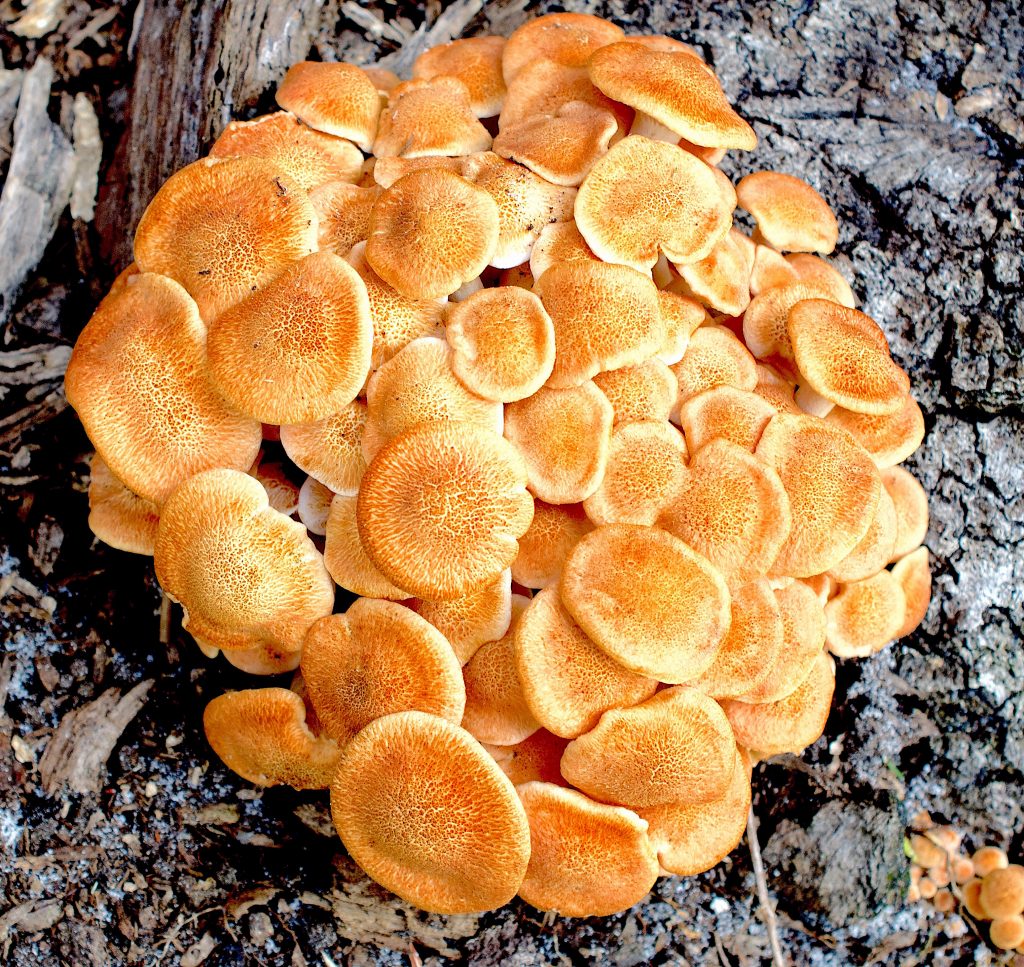
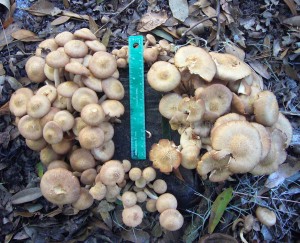
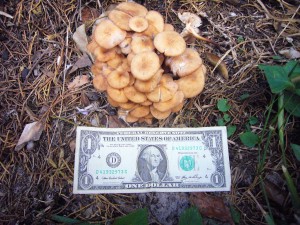
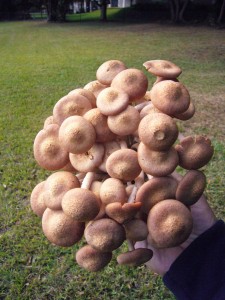
Ringless Honey Mushroom, Armillaria tabescens, Photo by Green Deane

Do not eat any mushroom without checking in person with a local, live, mushroom collector.

The first time I thought I saw the Ringless Honey Mushroom was about a decade ago in November on my neighbor’s lawn. The only problem was this species of mushroom grows on wood such as stumps or on decomposing roots (not mulch.) I had lived in the neighborhood 13 years and didn’t remember a tree on the lawn … though maybe there was a stump there when I first moved in…

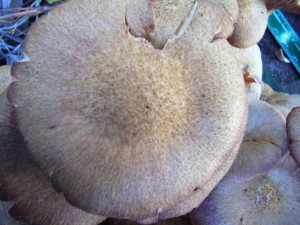
Notice a slight raise and more dark hairs in the middle of the cap. The cap’s flesh is also white (see inside crack) to help you distinguish it from the toxic orange-flesh Jack-O-Lantern. Photo by Green Deane

Next time I thought I saw it was 200 miles away in West Palm Beach growing on an Eastern Cedar stump, or Southern Cedar … much the same thing (Junipers.) Ringless Honey Mushrooms usually don’t like conifers (its the pitch I imagine. I’ve also noticed them growing on Camphor stumps — pass — and on banyan roots… maybe worth trying as that is the fig family.)  The third time, however, was a charm, about a mile from my house growing on oak stumps in an area that had been cleared a couple of years earlier. It was a mushroom mine, so to speak. When I later took a Mushroom Certification class in late August in North Carolina they were everywhere. It gets cooler there sooner. Locally Ringless Honey Mushrooms like October through December with November being the heaviest month. 

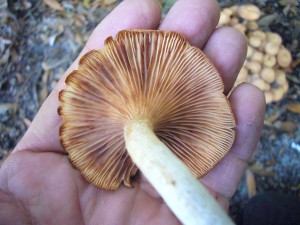
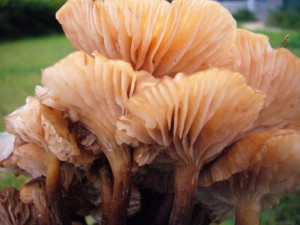
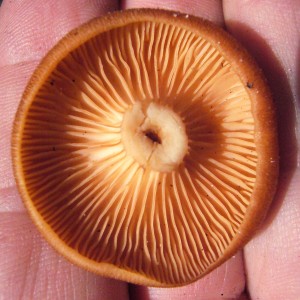
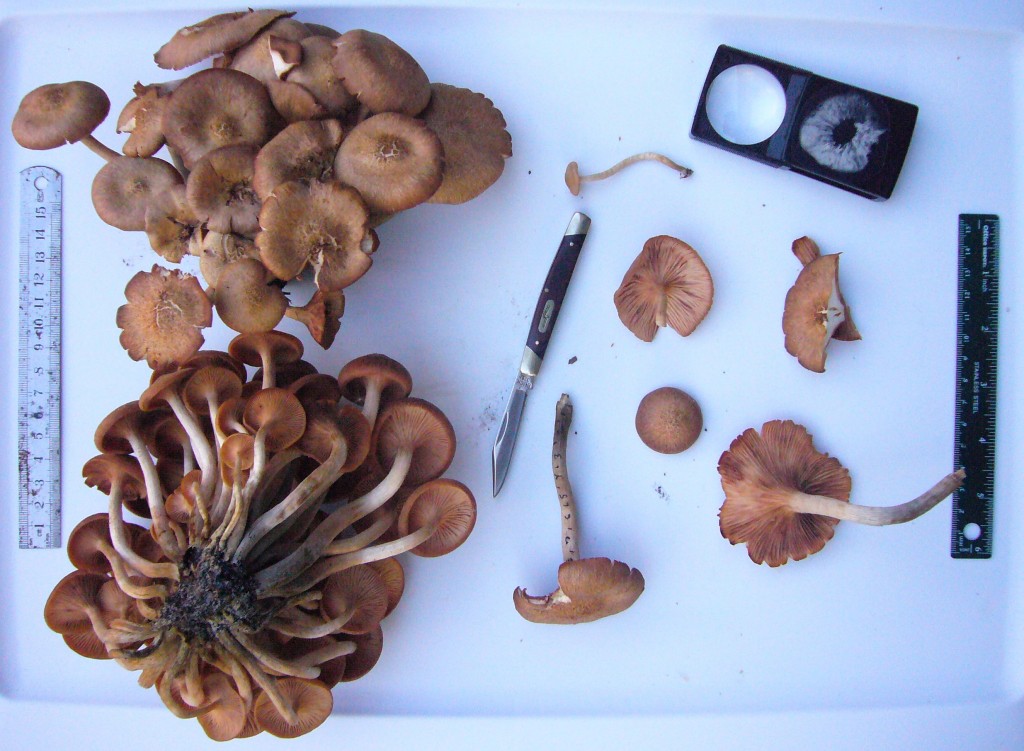
Gills are widely spaced, touch but don’t run far down the stem, and stain or turn brown or brownish pink when bruised or aged. Photo by Green Deane

The Ringless Honey Mushroom, Armillaria tabescens,  is a southern stand-in of a very common mushroom in North America and Europe, Armillaria mellea. which is also edible. The A. mellea, however, has a ring around the stem — an annulus — as almost all Armillaria do. The Ringless Honey Mushroom does not have a ring and there is also one ringless species in Europe, the A. ectypa. It’s rare and classified as endangered in some areas. I note A. ectypa only grows in acidic marshes and is listed as edible and non-edible…. not good form to list an endangered species as edible. A. mellea is an infrequent Florida mushroom in the spring. Though looking similar it has an annulus and the cap is tacky.

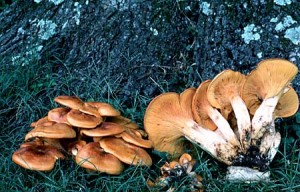
Ringless Honey Mushrooms grow on wood, in this photo around an oak stump. Photo by Green Deane

As mushrooms go the Ringless Honey Mushroom is one of the easier to identify. The mushroom grows on wood, preferably oak. But has also be found growing on Buckeyes, Hemlock, Hollies, Junipers, Sweetgums, Plums,  Apples, Perseas, Maples, Pines, Ash, Alders, Almonds and Walnuts. Ringless Honey Mushrooms found growing on Hemlocks and Buckeyes are known to cause digestive upset. I would avoid those growing on plums, apples, almonds and hollies. Those trees can have some nasty chemicals in them including hydrocyanic acid. However a mycology professor specifically told me these mushrooms should not pick up any bad chemicals from such trees. Oak is the most common and safest bet. You will find it on stumps, exposed roots, at the base of trees, and growing on buried roots. This is particularly common where a dead tree has been removed so there appears to be no tree but the mushroom is still living on the buried dead root. This is why one can find them growing in lawns without any trees nearby. Incidentally, if the tree you find them on is living this species will in time kill it. 

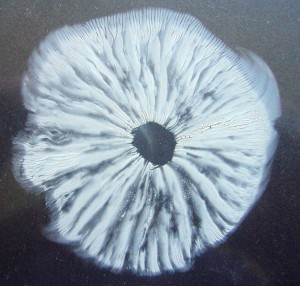
The spore print is white which helps separate it from the hallucinogenic Gymnopilus spectabilis (orange-brown spores) the deadly Galerina autumalis (brown spores) Pholiota species (brown spores) and Hypholoma fasciculare, “Sulphur Tufts” which are also cespitose and have purplish-brown spores. Photo by Green Deane

James Kimbrough in his book “Common Florida Mushrooms” says of the Ringless Honey Mushroom: “This is the most common late fall-early winter mushroom in Florida. It causes mushroom root-rot of numerous tree and shrub species, and is especially critical in the die back of oaks. It is seldom found in summer months, but appears in striking numbers as soon as late fall rains commence. It is a choice edible species, but because of its toughness, must be cooked longer than the average mushroom.” I would add one usually does not eat the stem (use them for flavoring.)  The mushroom is also a good candidate for drying. I fry them them in coconut oil until they are about half the size they started and thoroughly cooked. Some people have to parboil them first then fry them to avoid digestive upset. And a few rare folks can’t eat them no matter how cooked. I think they’re tasty. Younger mushrooms are a bit more springy than middle-aged ones. I think the best age/size is when they are between the size of a quarter and a half dollar. Their texture lends themselves well to dishes that require long cooking. 

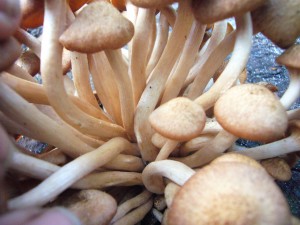
Gills are knife-thin, sometimes forked, stems are white or light yellow on top tapering downward to darker stems. Photo by Green Deane

As for the scientific names, Armillaria (ah-mill-LAIR-ree-ah) is Dead Latin for “little bracelet.” Tabescens (tay-BESS-sins) mean decomposing. One would like to think it is called “little bracelet” because it can embrace an entire small stump but no. It is because of a bracelet-like frill on the fruiting bodies. And I don’t know if tabescens refers to helping wood decompose or the brown-black pile of dried muck the mushroom becomes when reproduction is done. They are called “honey mushrooms” because their color is similar to honey. And it should be added that not all categorizers of mushroom like “Armillaria” for the genus and prefer “Desarmillaria.” The naming science is not settled.

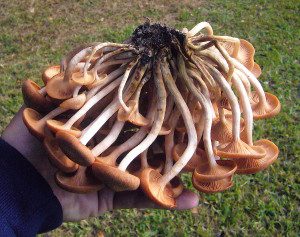
Ringless Honey Mushrooms are cespitos, growing in a cluster. Also note how light-colored the young stems are. Photo by Green Deane

Kimbrough describes Ringless Honey Mushroom this way: Pileus is 2.5-10 cm, convex to plane, sometimes sunken at the disc with uplifted margins; yellow-brown with flat to erect scales. The lamellae are decurrent, somewhat distant, staining pinkish brown with age. Stipes are 7.5 to 20 cm long, 0.5 1.5 cm wide, tapering towards the base; off-white to brownish in color, lacking an annulus. Spores are white in deposit, broadly ellipsoid, 6.0-10 x 5.0-7.0 um, not staining blue in iodine. Basidia are clavate, 30.0-35.0 x 7.0-10.0 um, with four sterigmata. Normally I would translate those technical terms into plain English but with mushroom you should also learn the argot. But to give you an idea: The cap is one to four inches across, shaped like an upside down bowl to flat across the top with the edge turned up…

David Arora author of Mushrooms Demystified, describes the related Armillaria mellea as an edible spring mushroom then adds Armillaria tabescens is the same except no ring (annulus) and a dry cap.  He provides more details:

Mature caps can range from two to four inches across. Photo by Green Deane

Cap: 3-15 cm broad or more, convex becoming plane or sometimes broadly umbonate or in age uplifted; surface viscid or dry, usually with scattered minute dark brown to blackish fibrillose scales or erect hairs, especially towards the center; color variable: yellow, yellow-brown, tawny, tan, pinkish brown, reddish-brown et cetra.  Flesh thick and white when young, sometimes discolored in age; odor mild, taste usually latently bitter.

A young cap’s color is uniform without any brusing or aging towards brown-pink. Photo by Green Deane

Gills: Mushroom perfectionists can really rattle on about gill attachment, which are admittedly important. Start with the acronym F.A.D. meaning Free, Attached, Descending. Gills are one of those three but there are nuances. Do they touch with an upward swing or a square-on 90 degree connection? If they don’t attach the stem at all they are free.  Ringless Honey Mushrooms are “attached” more specifically  “adnate” meaning square on to slightly decurrent (running down the stem some) or sometimes notched — half adnate;  Just remember they are attached and can run down the stem. The gills are white to yellowish or sordid flesh-color, often spotted darker in age. Stalk: 5-20 cm long, 0.5 3(5) cm thick, tough and fibrous with a stringy pith inside; usually tapered towards the bottom if growing in large clusters, or enlarged below if unclustered and on the ground; dry, whitish (above the ring in the A. mellea) soon yellow to reddish brown below and often cottony-scaly when very young.  Spore print white 6-10 x -6 microns, elliptical, smooth, not amyloid.

Habitat: In small or massive clusters on stumps, logs, and living trees, or scattered to gregarious (occasionally solitary) on ground — but growing from roots or buried wood; common on a wide variety of trees and shrubs… on oaks trees the mycelium (mushroom roots) can frequently be seen as a whitish fan like growth between the bark and wood.

Whether young or middle aged select only firm caps for cooking. Stems are tough and fiberous. Photo by Green Deane

Arora says (of the A. mellea which he also says describes the A. tabescens) is eminently edible. Use only firm caps and discard though stalks (which are used for stock.) It is an abundant food source, crunchy in texture, and a very passable substitute for the shiitake in stir-fry dishes. Arora recommends because of its various  forms beginner should pick only those growing on wood.

There are three or four similar-looking mushrooms which are toxic. The Galerina autumnalis has a ring, is smaller, and has brown spores. The Pholiota species also have brown spores. Gymnopilus have rusty-orange spores. The Sulphur Tuft, Hypholoma fasciculare, which likes to grow on wood, has purple-brown spores. That leaves Jack-O-Lanterns, Omphalotus.

Jack-O-Lantern mushrooms, above,  look similar but the cap’s inner flesh is orange or yellow, not white like the Ringless Honey Mushroom. The Jack-O-Lantern can cause severe gastric distress.

“Jacks” are similar but in age can become vase shaped. More importantly their color is shades of orange or reddish-orange, occasionally yellow orange or one species olive orange. The cap is smooth, the Ringed Honey Mushroom has small black hairs. Also the gills run down the stem strongly on the Jach O Lanterns whereas in the Ringless Honey Mushroom the gills meet the stem or run down only a little. The flesh of the Jack-O-Lanterns is about the same color as the cap whereas the Honey Mushroom cap is tan/brown and the flesh is white.  If you’re healthy Jacks won’t kill you but will cause severe gastrointestinal illness. Fresh Omphalotus gills can glow faintly in the dark. I’ve seen this several times. As the mushroom ages it loses the ability to glow so don’t rely on it. Some folks mistake Jacks for Golden Chanterelles but Chanterelles when cut are white inside (like the Honey Mushroom) and do not have true gills but rather ridges.

From the kitchen of James Kimbrough: Mushroom Meatloaf.

Young Armillaria tabescens. Photo by Green Deane

2 pounds of Armillaria mellea or A. tabescens
1 Large onion
2 Tablespoons butter
1/2 Cup of dry bread crumbs
2 Eggs, lightly beaten
1/4 Stick of butter melted
1/2 Teaspoon salt
Dash of pepper

Saute half of the onion in two tablespoons of butter until golden brown. Save several large mushroom caps for garnish. Chop remaining mushrooms, including stems and remaining onions; mix with bread crumbs, salt, pepper, and remaining butter. Stir in eggs and sauteed onions. Press entire mixture in a well-greased loaf pan. Arrange mushrooms caps on top and press slightly. Bake for one hour at 350 F. Let stand several minutes; slice and serve with mushroom gravy.

{ 55 comments }

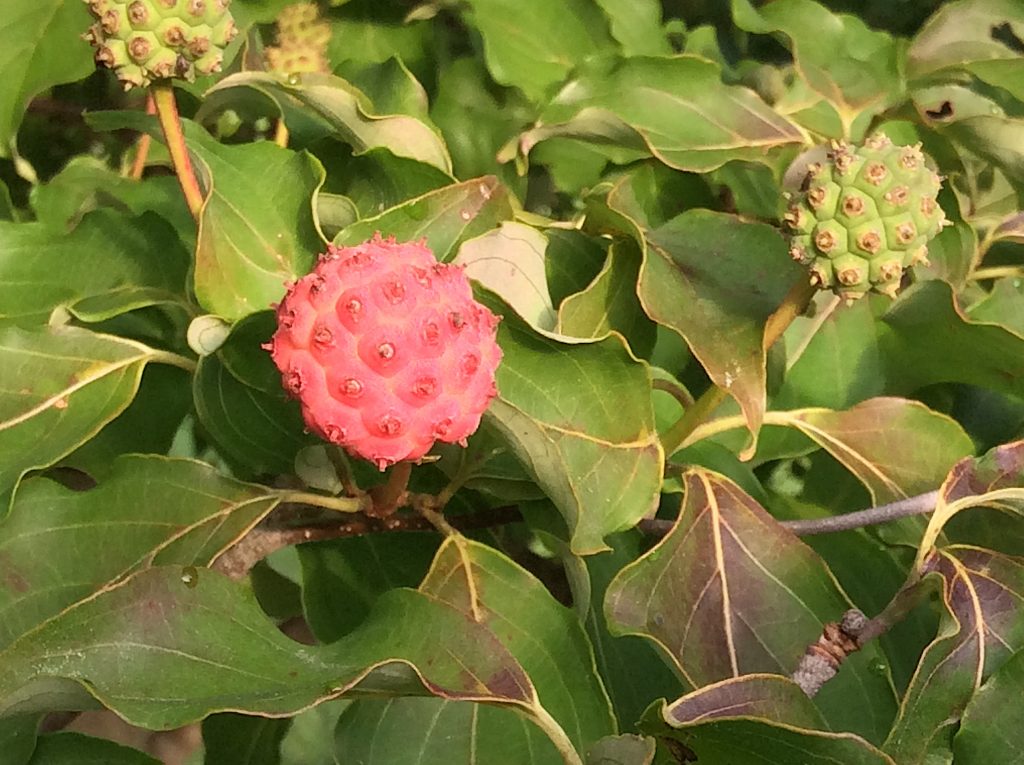
Ripe and unripe Kousa Dogwood fruit. Photo by Green Deane

 Cornus kousa: A Dog-gone-good Dogwood

The Kousa Dogwood is one of those plants that makes you ask: What is it?

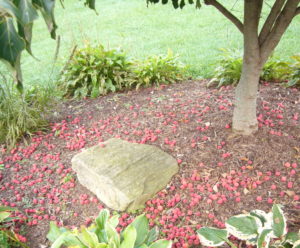
Kousa dropping fruit in Boone North Carolina.

Its large, bumpy, red fruit looks like a raspberry on steroids. Very eye catching and exotic, which it is in North America. Planted as an ornamental reports say it is naturalized only in the New York city area. But I have personally seen it growing on its own from there south and west. You can also find it in protected or warmer areas farther north. Look for it in landscaping or as a potted plant. In the Carolinas, where I go for a busman’s holiday, it’s a common ornamental. In fact where I stay in Boone, North Carolina, there’s one at the bottom of the hill. In Ashville where I study mushrooms it’s an escapee. In late August it and the ground beneath it are covered with fruit.

The Kousa grows to 15 to 20 feet, has flakey bark, and long-lasting white “flowers” which usually come out about a month after its cousin, the Flowering Dogwood (Cornus florida.)  Actually, its flowers are quite small. The shrub’s showiness comes from large white bracts that dwarf the true flowers. The bracts are two to three inches across, sometime off-white to light yellow, and cover the entire tree when in bloom. Another reason why this Asian native is used in landscaping is as it matures the bark flakes leaving a camouflage pattern of tan and brown, sometimes tan and green. In autumn the leaves turn bronze before dropping.

Kousa Dogwood showy bracts

Kousa’s bracts can turn pink to red through the season, and the Cornus kousa satomi starts with pink flowers that turn purple. In fact, there are nearly 100 different cultivars of the plant and it’s been in western gardens since 1875. The Kousa is also resistance to Dogwood Anthracnose, a fungal disease that has been infecting flowering dogwoods in eastern North America.

Although the fruit is pink to red, inside it is yellow to orange and has a taste people can’t agree on. Some say the texture similar to a pear or apricot. To me the pulp texture was like a ripe persimmon, the flavor like an apple. The tougher skin tasted like bitter peach. Usually it is eaten raw but can be cooked but doing so can destroy its delicate flavor. The fruit can also be made into jelly. As I said the skin can be tough and sometimes the fruit is bitter.  The young leaves are cooked and eaten by mountain people in Japan. I have not tried said, so be wary. Additionally, the fruit may have anti-tumor activity. Read the Herb Blurb below. It ain’t easy…

Botanically Cornus (KORE-nus) means “horn” which can mean a wind instrument or hard. The dogwood is known to make stiff skewers and dogwood is from Dag where we also get the word dagger.  Kousa (KOO-sah) is the Japanese name for the tree, It is also called Benthamia kousa – (Miq.) Nakai, and  Benthamidia japonica (Siebold.&Zucc.) H.Hara.

Green Deane’s “Itemized” Plant Profile

IDENTIFICATION: Shrub or a small tree to 25 feet, camouflaged-patterned bark, tan and brown, leaves 2 to 4″ long, opposite, simple, dark green; reddish purple to scarlet to bronze fall color. Vase shaped when young growing into a  rounded shape with horizontal branching.

TIME OF YEAR: Fruit in the fall, young leaves anytime present.

ENVIRONMENT: Well-drained soil, full sun to partial shade, usually in landscaping or potted.

METHOD OF PREPARATION: Ripe fruit edible raw.  They can be made into jelly.  Young leaves boiled.

HERB BLURB

20 May 2005, Life Sciences, Volume 78, Issue 7, pp 777-784: The anthocyanins in native Cornus alternifolia, Cornus controversa, Cornus kousa and Cornus florida were quantified by HPLC and characterized by spectroscopic methods. The analyses of C. alternifolia and C. controversa revealed that both contained delphinidin 3-O-glucoside (1), delphinidin 3-O-rutinoside (2) and cyanidin 3-O-glucoside (6), respectively. Similarly, C. florida and C. kousa showed identical anthocyanin profiles with major anthocyanins as cyanidin 3-O-galactoside (4) and cyanidin 3-O-glucoside (6), respectively. The amount of anthocyanins 1, 2 and 6 in C. alternifolia and C. controversa were 8.21, 8.44 and 0.02 mg; and 7.74, 5.92, and 0.02 mg/g of fresh fruits, respectively. The anthocyanins 4 and 6 in C. kousa and C. florida were 0.02 and 0.16 mg; and 0.62 and 0.03 mg/g fresh fruits, respectively. Anthocyanins 1 and 2 were not studied earlier for their inhibition of lipid peroxidation, cyclooxygenase enzymes (COX-1 and COX-2), and tumor cell proliferation. At 50 μg/mL, anthocyanins 1 and 2 inhibited lipid peroxidation by 71% and 68%, respectively. Similarly, they inhibited COX-1 enzymes by 39% and 49% and COX-2 enzyme by 54% and 48%, respectively, at 100 μg/mL. Anthocyanin 1 displayed 50% growth inhibition (IC50) at 21, 25, 50, 60, and 75 μg/mL, against HCT-116 (colon), MCF-7 (breast), NCI-H460 (lung), SF-268 (central nervous system CNS), and AGS (stomach) human tumor cell lines, respectively. Similarly, IC50 values for anthocyanin 2 were 38, 30, 76, 100, and 100 μg/mL against HCT-116, MCF-7, NCI H460, SF-268, and AGS, respectively. This is the first report of the quantification and biological activities of anthocyanins in C. alternifolia, C. kousa and C. florida in addition to the anthocyanins not previously quantified in C. controversa.


{ 35 comments }