Spanish Cherry fruit is edible and is related to Monkey’s Apple


Foraging is treasure hunting for adults. Not only is finding food fun but finding new food you didn’t know about is a joy as well. That happens reasonably often during my foraging classes in sub-tropical south Florida.
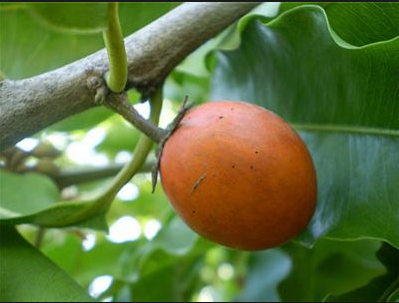
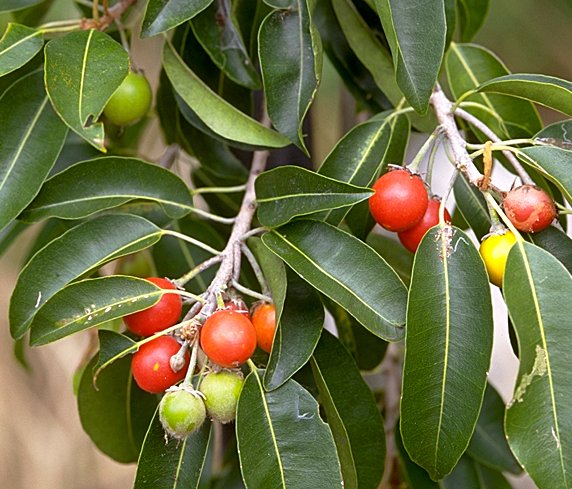
The ripe fruit ranges from yellow to orange to red.

As far as I know there is no complete accounting of all the plants in Dreher Park, West Palm Beach. And it suffered significant storm damage particularly hurricanes a decade ago but also Hurricane Irma last year. I had been teaching in the park for several years and had walked past this particular tree many times, at the end of a street near a foot entrance (that might be a clue to finding other “treasures.”) This time, however, the ground was covered with orange orbs. Hundreds of inch-long “bullet”-shaped fruit that resemble a small persimmon except longer (and the calyx was different and a key identifier.) As you can imagine doing a Goggle search for “Florida fruit orange” was not helpful. I eventually identified it as the south Asia native Mimusops elengi, Spanish Cherry, Bullet Wood, and Malabar Plum. Oddly it is not listed in the good book “Tropical Trees of Florida and the Virgin Islands.” Its central native range is India and surrounding areas where it is called Bakul along with over one hundred local names (yes, I counted them.) Interestingly it has a relative that is also cultivated in south Florida and like warm areas, Monkey Apples, or M. coriacea. They are both in the greater Soursop group.

As for the botanical name, Mimusops (MIM-you-sops) comes from the Greek words, mimo meaning ape, and ops meaning resembling. In English we would say “looks like a monkey.” “Elangi” — ee-LAN-gee — is from the common Malabari name for this tree and flower though it is also called the Tanjong Tree.
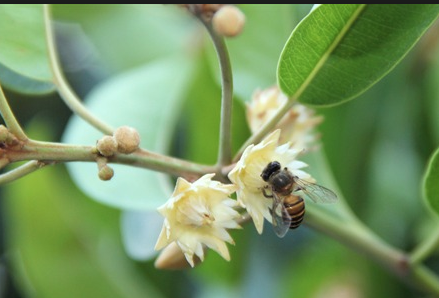
Fruiting season depends where on earth you are.

The evergreen tree is quite valuable commercially and otherwise. The wood is hard — is that why it is called Bullet Wood or possibly because of the shape of the fruit — and is deep red. The fruit is orange to red and edible. Various parts of the tree have also been used in Ayurvedic medicine (see Herb Blurb below.) It’s considered a prize addition to gardens for its fruit and fragrant flowers. The tree won’t grow in temperate climates but can survive subtropical areas and is tolerant of light frosts but not salty areas. The fruit reminds one of small persimmons in color and mild taste when ripe but a different texture, mealy.  The tree’s bark resembles an oak but the leaves favor a Magnolia look and at one time the tree was named in that genus. Definitely a tree to look out for (I even brought home a seed for pot planting.) I think Mr. Dreher, Superintendent of Parks, would be proud.

Paul Dreher

Dreher Park was the main project of Paul Dreher, a German immigrant, who came to the United States in the 1920s from Wurttenberg. (He had an aunt who was among the pioneer settlers of Delray Beach in 1895.) Thus a foraging fellow from a cold climate got a chance to create a park in a warm place before the advent of lawyers and rabid municipal liability. The “Johnny Appleseed” of West Palm Beach, Dreher had a degree in horticulture from the University of Hohen-Heim in Stuttgart. He was hired for 25 cent an hour then later $5 a day. His projects included picking thousands of trees for the city’s streets, Flager Park, Currie Park, Phillips Park, and Bacon Park. In 1951 Dreher convinced the city to buy 108 acres for a park. The city came up with $100 to buy the land but would not fund its development. Dreher scrounged plants for ten years, rummaging around landscapers’ dumps and taking donations. That became the basis for what is now Dreher Park. (The loud interstate to the west, I-95, was not built until the 1964.) Six farm animals Dreher had on the property — a goat, two chickens, two ducks and a goose, valued at $18 total — became the beginning of the Palm Beach Zoo. Dreher, whose hobby was collecting rocks in rockless Florida, also was involved after his retirement in the landscaping of the city of Palm Beach Gardens, the PGA National Golf Course and Lion Country Safari. He died in 1993, at age 90. His wife of 63 years, Alice Irene Owen, died nine years later in 2002, age 92. Dreher’s philosophy was “Anything green that grows is good. You just have to control it.”

Green Deane’s Itemized Plant Profile

IDENTIFICATION: A large glabrous evergreen tree from 50 to 90 feet, with a relatively short trunk and a compact leafy crown, bark smooth, scaly, and gray, Leaves spirally arranged, four inches long, and inch wide, elliptic shortly acuminate, glabrous, base acute or rounded, flower star-shaped, white, fragrant, solitary buds, fruit about an inch long, similar to a small olive, ovoid, yellow to red when ripe, seed solitary, ovoid, compressed, brown, shiny. The wood is very hard.

TIME OF YEAR: Blossoms in Fall, fruit is the new year here in Florida, or, it can blossom in the spring and fruit in early summer.

ENVIRONMENT: Full sun, average water, dryer areas than wetter areas, it does not like its wet feet. Grows year round, evergreen. Does not like to be close to the sea shore. Inland a few miles is fine. Endures high winds well.

METHOD OF PREPARATION: Fruit edible raw, cooked, pickled, seed oil is used for cooking but also used for lamps. The fatty acid line up is oleic acid 64%, linoleic acid 14.5%, palmitic acid 11%, stearic acid 10% and behenic acid 0.5%. Bark oil is used in making perfume. Blossoms are used for potpourris.

HERB BLURB

The bark is acrid and sweet; cooling, cardiotonic, alexipharmic, stomachic, anthelmintic, astringent; cures biliousness and diseases of the gum and teeth[1],[2]. The flowers are sweet, acrid, oleagenous; cooling, astringent to the bowels; good for the teeth, causes flatulence. They are used as expectorant; cures biliousness, liver complaints, diseases of the nose, headache, and their smoke is good in asthma[3]. The seeds fix loose teeth; as an errhine cures nasal congestion and headache[4]. The root is sweet and sour; aphrodisiac, diuretic, astringent to the bowels; good for gonorrhoea; as a gargle, strengthens the gums[1]. The fruits are sweet and sour, aphrodisiac, diuretic, astringent to the bowels, good in gonorrhoea. The pulp of the ripe fruits is sweetish and astringent and has been successfully used in curing chronic dysentery[1],[5]. The leaves are well known for analgesic and antipyretic
{ 0 comments }

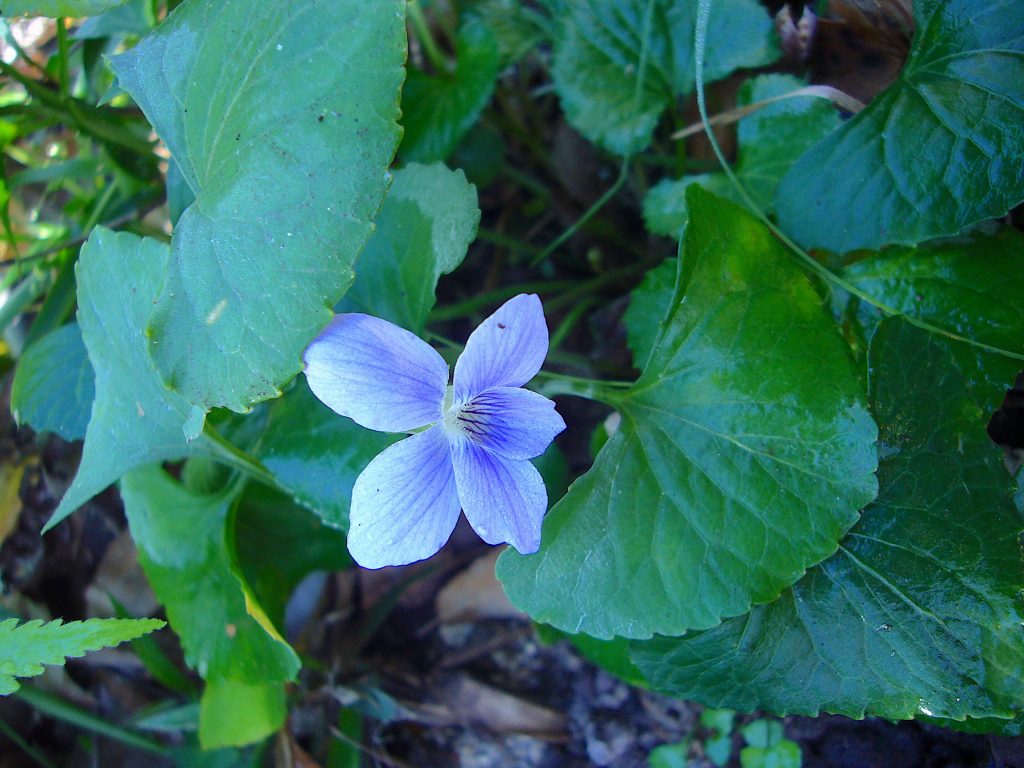
Five petals, with lowest petal heavily veined. Photo by Green Deane

Viola affinis: Florida’s Sweet Violet

My introduction to violets was seeing my mother eat “Piss-a-beds” in the spring  (Viola rafinesquii. VYE-oh-lah raff-a-NESK-kee-eye.)  They grew in the shade near the smelly cellar drain and were, as you might guess, a diuretic.

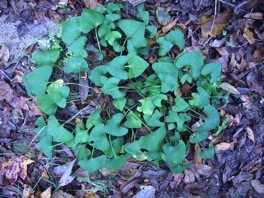
Colony of violets in Florida

For all their presence in Florida I did not see violets for quite a while. More so, they show great variation so getting the right identification can be a bit irritating. Pictured here, I think, is Viola sororia/affinis. (VYE-oh-lah-ROR-ee-uh / aff-EYE-niss.) However, violets are like oak and pine trees, you really don’t need to know which exact species it is as long as you have the right genus. (And just to make sure, we are not talking about African Violets, which are in a different genus completely.)

Violets leaves can be used raw in salads or cooked like spinach. Their flowers can be eaten raw, or candied, the dried leaves can be used to make tea. Violets can also be added to soups as a thickener. In fact, in the 1800’s that was the most common reference for them. While they traditionally blossom in the spring, warmer areas can see them blossom in the spring and late fall. In Central Florida’s winter, Christmas to Valentines, they are quite happy and blooming.

Native Americans had various medicinal uses for some 17 species of violets. Surprisingly there is little record of them eating violets with only three western tribes doing so. They did, however, used violets as poultices for headaches and boils, as an infusion for dysentery, kidney problems, bladder issues, heart pain, colds and coughs (they are high in vitamins A and C.) They were also used for skin problems, as application research confirmed in 1995.

Violet roots, however, are not user friendly. They can clean you out. The Indians soaked them with corn seeds as a pre-planting insecticide. Indeed, violets have long been associated with chemistry. Before there was the “litmus” test there was the violet test for acids and alkalis. And of course, recreating the aroma of violets was a major challenge of the perfume industry.

The name “violet” is often given as from Dead Latin, and it is. However, there is Greek behind that Dead Latin. Contemporary Greeks say violetta  — adapted from English — or menekseis. The English word “violet” is from the Dead Latin “viola” the Roman’s name for the plant. However, viola came from the Greek word Vion, which is a variation of Io, (EEoh… Ιω…) the beautiful daughter of Inachus, King of Argos. Io was also priestess to Zeus’ wife Hera.  According to Greek legend, Zeus was so smitten by Io that he seduced her after much pursuit and rejection by her. The seduction made his wife, Hera, quite angry. To protect Io from Hera Zeus transformed her into a white heifer. (Ain’t that nice: You’re young, beautiful, you’re seduced by the most powerful god around and then get turned into a cow.) As a heifer, however, Io wept because she had to eat coarse grass. To compensate her for her suffering Zeus changed her tears into sweet-smelling, dainty violets for her to eat. However, Hera was not without her means and caused the earth-wandering Io/heifer to be incessantly bothered by a gadfly.

Mythology notwithstanding, violets have quite a history. Violets were first cultivated in Greece around 400 BC or about the time of Socrates, Hippocrates, and the building of the Acropolis. ( so-CRA-tis, i-po-CRA-tis, a-CROP-po-li ) In fact they were the first commercial flower product. Athens was known as the “violet-crowned city.” The Romans liked violet-flavored wine so much they spent more time cultivating violets than olives, much to the irritation of Horace (65-8 BC.)  Violets, associated with resurrection, were secretly planted on Nero’s grave. And when Chopin died in Paris his student, Jane Stirling, bought all the violets she could find in Paris and put them on his grave. That tradition lasts to this day with visitors to his grave leaving violets. [Note: Chopin’s body is in Paris but his heart was removed and resides in Warsaw.] Napoleon was nicknamed the Caporal Violette which he used as a nom de plume along with Pere La Violette. When he died he was wearing a locket of violets taken from the grave of his wife, Josephine. They were her favorite flower, and that of England’s Queen Victoria’s, too.  Until the early 1900’s violets were associated with  St. Valentine’s Day, not roses.  According to the legend, Valentine crushed the violet blossoms growing near his cell to make ink to write messages on violet leaves to his friends, delivered by a dove.  He was executed on 14 February 269 A.D.

The state flower of Wisconsin, Rhode Island, Illinois and New Jersey, there are some 850 species of violets, in two large groups, sweet and wood. Sweet is strongly scented, wood less scented but larger than the sweets.  At least three violets are native to Florida, V. conspersa, sororia and bicolor.  Affinis means “similar to” and is a synonym for sororia, sometimes a variation.  Conspersa (kons-PER-sa) is sprinkled, sororia sisterly, and bicolor two colored.

Nutritionally violets have 15,000 to 20,000 IUs of vitamin A per 100 grams serving.  See recipes below.

 Green Deane’s “Itemized Plant Profile”

IDENTIFICATION: Blossoms blue, violet, yellow, white, shades in between and multi-colored. Five petals, with lowest petal heavily veined and going back into a spur. Low growing, there is a wide variety in the leaf shape. Sweet violets are the most aromatic, wood violets tend to be larger.

TIME OF YEAR: Varies slightly. Sweet violets first in spring, the wood violets. In warmer climates they can blossom again in fall

ENVIRONMENT: Moist shaded areas, partial sun.

METHOD OF PREPARATION: Leaves raw, dried or cooked. Blossoms raw or candied. Yellow violets can be mildly laxative.

Violet Jelly

2 cups fresh violets

2 cups boiling water

Juice of one lemon

1 pack pectin

4 cups sugar

Place the violets blossoms in a glass jar and cover them with the boiling water. Make an infusion with violets and water by placing your blossoms in a glass jar and covering them with boiling water. Put a lid on the jar, and set aside for anywhere between 2-24 hours. The water will turn to an aqua blue. Strain and discard the spent flowers. Add the lemon juice and the mix will change to a pretty pink. (After you do this a time or two, you can sort of judge how much lemon juice to add to get a color that `suits’ you.) Stir in pectin, and bring to a boil. Add sugar, bring to a boil again, and boil vigorously for one minute. Skim if necessary. Pour into sterile jars and seal. Makes approximately 2 1/2 cups jelly.

 Violet Syrup

4 cups of violets

2 cups boiling water

6 cups sugar

Juice of one lemon

2 cups water

Place violet flowers in a mason jar and pour boiling water over them. Let sit 24 hours. Strain liquid into a bowl (not aluminum!) squeezing out all the goodness from the flowers. Place sugar, lemon juice and water in a saucepan and boil into a very thick syrup, near the candy stage. Add violet water and bring to a rolling boil. Boil 10 minutes or until thickened. Pour into sterile bottles. Allow to cool, then seal and refrigerate. Serve with club soda or as pancake topping, or brush on baked goods.

{ 20 comments }
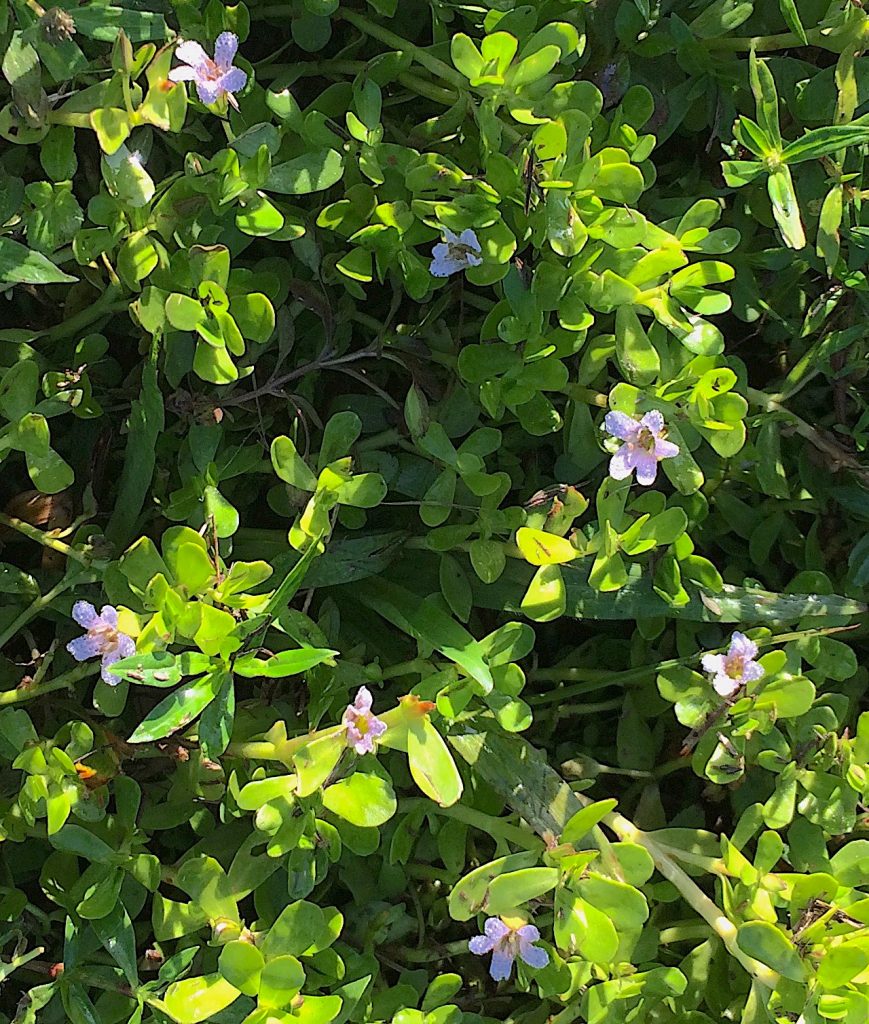
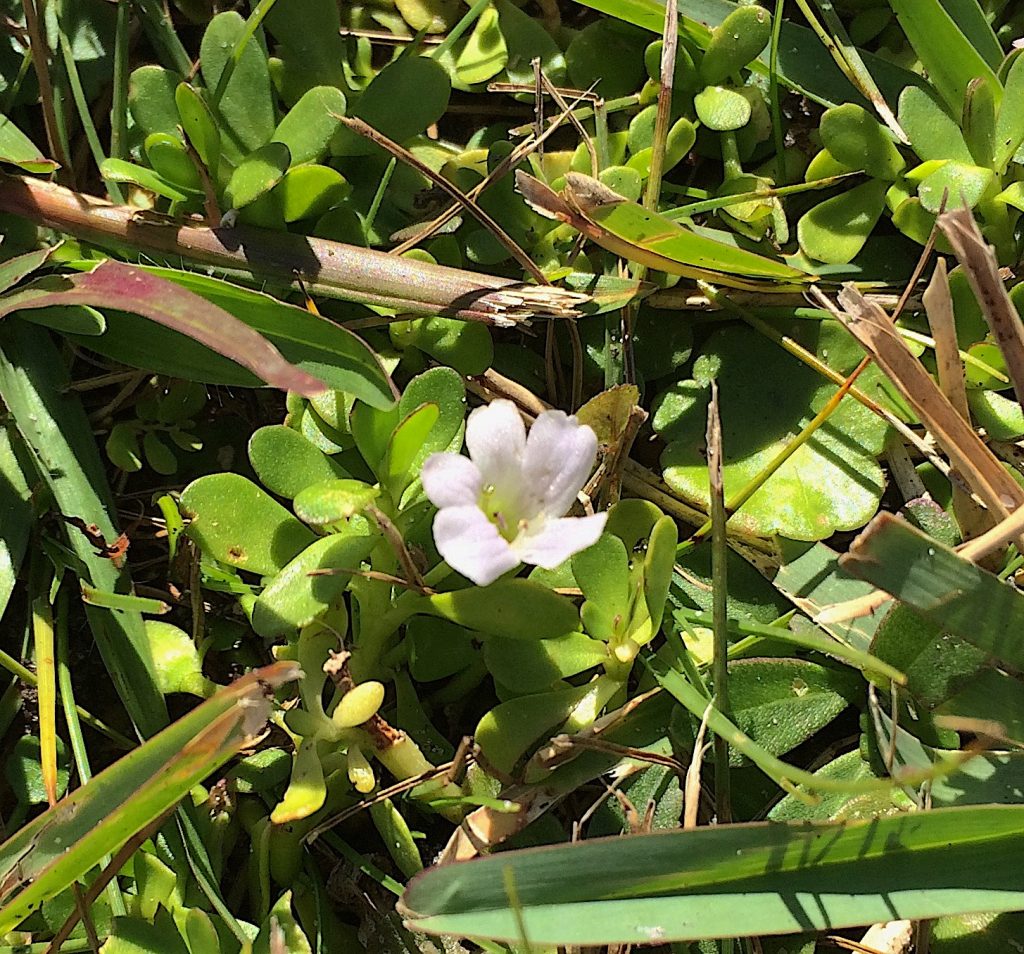
The blossoms are officially white but they can often be tinged with pink or light blue. Photo by Green Deane

Photos and article by Green Deane

There is no getting around it: Bacopa Monnieri is bitter… really bitter. But of course part of that perception depends on what bitter gene you have. There are several variations.

Bacopa caroliniana is not bitter.

Some like the bitter flavor all their lives, some dislike the bitter flavor all their lives. Some are extremely sensitive to bitter as a child — exponentially so —but very insensitive to it as an older adult. They’re the ones who could not stand broccoli as a kid and love it in retirement. At any rate Bacopa monnieri is bitter, as are two of its local relatives, Bacopa innominata and Bacopa repens. A fourth, Bacopa Caroliniana, is not bitter at all and is the least like the other Bacopas. How do you tell them apart?

The blossom can have four or five petals.

There is no shortage of research on the memory effects of Bacopa monnieri. If it had been invented by a pharmaceutical company it would be in all the water supply systems by now. As it is a lowly plant used for some 7,000 years there’s no patent money to made off it. But the research ranges from its potential use from Alzheimer’s to Attention Deficit Disorder to migrains. Interestingly it appears to be able to improve most people’s memory function whether 15 or 85. 

It can take 12 weeks.

How Bacopa Monnieri works is a bit of a debate. It might have several avenues of efficacy. One is stopping the reduction of chemicals the brain uses for thinking and memory. Another could be it up regulates genes and they prompt new memory cells. It could increase cerebral blood flow and is a strong anti-oxidant. Any or all are possible. But the research also seems to agree that it takes time to do it herbal magic, usually several weeks. 

A wide variety of dosage works.

Most of the studies are — like bitter — a variation of a theme.  Sometimes the subjects are all older than 70, or the are all older than 55 with memory issues, or healthy volunteers of all ages. Sometime the does is 125 twice a day, sometime it is by weight (300mg under 200 pounds, 450 mg over 200 pounds.) Or it is an extract or 300 mg once a day. And usually there is no immediate improvement (in hours) but over weeks memory improves, information processing is faster, and better associate learning.  

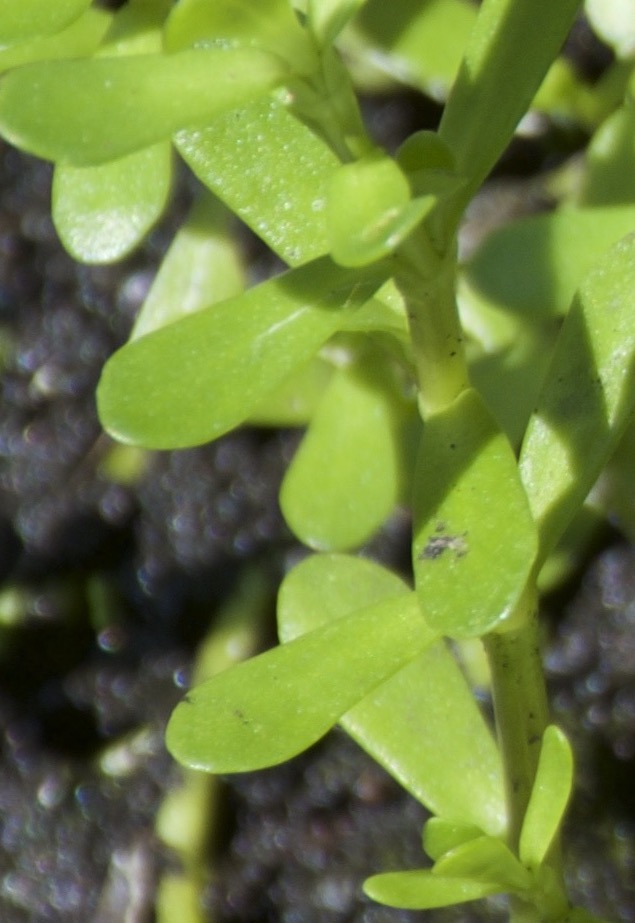
The leaf has one main vein.

Whether you call Bacopa a food or a medicine perhaps depends upon your tastes, or needs. Some folks chop it up and toss some in salads. I now more people who use it as a nootropic. Four people have told me it has made a significant difference in their memory abilities. The genus name “Bacopa” is the Latinized name the aboriginals Indians called it in what is now French Guiana. Monnieri honors Louis Guillaume le Monnier, 1717-1799, French botanist and royal physician to Louis XV. You can see an earlier article about this Bacopas and B. caroliniana here and learn why they are called “Hyssop.”

Green Deane’s “Itemized” Plant Profile

IDENTIFICATION: The leaves are succulent and thick, 1/8 inch wide and 5/8 inch long. They’re oblanceolate (skinny on this end, fat on this end)  opposite, and have 1-veined. Flowers are small and white, with 4 or 5 petals. This species is also called the Smooth Water Hyssop and is often spelled Waterhyssop.

TIME OF YEAR:  All year

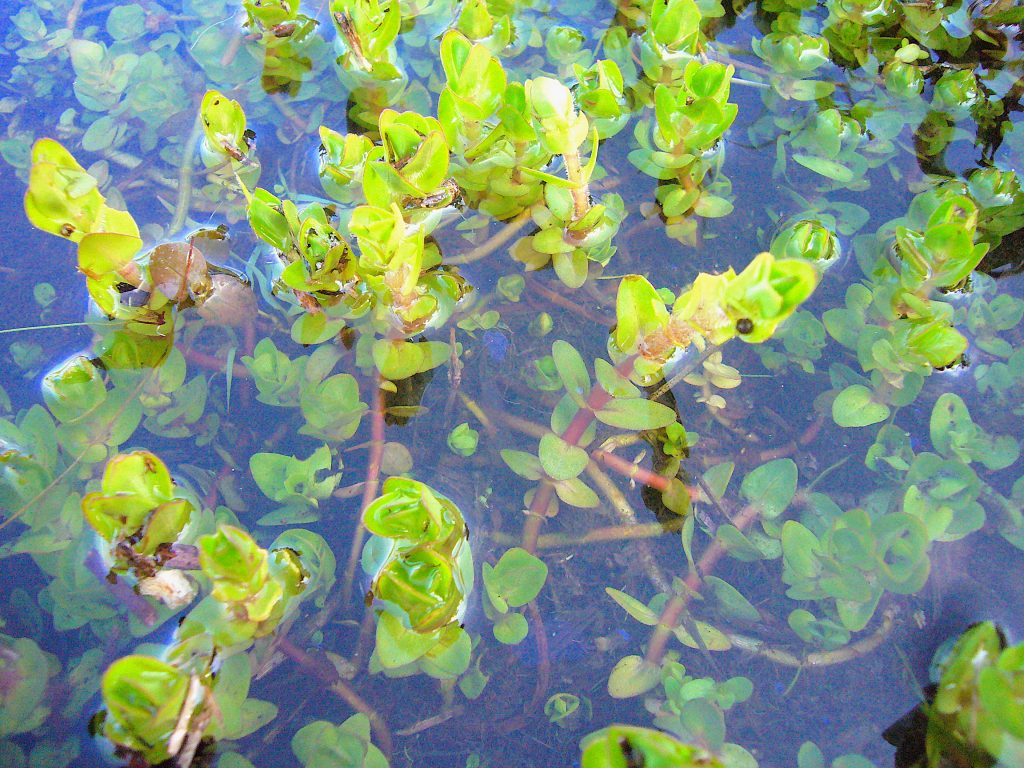
ENVIRONMENT: Fresh and brackish waters, usually sunny damp spots. 

METHOD OF PREPARATION as a food:  Raw when fresh, but very bitter. It can be steamed for a cooked vegetable and in India it is dried and used as a tea… let’s just say that tea is a very acquired taste. Memory applications vary greatly.

You can see an earlier article about some Bacopas here. 

Three Bacopa studies are:

https://www.hindawi.com/journals/ecam/2012/606424/

https://www.ncbi.nlm.nih.gov/pubmed/12093601

https://www.ncbi.nlm.nih.gov/pubmed/18683852


{ 6 comments }
Brazilian Pepper, invasive spice

Article and photographs by Green Deane

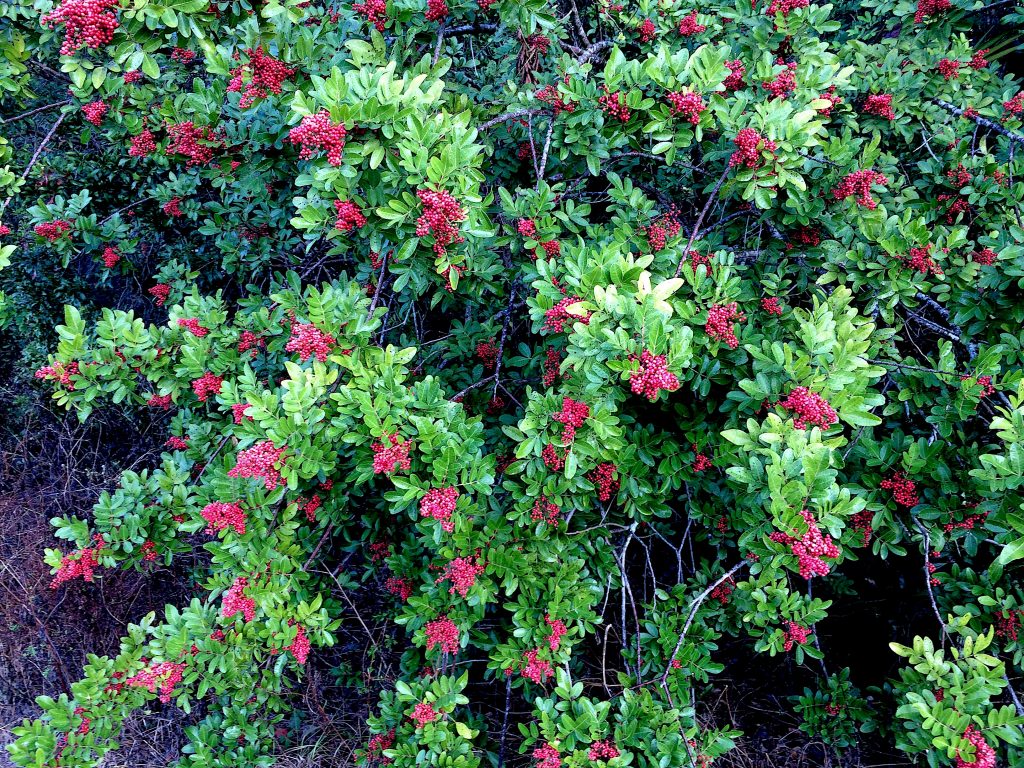
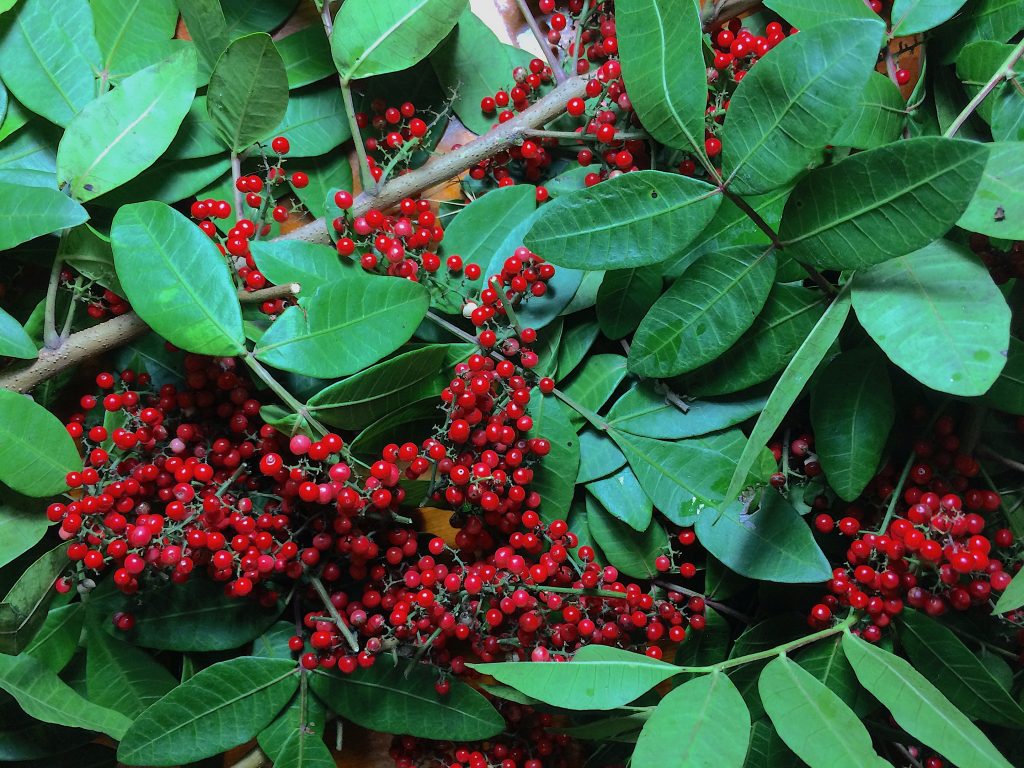
Brazilian Pepper is a personal unknown: You might like it but it might not like you. This is because many people are allergic to it on par with poison ivy. Others have used Brazilian Pepper for decades as a spice without incident.

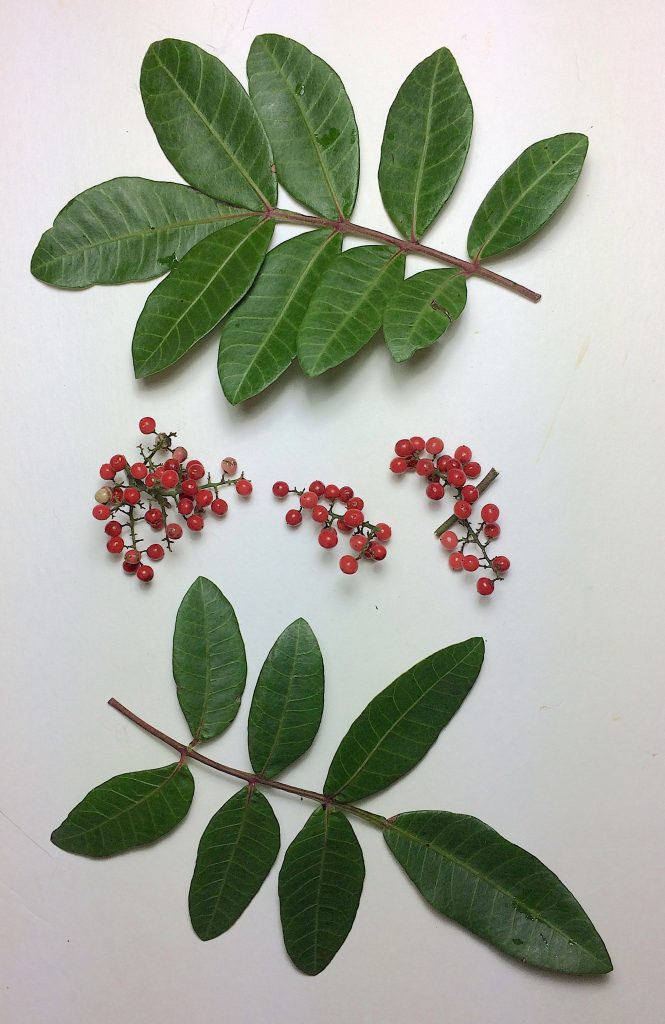
Leaves of seven and nine leaflets

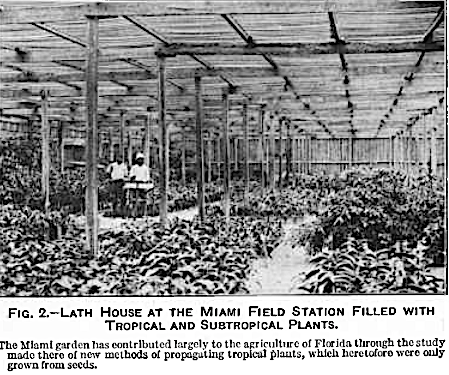
Native to Brazil, Argentina and Paraguay, this invasive species was imported to the United States in the 1800’s though when is a debate. Governmental records definitely say it was here just before the the 1900’s but the plant was listed in at least one seed catalogue as early as 1832.  The U.S. Department of Agriculture got packages of seeds in 1898, 1899, and 1901 (one of them from Algeria.) Those seeds, or subsequent seedlings, were forwarded to the Plant Introduction Station in Miami where the species was studied. But it was Dr. George Stone of Punta Gorda, Florida, who championed the species in the 1920s changing the tree from a personal passion to a public menace. An amateur botanist Stone raised and gave away hundreds of plants. They were called “Florida Holly” and planted along the streets in Punta Gorda and elsewhere. In 1937 one company advertised the Brazilian Pepper as “one of our most worthwhile plants for general landscape purposes, as it makes a fine subject for mass planting and succeeds well along the beach, standing quite a lot of salt spray.”  An article in the 1944 edition of the magazine “My Garden in Florida” said of the Brazilian Pepper “it ought to be in every garden in Florida.” Just six years later folks began to noticed it was becoming a serious problem. Brazilian Pepper is so invasive that today it’s in 20 counties of the state limited only by cold weather. Nearly everywhere it’s been imported it’s on the noxious weed hit list. Besides Florida and Texas it’s a serious weed in South Africa, Spain, Portugal, Australia, New Zealand, and on Pacific, Caribbean and Indian Ocean islands. In its native range it is not invasive.

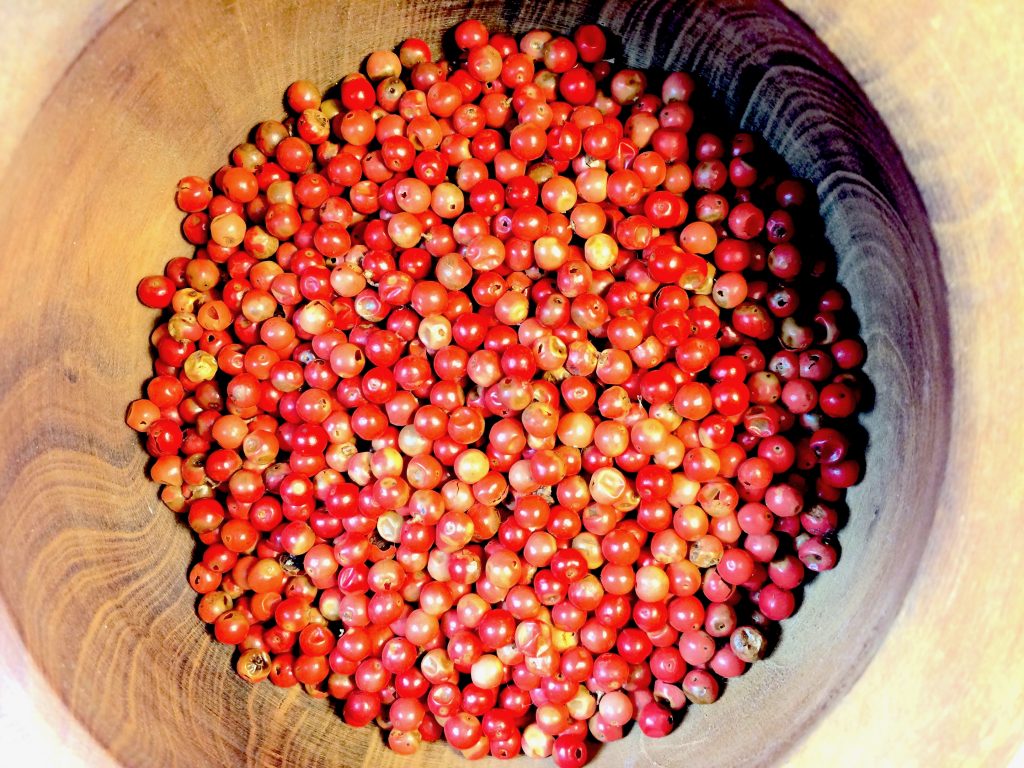
Dried berries are peppery for at least five years.

The species itself is in the Anacardiaceae (Cashew) family which also includes poison ivy, poison sumac, poison wood, and mangoes, all known allergens along with cashews and pistachios. Toxicity in that family is usually caused by a resin. People can get contact dermatitis from Brazilian Pepper, welts from it like poison ivy, or rashes as from mangoes. Some people can get sick just being in the same room with the crushed berries. It has sickened researchers working with the fruit. The sap can cause lesions resembling second-degree burns. Brazilian Pepper can cause edema, and eye and facial swelling.  When pollenating — usually September to October — it can be a severe allergen even though the pollen is sticky and heavy. Brazilian Pepper can intoxicate birds, injure livestock and can cause fatal colic in horses… Are you sure you want to try it as a spice?

Spice is used from fish to popcorn to ice cream.

I’m not allergic to the berries but I don’t care for the flavor. I have met six people, however, who use it; two couples and two individuals. In fact both couples have been using it as a spice for decades and one couple likes it so much they put it on pop corn. I know a man who, again for decades, uses Brazilian Pepper as a spice but only on fish and no other time. He grinds up a few berries in a mortar and pesetle as needed. I know a young man who eats the ripe berries off the tree. He doesn’t eat a huge amount of them at a time but he does eat them and I’ve seen him do it. I also know of a young woman who liked the flavor of the berries so much she used them extensively as a spice for a week — even on ice cream — and then got very sick from them. She couldn’t use them after that. So it’s across the board varying from individual to individual from some who consume it as a spice with no problems to others with a wide variety of sickening symptoms.

There are four varieties of Brazilian

Pepper.

Despite its dubious nature Brazilian Pepper has several uses other than a spice. Bee keepers champion the species. Opinions on its honey vary: Some call it “esteemed” other say it is below “table grade.” It’s popular enough however to sell between six to eight million pounds annually. The taste is sweet with a mix of spicy aftertaste flavors. Honey becomes “Brazilian Pepper honey” when about 70% of the blossom visited by the bees are that species. The tree has also been used to make toothpicks, stakes, posts, railway ties and research shows it might make a good pulp wood. A resinous extract is used to protect fishing line and nets. It has been used to tan leather. The species also has many herbal applications. A 2017 study said in Brazilian herbal medicine it was used for: “…its antiseptic and anti-inflammatory qualities in the treatment of wounds and ulcers as well as for urinary and respiratory infections.”  The study reported it might have some use against MRSA. It seems to interrupt the bacteria’s signaling capacity keeping it from releasing toxins thus giving the person’s immune system time to mount a counterattack.

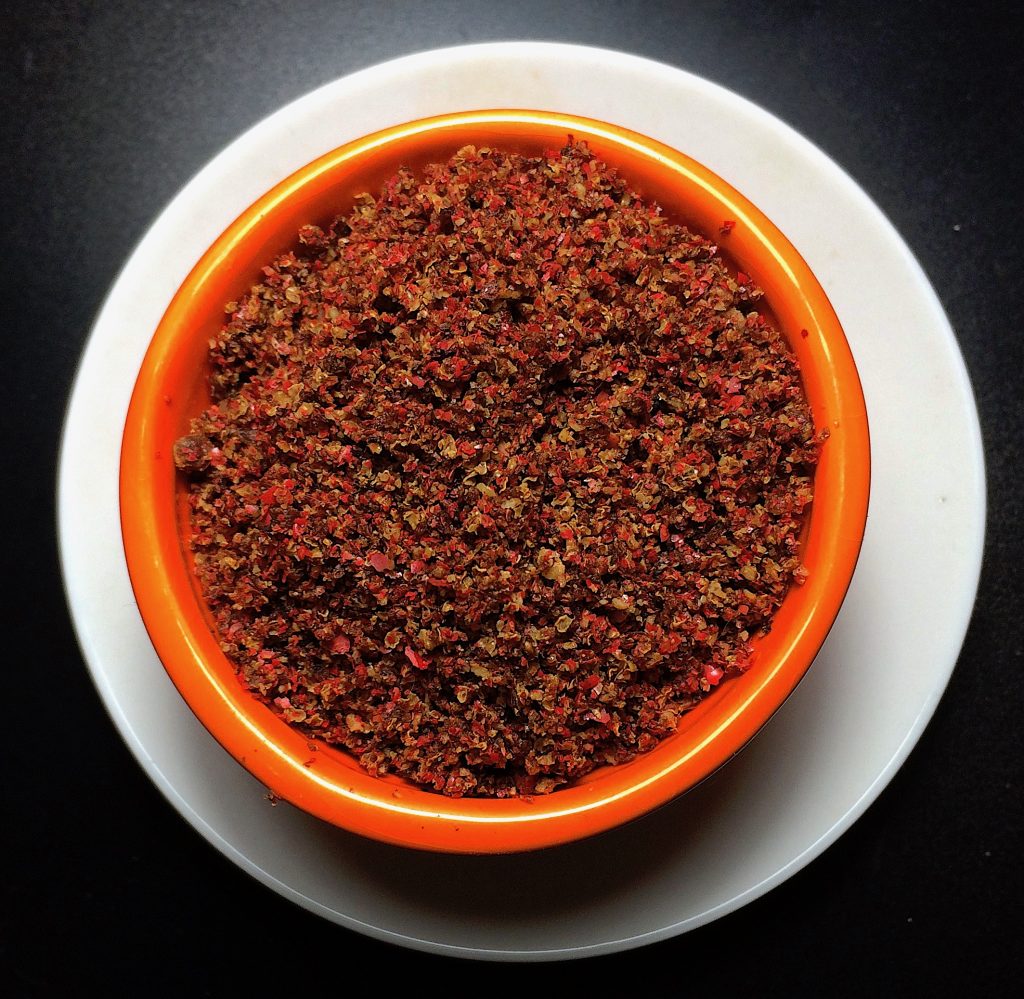
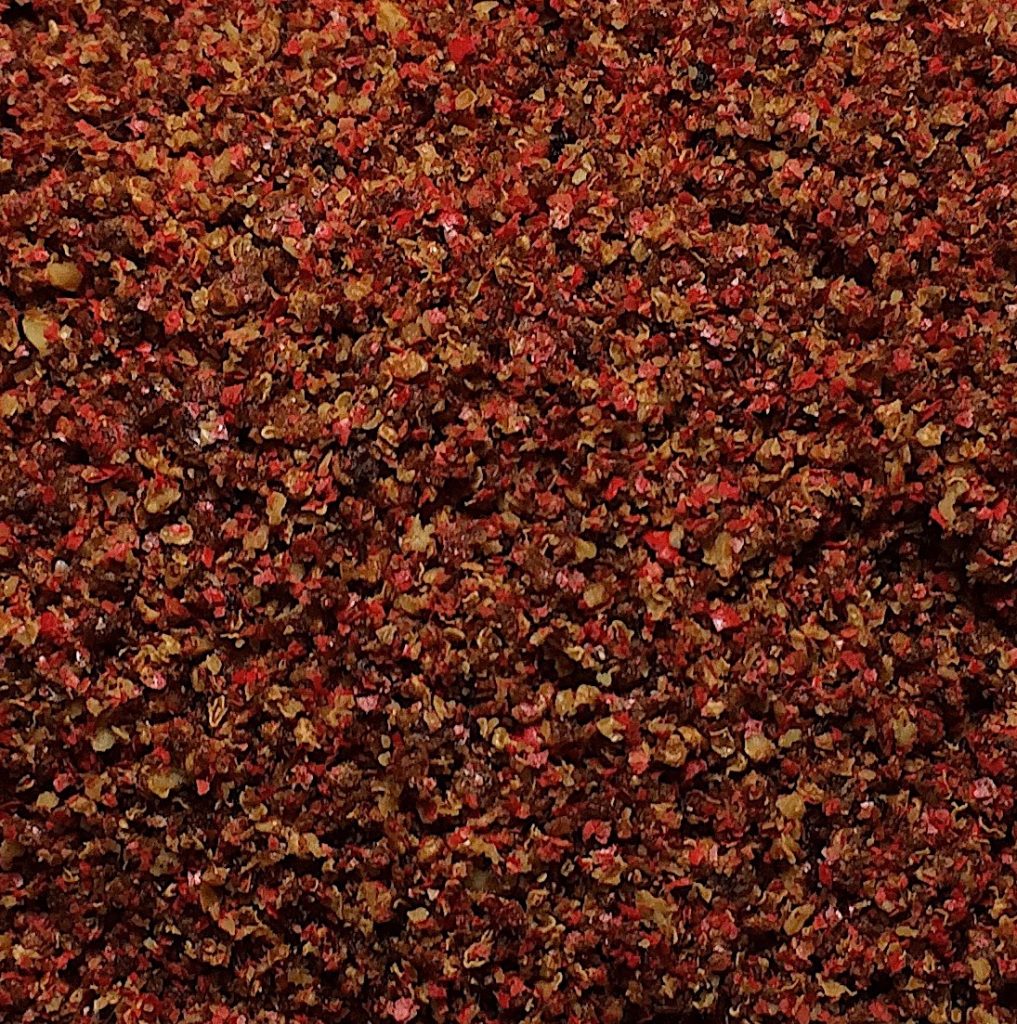
The berries can be ground to a desired grade.

As for the botanical name it is — as is so often the case — Greek mangled through Latin tongue-tied into English. The Latin Schinus comes from the Greek word Σχίνος (SKI-nos) which means “lentisk” which is the Mastic Tree. The genus name was chosen because Brazilian Pepper has similar foliage as the Mastic Tree which also exudes a sap. The English the genus is said SHY-ness or SKY-ness. Take your pick. The latter is closer to the original Greek. Terebinthifolius is also Greek but slightly less distorted: τερέβινθος (ter-REH-been-thos.)  In English terebinthifolius is said terra-been-tha-FOE-lee-us  which means “turpentine leaves.”  The species’ name from the Terebinth Tree, Pistacia terebinthus,  which is the turpentine tree in the Mediterranean area.  With Brazilian Pepper you don’t have to crush them to smell them. Just bring them into a room. And for night time fun if you lignite the dry leaves their oil content is so high they can pop and sparkle. 

Note it is illegal in Florida and Texas to sell, transport or plant Brazilian Pepper in any form. A relative, S. molle, is also found in Florida and Texas. Both are also in Hawaii, southern California and Puerto Rico. Brazilian Pepper seeds are popular with mocking birds, cedar wax wings, migrating robins and the Red Wiskered Bulbul. Raccoons and possums eat the seeds. Planted seeds have a high germination rate and sprout within three weeks.

Green Deane’s “Itemized” Plant Profile

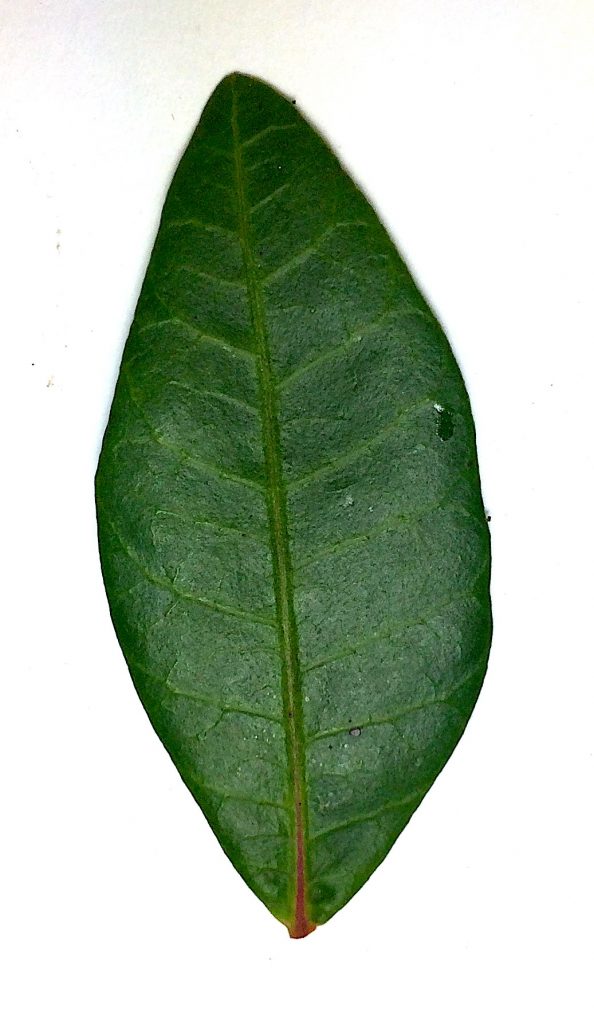
Note the red at the base of the stem.

IDENTIFICATION: It is an evergreen tree to 40 feet, low-branching, bushy, and spreading to equal width; the foliage is dense. Glossy leaves are aromatic with a red midrib, they’re about three inches long, compound, five to nine leaflets to a leaf. Flowers are tiny, white, compact, male and female blossoms on separate trees. Fruit is the size of a BB, 3/16 of an inch round, red, juicy, with an aromatic oil and a peppery flavor. The seed is yellow and kidney shaped.  Sometimes it is mistakingly called “pink pepper corns” which is actually the fruit of a different species mentioned earlier, Schinus molle. 

If you want to get technical there are actually four recognized varieties of Brazilian Pepper: var. acutifolius (lance-shaped leaves, tips pointed,) var. pohlianus (stems winged, stems and leaves velvety-hairy) var. raddianus (leaf edges toothed to toothless, tips rounded) and var. rhoifolius oval to obovate leaves, tips rounded.)  They can be difficult to tell apart. 

TIME OF YEAR:  September to October or November is the main flowering season, fruits mature in December. However the tree can flower and fruit anytime of year and the fruit is persistent. 

 ENVIRONMENT: Dry or wet conditions. You’ll find it in waste ground, at waterfront, in right-of-ways, lawns, pastures, groves, dry lakes or even invading stands of larger trees. 

METHOD OF PREPARATION: The ripe berries are dried then ground to a desired state and used as a spice. Some people eat a few ripe berries at a time. 

Photo courtesy of Department of Agriculture Fieldbook, 1916.
{ 3 comments }
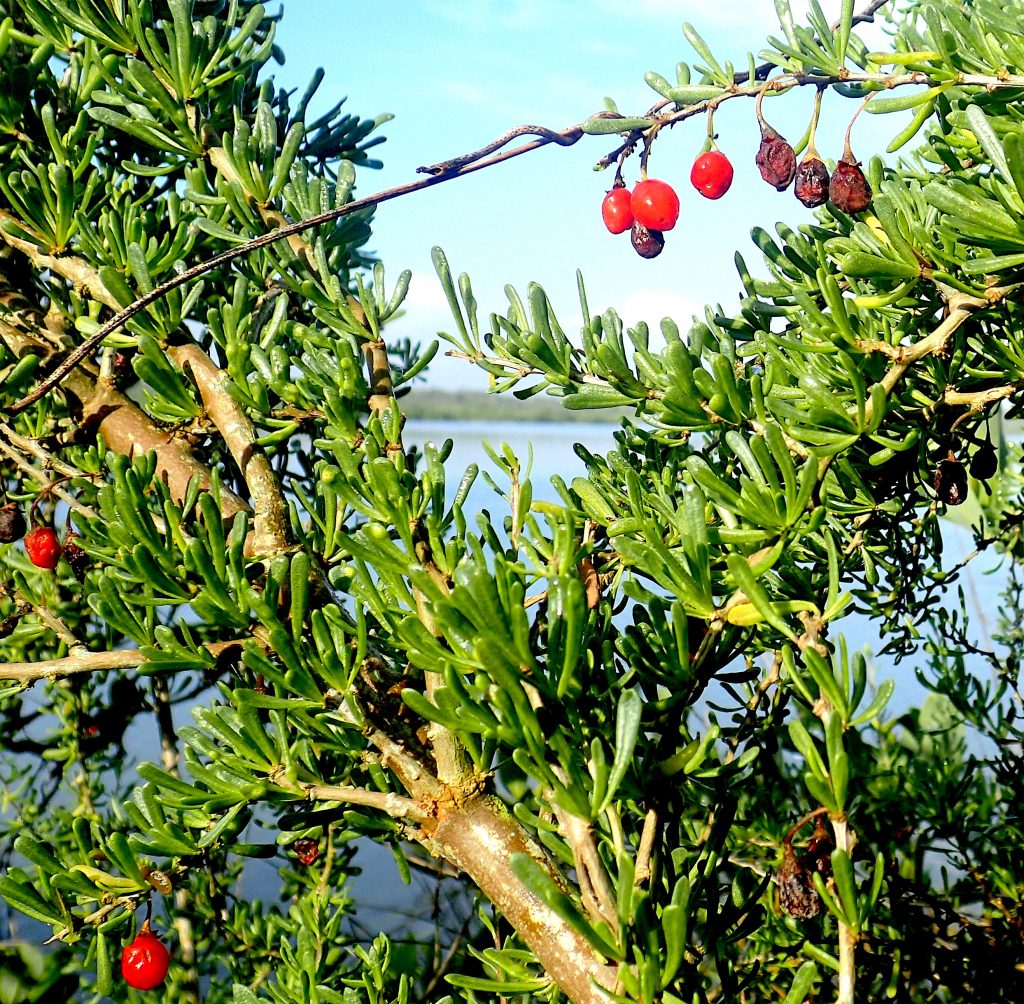
Our local “Goji” berry is one of many “Christmas” berries you can find this time of year.
Photo by Green Deane 

Christmas, Wolf, Goji, They’re All Berries

It’s called the Christmasberry even though it fruits from Christmas to April. And while it is one of several “Christmas Berries” this one happens to have a famous relative, the Goji berry of health food fame.

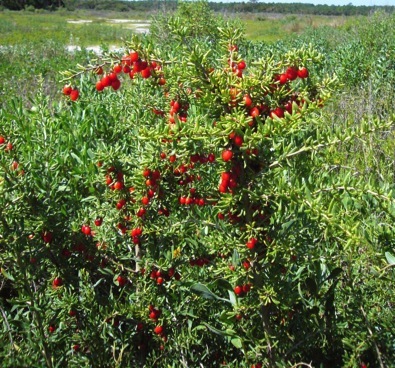
Wolfberries, Goji’s relative, photo by Green Deane

Botanically the Christmasberry is Lycium carolinianum (not to be confused with a couple of edible Crossopetalums also called Christmas Berry.) As for how Lycium carolinianum is pronounced is a bit of debate. Some say LIE-see-um, others lie-SEE-um. As the original word is from the Greek, λύκειον (LEE-kee-on) meaning a Greek school we might argue the genus is more properly LEE-see-um.  Carolinianum means central North America and is said kar-row-linn-ee-AY-num.

For most of the year the Christmasberry is an unimpressive shrub that resembles from a distance a rosemary bush. But there are hints of more going on. Its leaves are plump and the shrub is salt tolerant, preferring coastal or inland areas of high saline content. In early winter or late spring the fruit is quite attractive and a welcomed food for woodland creatures particularly birds. Technically the L. carolinianum fruits all year in Florida but favors the late fall and to early spring. However, I have also found them in abundance in mid-spring and late fall.

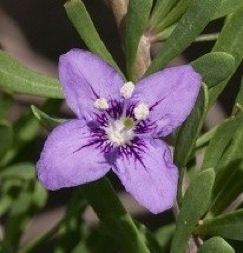
Lycium carolinianum blossom

While the foliage would not give it away as a member of the Solanaceae clan the blossoms and berries can. The blossoms look very similar to other Solanums and the berries have an ornamental pepper look, if not in color then shape. The seeds are a familiar look as well reminding one of small tomatoes or pepper seeds. Opinions on taste vary, from sweet and tomato-ish to famine food. All the ones I’ve eaten were on the sweet and juicy side, soft if not hollow but there is a bit of aromatic oil or flavor to them as well as well, nothing dramatic but definitely there.

While most foraging books ignore the L. carolinianum in their line up of edible Lyciums Dr. Fernando Chiang of the National University of Mexico confirms academically that the fruit is edible. Dr. Chiang is an expert on the genus and was consulted on the species for the publication of Florida Ethnobotany by Dr. Daniel Austin.  Chiang describes the berries of other Lyciums as “often edible.” At least one, L. acnistoides, found in Cuba, is toxic. In some species the berries and the leaves (cooked) are eaten. With some edible, one toxic for certain, and others unreported it is best to identify carefully.

In North America among the edibles species, besides L. carolinianum, L. andeersonii, L. fremontii, L. pallidum, and L. torreyi. The leaves of the L. halimifolium are cooked and eaten in Eurasia as is the L. chinense. Best known, perhaps, is a Lycium closely related to the L. chinense, and that is the L. barbarum, also called the Goji (GO-gee) berry which oddly is naturalized in England. Also listed as edible is Lycium ferocissimum, which is a pest in Australia. Its native L. australe was eaten by the Aboriginals.

Also called the Wolfberry, L. barbarum is known as a powerful antioxidant and credited with giving you energy, in and out of bed, better metabolism, improved immune system response, blood pressure regulation, cardiovascular health and slowing down aging. Animal research suggest it may be effective against cancer, inflammatory diseases, macular degeneration and glaucoma. It is consumed in the form of pills, juice, dried fruit, powder, teas and the seeds eaten.

The Goji berry is about 68% carbs, 12% proteins, 10% each of fiber and fat. A 100-gram serving is about 370 calories.  It has 11 essential dietary minerals and traces of 22 others; 18 amino acids, six essential vitamins, five unsaturated fats, and five carotenoids. Specifically it is high in calcium, potassium, iron, zinc, selenium, vitamin B2, Beta-carotene, and exceptionally high amounts of vitamin C. It’s also full of antioxidants via its pigment, which I would presume to be lycopene. If your local Lycium lives up to that, it would be quite a dietary addition.

Processed fruits of various species in the genus have also been used to treat diabetes, impotence, and to retard aging. One ingredient, Physalin, is extracted to treat Hepatitis B. Another chemical, Betaine, is taken by weightlifters to bulk up.

As a food Goji berrie (L. barbarum) are usually bought dried like raisins and are cooked before eaten. But the berries are also used to make a tea. Young Goji shoots and leaves are used as a cooked green. The one medical warning associated with Goji berries is they may increase the potency of drugs like Warfarin (making you bleed more easily.) Goji berries also contain atropine in low amounts.

Clearly you cannot assume your local Lycium is as all-around edible as the Goji is. But, identify and investigate.  One would presume many of them would have similar nutritional profiles.

And one last thing: Goji berries are very high in lectins. If those bother you then perhaps you should try only a few at first or skip them altogether. 

Green Deane’s “Itemized” Plant Profile

IDENTIFICATION:

Lycium carolinianum: Shrub to six feet, sprawling, spiny, small, succulent leaves. The four-petaled, somewhat tubular, lavender/blue flowers usually singular, red/orange berries, fleshy. Locally they are often covered with Ramalina, a hairy, flat leaf lichen.

TIME OF YEAR:

Fruits year around in Florida but favors mid-spring

ENVIRONMENT:

Salt tolerant, coastal areas or inland salty ground

METHOD OF PREPARATION:

Ripe berries, fresh or dried, as fruit or tea. I eat them off the bush. 

{ 25 comments }