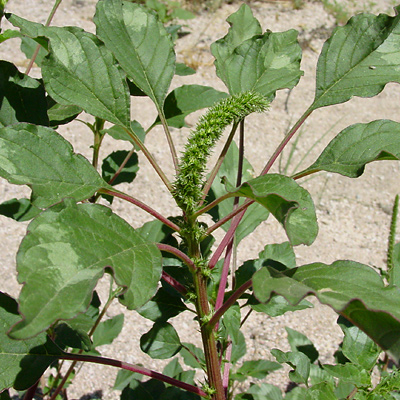
Glyphosate resistant Palmer Amaranth, photo by FireFlyForest.com

A farmer’s headache is not necessarily a forager’s delight.

Palmer Amaranth (Amaranthus Palmeri) has been a foraged food for a long time. It was used extensively by the native American population with at least seven tribes preparing it a wide variety of ways. More on that in a moment.

Amaranth, in general, is a good wild food. It occupies the middle ground between excellent and poor. When collected very young Amaranth is a dietary analogue to spinach, which is a relative. At the meristem stage, still young and tender because the cells are still growing, it’s a tasty green usually boiled. Later it becomes a source of grain.  These stages, however, are dynamic, changing and they change at different rates with different species of amaranth. Some amaranths stay more palatable longer than others. More so, depending upon growing conditions, amaranth can also accumulate high levels of nitrates and oxalates making them less than desirable to eat, for you or livestock.
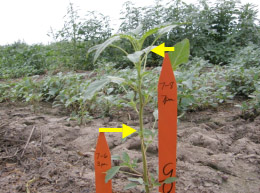
Palmer Amaranth Growth in 52 hours, photo by caes.uga.edu

Palmer Amaranth doesn’t stay young and tender too long. It converts CO2 into sugars more efficiently than corn, cotton or soybean. This allows for rapid growth even when it’s hot and dry because it also produces a large taproot that is studier than that of soybeans or corn and can penetrate hard soil better than cultivated crops, read it can reach water and nutrients other plants can’t reach. Under ideal conditions, Palmer Amaranth can grow several inches per day, see photo left. The species also has a rugged stem to support that growth and height.
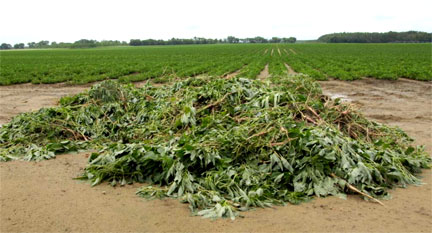
Palmer Amaranth Pulled From A Peanut Field, photo by Rome Etheredge, extension agent, Seminole County, Georgia.
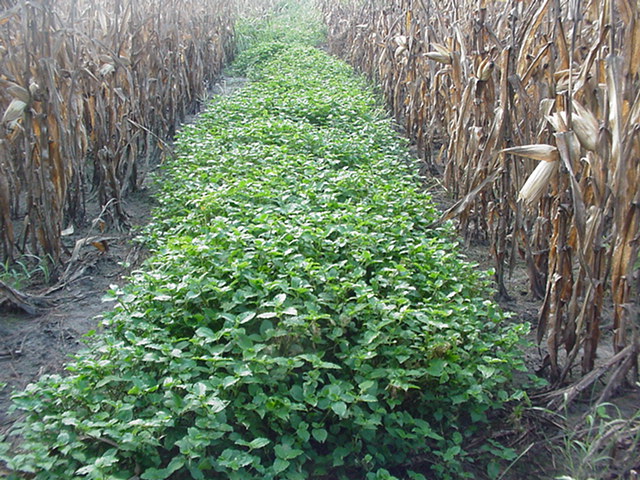
Palmer Amaranth between corn rows

If you think Palmer Amaranth is already a Botanical Bully then consider this:  It is unusual for an amaranth in that it has male and female plants which greatly aids in distribution and ability to adapt. It can also produce half a million seeds per plant. Every seed is a chance to defeat Genetically Modified Organisms, which are quite expensive to develop. When you consider Ma Nature produces million of Palmer Amaranth plants every year that adds up to perhaps billions of chances annually for her to roll a winner, virtually for free. And that’s exactly what happened. Palmer Amaranth developed a resistance to the weed killer glyphosate and became a superweed. That resistance is costing literally millions of dollar in lost agricultural crops. It “single-plantedly” ruined large farming operation in southern Georgia. That has lead to a lot of hard feelings and finger pointing.
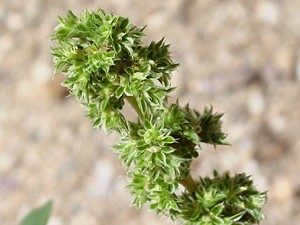
Female flower is bristly, photo by FireflyForest.com

With the help of a nescient media and the no-quality-control Internet the issue is putting farmers and foragers on opposite ends of the nasty rumor mill. More so, what is playing out in Georgia can and will happen elsewhere because resistant Palmer Amaranth is now found in some 20 states. Also, the resistance is expected to spread to other amaranth species plus other edible weeds are developing resistance which brings new meaning to the phrase “seeds of change.”
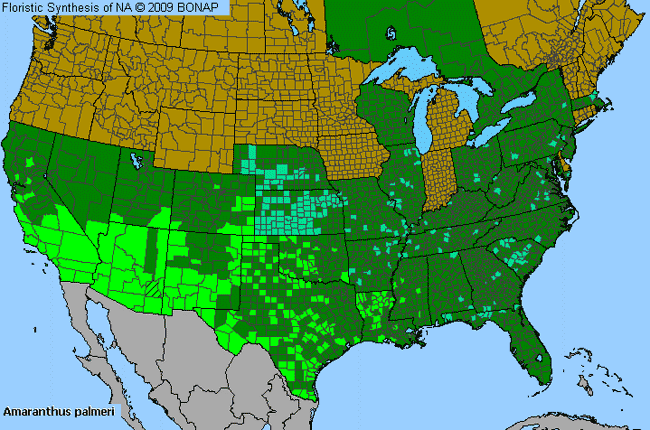
Palmer Amaranth Distribution

Threatening perhaps 500 acres of soybean and cotton in 2004 Palmer Amaranth by 2010 was affecting up to two million acres in the lower half of Georgia. While that put thousands out of work on the other side of the garden row were foragers saying  ‘not all is lost, all you have to do is eat the weed.’ It was inevitable that Internet sites began saying experts were advising people not to eat Palmer Amaranth because the resistance, a kind of botanical doomsday scenario from a grade B movie. ‘Palmer Amaranth killed our crop and it will kill you too.’ That led to a lot of email to me and we all get too much email. I thought getting to the nitty gritty of it all would in the long term help ease my email inundation.

Dr. Stanley Culpepper

The person most often cited as saying the resistant amaranth is not edible is Dr. Stanley Culpepper, associate professor, University of Georgia, and Extension Agronomist. Not so. I contacted Dr. Culpepper personally regarding the edibility of Palmer Amaranth and asked him about it. His view is quite different than what’s rumored on the Internet.

“If one decides to eat Amaranthus Palmeri,”  Dr. Culpepper said, “there will be no difference in its taste or nutritional value if it is resistant to glyphosate or not.  To date, we have not documented any change in the biological aspects of plant growth or reproduction with regards to resistance.”

Dr. Lynn Sosnoskie

That’s quite straight forward. Where in that statement do you read Palmer Amaranth is not edible? No where. Dr. Culpepper’s post doctoral assistant, Dr. Lynn Sosnoskie, who was also kind enough to contact me, added that there shouldn’t be any difference between the resistant and non-resistant plants though that was not specifically tested by researchers. More so Dr. Sosnoskie said that unless one actually tested a plant for glyphosate one could not readily tell the difference between a resistant and a non-resistant plant. However Dr. Sosnoskie did add an observation of interest to us forager. She said Palmer Amaranth tends to grow mostly on highly managed agricultural land and that land has “likely been treated with insecticides, fungicides, and/or herbicides.” That is important.

Thus, and this is my opinion not Culpepper’s or Sosnoskie’s so blame me not them: If there is an issue with Palmer Amaranth edibility it might not be the plant or glyphosate resistance per se but that of an unmanaged plant growing on highly-treated agricultural land. Unlike a commercial crop grown on such land with supervision and exact timing a wild plant might be on such land too long, under the wrong conditions, or harvested at the wrong time. I can see how that might affect edibility particularly with amaranth’s penchant for taking up too much nitrates and oxalates. Again, that is my opinion not Culpepper’ or Sosnoskie’s.

Philosopher William James

The philosopher William James, and brother to novelist Henry James, always insisted there be a practical side to everything, including philosophical notions. A hard-core New Englander he called it “take home change.” What’s the “take home change” of all this? Palmer Amaranth is edible but not the best of the amaranths. There is no evidence the edibility of Palmer Amaranth is different if it is “resistant” or not. It’s fast growing and does not stay young and tender very long. It can accumulate elevated levels of nitrates and oxalates and would probably do so on improved land, read land that is fertilized a lot such as agricultural land is. Amaranth on unimproved land usually has safe levels of nitrates and oxalates.
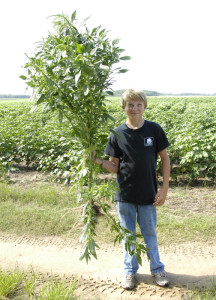
Lane Williams pulled this pigweed mid-summer, 2012, photo by Seminole Crop E-News..

Lane Williams pulled this Palmer Amaranth mid-summer, 2012, photo by Seminole Crop E-News.

The foraging advice of “just eat” Palmer Amaranth does not take into consideration the environment. As my readers know I champion my I.T.E.M. system of foraging and that includes E, for environment. In this case the edible plant in question usually grows in a highly fertilized if not chemicalized environment (vs the poor soil it usually inhabits.) This increases its chances of having higher than normal nitrate and oxalate levels, and probably other things, too. You have to take that inconsideration as part of your foraging decisions. I personally doubt some young and tender Palmer Amaranth plants are much of a problem. But, older plants could be and adult plants might sicken livestock. Also, the problem should lessen with time if the fields lie fallow. It’s an environmental issue more than a genetic engineering one for us foragers. Now you have the accurate information and reasoning you need to make an informed foraging decision regarding Palmer Amaranth in agricultural fields in Georgia. That said, what about Palmer Amaranth?

Amaranthus palmeri aka Carelessweed, is one of 60 to 70 species in the genus, depending upon who’s counting. Palmer Amaranth is a very competitive native now found in 30 states but not reported yet in Maine, New Hampshire, Vermont, Connecticut, Rhode Island, Delaware, Michigan, Alabama, Hawaii, Indiana, and the northern tier states from Iowa north and west.

The Cocopa, Mohave, Navajo, Papago, Pima, Pima Gila River and Yuma tribes all used the Palmer Amaranth for food. Their methods varied greatly including: Fresh plants baked and eaten; leaves boiled as a green; leaves cooked, rolled into a ball, baked and stored; leaves dried then stored for winter; leaves boiled and eaten with pinole; seeds ground into a meal; parched seeds ground then chewed for sugar; seeds parched, sun dried, cooked, stored for winter.

Edward Palmer

Amaranthus (am-ah-RAN-thus) is from Greek means unfading, or evergreen. Palmeri (PALM-er-ee) was named in 1877 after Edward Palmer, plant explorer extraordinaire. Palmer was the right person in the right place at the right time. When Europeans first landed in the new world they were very interested in plants but didn’t record much about how the natives used most of their plants. By the time the white man was pushing west to California a different attitude prevailed. This is why in most ethnobotanical references we know far more about what the Western natives did with plants than the Eastern natives. And one of the reasons why we know that was Edward Palmer, 1829-1911. He collected over 100,000 specimens and discovered some 1,000 new species. Palmer also visited local markets to get plants and study how they were used helping to found modern ethnobotany.


Green Deane’s “Itemized” Plant Profile: Palmer Amaranth

IDENTIFICATION: Amaranthus palmeri: Long dense, compact terminal panicles to 1.5 feet, tall — six feet — with alternately arranged leaves, petioles longer than the leaves.  The leaves of Palmer Amaranth are also without hairs and have prominent white veins on the under surface. The male flowers have highly allergenic pollen.

TIME OF YEAR: Flowers summer and fall

ENVIRONMENT:  Agricultural land, disturbed areas, riparian locations, desert, uplands.

METHOD OF PREPARATIONS: Young leaves, young plants, growing tips boiled, baked or dried. Seeds used as grain, parched, roasted, or ground into flour.

Other thoughts: Most plants have a shikimate pathway, which is a seven-step metabolic process. Humans don’t have that pathway. Round up or Glyphosate, interferes with the shikimate pathway, which is how it kills plants, except plants that have been genetically modified. The logic was clear: Make food plants modified to not be affected by any herbicide that affects the shikimate pathway, thus all you needed was one herbicide to kill all unwanted plants in your crops fields.  However… bacteria do have a shikimate pathway but when Glyphosate was being developed there wasn’t much interest in or knowledge about our gut biome. My assumption is Round Up and the like affect our gut bacteria, and as we all have a different gut biome the symptom vary widely making it difficult for medicine to identity a consistent problem. 


{ 55 comments }

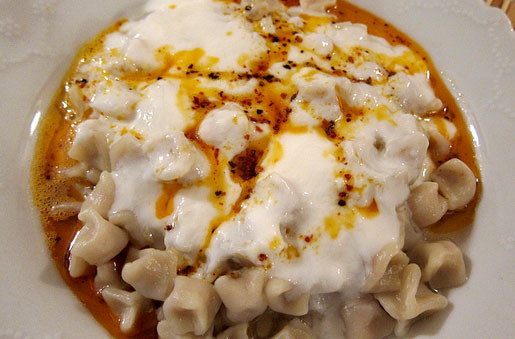
Manti, steamed dumplings of horse, pumpkin, and hot pepper smothered in cheese, down home cooking in Kazakhstan

“I’m so hungry I could eat a horse.”

We’ve all heard the phrase, and it comes from when horse was on the menu. It was rather significant phrase to me as a kid because I grew up with horses, usually five occasionally six. They were my mother’s hobby and the main reason why I spent some 13 summers of my youth haying until I joined the army. I know horses, haying and ground hornets well. I also know it take one huge hole to bury a dead horse. It’s not a hole you dig by hand. Want a reference point? Dig a hold to bury a car. That’s about right except you have to make it deep or carnivores will dig down to it. Even getting a dead horse to the hole is a chore particularly if it dies in a stall in the barn.

Not only did my mother bring home live horses but horse meat as well. We bought it in the butcher store occasionally. It had to be separated from the beef — other side of the store — but there it was, several different cuts catering to the Canadian shoppers. In fact, horse meat was on the menu at the Harvard Faculty Club up until 1983. It was a common food in the U.S. during WWII and was consumed in quantity because it was not rationed. Archaeologists tell us early man hunted and ate horses. They became beasts of burden much later. Horses are called the noble beast because they will always try to do what you ask of them.
Equinonoid Henry Ford

Here’s a bit of trivia for you: Henry Ford loathed horses. He hated them.  He said he worked hard to develop the car to free man from the Culture of Horses. Ponder that. Here’s a man who helped change an entire society — the world — because he hated a particular animal. Then again, someone who loved horses, which were the main muscle of the day, could have developed the car because they wanted to save horses from all that work and suffering. Either way the internal combustion engine put an end to the horse culture.
Saint Boniface

The banning of horse meat goes back to the eighth century. Popes Zachary and Gregory III both told Saint Boniface to forbid his missionaries to eat horse meat, as it had a strong correlation to the Germanic pagan rituals which Christians were trying to eradicate. The Germans of old liked their horse meat, and still do and until 2005 the United States was the major exporter of resturant grade horse meat.

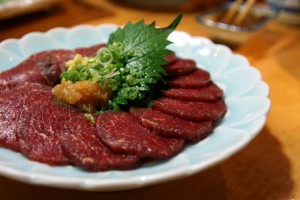
Japan’s Basashi

Buying horse meat and slaughtering horses for commercial meat was illegal in the United States from 2006 until Nov. 18th, 2011, though it was available in other countries during those times. Horse meat could be in US markets in early 2012 but it was sure to create public controversy. The only legal impediment nationally is funding federal meat inspectors. However, California and Illinois have banned the slaughter of horses for human consumption, and more than a dozen states tightly regulate the sale of horse meat. Not so elsewhere.

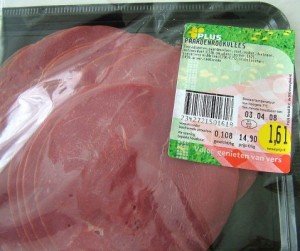
In Japan there’s a sashimi dish made of horse meat. Horse is very popular in France.  From a culinary point of view horse meat is lean, much along the taste and texture of moose, deer or kangaroo. It is a gray colored, dry, sweeter than beef, and improves in flavor greatly by the inclusion of fat when cooking or from a marinade. Fresh is far better than frozen.

As mentioned elsewhere most people would not eat their pets, regardless of what those pets are. When I meet someone who has a reptile for a pet I have to remind myself of that least I make a few misplaced iguana shoes or turtle soup jokes. Though we ate horse meat eating our horses when they died was not an option. We buried Ginger, Bonnie, Cheeko, Rusty, Mary and Sootie. And I am sure all these years later I would be bothered by the deed had we eaten those big, lovable pets. However, in hindsight all these years later, we also buried a lot of meat. Combined they weighted some 6,000 pounds. Even after dressing that would be three to four thousand pounds of meat, two tons of it. That’s a lot of food to put into the ground. If raising cattle that we eat is a waste of land resources then what is burying a pet horse?

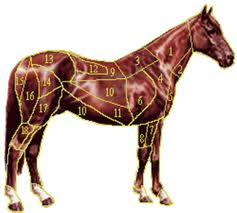
Horses have cuts just as beef does, with more or less tender parts. We usually bought steaks but they ended up in stews more often than fried. Without some tenderizing and fat the frying pan does not treat horse meat well. The stews were excellent. Indeed, my mother loved New England Boiled Dinners. We had that virtually every Sunday for every Sunday I ever lived at home — without exception — and more than once there was a chunk of horse meat in there growing tender by the long, moist heat.

Foul-mouth chef Gordon Ramsay says horse is healthy, packed with half the fat of beef and has far more Omega 3 fatty acids than beef. He describes it as “slightly gamey” and “packed with protein.” I don’t remember it being gamey at all.

While there are legitimate reasons not to eat horse on the positive side, horses don’t have mad cows disease.

Horse meat with mustard

  • 1 1/2 lb. (675 g) lean ground or cubes horse meat
  • 1 Tbsp. (15 mL) olive oil
  • Tomato Sauce
  • 2 Tbsp. (30 mL) olive oil
  • 1 cup (250 mL) tomato sauce
  • 1 Tbsp. (15 mL) brown sugar or honey
  • 1 Tbsp. (15 mL) mustard
  • 1 Tbsp. (15 mL) Worcestershire sauce
  • 1 medium onion, thinly sliced
  • Salt and pepper to taste

Preparation

In a pan, sauté the horse meat in oil. Drain the meat and throw out the cooking fat. Put the meat back in the pan. In a glass bowl, mix all the sauce ingredients. Pour into the pan over the meat. Cover and simmer for one hour. Serve with pasta and sprinkle with Parmesan or Pecorino cheese.

{ 7 comments }

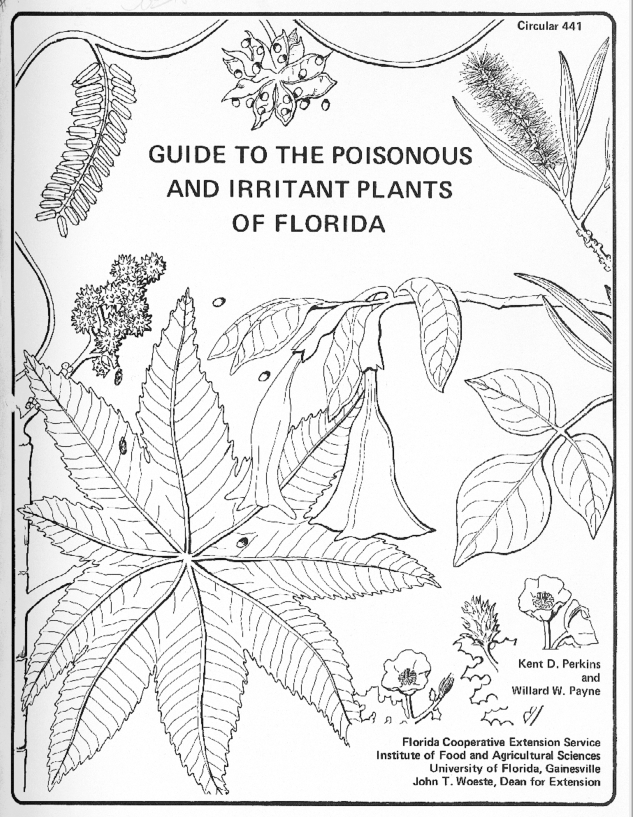
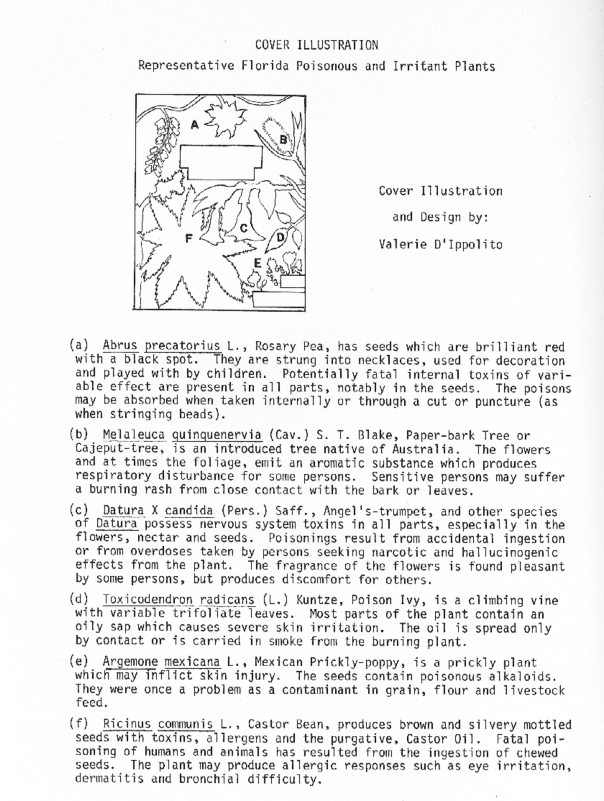
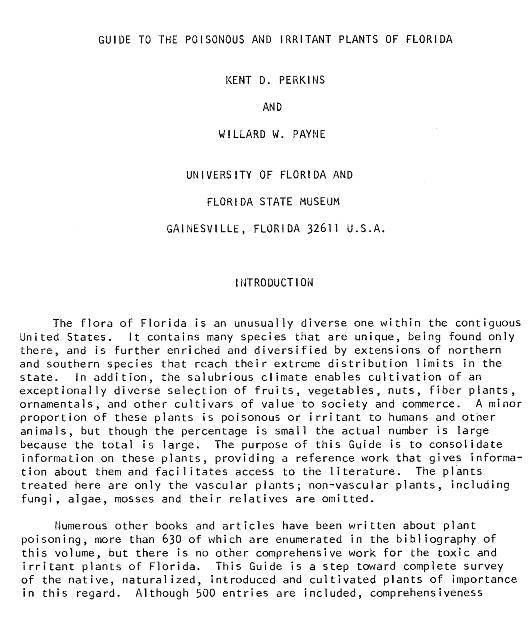
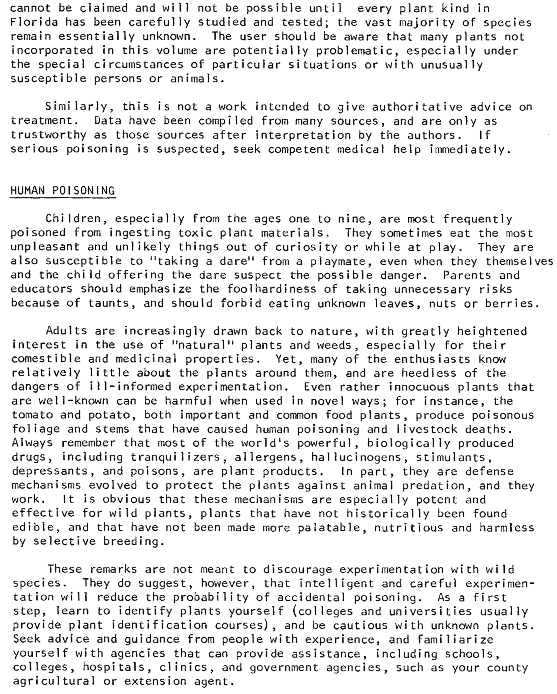
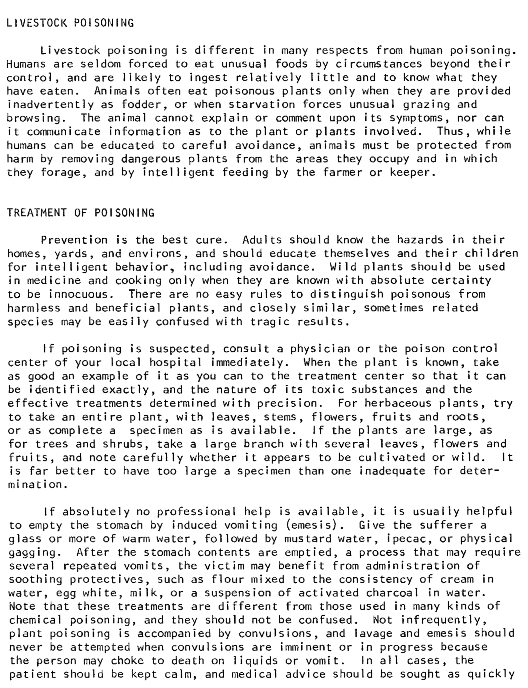
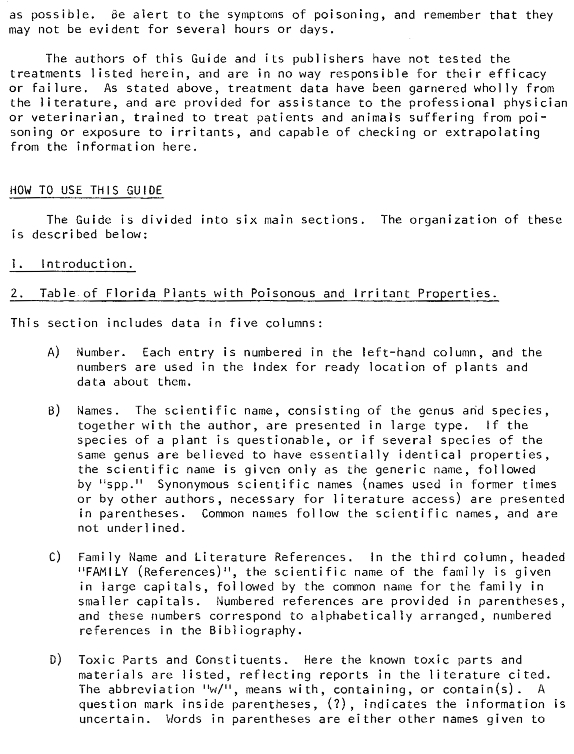
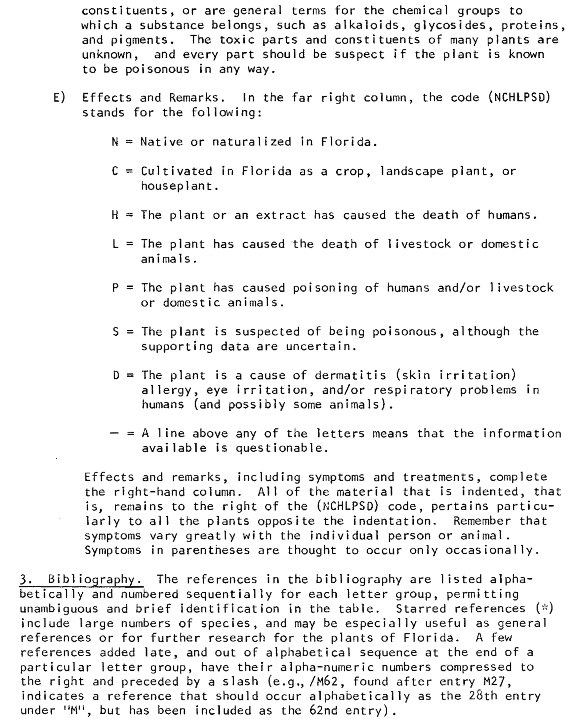
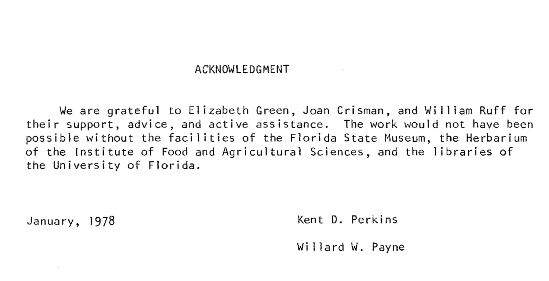
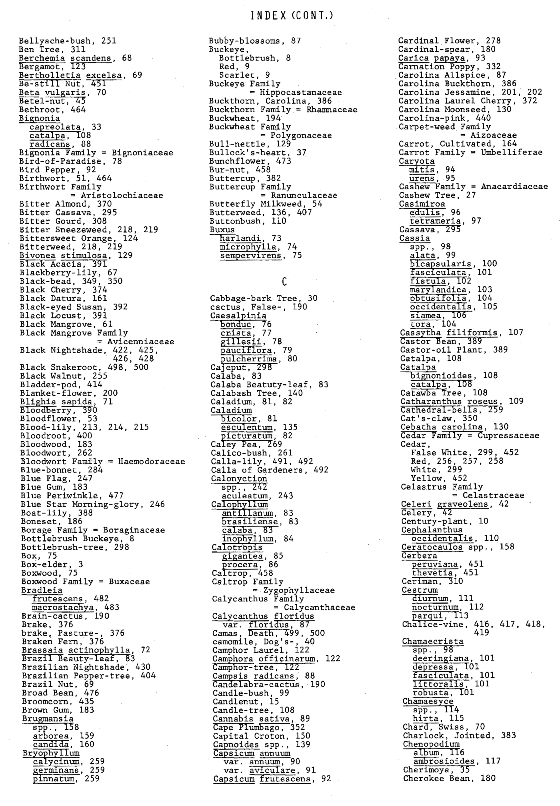
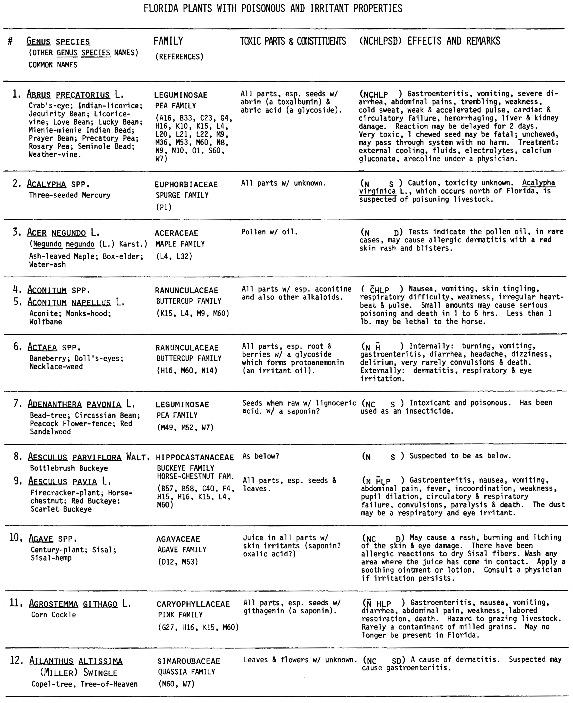
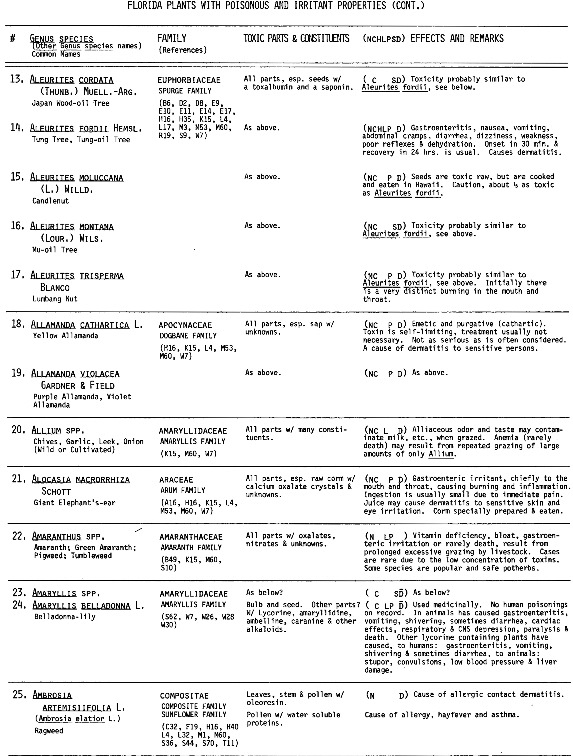
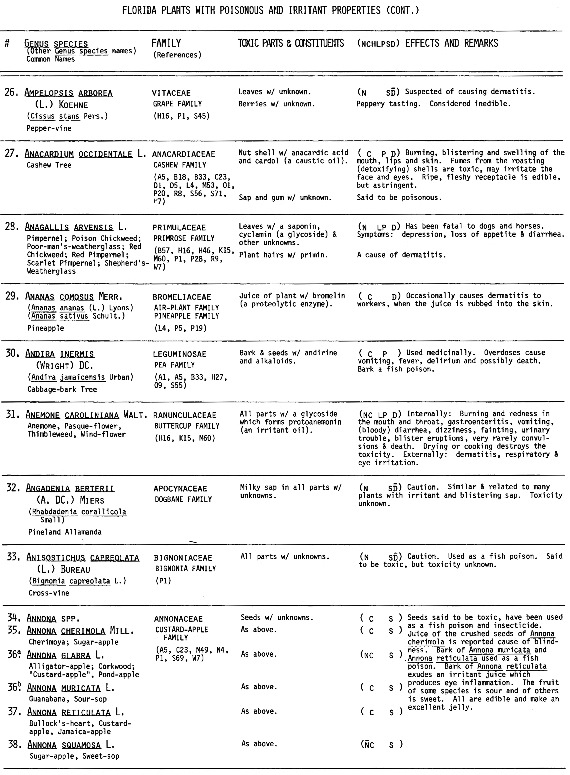
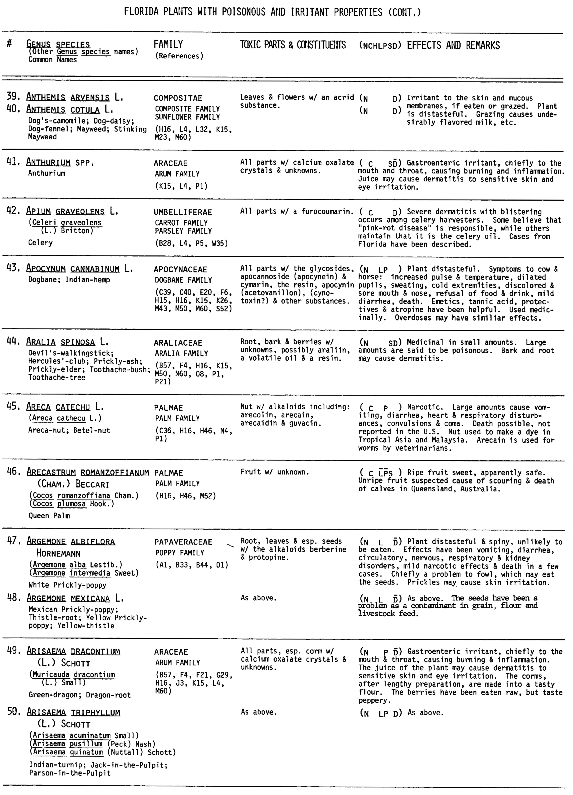
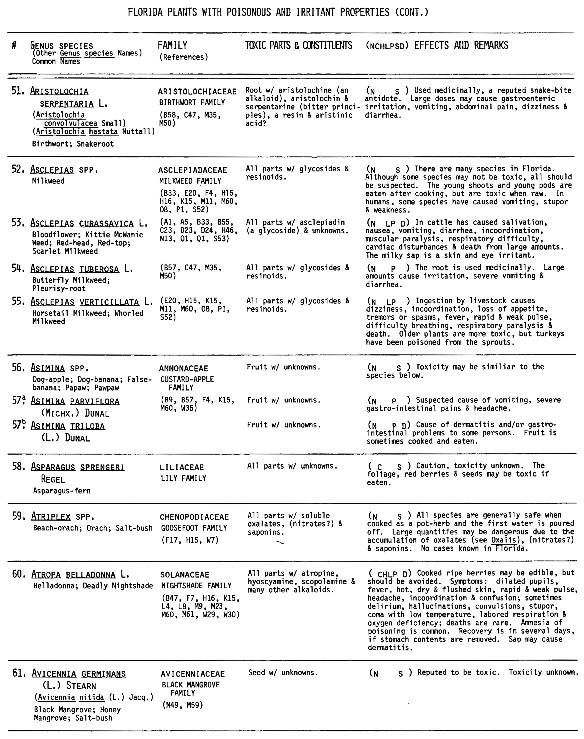
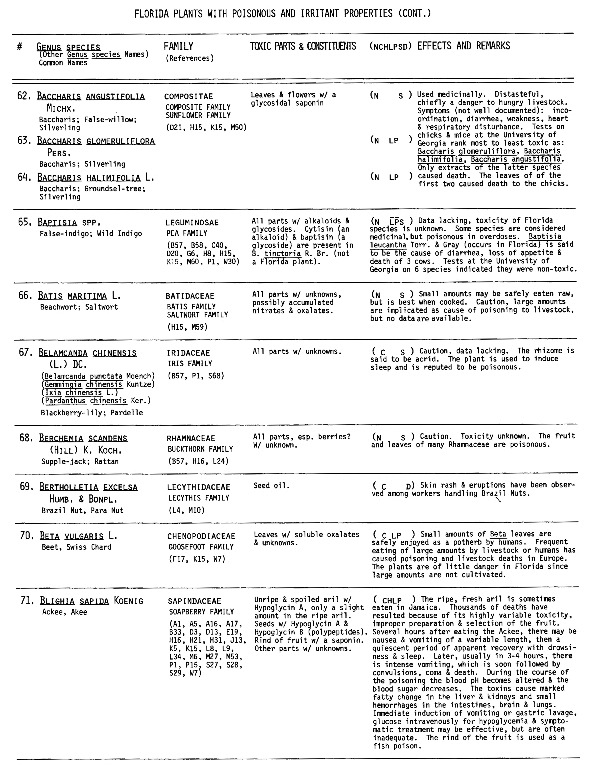
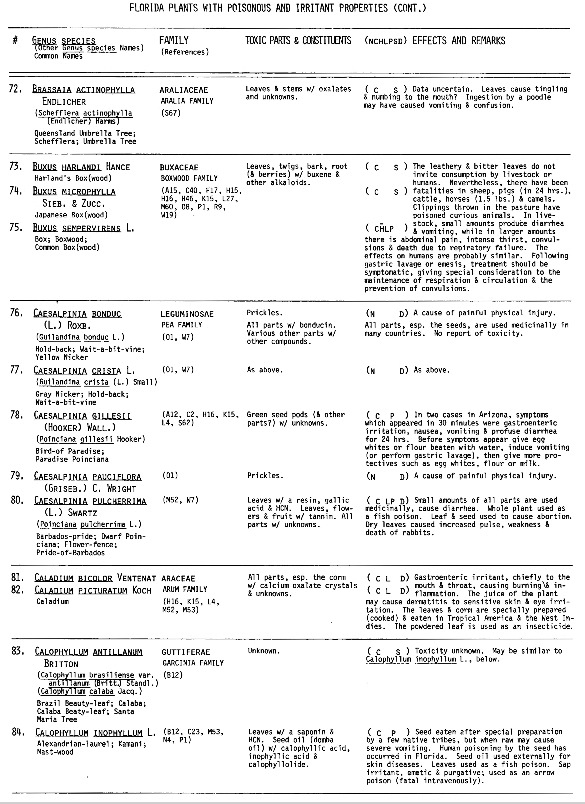
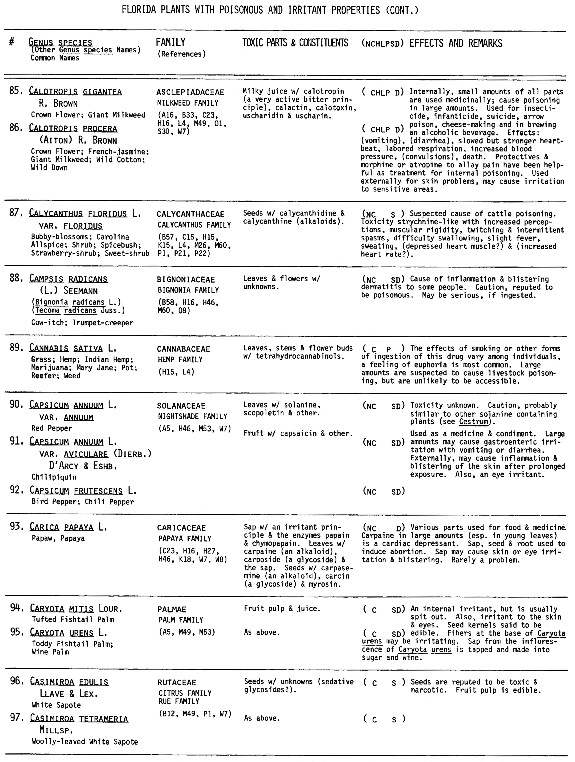
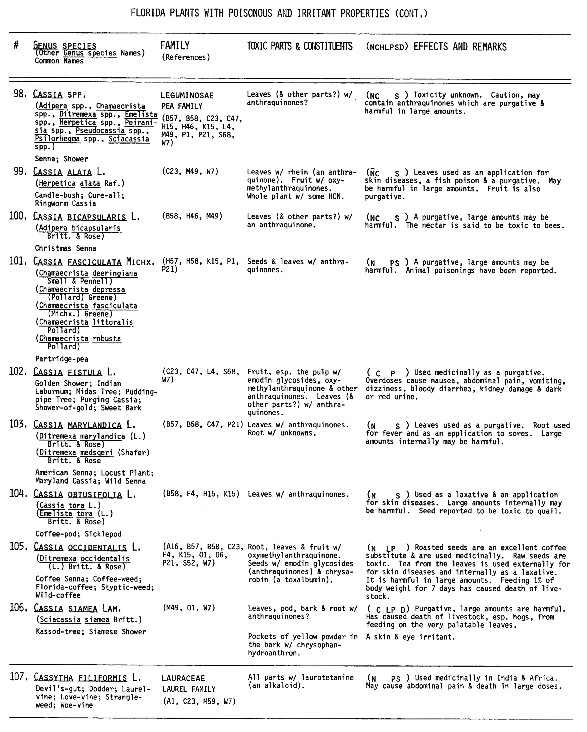
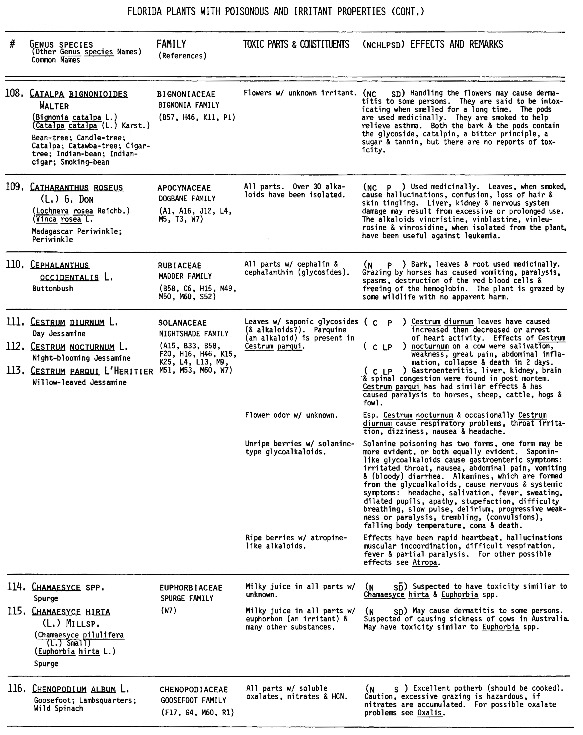
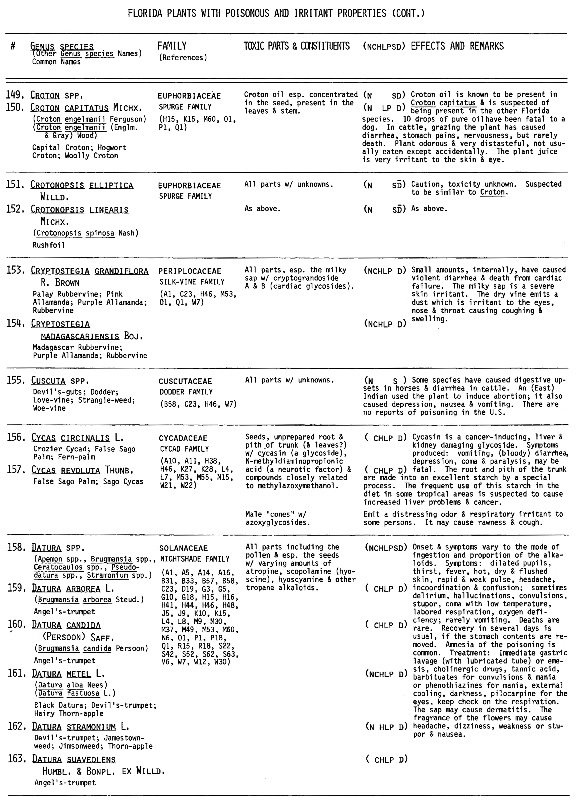
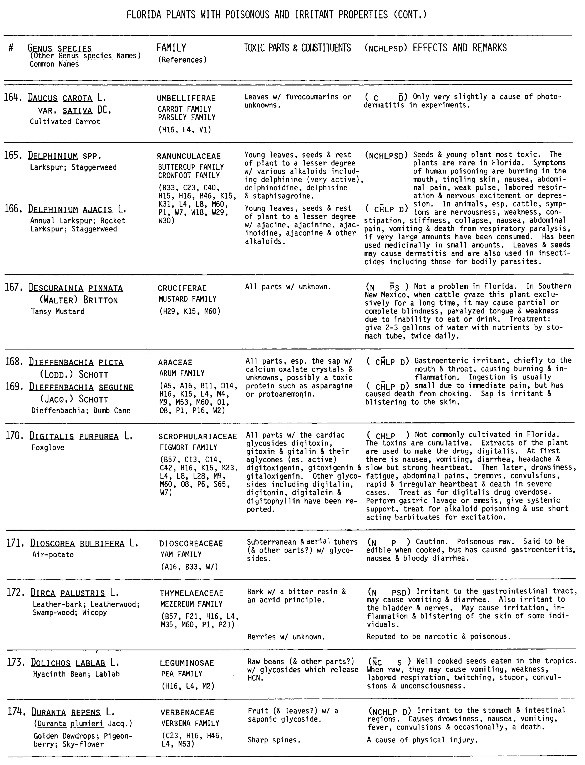
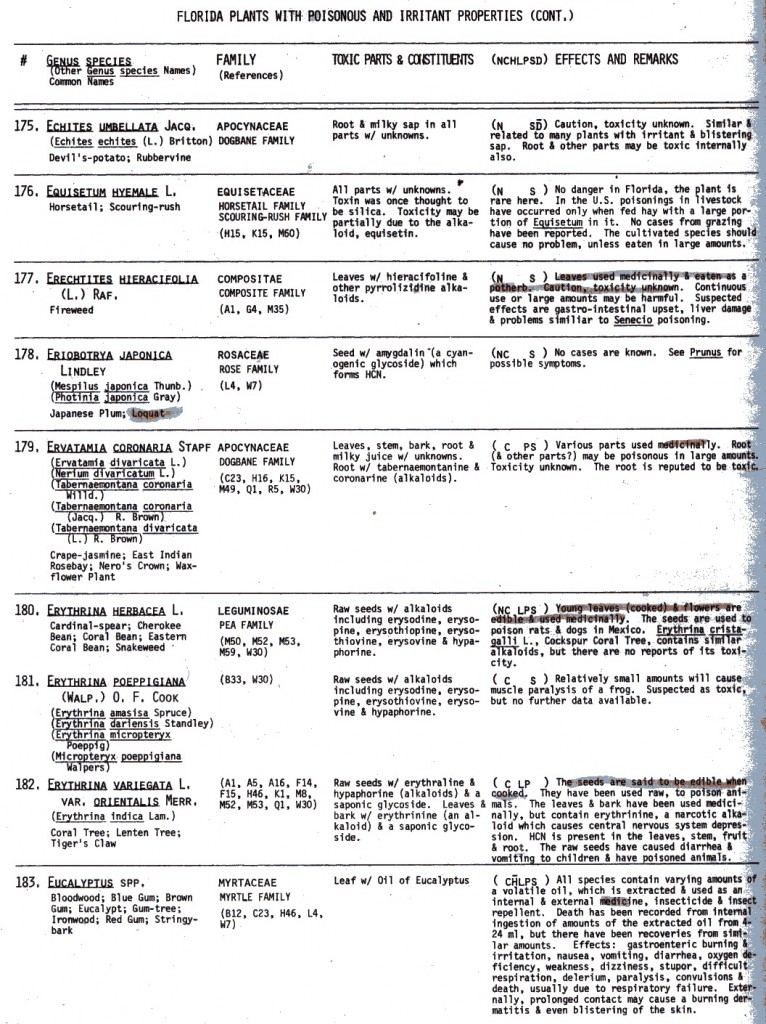
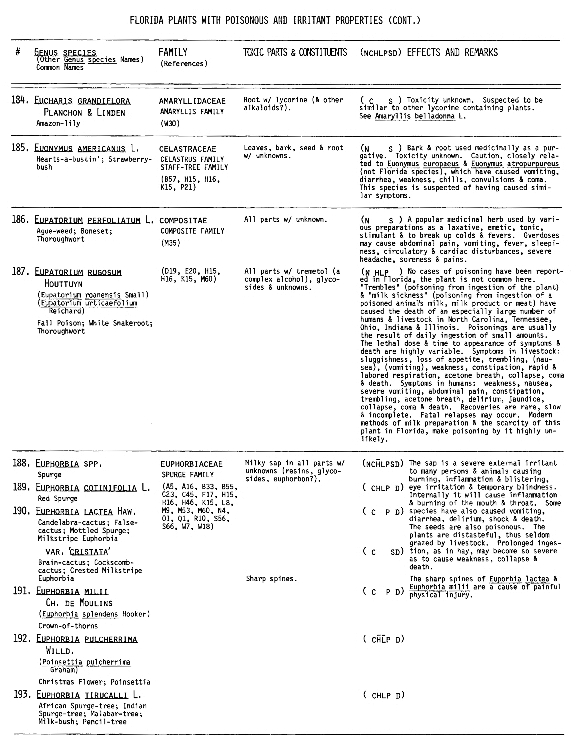
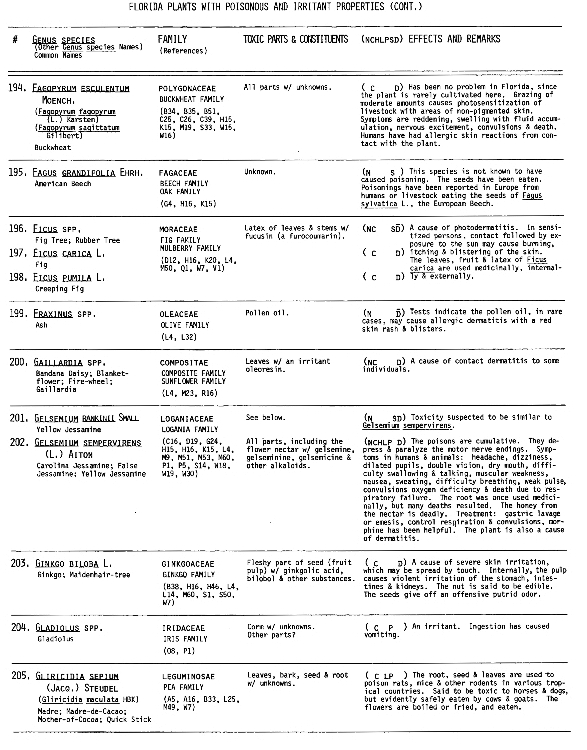
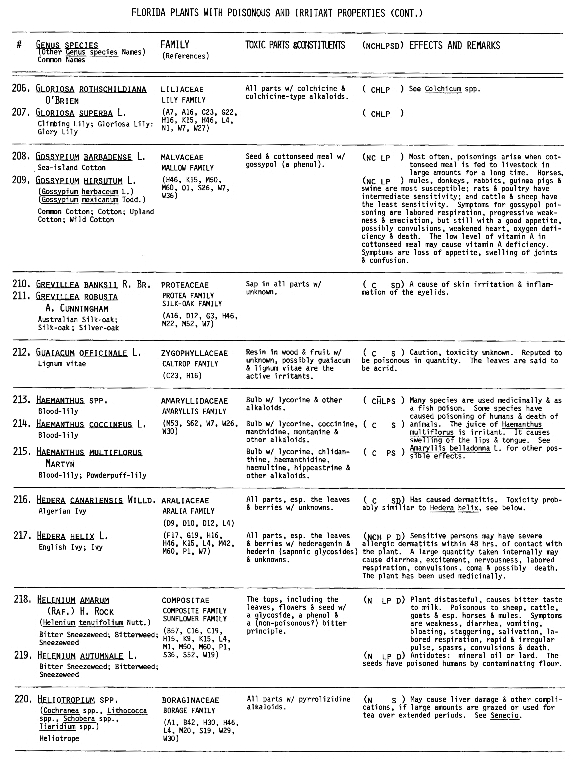
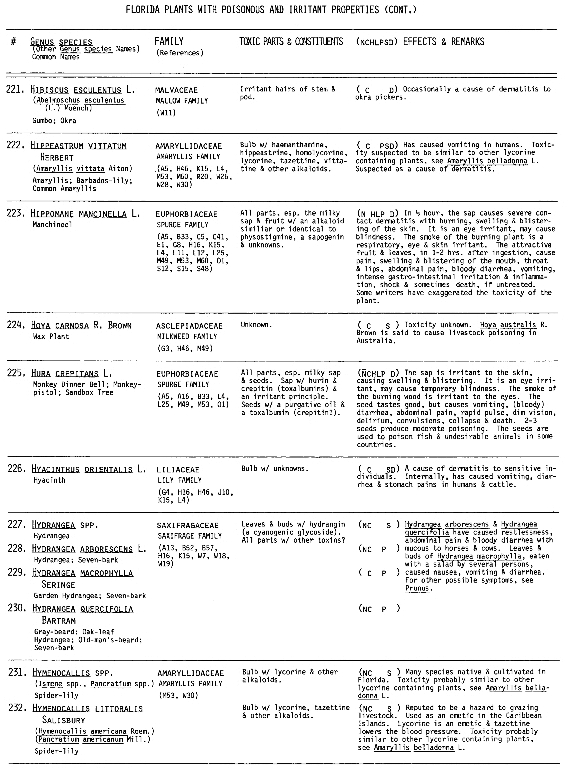
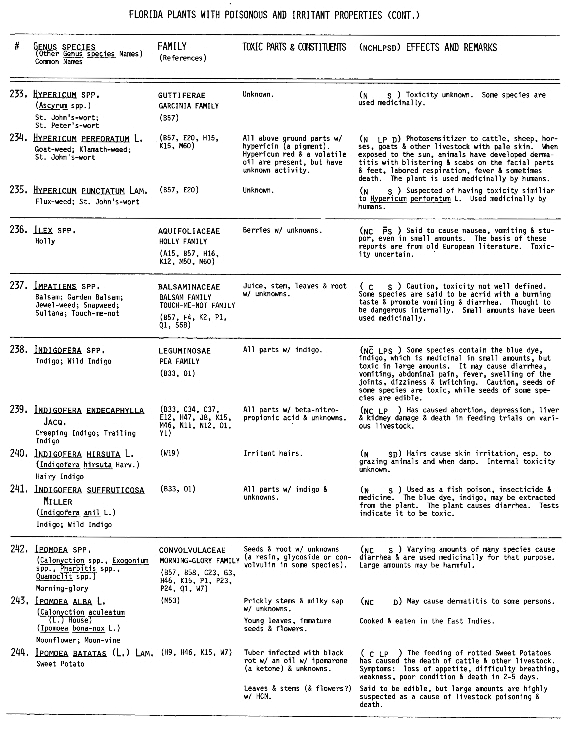
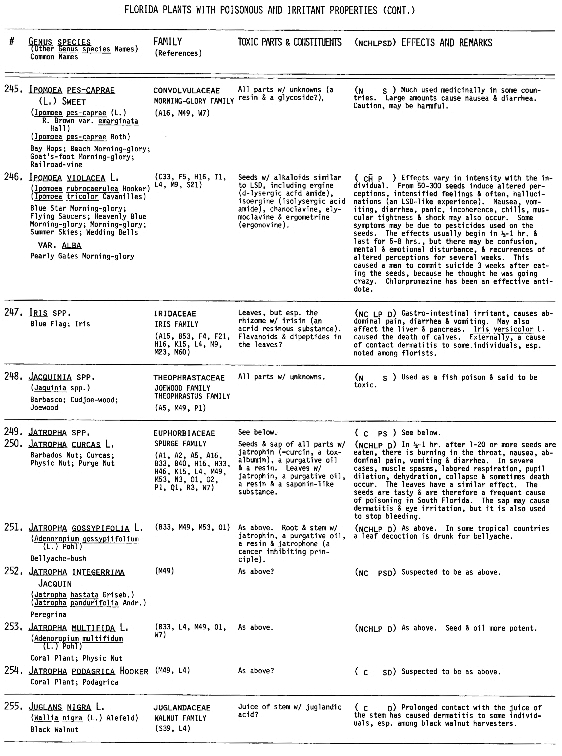
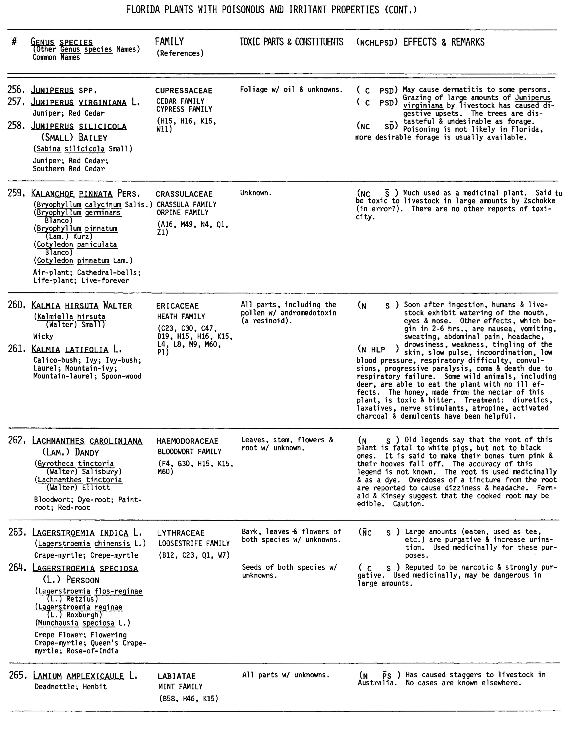
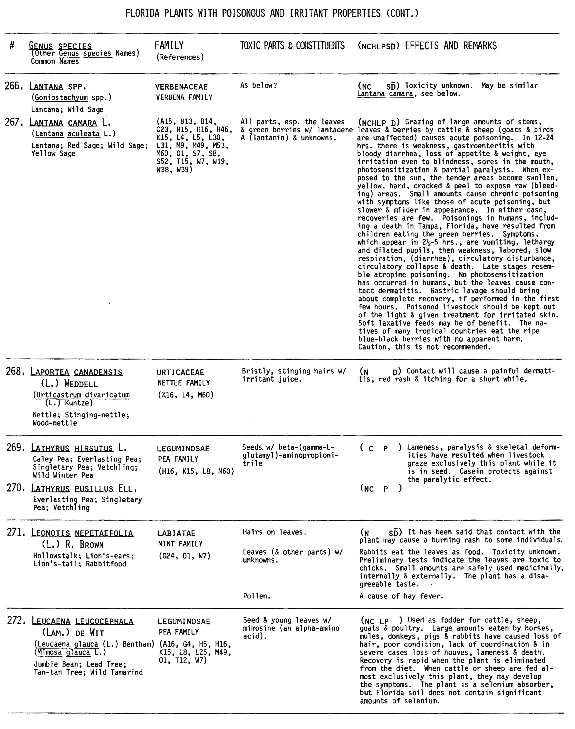
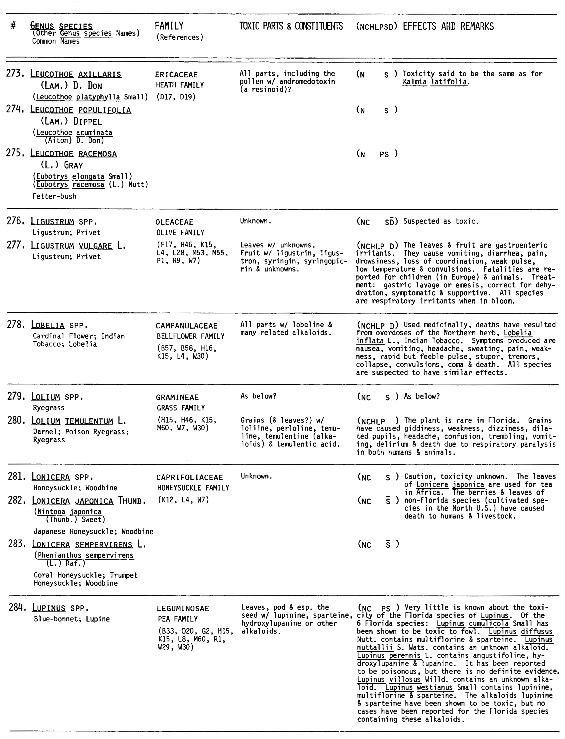
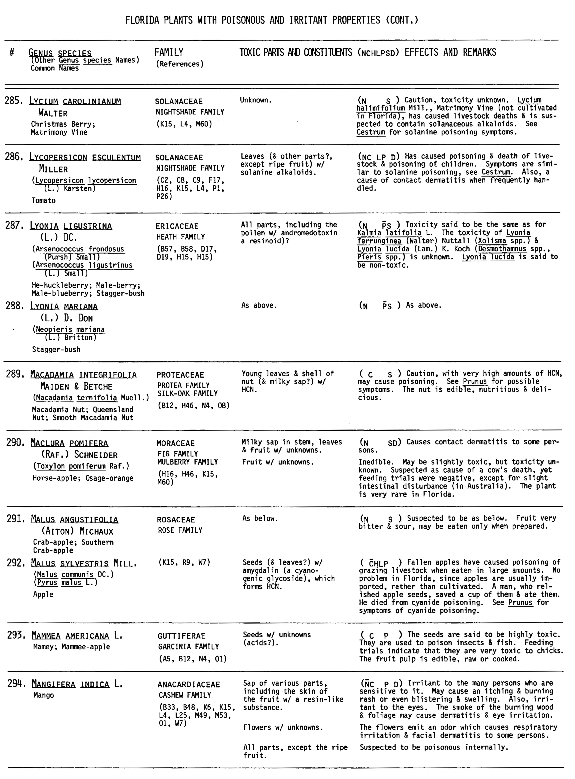
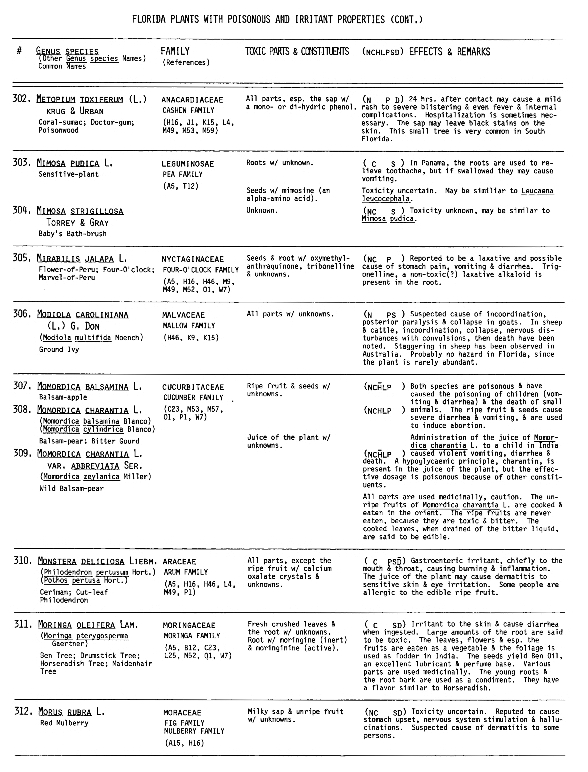
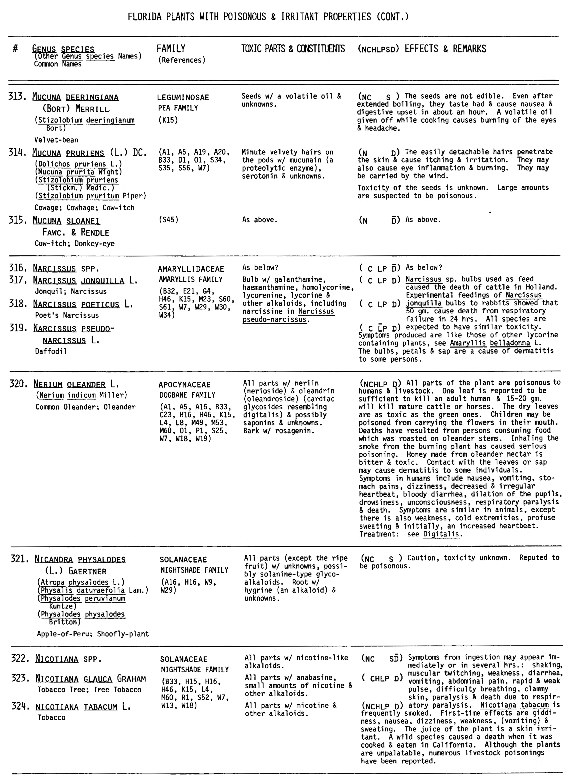
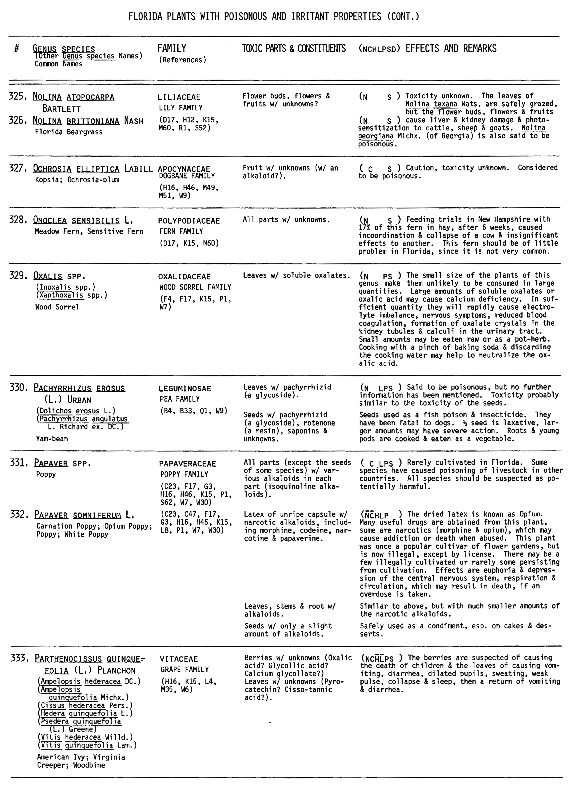
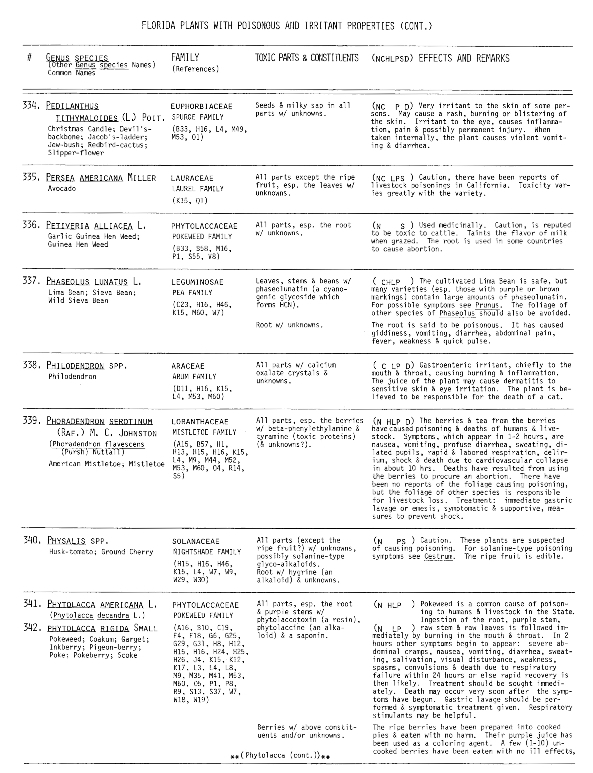
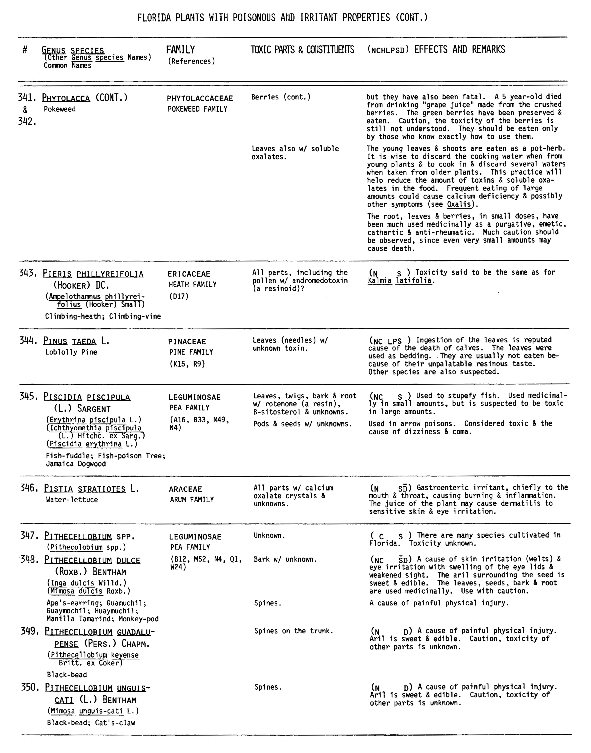
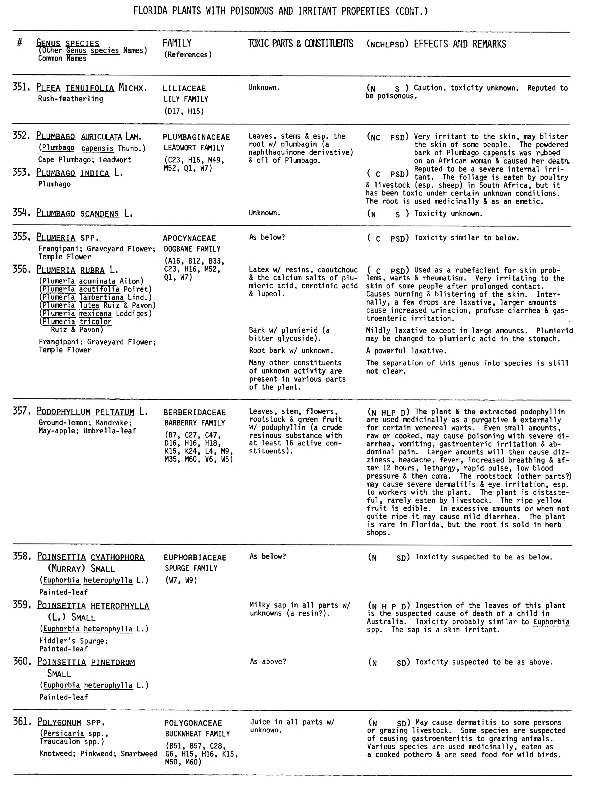
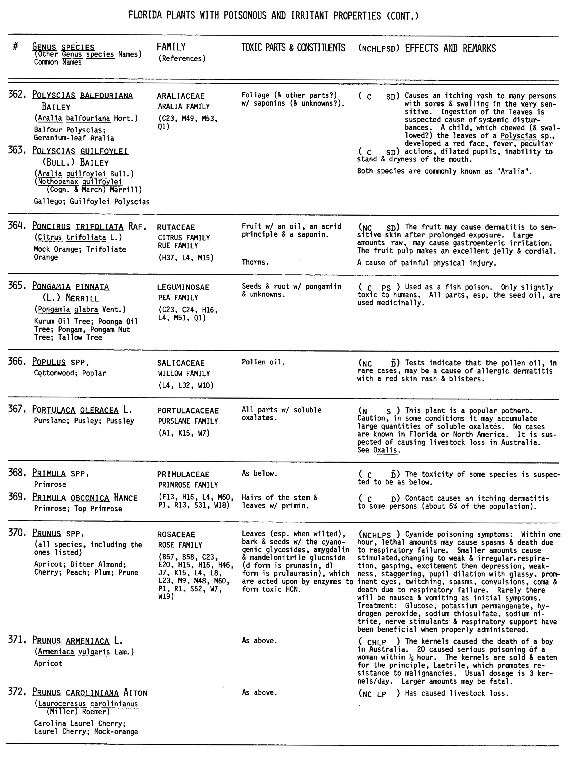
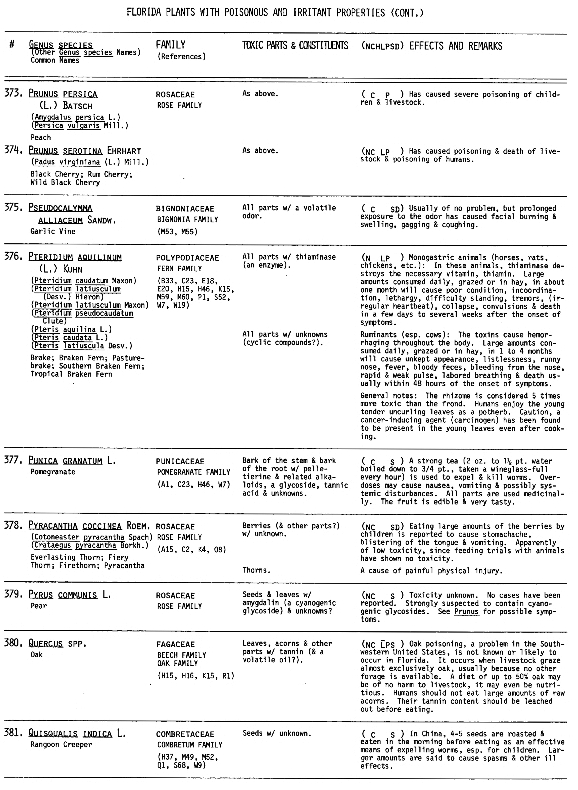
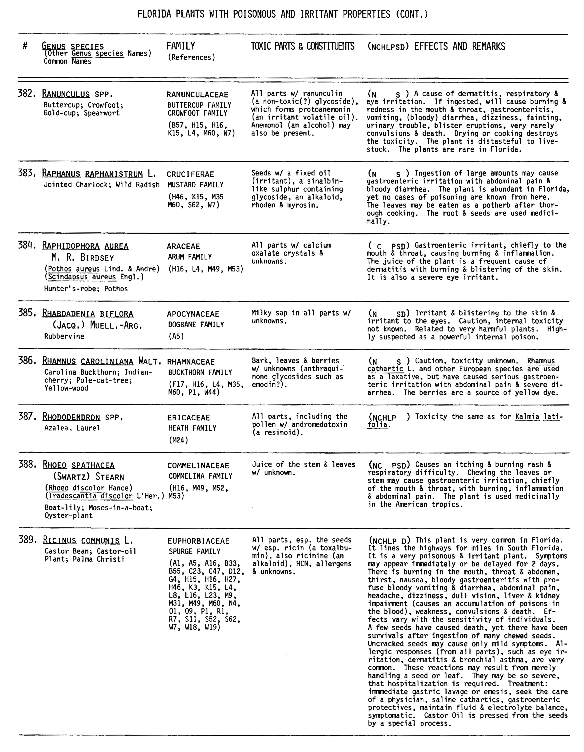
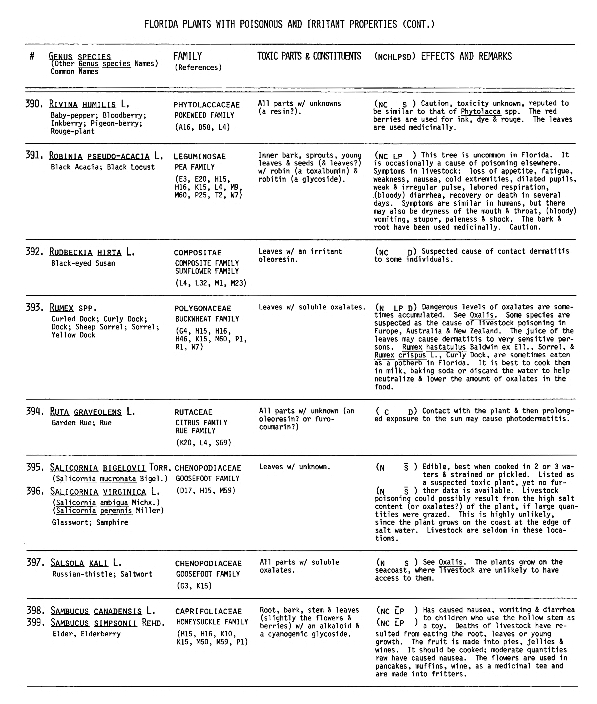
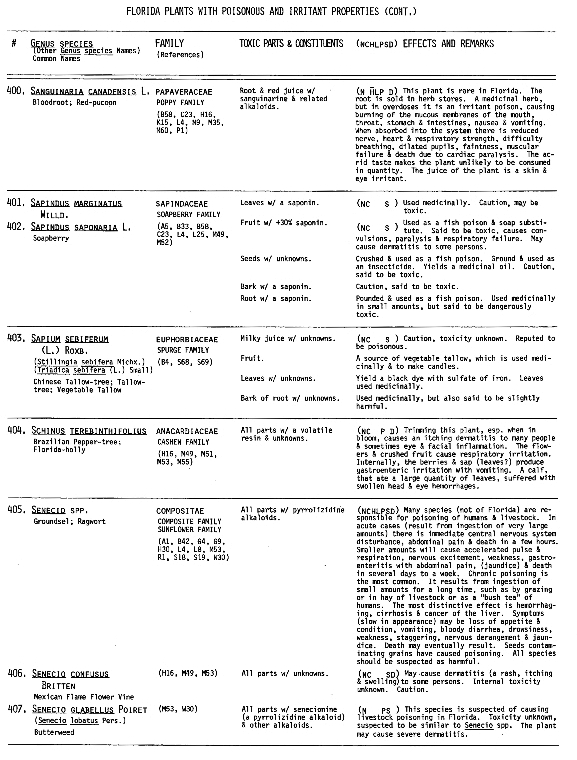
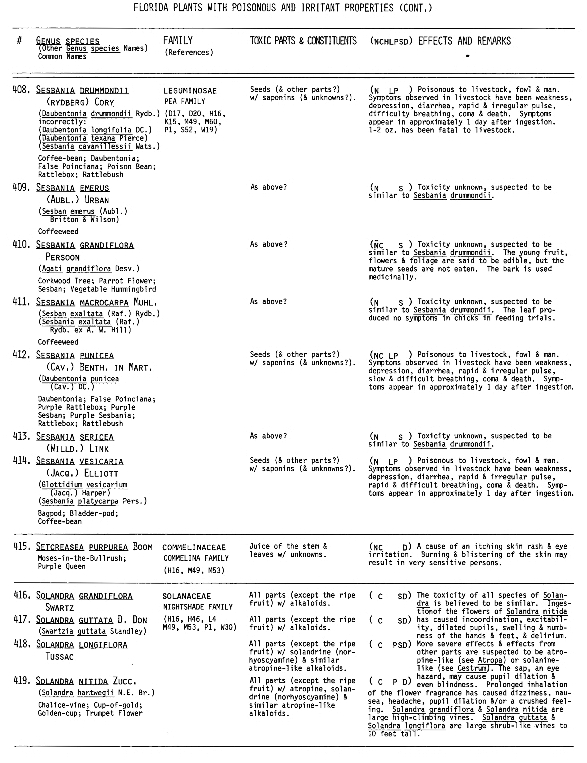
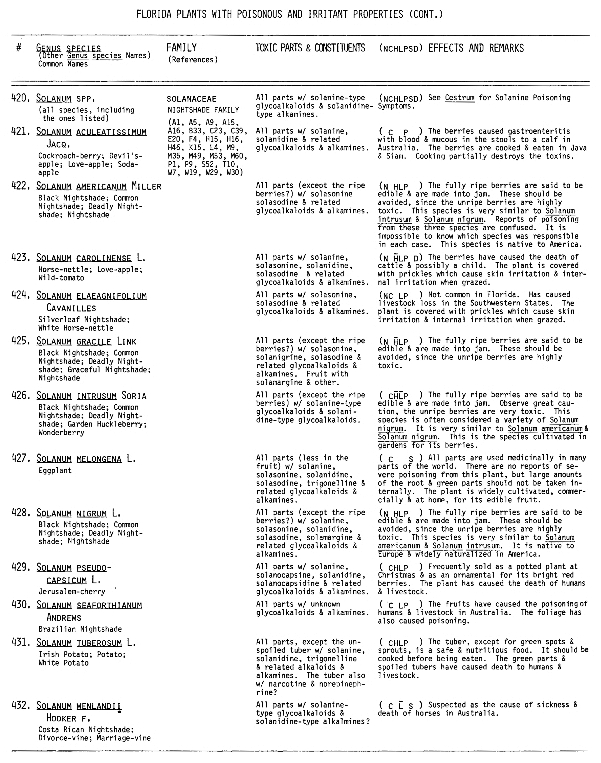
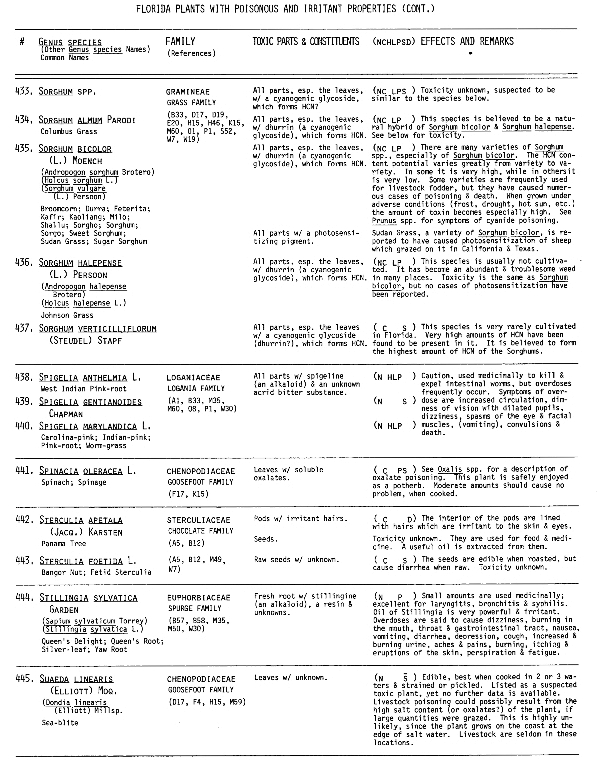
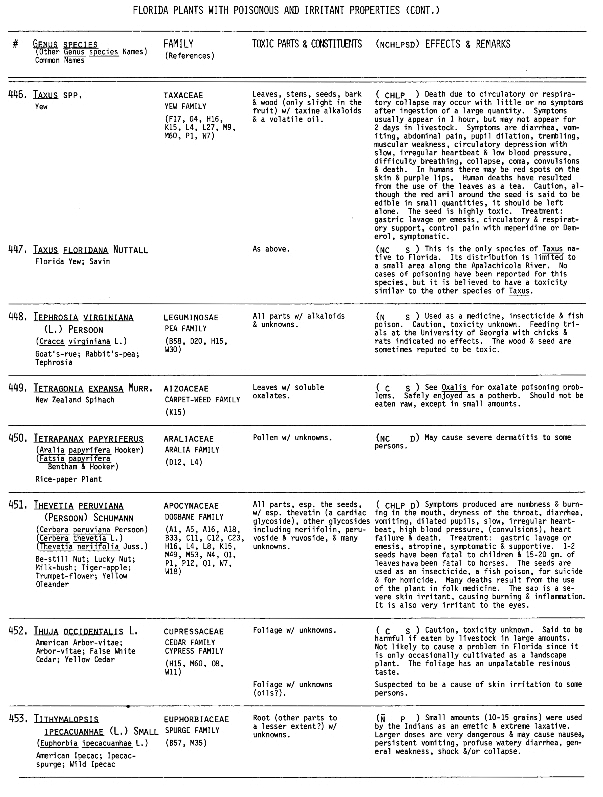
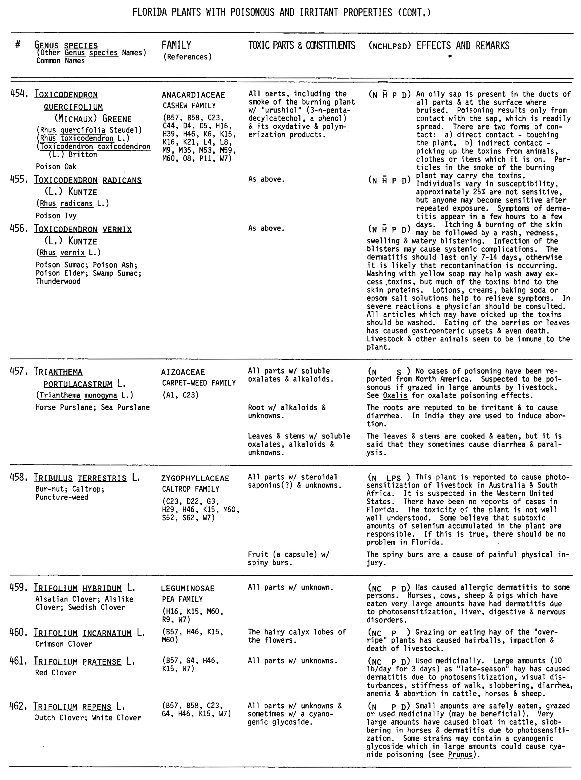
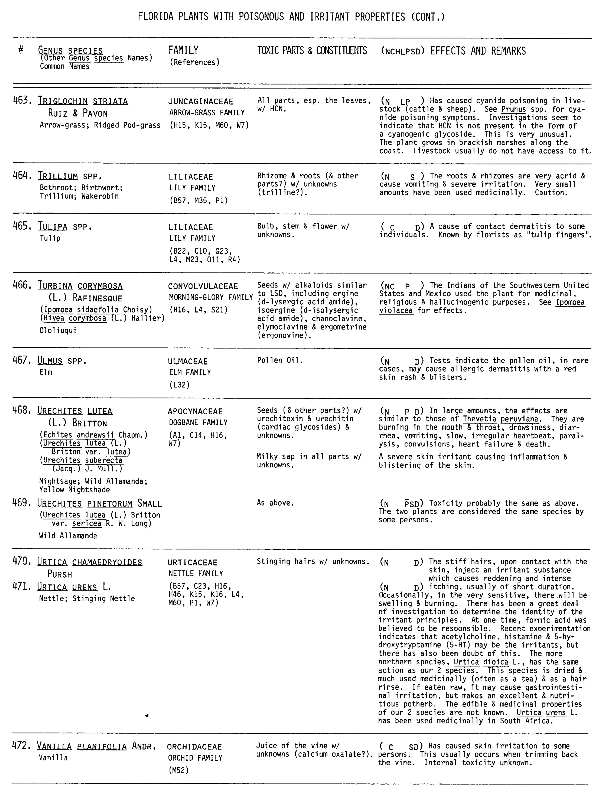
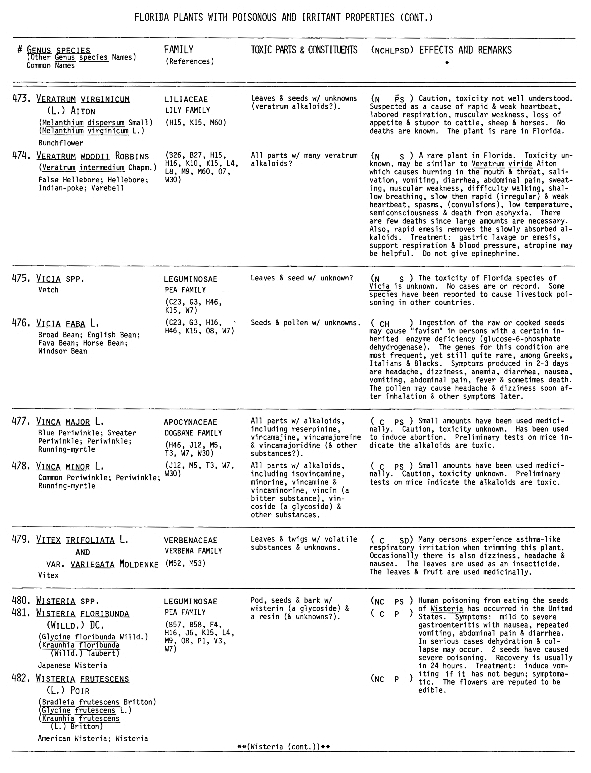
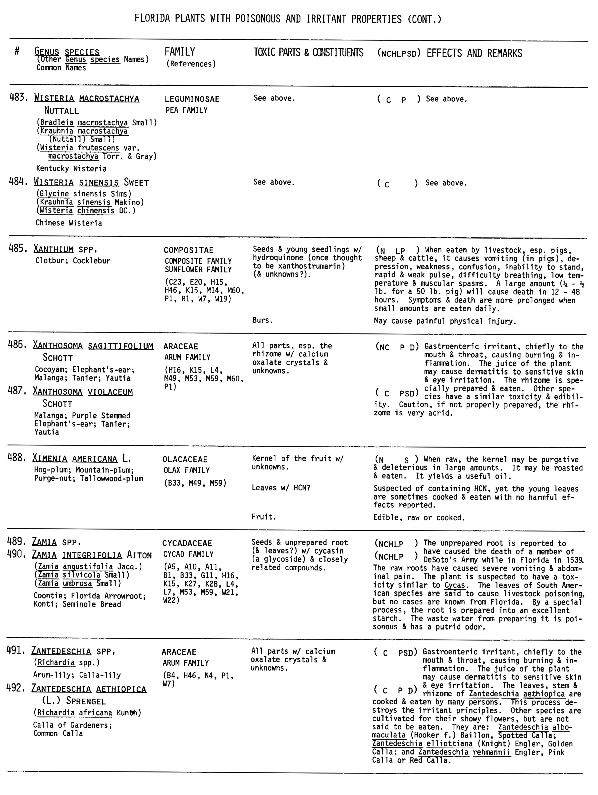
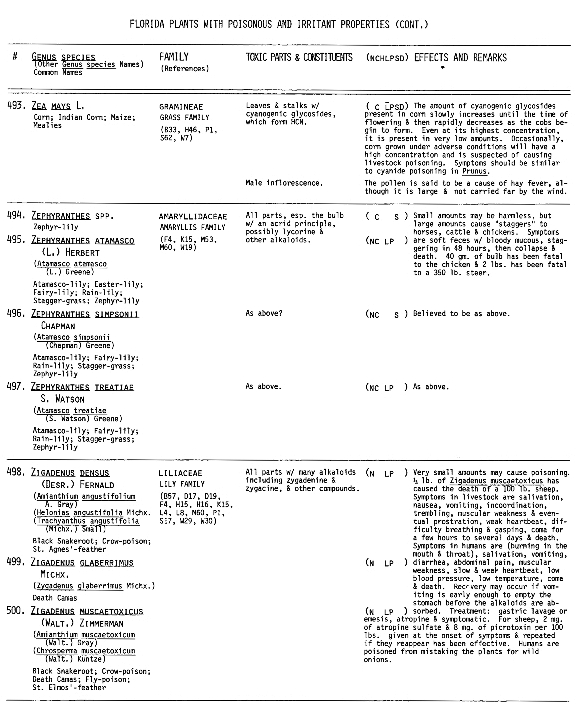
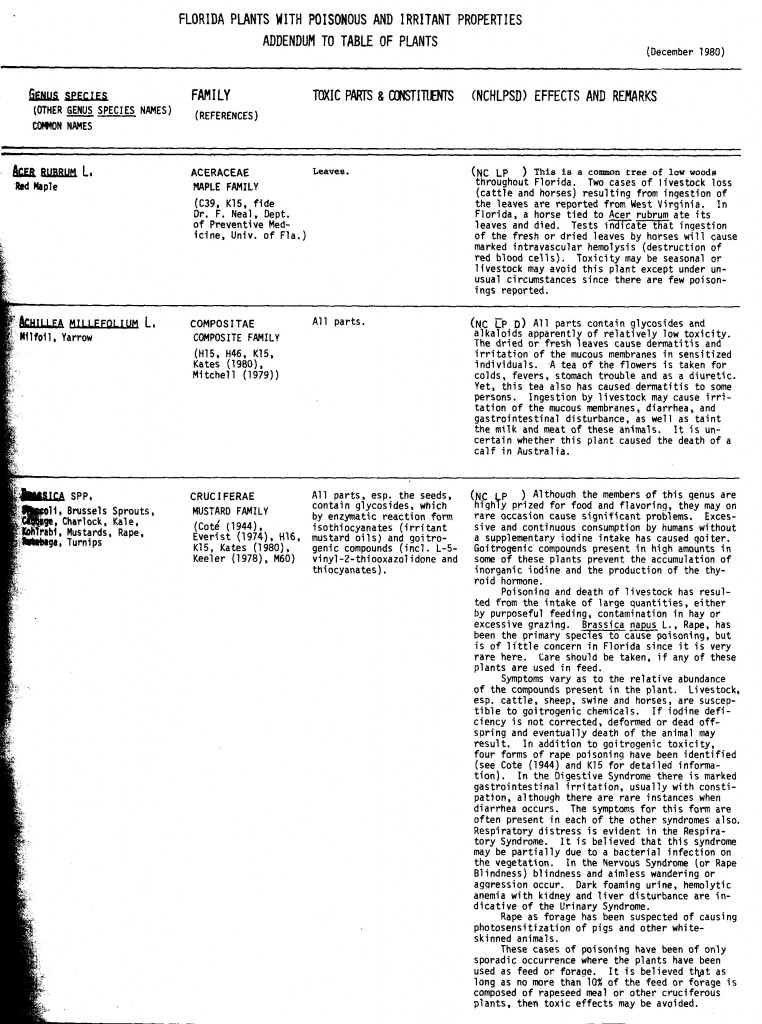
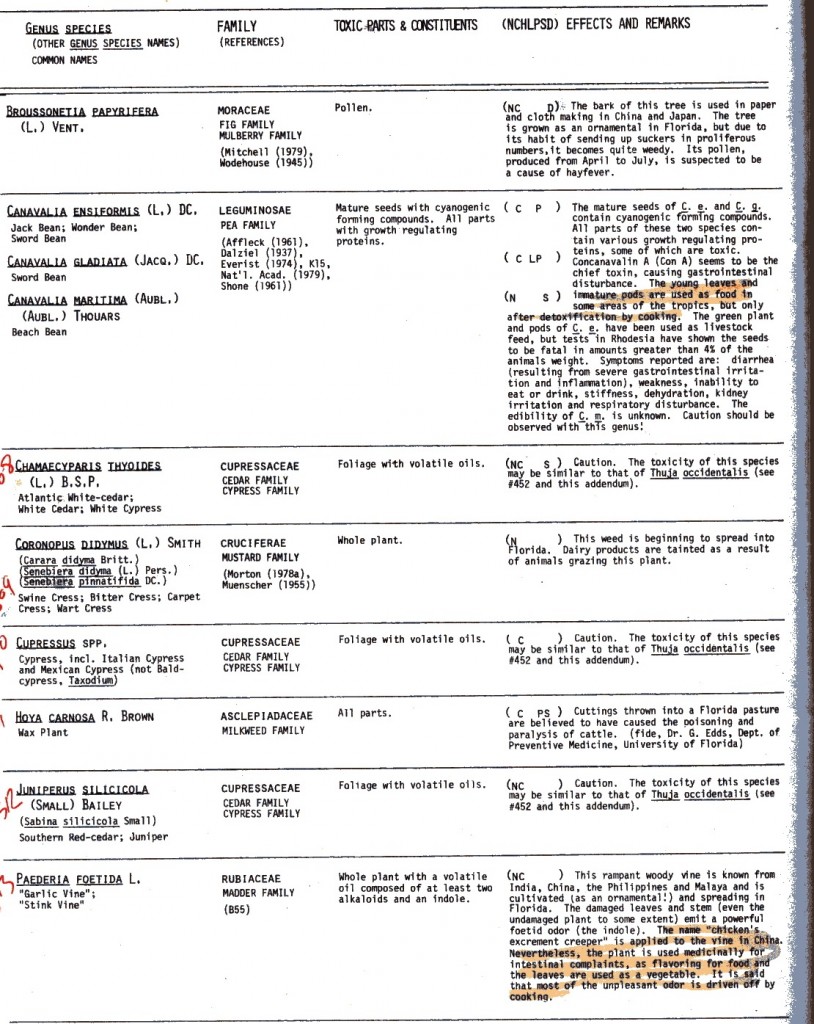
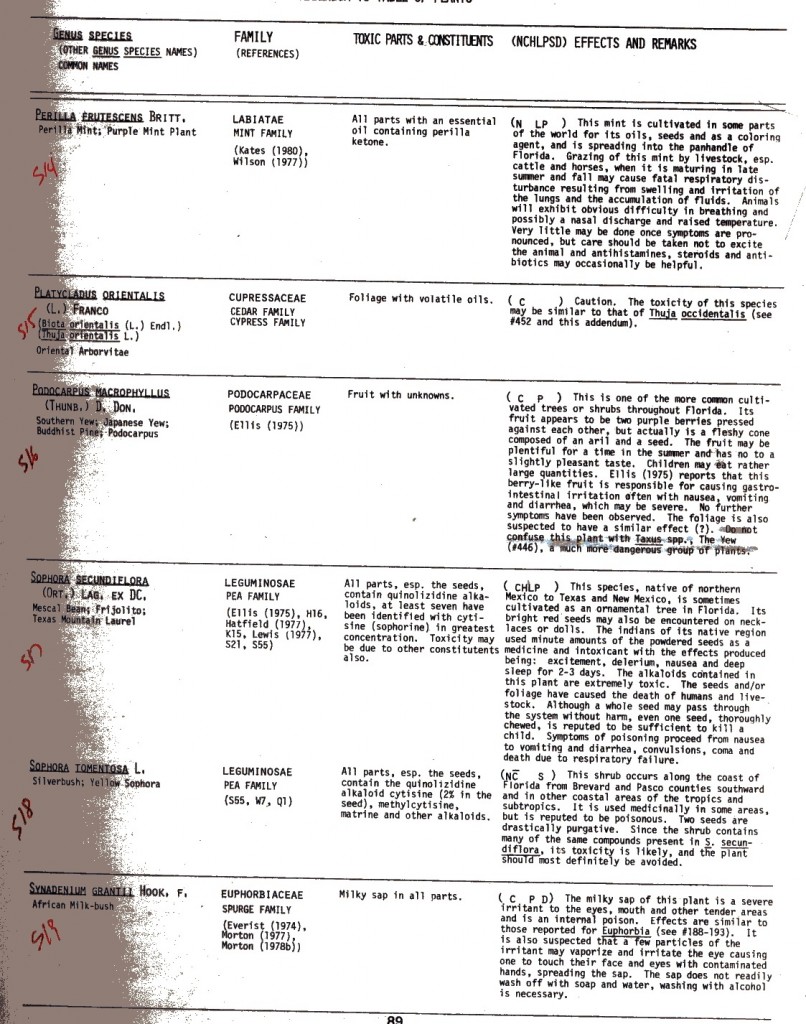
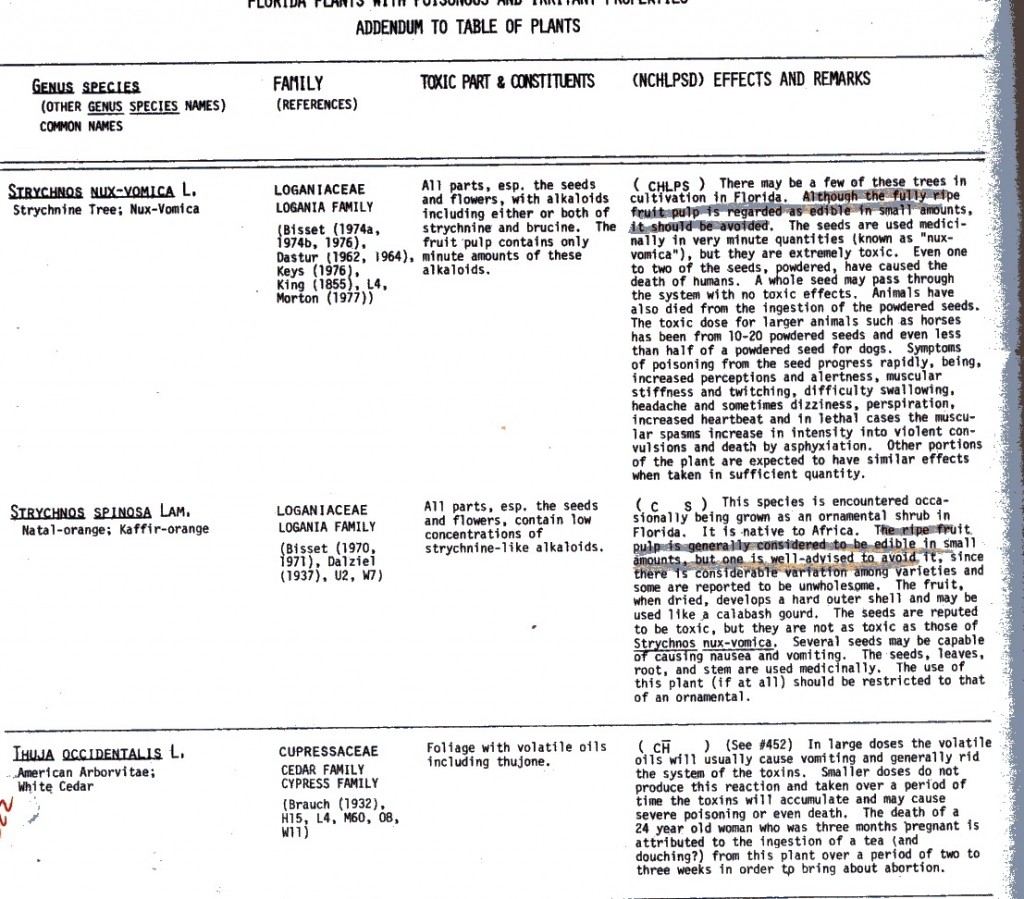
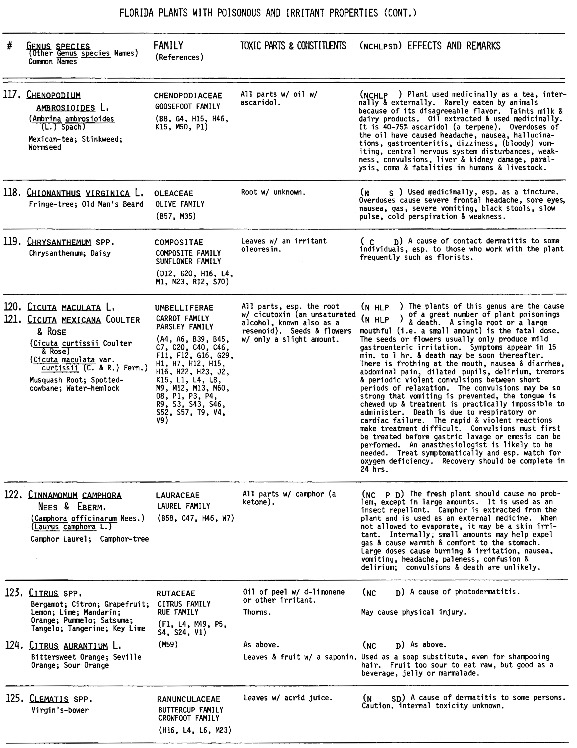
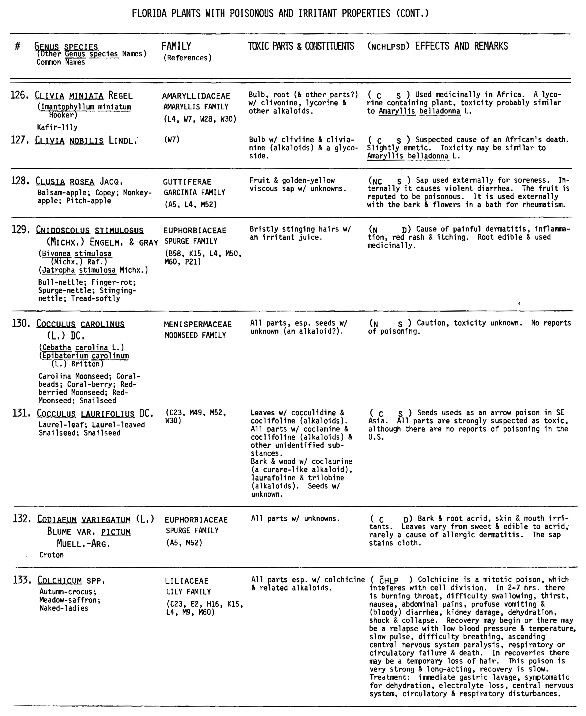
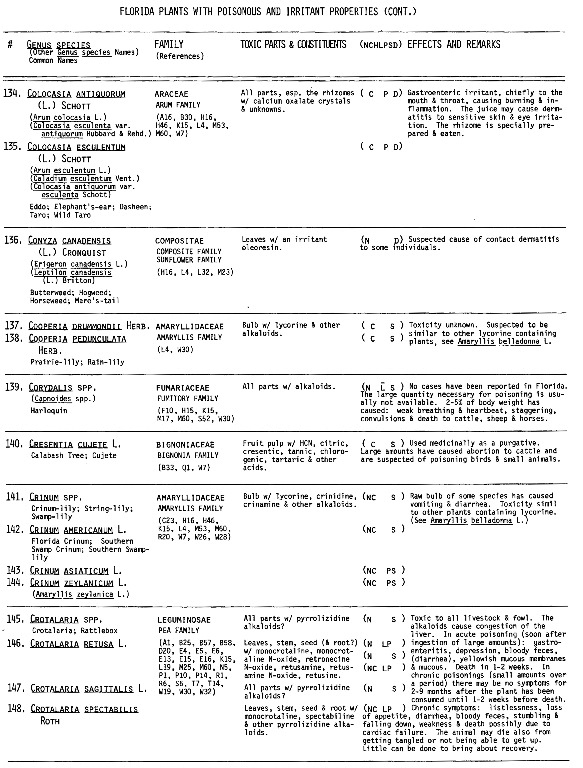
Below is a circular published by the state of Florida in 1978. I think it is no longer in print though I have a hard copy. It is reproduced below. Visual quality varied on the original typewritten copy. There is no intent to violate copyright but just to provide information written before the Internet to the Internet. I have moved the index to the front rather than leaving it at the end. The index is by number not page. There is also a four page addendum at the end which was not indexed in the original so if you don’t find your plant in the index, check there.

Addendum

{ 4 comments }

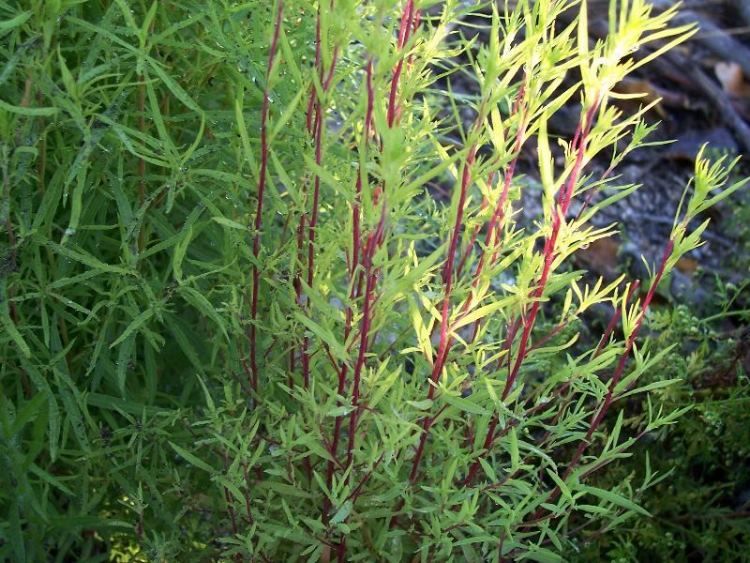
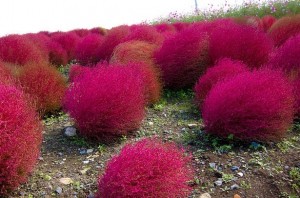
Kochia is related to Lamb's Quarters and Russia Thistle

Bright Ornamental in the Fall

Immigration brought weeds from around the old world to the new world. Quite a few of them came from southern Russia — the grassy steppes — to the prairies of middle America. Among them was Kochia.

Is Kochia a food plant or an ornamental? Most references say it’s an ornamental because of the fiery color it displays in the fall. But isn’t that a modern view with a full belly? It seems more likely that first it was an edible or a dye plant and only after man moved off the farm did it become an ornamental. It’s also part of the Wild West myth.

Black-tailed prairie dog

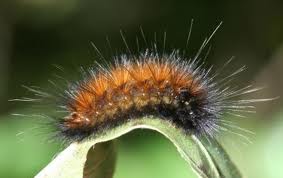
You know the myth, tumbleweeds rolling though deserted dirt streets just before a good-guy-bad-guy shoot out. Didn’t happen. Hollywood notwithstanding the Wild West and tumbleweeds were several decades apart. Indeed, two weeds known as tumbleweeds  — Kochia and the thorny Salsola kali, the Russian Thistle —  came from southern Russia and really didn’t make it into the”Wild West” until around 1900. However, late day Navajo did use Kochia for drought-resistant sheep forage… Yes, Indians raising sheep. Don’t see that in Wild West movies either. Besides the domestic versions wild Prong Horn sheep and deer like the foliage, Black-tailed prairie dogs eat the seeds as do sparrows and presumably other birds. No one has really studied that.  The Diacrisia virginica (Woolly Bear Moth) feeds on the leaves.

Kochia seeds made into Tonburi

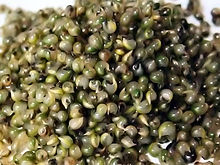
Kochia  leaves and growing tips are edible cooked. The plant is very salty tasting. Seeds are also a garnish called  tonburi with a texture similar to caviar. In fact it is called “land caviar,” “field caviar,” and “mountain caviar.” In Japan tonburi is a delicacy. Seeds are dried, boiled then soaked in cold water for a day. They are rubbed by hand to remove the outer skin. The seeds are a glossy black-green. Plants produce about 15,000 seeds each though three times that is possible. Distribution is by… tumbling.

Like many members of the greater Chenopodium family Kochia, aka fireweed, burning bush and summer cypress, can accumulate nitrates like spinach so if you avoid spinach you should avoid Kochia. Also called Bassia scoparia it is found throughout North America save for Arkansas, Alabama, Georgia, Florida, North Carolina and Maryland. In some states, particularly western states, it is a “noxious” weed, as is the Russian Thistle.

Professor Koch

Kochia (KOH-kee-ah) is named for German Botanist Wilhelm Daniel Joseph Koch, 5 March 1771 – 14 November 1849, professor of medicine and botany. His best known written work was a treatise on German and Swiss flora entitled Synopsis florae germanicae et helveticae (1835-37.) Scoparia (sko-PAIR- ee-uh) is dead Latin for broom-like.

Green Deane’s”Itemized” Plant Profile: Kochia

Woolly Bear

IDENTIFICATION: Kochia scoparia: The young plant forms a small rosette. Mature Kochia grow from 2 to 5 feet (60–150 cm) tall, usually branched from the base (Don’t confuse with Fivehook Bassia which branches along the main stem.)  Leaves are linear to lance shaped, flat, generally gray green, covered with soft hairs (Kochia is less hairy than Fivehook Bassia.) The leaves have smooth edges, and alternate, 1/5 to 2-2/5 inches (5–60 mm) long and from 1/25 to 2/5 of an inch (1–10 mm) wide. Stems are sometimes reddish late in the season.  Seeds are egg shaped, flattened, and roughly 1/25 to 1/12 of an inch (1–2 mm). Plants under cultivation are softer and fuller than wild specimens.

TIME OF YEAR: Blooms July through October. Flower head is a spike forming clusters of inconspicuous, green, petal-less, stalkless flowers that grow in the axils of reduced leaves.

ENVIRONMENT: Roadsides, fields, pastures, disturbed places, new crop fields, ditches, floodplains to 5,000 feet.

METHOD OF PREPARATION: Young leaves and tips cooked, seeds cooked. Protein content ranges from 11 to 22%,  decreasing as the plant matures.

{ 5 comments }

“Green” Perilla

The first Perilla I ever had came from a can, just like the kind sardines snuggle in. The leaves were very spicy and were used that way, as a spice. Later in my garden I grew the plant, which reseeded itself. That’s probably why Perilla is naturalized in the eastern half of North America excluding Vermont, New Hampshire, Maine and Canadian points north and east. Its native land is India.

Green Perilla Leaves

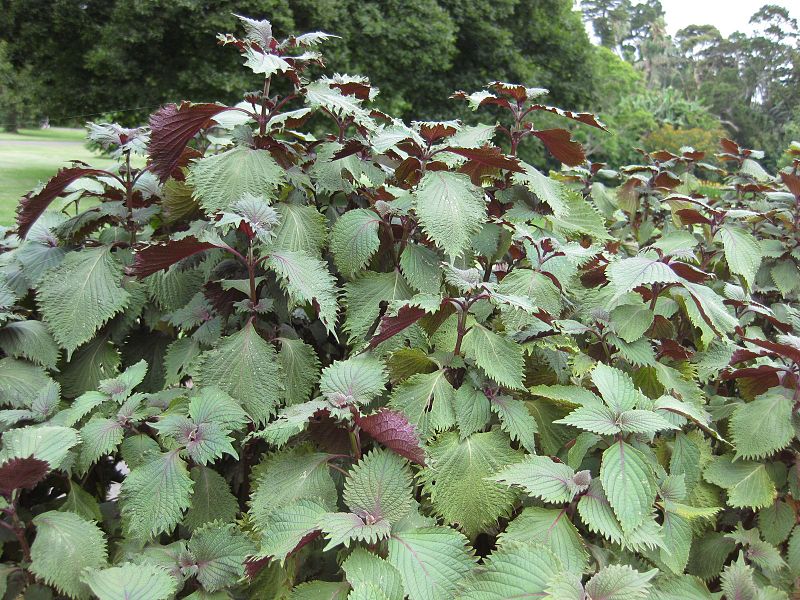
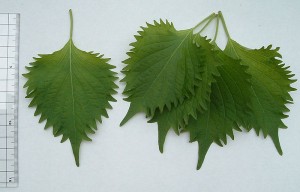
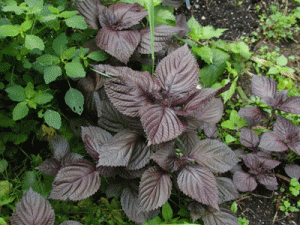
Strictly speaking Perilla is a monotypic genus. (See article on monotypic genus.) There is only one species in the genus, but three are varieties. There are two major forms of cultivated Perilla, green and red though green is the most common escapee I have seen. Those common names are slightly misleading. The “Green” version is green on top of the leaf, and purple below. The “red” version has leaves that are purplish on top and bottom.

Perilla has been used as a salad ingredient, potherb and for its seed oil for literally thousands of years. And while the seed oil is edible  — up to 64% Omega 3 fatty acids — it may not be the best oil to cook with. The oil, similar to unrefined Canola oil, has a chemical that is a potential lung toxin.  The oil also has been used for lamps, which might be a dangerous use regarding potential lung damage. (Unrefined Canolia oil — rape seed oil — was used for cooking in India and a common cause of lung problems.)

According to the Federal Department of Agriculture Perilla has three chemical that are known lung toxin to cattle; egomaketone, isoegomaketone, and perilla ketone, the latter the most abundant and worse. Tests show Perillla ketone also produced pulmonary emphysema in goats, mice and rats. It does horses as well. While humans eat the species with little issue it is best to use any seed oil cold not heated.

In the greater mint family, noses and palettes disagree on what Perilla tastes and smells like, from cinnamon to licorice. I lean towards spicy cinnamon. It has numerous common names, among them Ao Shiso, Beefsteak Plant, Ji Soo, Perilla, Purple Perilla, Shiso, Wild basil, Wild Red Basil, Chinese Basil, Purple Mint, Rattlesnake Weed, Summer Coleus and Perilla Mint. In some individuals the plant can cause dermatitis.

Purple Perilla

Why the genus was called Perilla by the Latin scholar Linnaeus is debatable. It could mean “little bag” referencing the caylex. Despite what Internet “Baby Name” sites say Perilla (per-RILL-ah) is not an American invention, though it was a common girl’s name in the 1800s in the United States. Perilla was the nick name of Caecillia Metella the poetess, and lover of the Ancient Roman poet Ticida, and many others. Ticida (probably Clodius Aesopus) was not political but besides writing poetry he provided supplies to Julius Caesar’s army in 46 BC. Caecillia also seduced several of Julius Caesar’s intimate friends and was involved in much political scandal and intrigue. Soon married and divorced Caecillia was a talented, savvy, good looking party girl who probably wrote erotic poetry and is also called Lesbia in other poems.  We know that Ticida invented the name “Perilla”  for her by using Greek word play on her family name Metella. When she died we do not know. Thus what was a common proper name in the 1800s for girls in America was at its invention used to protect the public identity of a woman who wrote racy erotic poetry and slept around. And perhaps that is why the species is called Perilla, it’s attractive, spicy, and gets around. Frutescens (frew-TESS-enz) means shrubby or bushy.

Green Deane’s “Itemized” Plant Profile: Perilla

IDENTIFICATION: Perilla frutescens: Stems to a yard high, erect, herbaceous, purple, four-angled, a single vertical groove on each side of the stem. Leaves are opposite, petiolate, purple with a very shallow groove. Blades ovate, serrate, acute, to four inches long (10cm) three inches wide (8cm) sometimes crisped (curled or undulated) or not, typically green above and purple-green or entirely purple below, mostly hairless above, hairy on the veins below. Flower spikes growing out of where a leaf stem meets a main stem or at the top end of the plant. Blossoms pink, four stamens, anthers pinkish, fading to purple, two blossoms per node, each with a folded bract. Bracts broadly ovate when unfolded.

TIME OF YEAR: Flowering August to October.

ENVIRONMENT: Gravel bars, rich soils, alluvial soils or dry soils along streams, spring branches, gravel bars, roadsides, railroads.

METHOD OF PREPARATION: Leaves used as a coloring or a spice. Flower spikes in soup or fried. Seeds uses as a spice or a source of edible oil. Sprouts cooked and eaten like a potherb.

{ 27 comments }