Foraging for Beginners

I was asked to write a short piece for a survivalist blog on getting started in foraging:

How are a Musician and a Botanist Alike?

As a professional musician I often meet other musicians who teach at the college level. What you may not know is most of them cannot play something as simple as Happy Birthday without music. Yet there are thousands, perhaps millions of non-degreed musicians who play very well without music, and often at the highest level of performance.

I have read many times that the great Italian tenor Luciano Pavarotti could not read music, and that is quite reasonable. He wanted to be the best lyric tenor of Italian opera, which is a limited amount of music, perhaps just a few dozen well-known tunes. He did not need to play piano or read music to remember thirty or forty songs which were also popular where he grew up.

Like college pianists who can’t play by ear, most of the degreed botanists would starve tomorrow if the grocery stores closed. Most of the people who have foraged and who do forage are not botanists. And like Pavarotti, foragers really only need to learn a few prime edibles in their local area.

What Do I Need To Know?

While there are thousands of wild edibles, in most places there really are only a half a dozen or so species really worth knowing, from a survival point of view.

Indeed, if you can learn six prime food plants and say three medicinal plants you can survive quite well.

You don’t need a degree in botany.

You don’t need to know the Latin names.

You don’t need to know all the plants that are out there.

You only need to learn just a few edibles, a few medicinals, and it also wouldn’t hurt to know if you have any deadly plants nearby, which are usually just a few as well. That may total a dozen plants. You can learn a dozen plants.  With a teacher this can be done in a season. Without a teacher it can still be done, it just takes more time.

Cattails and Blackberries and Hemlocks, Oh My!

To get you started I will list an edible, a medicinal, and a poisonous pair that are found just about everywhere in North America. The edible is the cattail.

The cattail is nearly impossible to misidentify. Tall, strap-like with horizontal roots it grows in water or where it is very damp. It has the famous fuzzy “cattail” on top (you should always look for last year’s cattails to be sure.) Nothing grows more starch per acre than cattails, and you don’t have to tend it. While one can eat various green parts of the plant at different times of the year the root is always full of starch. Roast it to a crisp next to a fire, open, and then pull the starch off the fibers with your teeth, kind of like eating taffy.

The medicinal (and edible) is the blackberry. A cane or a vine with spines and five petaled white blossoms that turn into an aggregate, edible purple/black fruit. The leaves can be dried to make a tasty tea which is also good for various digestive disorders including  diarrhea. That tea can also be a marinade or the leaves used to stuff fish or fowl. Young shoots are edible if peeled and boiled. Indians whipped blackberries and fish eggs together to make a cream-like froth which they then froze and enjoyed.

The poisonous plant is the hemlock and its close relative the water hemlock. (Not the tree.) Large and leafy, they can grow to six feet or so on dry land or in water. The stem is smooth, often splotched with purple, often has vertical ridges. The flower looks like a fireworks explosion as does the seed head. But they both have one prime identifying characteristic: On the surface of the leaf, most of the veins clearly end in the notches between the teeth. In most plants the veins peter out or end at the tips of the teeth. Veins on the hemlocks clearly end between the teeth. They are a poison you should know because they can kill you in two hours. If you get to the hospital within 40 minutes of eating you might survive. The toxicity increases as you go down the plant, the seeds the least, the root the most. According to those who have consumed said, it is supposed to be very tasty raw or cooked (thus remember, taste does NOT indicate edibility.)

You Can Do It!

In every area there are a limited number of prime edibles, a limited number of really useful medicinals, and a limited number of deadly plants. You can learn to identify them, and ignore the rest. You can tell the difference between a horse and a cow, a cow and a buffalo, a dog and a fox, a fox and a cat. You can tell plants apart. You can do it. You don’ t need to learn the whole green world out there or be a botanist. You just need to learn a few “tunes.”

{ 20 comments }

Mole Crickets and Lawns

The name of my website is “Eat The Weeds (and other things too.)” If you wander around the long index — or click on the category “critter cuisine” — you will find other edibles, such as anoles, scorpions, grubs and snails and things like that. To expand choices I have been adding edible insects. No, I am not going to launch into a lecture on how if we ate more insects we could save the world. But…

Those who follow my writing know I do not care for lawns as residential features. They just aren’t green. They’re fine for golf courses and cemeteries, but I think a lawn with every home is a costly affectation. How costly? Let’s look at one little corner of it.

Lawn + Cricket = No Fun

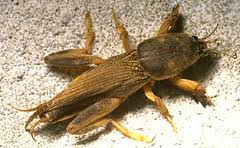
Locally there are three mole crickets, ugly-looking burrowing insects. Two of them arrived here from South American about a century ago and are a disaster to lawns. In fact, we spend hundreds — hundreds — of millions of dollars to get rid of mole crickets, and yes they are edible. In some parts of the world they are close to a protein staple.

If we didn’t have lawns we wouldn’t have a mole cricket problem, we wouldn’t spend hundreds of millions of dollars, and I’d have a few less bugs to eat. In a goodwill gesture I will give up mole crickets if folks give up their lawns. I really just want to point out that the idea that we must have lawns leads to we must fight mole crickets. Getting rid of lawns just isn’t in that thought process, nor is eating mole crickets, nutritious as they are. (See Mole Cricket, Kamaro)

I have a difficult enough time getting people to eat weeds so I’m not even going to try to get folks to eat insects. They are either interested or they are not.  But it does seem to me the money spend on lawns and defending them could be better spent elsewhere.

{ 0 comments }

Dog and Cat

Your pets are off limits, others’ pets are not

Most Westerners would starve than eat their pet, and understandably so. There is a tacit agreement between pets and their owners.  In exchange for putting down their natural defenses the animal accepts your promise not to harm or eat them. There is a function of trust operating. However, the neighbor’s dog who barks all night or cat that uses others’ lawns for a bathroom enjoys no such protection. To many Westerners pets are personal but non-personal pets are free game, so to speak.

Besides the pet issue there is another aspect to eating dogs and cats. Generally animals for consumption are plant eaters: Cattle, Fowl, Lambs, Pigs, Rabbits, various ground and swamp rodents, squirrel, deer even horse (which was on Harvard’s menu until the 80s.) .

Humans usually don’t eat other carnivores

Carnivores, meat eaters, usually are not on the menu. Humans tend to not eat other meat eaters. Humans tend to eat plant eaters. I don’t know why most humans don’t eat meat eaters. It might be an issue of taste or some distant respect to another carnivore.  One common exception is humans eat fish, and most fish live off other fish. Despite that fish is not called meat by some. Many people in many cultures don’t eat certain animals for many reasons. In Colonial America lobster and crab were considered disgusting trash. When I was a kid, mussels were below contempt. Now they are in gourmet markets. Some suggest dogs and cats are one possible answer to world hunger. Others might argue cat should be available in health food stores.  Cat meat is high in protein, low in calories with very little cholesterol and saturated fats. Perhaps it can get the American Heart Association’s stamp of approval.

My introduction to carnivore meat was bear sausage at a very fancy restaurant. Bears are wild and though a distant relative of the dog it fell into the wilderness food realm.  It was spicy, substantial, and quite good.

Euell Gibbons

One time the well-known forager Euell Gibbons and a friend were hunting in Canada. They were still empty-handed after a few days in the wilds and had planned on shooting what meat they would need. Eventually they managed to shoot a bobcat. That evening they roasted the bobcat over a fire, their first meat in several days. Gibbons said his friend said the “bob” part tasted good but the “cat” part didn’t. (Not all agree: Chinese billionaire Long Liyuan loved eating cat. In fact he was murdered on 23 December 2011 when one of his dinner companions poison his cat stew with Gelsemium elegans.) And had Gibbons and his hunting partner been in California they might have been arrested. Henry Arniba, a 38-year old man from Morgan Hill, California, who lived in a trailer with 40 roosters, was arrested on 8 Nov. 2011 when police investigating a report of illegal marijuana growing found the remains of a bobcat on the property. The man said he shot the bobcat because it attacked and ate a few of his roosters. Then he decided to eat the bobcat. It is illegal to kill bobcat in California without a license but not illegal to eat it. No marijuana was found but cockfighting implements were discovered and some methamphetamine. The case was not resolved as of June 2012.

Norwegian explorer Roald Amundsen who was first to the South Pole was known to have eaten sled dogs during his expedition. By eating some of the sled dogs, he was required to carry less human and dog food, lightening his load. He wrote:
“…there is the obvious advantage that dog can be fed on dog. One can reduce one’s pack little by little, slaughtering the feebler ones and feeding the chosen with them. In this way they get fresh meat. Our dogs lived on dog’s flesh and pemmican the whole way, and this enabled them to do splendid work. And if we ourselves wanted a piece of fresh meat we could cut off a delicate little fillet; it tasted to us as good as the best beef. The dogs do not object at all; as long as they get their share they do not mind what part of their comrade’s carcass it comes from. All that was left after one of these canine meals was the teeth of the victim – and if it had been a really hard day, these also disappeared.”
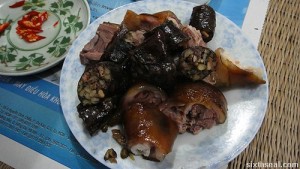
Dog in Vietnam

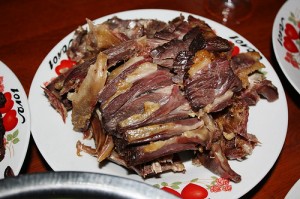
It is also something of an irony that Switzerland, which is well-known for not having a memorable cuisine, is Europe’s center of dog consumption. They eat cat as well, as do the Basque. Not only do the Swiss have many dog recipes but dog jerky and sausage are also esteemed. No word on dog and chocolate together. Dog meat is flavorful and tasty. If overfed, also fatty. Note: In New York and California eating of dog is illegal. On the other hand in some countries there are dogs specifically raised for food.

By the way, like bear liver dog liver is very toxic to humans, and the older the dog the more toxic. Seal and walrus liver is also toxic. What these animals have in common is a liver that stores high amounts of vitamin A. A diet that includes dog liver can be fatal to humans. Antarctic explore Xavier Mertz (c. 1883 – 8 January 1913) is believed to have died from it. As it is not likely to be detected some speculate it has been successfully used as a murder weapon: Death by dog liver.

Walking your dog and woking your cat

When my cats misbehave I tell them that in a roasting pan there is little visual difference between a rabbit and a cat. While cat is on the menu in some South American countries — and the Australian Aboriginals eat them as well — the epicenter of cat cuisine of the world is Guangdong province in China. A media report in 2008 said 10,000 cats per day are eaten in the province which is some 3.65 million cats a year. This is quite different in California where it is illegal to consume them. You do see the difference don’t you? In California it is illegal to kill a wild bobcat but not illegal to eat it. In California it is illegal to eat a domestic cat but not illegal to kill it.  One Jason Louis Wilmert, 36, found that out. He was arrested in February 2012 for preparing cats to eat or eating cats in his home. He plea bargained and got three years probation, community service, and ordered to seek mental health counseling.
Feral Feline

In other states Wilmert’s actions would have been legal. Local law here requires the animal be killed humanely and not be worried…. read you can’t kill a cow with a pack of dogs. In my distant past I was a newspaper journalist for a while and one or two times a year someone would call in and say an ethnic family moved into the neighborhood and all the dogs and cats were being eaten. To which I always had the same reply: It’s not illegal and do you have the address? I’d like to give it a try. If you are so inclined:

Dog Gone

Lemon Grass Dog
•    2 lb dog meat
•    4 three-foot stalks lemongrass
•    3 tbsp Vietnamese fish sauce (nuoc mam)
•    2 tsp lime juice
•    1/2 tsp lime zest
•    Jasmine rice (if desired)
•    Rice vermicelli (if desired)
•    Baguette (if desired)

Try to ensure that it is from a medium-sized dog. The breed does not matter, unless you have certain preferences.  Mince four 3-feet stalks of fresh lemongrass. (Alternatively, use an 8 oz. package of frozen minced lemongrass.) Mix the minced lemongrass with three tablespoons of Vietnamese fish sauce, two teaspoons of lime juice, and a half teaspoon of lime zest. A recommended brand is Three Crabs Brand, but all in all, fish sauce tends to taste the same. Chop the dog meat into 1-inch pieces. Add the lemongrass marinade and stir. Leave the mixture refrigerated overnight. Either sauté, steam, or grill the meat. A recommended way to cook this dish is to skewer the meat chunks and roast it in a rotisserie oven.

Cat Braisé
•    1 cat cut in serving-sized pieces dusted in flour with salt and pepper
•    1/4 c. extra virgin olive oil
•    6 artichokes
•    2 1/4″ thick slices of slab bacon, diced
•    1 small sweet onion, diced
•    4 cloves garlic, minced
•    1 carrot, diced
•    1 lemon
•    3 small tomatoes, peeled, seeded, and diced
•    1/2 c. dry white wine
•    2-4 c. homemade chicken broth
•    garni of 4 flat parsley stems, 6 leafy thyme branches, 1 bay leaf tied up with kitchen twine Salt and pepper
•    1/4 c chopped flat-leaf parsley (optional)

Snap the leaves off the artichokes until only the tender inner leaves remain. Snap off the stem. Trim the remaining green bits from the bottom of the artichoke, and cut off the inner leaves in a bunch at the point where they are very tender. Pare the tough green outer layer off the remaining stem, pairing the stem into a point. Now cut the artichoke bottom into quarters and remove the choke with a sharp knife from each quarter. Rinse to remove any traces of foin (“hay”) and drop them into a bowl of water acidulated with the juice of half a lemon.

Heat two tablespoons olive oil in a large heavy casserole or Dutch oven. Dredge the cat pieces in seasoned flour, shaking off excess. Brown over medium heat, turning regularly, until golden on all sides. Remove cat pieces to a plate and dump any oil remaining in the pan. Add one tablespoon of the remaining oil and the bacon dice.  Sauté until cooked but not “crisp”. Add the remaining tablespoon of oil and the onion and carrot. Saute for five minutes, then add the artichoke quarters and the garlic, stir one minute, and add the tomatoes and the white wine. Turn up the heat and reduce until syrupy, stirring constantly, for about five minutes. Lay the bouquet garni on top of the vegetables. Arrange the cat pieces on top, together with any juice accumulated in the plate.

Pour in enough broth to come halfway up the sides of the cat pieces. Cover and bring to a simmer. Continue to simmer over very low heat about one hour or cook in the oven at 350Fº for the same amount of time. The cat should be just tender and part readily from the bone. Don’t overcook or it will become dry. Check the liquid level frequently and add more broth if necessary. Turn the cat pieces once.

When done, remove the cat pieces to a warm platter and arrange the vegetables, removed with a slotted spoon, around them. Cover and keep warm. Strain the remaining pan juices into a smaller saucepan and reduce over high heat, skimming frequently, until reduced by one third. Pour over the platter and serve immediately. Sprinkle with finely chopped flat-leaf parsley if you like.
Cat Call, or Cat Tales

{ 2 comments }

Who need chips when you have flowers to hold dip?

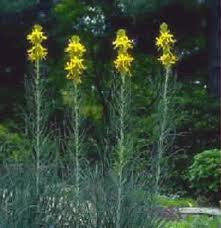
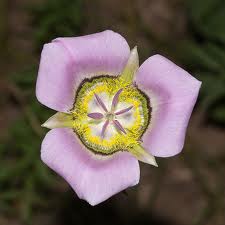
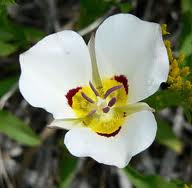
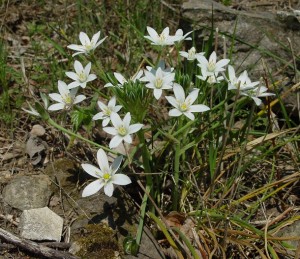
Tulip Tree, Eucalyptus, Melaleuca, King’s Spear, Gunnison Mariposa, Sego Lily, Star of Bethleham, Forest Lily, Guinea Arrowroot, Neem Tree

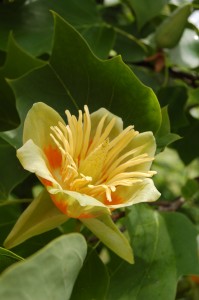
Tulip Tree Blossom

Please ignore the misalignment. I am having wordpress issues they can’t quite seem to sort out.

The blossom of the Tulip Tree, Liriodendron tulipifera, is not edible as far as I know nor would I try it. Other parts of the tree have a heart-stimulating alkaloid that is best avoided. But the flower nectar is drinkable. For just a short time while the tree is blossoming there is a small amount of very sweet nectar in each blossom. It is heavy and honey-flavored. You can drink it directly from the blossom. While early reports say the native made honey from the blossom what they were really doing was collecting nectar. The tree was also called the Sap Poplar, perhaps because its sap is consumable. I don’t know and have not found any reference to said but it wouldn’t surprise me. As a source of nectar the tree also attracts hummingbirds, squirrels and is a host plant for tiger and spicebush swallowtail butterflies.

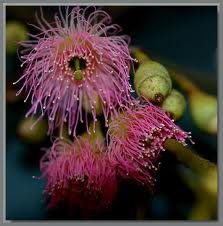
Eucalyptus blossoms

While on the topic of flowers that are not edible but produce a sweet nectar than let’s add the huge family of Eucalyptus. Here in North America Eucalyptus is usually thought of in medicinal terms, some what in the same category as camphor, one of those aromas in your grand- or great grandmother’s house. Where they are native however, Eucalyptus are significant producers of honey, flower nectar, and “manna” sweet dripping directly from the tree or scraped from leaves. Cornucopia II lists no less than 37 Eucalyptus species producing, honey, nectar, manna and in come cases edible bark and seeds. “Eucalyptus” comes from Greek. “Eu” means “well” and “kaleptos” means covered. Well-covered, in reference to the hidden flowers. The base of flowers are sipped on for their nectar. Incidentally in Greek Eucalyptus is pronounced eff-KA-lip-tos. Blame the difference on Dead Latin.

Melaleuca quinquenervia

To compete the trio of sweet flowers that are not edible let’s add the Melaleuca, an invasive nightmare in south Florida. The blossoms and leaves of the M. quinquenervia can be used to make a sweet tea. Usually the tea is made from the leaves and the blossom used to sweeten it. Also called the Paper Bark tree it is used to make temporary huts in the outback as well as containers for cooking food. The Melaleuca  is the number one invasive plant in Florida. It was introduced in the late 1800s but got a huge boost after the turn of the 20th century from one Dr. John Gifford. It consumes huge amounts of precious water, is very prolific, and very difficult to get rid of. On the other hand, like the Eucalyptus it is also a prime producer of honey.

Asphodeline lutea

Like many European wild flowers the King’s Spear, aka Asphodel, Asphodeline lutea, is found in flower gardens around the world. These days it is appreciated for its looks more than its flavor. However, the ancient Greeks and Romans roasted the roots and ate them like potatoes with oil and salt. Sometimes they mashed them with figs. The flowers are also eaten and have a sweet, delicious flavor. It will grow in any soil and under most conditions, except facing north. Very showy, low maintenance, blossoming for about six weeks from May into June. Harvest roots in fall.

Gunnison Mariposa

The blossoms of two Mariposa get over looked because so much of the rest of the plants are edible. First the Gunnison Mariposa, Calochortus gunnisonii. The fresh bulbs are easten raw with salt and taste like a raw potato. Fried or baked they have a crisp nut-like texture. Dried they are pounded into flour for use as porridge or mush. The seeds are ground and eaten. And the flowers and buds are eaten raw in salads or as a trail side nibble. The Gunnison Mariposa is found from Mexico to Canada in states bordering or containing the Rocky Mountains.

Sego Lily

The second mariposa is called the Sego Lily, Calochortus nuttallii, and is not related to the palms or cycads which are spelled Sago. The bulbs of the Sego Lily are excellent raw, fried or boiled. Preferred ways of cooking include steaming them in pits or roasting them over a smoky fire, each method creating special flavors. The seeds are ground into meal and the whole plant can be used as a pot herb. The flowers and flower buds are eaten raw as a trail nibble or in salads. The Sego has a larger range than its kin above, farther east and west.

Star of Bethlehem

The Star of Bethlehem started out in central and southern Europe, North Africa, southeast Asia and presumably Levant. When it came to North America is not known but it escaped. Now it is found in most of North American except the Rocky Mountain states and due north into Canada. Botanically Ornithogalum umbellatum the cooked bulbs are sometime eaten. Raw bulbs have been implicated in animal poisonings.We, however, are more interested in higher up. The flowers are traditionally eaten baked in bread. The unopened inflorescence of a relative, Ornithogalum pyrenaicum, are cooked and served like asparagus. It’s a seasonal food in southwest England around Bath and Bristol.

Veltheimina bracteata

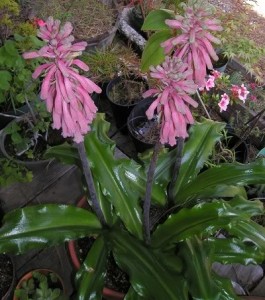
Closely related to some species in Edible Flowers: Part 18 is the Forest Lily, Veltheimina bracteata. A native to Africa it is found in flower gardens in warmer climates around the world.  The species is named for the German patron of botany, August Ferdinand Graf von Veltheim (1741-1801). There are only two species in the genus. The Forest Lily’s inflorescence is a dense raceme of tubular flowers on a long stalk. The color of the flowers vary from pale pink to dusky pink to orange-pink or deep rose pink, occasionally greenish-yellow.  The tips of the flowers are sometimes green or spotted with green. Forest lilies flower during late winter to spring. Each flower-head lasts about a month. They are eaten like spinach.

Guinea Arrowroot

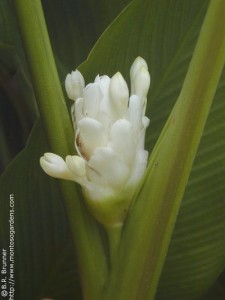
For a plant that has been cultivated for thousands of years Guinea Arrowroot, Calathea allouia, is little known and raised only by subsistence farmers. What they know that few others don’t is that the plant’s crisp tubers taste like sweet corn and rival any gourmet hor d’oeuvres in flavor and texture. The leaves are used like tamales wrapping food to impart flavor. And of interest to us young flower clusters are cooked and eaten. The roots are a traditional Christmas food in the Dominican Republic. The species has been distributed around the world and is found in warm climates. The roots keep their crisp texture even after long cooking. They are usually boiled 15 to 20 minutes. As well as being eaten on its own, they are often an ingredient of salads, mayonnaise and fish dishes.

Neem blossoms are bitter

Neem blossoms are bitter

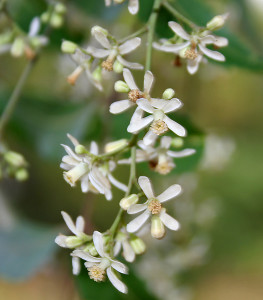
To round out this set of ten flowers let’s end with the Neem Tree. Neem is known for a wide variety of medical uses. There’s hardly any part of the tree that is not employed in some medical use or another. It is also consider a trash tree and a pest in many areas including the Middle East and sub-Saharan Africa. And what few folks know is that the bitter flowers are edible. They are usually eaten with other food as a premeal appetite or a palate stimulant. Botanically the tree is Azadirachta indica, suggesting it’s native to India. In fact, just last week I was given a Neem sapling. It is now happily in the ground. Incidentally, the young leaves are cooked and eaten, the most common way in water buffalo meat salad. Neem honey is prized and the sap is fermented into a local alcoholic drink. If you don’t have your own Neem Tree the leaves and flowers can be bought in Indian markets.

See Edible Flowers: Part Twenty (link not yet active. )

{ 5 comments }

Antikythera Mechanism

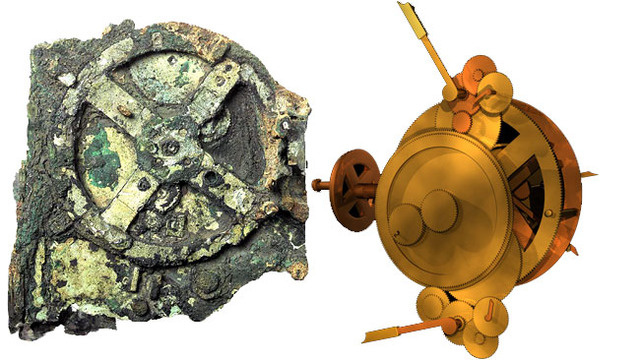
The Antikythera Mechanism is unique, kind of like a monotypic genus plant. In fact, this short article was originally written as the introduction for the page “Only Plant In Its Genus.”  It didn’t quite fit and I also didn’t want to throw it away, thus it is here in a personal blog.

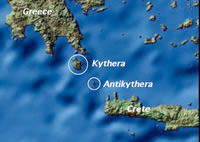
Said “anti-KITH-air-rah” it loosely translates into “Opposite of the Guitar.” Why? Because the nearby large island of Kythera, which has some 3,000 permanent residents, is shaped like a harp. The Greek government want’s to repopulate the island. If you have kids or can have kids they will give you a house and land if you move there.

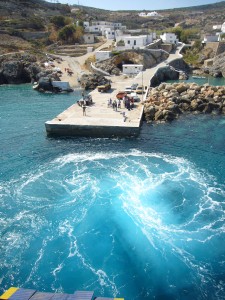
The only port on Antikythera at Potamos. Photo by Green Deane

which is called a “kythera” from which we get the English word “guitar.”  It is also where  some 60,000 Greeks in Australia can claim ancestry. Almost no one claims ancestry from Antikythera which is 23 miles to the southeast. In land mass “Little Kythera”  is about nine square miles and had only 13 permanent residents when I was there. Now it has about four dozen and is the most remote inhabited island in the Mediterranean. Crete is 18 miles to the southeast.  In season the ferry stops  twice a week and literally for only two or three minutes. It’s the nautical equivalent of an airport touch and go. The ferry backs up lowering the rear gang plank. A minute or less is spent off or on loading people and vehicles then the ferry pulls away gang plank still down.

From Gythio in The Mani — the main city on the eastern side of the central peninsula in southern Greece, one can sight navigate to Kythera. From Kythera you can sight navigate to Antikythera. From Antikythera you can sight navigate to the Rodopou Peninsula on Crete. In ancient days it was the main shipping lane. It’s a route still followed by ferries and weekend sailors. The Historian Plutarch said King Kleomenes III of Sparta occupied the island on his way to Egypt after his defeat in Sellasia in 222 BC. He also tells us a faithful follower of Kleomenes, Thirykion, committed suicide there because as a Spartan he could not bear the shame of retreating. In the 1800s most of the island’s inhabitants were Greeks from Crete or southern Peloponnesos escaping murderous Turks. Following the Greek Civil war (immediately after WWII) exiled politicians were sent to Antikytheria as a form of “island arrest” until 1964.

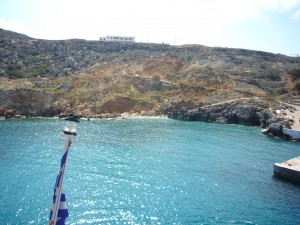
Tiny Antikythera has three claims to fame: 1) On 11 August 1903,  an 8.3 earthquake raised part of the island 20 feet, a riff easily seen today (the grassy area in the photo lower right.)  That means in the picture to the upper left the harbor used to extended inland to beyond all the nearby buildings.  In retrospect it is probably better for an island to go up 20 feet than go down 20 feet.  2) The island was the home base of fort-building pirates for several hundred years before and after 0 AD. They anchored in the protective harbor the rising island eliminated. And 3) the Antikythera Mechanism, the world’s first mechanical computer.

Visible effect of the earthquake on Little Kythera

Made around 1500 BC to predict astronomical events the Antikythera Mechanism was 1,500 years ahead of its time, or, everyone else was 1,500 years behind the times.  The mechanism was found by sponge divers a century ago. Were the pirates involved? The time period is right. Was the mechanism lost plunder? Did it sink unknown to the pirates? What was it doing there? Was it from the mainland heading towards points south and east, or,  from the Middle East heading towards points north and west? Was technology set back 1,500 years? Since we know know it had at least one dial to track the Olympics — every four years — we know it was at least used by Greeks if not made by them.

One can sight navigate from Crete to the Greek mainland.

One can sight navigate from Crete to the Greek mainland.

Consider these islands 1,500 years ago or even today. The vegetation was sparse, and still is, mostly scrub for goats plus a few spices, thyme, marjoram, oregano, capers. Other edibles included some thistles, wild onions, and a few greens. Most food came from the sea, or robbing, the main occupation. Most of these islands have no springs. Life was harsh. Was the mechanism overlooked for a clay pot of olives, or wine? We’ll never know.

On Cyprus, a few hundred miles to the east, less than five dozens plants are used for food, including several spices. Even soil is hard to come by. In my grandfather’s village of Karea in The Mani (south of Sparta) soil is brought in to create elevated gardens on slabs of bare rock. The land is basically crushed boulders and gravel. Foraging was, and still is a way of life there. But one has to scrounge to find enough to eat. Even in the best of seasons it is like a rocky desert and one reason why the area was never occupied by the Turks or the WWII Germans.

To videos about the Mechanism go click here and here. 

{ 2 comments }