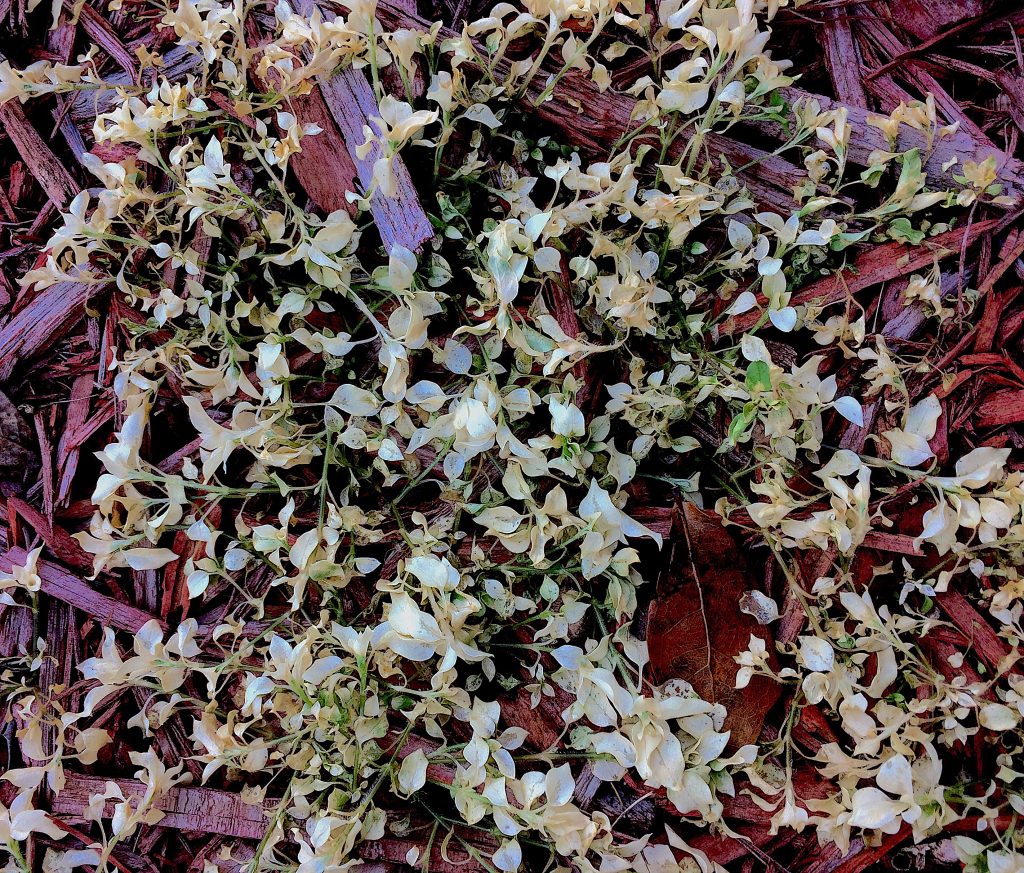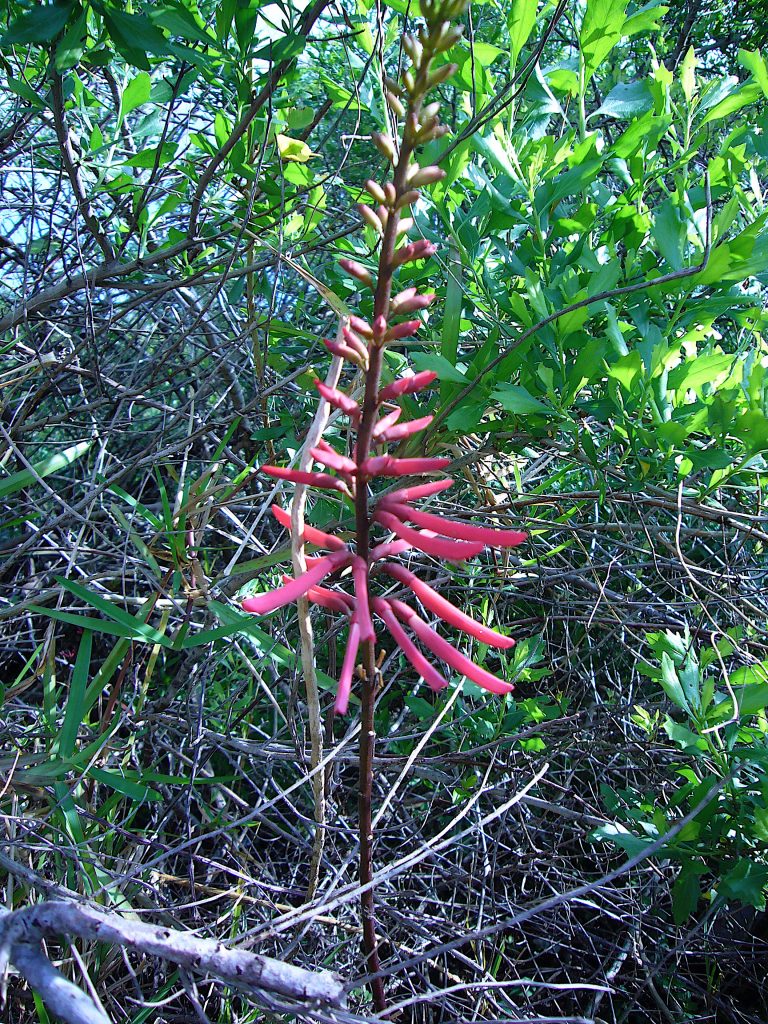
The Eastern Coral Bean is easy to spot this time of year. Photo by Green Deane

Erythrina herbacea: Part Edible, Part Not
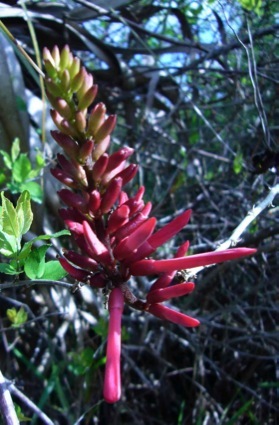
Eastern Coral Bean in blossom

The (eastern) Coral Bean is one of those damned if you do, and damned if you don’t kind of species.  Parts of it are edible, parts of it are toxic, narcotic and hallucinogenic. So there is a trade off: Very easy to identify, but harvest carefully.

The boiled flowers and young leaves are edible, cooked like string beans but in more water.  This semi-toxic plant is also quite healthy. A Japanese study published in the Journal of Natural Medicines, 29 Jan 2008, confirmed five antioxidants in the coral bean flower and found a sixth antioxidant. I boil mine for 15 minutes in plenty of water. They turn green and limp when cooked and reduce in size so collect a lot. The flavor is mild, like young spinach.

Coral Bean is a plant of the old South and into Mexico. But, it can grow not only across the southern tier of the United States but up the east coast to Maryland and up the west coast to Washington state. Out hiking it is always very easy to spot though in the wild it is rarely more than a spindly bush. However most people know the coral bean as a landscape plant and under cultivation and ideal conditions can reach 25 feet.
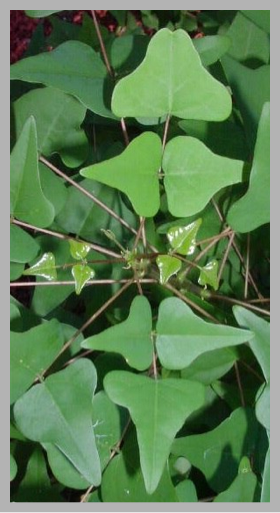
Cooked young leaves edible, but poor fare

It is one of those odd thing in the plant world that people interested in plants tend to view them three basic ways. One is the agriculturist who views them as a commodity.  There are those like foragers who tend to land on the nature side of things. They want to know where does it grow and can it be eaten. Then there are those who view plants like artistic elements to be put in a living canvas, the landscaped garden. I have a close friend like that. His property is as disciplined as mine is feral. He knows probably not a botanical name, nor which leaf he can eat, yet he’s a good husband of his plants and his yard a thing of beauty.  He works very hard at it.

A coal bean to him would be a bit of color, and color over time because a landscaped garden is an interplay of plants as the season progresses. To an agriculturist the coral bean is a source of costly contamination, especially the seeds. It is a weed, weeds cost money and they are thus called noxious and must be dealt with as some enemy. To me it is something to add to the herb pot if it is shy on content. And I suppose there is a fourth group that includes most people. They ignore plants even though their lives depend on them.
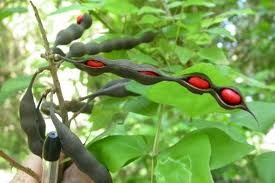
The seeds are toxic, do not eat

The coral bean is an interesting plant for many reasons, one of which is that it always turns it leaves towards the sun. Each petiole has three uterine-shaped leaves, two on short stems but all three stems have the ability to turn the leaf. And you will notice unlike most trees and more like an herb, the smaller leaves are in the middle. Those are the edible young leaves, and of course, the red blossoms, both cooked. The seeds are NOT edible. They have been used for beads, however, and played an important religious role for the Aztecs in auguring the future. In tiny amounts the seeds are said to be hallucinogenic.

As for the toxin, it is not great according to the data base of the state of North Carolina. It varies from according to age, weight, physical condition and individual susceptibility. Most of the reports involve kids eating the scarlet seeds. In Mexico the seeds are used to poison rats, dogs and fish. It is similar to curare and hypnotic. That the flowers and leaves are edible is confirmed by no less august authority than Dr. Julia Morton, who for most of her life was the final say on toxic plants in warm climates, such as Florida. In fact, she is one of the experts that authored the edible plant portion of the U.S. military’s survival guide. I like the flowers. Boiled they are a mild in flavor.

The flowers of the Erythrina flabelliformis (fla-bel-ih-FOR-miss, fan shaped) are  reported as edible — very favored in Mexico — but I have not tried them.

As for the botanical name of the coral bean, Erythrina herbacea (air-rith-RYE-nuh hur-BAY-see-uh) …There are about 112 species in the genus Erythrina, which comes from the Greek word ερυθρος which means red.  The species name, herbacea in Latin means “grass, low growing, not woody.” It was named that because this particular plant is more herbaceous than others in the genus.  Many of the plants in the genus are well-known and used in the tropics and subtropics as street and park trees. Some are used as shade trees for coffee or cacao and can grow to a hundred feet high. In most of its range in the United State the Coral Bean is a bush. The common name might come from the fact the flowers are shaped like a form of red coral. It is also called the Cherokee Bean, who used a decoction of the root for various purposes including kidney and urinary blockage.

Besides brilliant color the Coral Bean’s second claim to fame is that it’s fast food for humming birds. They were made for each other and one of the quickest way to get hummers to your yard is to grow a Coral Bean, just keep the seeds away from the kids. Humming birds, by the way, follow routes, kind of like air corridors called traplinings, (for next time you’re playing scrabble….

Other known edibles in the genus include E. americana, E. berteroana, E. fusca, E. rubrinervia, and E. veriegata.

Green Deane’s “Itemized” Plant Profile

IDENTIFICATION: Bush, three to sixteen feet,compound, uterine-shaped leaves lost in winter in cooler areas, kept in warm areas, herbaceous, bushy, can survive a lot of trimming. Stems have small, curves prickles, as do leaves. Flowers on leafless spikes  in early to early summer depending upon the latitude, young leaves throughout the growing season. Easily blooms in February in Florida. Occasionally blossoms in fall. In dry areas can keep blossoms after leaves have fallen

TIME OF YEAR: Broken shade, sandy woods, hardwood hammocks,  dry coastal tidewater  areas, roadsides

ENVIRONMENT: Usually an understory plant among other bushes. But I’ve also seen it grow in full sun. Become less common due to destruction of habitat.

METHOD OF PREPARATION: Boil young leaves and blossoms in ample water. Whether the blossoms are edible raw is a bit of a debate with one authority quoting another in a questionable reference saying yes. Be safe and don’t eat them raw. I know one can be eaten raw but beyound that I do know know. Besides containing harmful alkaloids, they contain antioxidants. Flowers turn mushy while cooking and loose their red color.
{ 29 comments }
Fireweed has a taste you will either like or definitely dislike. Photo by Green Deane.

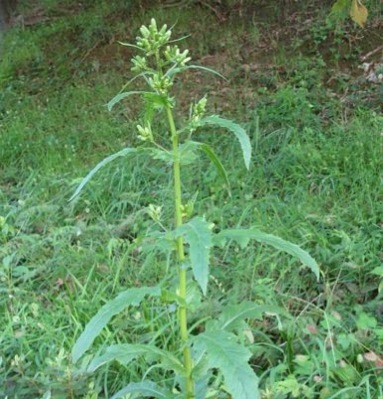
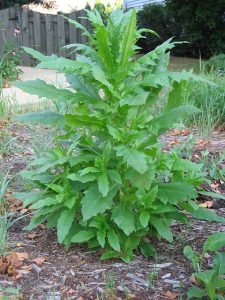
Erechtites hieraciifolia: Edible Pile Driver

Art Gallery Pension, Athens, Greece. Photo by Green Deane

When I go to Greece I always stay a few days in Athens to get used to the time change and visit in-town relatives (as opposed to out-of-town relatives.) I stay at the same little hotel — the Art Gallery Pension — on Erekthion Street. It’s a few hundred feet due south of the Acropolis and the Erechtheon, a shrine also atop the Acropolis (or Acropoli as the Greeks say.)  I also stay at the same pension a month or so later when I am ready to leave, to enjoy the Plaka night life after I’ve adjusted to the time change and to visit in-town relatives again. So when I see Fireweed’s scientific name, Erechtites hieraciifolia, though half a world away I am reminded that even after some two and a half millennia the language of the past is still with us, particularly with Greek in botany. More on that later.

Erechtheion, or in Greek Ἐρέχθειον

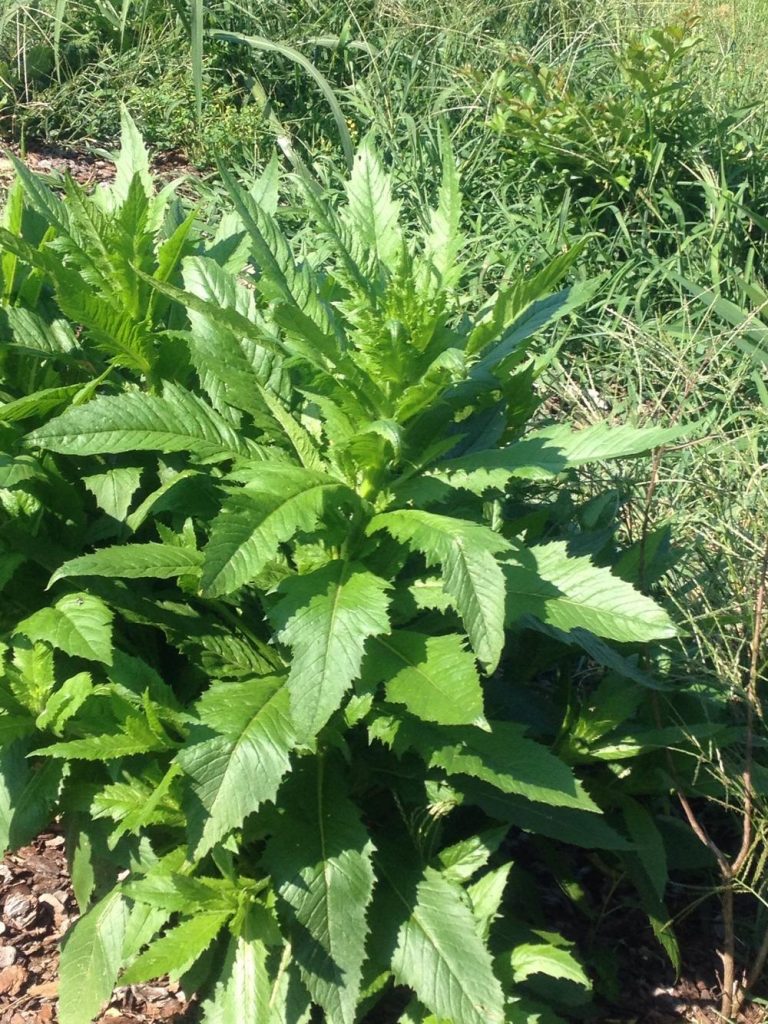
Opinions vary greatly on the Fireweed. Horrible, a choice edible, or toxic? Widely used in the past and the present in Asia this is not a dainty-flavored plant. While young leaves can be eaten raw and older ones cooked Native Americans did not use it for food but rather medicine. This might give us pause to be cautious. A 1939 study found the plant has pyrrolidines. That’s a group of chemicals that can damage your liver, permanently. Usually species with pyrrolidines are not eaten. Yet this plant has a history of consumption.

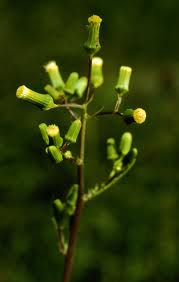
Fireweed (Erechtites hieracifolia) Photo by Green Deane

Merritt Lyndon Fernald, of Gray’s Manual of Botany and also co-author of Edible Wild Plants of Eastern North America, wrote twenty years after the above study: “There is no reason, except the odor, that prevents us from using it.” Dick Deuerling, author of Florida’s Incredible Wild Edibles, told me personally he only ate tasty wild foods and that did not include the E. hieracifolia, though he included it in his book.  Dr. James A. Duke author of the Handbook of Edible Weeds and a second book, Medicinal Plants, said he could not improve on the comments of Troy Peterson, author of A Field Guide to Edible Wild Plants who said of the E. hieraciifolia: “The strong flavor suggests this is an acquired taste.” Duke recommends we don’t eat it.

Fireweed, famine food or goumet delight?

Fireweed, famine food or goumet delight? Photo by Green Deane

That said I have a good friend who enjoys the flavor immensely, raw or cooked.  Here’s what one reader — below –had to say about it: “I’m honestly perplexed with regards to the culinary reputation of this plant. Every chef I’ve shown this plant to so far has been really impressed, in a good way. The distinct perfume and flavor goes amazingly well in multiple preparations. I did cold blanched greens Korean style with sesame oil and soy sauce, brown rice steamed with chopped fireweed and shiso, and a quick chutney pickle of peeled fireweed stems and leaf tips, poor man’s pepper, nasturtium leaves, chopped apples, cucumber and coriander. I also used it as a soup base with lamb’s quarter and nettle. One vegetarian cold soup with raw goat buttermilk and the cooked wild greens puree, and one with chicken broth. The blanched greens also went into translucent summer roll wraps with sauteed pickerelweed, plantain seed heads, chanterelles, venison and nasturtium flowers, to be served with the chutney.

Not a single person in the large class (22 students + wildlife center interns and instructors) found the fireweed to be less than delicious prepared by these methods. All of the above dishes vanished like snow on a hot griddle, and I had to go harvest more fireweed after class so there would be any left for my chef buddy to play with at his restaurant. They ate it all.

Identification is 100% certain; this is Erechtites hieraciifolia. Properly prepared, it is delicious, and all of the local professional chefs whom I’ve gotten interested in wildcrafted foods are pretty excited to work with this plant. It’s not at its best raw and unadorned, but a little kitchen tweaking and flavor pairing and it’s suddenly amazing.

All I can say is if other foragers don’t know how to use and appreciate this green, that just leaves more for me and my chef friends!”

E. hieraciifolia has been viewed a famine food as the Caesar Weed (Urena lobata) is a famine food: Nutritious, common, and edible if you can get past this or that. With Caesar Weed it is texture, with E. hieraciifolia it is aroma and flavor though opinions do vary from ugh to delicious. These plants are plentiful in the spring and summer. Tall, rank and in your face, it is hard to misidentify a Fireweed. Foul or not it is as good as any other spring/summer green and is not unheard of in winter either. Perhaps the key is proper preparation. Fernald did not have a lot of chefs giving the green a try.

As to the scientific name, Erechtites hieraciifolia. The latter part, hieraciifolia, is easy: It means “having leaves like the hawkweed,” referring to the Hieracium (which itself means of or pertaining to priests.) But, Erechtites is more involved and botanists tend to not know their Greek. One, for example, will say the genus name may come from Erechtho, to break. Another says it might be for the fable early king of Athens, Erechtheus. Both close but no cigar. They need to read more of the Classics.

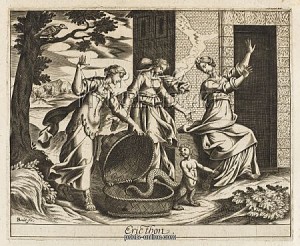
Ericthonius scaring maidens to jump off the Acropolis

The goddess Athena went to the lame blacksmith-god Hephaestrus. He was the tool maker for the gods. She wanted some weapons. (For sake of the story we will set aside why a goddess would need weapons or someone to make them.) Things did not go as she planned. Hephaestrus found her so enticing that he tried to overpower her and take away her virginity. She successfully resisted and he missed his mark, so to speak, leaving a deposit on her thigh. With a scrap piece of wool she wiped it off and threw the wool to the ground. That impregnated the earth, Gaia. Gaia gave birth to a son and took him to Athena who named him Erichthonius. Erextho means trouble and xthon means earth.  The name has come to mean “troubles from the earth” for a troublesome, ruderal weed that pops up after fires.  The transliterated spelling varies greatly. Erechtites was also the name of an ancient groundsel in Greece and was first used to describe a plant in 40-80 CE by Dioscorides (for whom the yam genus is named.)   King Erechtheus, who invented the chariot, was actually an early king of Attica not Athens but the region of Attica included Athens.

Erechtites hieracifolia blossoms. Photo by Green Deane

The plant has many local names as well besides Fireweed: Goat’s Chicory, Burn Weed, Stickers, Sun’s Ribs, Dog Weed and American Burnweed. There is also a second “Fireweed” a tall perennial (Epilobium angustifolium) in the evening-primrose family with spikes of pinkish-purple flowers. It is also edible. Our Fireweed has one other common name: Pilewort. Folks used Oil of Fireweed to externally treat their hemorrhoids. Fireweed puts out the fire.  A poultice of the leaves work well I am told. Fireweed also has some internal uses as well such as treating dysentery.

And I saved this for last. The pronunciation of Erechtites hieraciifolia, is eleven syllables: e-rek-TEE-tez  hee-eh-rak-ee-FO-li-a. I should mention that some folks remember Erechtites by starting with “Eric’s Teeties.” Clearly Greeks like long words. That is why it is easy to tell the difference between an Irish and Greek cemetery. When you drive by the Irish cemetery the stones are all tall and skinny with vertically engraved short names like Sean Ireland. Whereas all the stones in the Greek cemetery are low and long to accommodate Βασιλιος Σταβρος Τσαπατσαρις.

Green Deane’s Itemized Profile

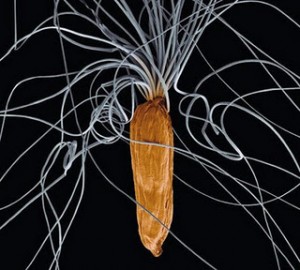
IDENTIFICATION: Erect annual to 80 inches, flower yellow to whitish, 1/3″- 2/3″ inches long; inflorescence flat-topped to elongated clusters of drooping heads, flowers barely open; fruit, a dry seed on a bright white fluffy powder puff. Leaf alternate, lance-shaped, sharply toothed, some times lobed. It has a … ah… distinctive aroma that once you know is unmistakeable.

TIME OF YEAR: Blooms early summer to autumn.

ENVIRONMENT: Dry to wet; open woods, partially disturbed sites, fields, lake shores. Often colonial.

METHOD OF PREPARATION: Tops, leaves, flower buds raw or cooked, including steaming and boiling.

* E. hieracifolia (L.) Raf. PYRROLIZIDINE ALKALOID: hieracifoline. Manske, Can. J. Res., 17B, 8 (1939)

{ 22 comments }

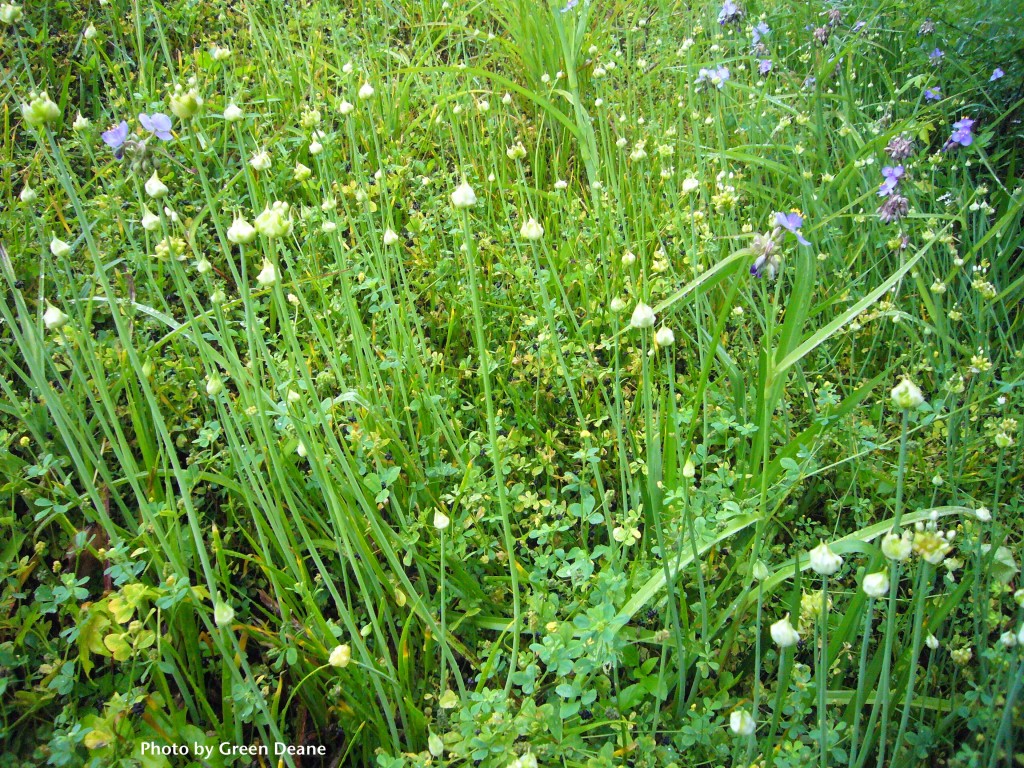
Wild Onions/Garlic and Spiderwort growing along the road near Ocala Florida. Photo by Green Deane

Wild Onions/Garlic and Spiderwort growing along the road near Ocala Florida. Photo by Green Deane

Allium canadense: The Stinking Rose

Your nose will definitely help you confirm that you have found wild onions, Allium canadense, AL-ee-um kan-uh-DEN-see. Also called Wild Garlic and Meadow Garlic by the USDA, walking through a patch raises a familiar aroma which brings me to a foraging maxim:

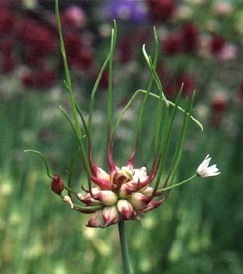
Wild onions/garlic, set bulblets on top

If a plant looks like an onion and smells like an onion you can eat it. If a plant looks like a garlic and smells like a garlic you can eat it. If you do not smell a garlic or an onion odor but you have the right look beware you might have a similar-looking toxic plant. For example, we have a native lily here in Florida that looks like an onion but has no aroma. It is toxic.

All parts of this particular Wild Onion/Garlic are edible, the underground bulbs, the long, thin leaves, the blossoms, and the bulblets on top. The bulblets are small cloves the plant sets where it blossoms. Harvesting them is a little easier than digging for bulbs but those are easy to find also. They’re usually about four inches underground. The bulblets are on the tippy top of the plant. It’s called both an onion and garlic  because while it is a wild onion it has a very strong garlic aroma.

Onions and garlic belong to the Lily family. The most common wild one is the Allium canadense. It has flattened leaves and hollow stems. On top there can be bulblets with pinkish white flowers or bulblets with sprouted green tails.  When it sets an underground bulbs they will be no bigger than pearl onions.  (See recipes below the I.T.E.M. panel.) They were clearly on the Native American menu though our local natives didn’t refer to them much.

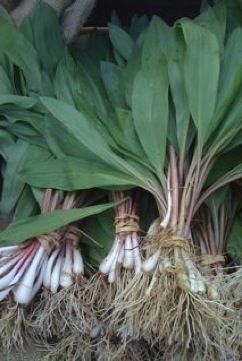
Ramps have wide leaves

It is often said the city of Chicago’s name is from an Indian phrase that means “where the wild onions grow.” That is quite inaccurate. Chicago is actually a French mistransliteration of the Menomini phrase Sikaakwa which literally means “striped skunk.” We would say ‘the striped skunk place.”  The skunks were there because Allium tricoccum (Ramps)  were growing there. Skunks know good food when they smell it (and are bright pets. Very common where I grew up.)  The nearby Des Plains River was called the “Striped Skunk River.” Incidentally because of man’s intervention that river now flows backwards from it original direction.

While northern tribes used the Allium species extensively there are few records of southeastern tribes using them, though various southern tribes had names for the onion.  Some of the tribes considered onions not edible. Ramps, A. tricoccum, (try-KOK-um) photo upper right, are also in the onion family, and very common in Appalachia. Farther north they are called “wild leeks.”  Unlike onions and garlic, ramps have wide leaves but are used the same way.

Allium was the Latin name for the onion. An alternative view is that it is based on the Celtic word “all” meaning pungent. “Alla” in Celtic means feiry. Canadense means of Canada, but refers to north North America. Tricoccum  means three seeds. Roman’s called garlic the “stinking rose.”

Allium canadense in large amounts can be toxic to cattle. Lesser amounts can flavor the milk as can salty fodder near the ocean.

 Green Deane’s “Itemized” Plant Profile: Wild Onion

IDENTIFICATION: Allium canadense: Grass like basal leaves, small six-petaled flowers, odor of onion or garlic, stems round, older stems hollow. Underground bulbs look like small white onions. Ramps, however, have two or three broad, smooth, light green, onion-scented leaves. Also see another article on a European import, the dreaded Garlic Mustard.

TIME OF YEAR: Depends where you live. Ramps in spring, onions through the summer, bulbs in fall. Locally we see bulblets in April then into the spring.

ENVIRONMENT: Like most plants onions like rich soil and sun but can grow in poor soil with adequate water. Leeks like rich leaf-losing woodlands and can grow in dappled shade. Locally all of the Wild Onions I’ve seen grow in damp places, or, places where run off gathers before seeping in.

METHOD OF PREPARATION: The entire plant is edible raw or cooked, in salads, seasoning, green, soup base, pickled. You can pickle them using red bay leaves, peppergrass seeds, and some vinegar

Recipes adapted from “Wild Greens and Salads” by Christopher Nyerges

Onion Soup On The Trail

Two cups onion leaves and bulbs

Two cups water or milk (or from powdered milk)

1/4 cup chia seeds (optional) or grass seed

four bottom end tips of cattails

A Jerusalem artichoke

Two table spoons acorn flour (or other flour)

1.4 cup water

Put chopped onions in 1/4 water and boil for five minutes. Add the rest of the liquid, cattail and Jerusalem artichoke. Cook at low temperature. Do NOT boil. When artichoke is almost done add flour and chia seeds. Mix. Salt and pepper to taste. Serves three.

Camp Salad

One cup onion leaves and bulbs

1/2 cup Poor Man’s Pepper Grass or Mustard leaves

One cup chickweed or other mild green

Two diced tomatoes

Juice of one lemon

Tablespoon of oil

Salt and pepper to taste

Collect onions, dice, add other green items torn into small bits, added tomatoes and other ingredients, toss.


{ 139 comments }

Little Mustards are seasonal like this Hairy Bittercress, Cardamine hirsuta. Photo by Green Deane

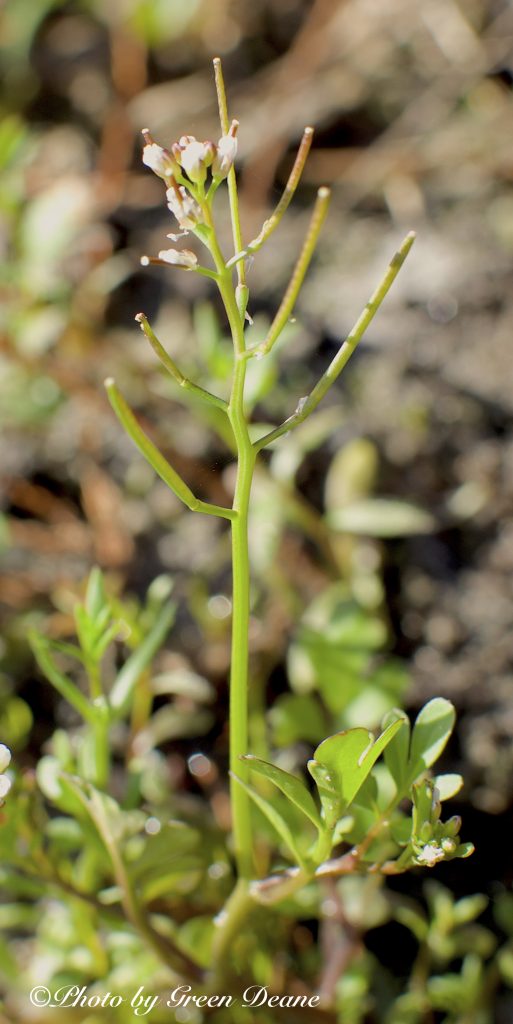
Coronopus, Descurainia, Cardamine, Erucastrum and Sibara

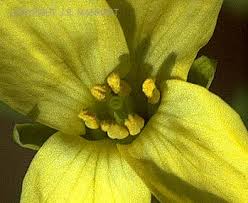
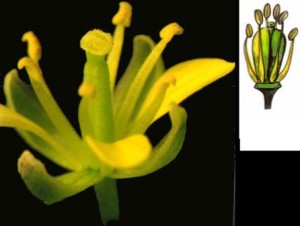
There are numerous little mustards that show up seasonally populating lawns and fields with spots of green against dead winter grass, and then they are gone. Their variety is rich and variations are many. You may never know exactly which one you have. With most, not all, look for the four-petaled flower with six stamen,  four long, two short. Blossom can be yellow, white or pink. The seeds pods can be long like tooth picks or short little hearts or round scales.

This quintet of little mustards shouldn’t be dismissed but they are easy to miss. Their season is usually as short as they are. Locally the little mustards pop up in our cooler months, carpet some areas, and then are gone before one gets around to study or harvest them. There are many of them and variations are seemingly endless, which mean you can easily reach the conclusion you’ve got a little mustard but exactly which one it is will be open to debate. Fortunately, in small amounts at least, there are no toxic mustards. Huge amounts of any mustard, however can upset the human digestive system (and cows, too.)

Swinecress has distinctive seed pods.

Swinecress (Coronopus didymus, koh-RON-oh-puss DID-eh-mus) is called said because pigs like it. Low growing, it’s usually a bright green rosette against the fading grass of cold weather. Locally it is found at the same time and with wild radishes. Flowers are greenish and minute. The entire plant very pungent when crushed. From a consumption point of view it is a trail-side nibble, a salad addition, and if cooked in at least one change of water, a pot herb. How many changes of water depends upon your tastes and how strong a tummy you have. In small amounts it is considered by farmers to be good cattle food but in large amounts toxic because it upsets their cows’ chambered stomachs. So find out how you and it get along before indulging greatly.

Tansy Mustard

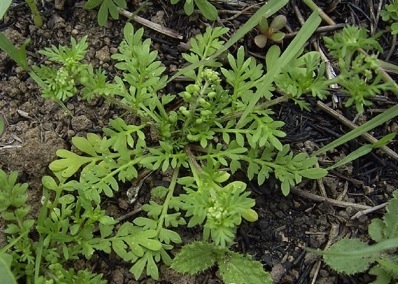
In this particular case, the botanical name is actually helpful. Coronopus is a forced amalgam of two Greek words meaning Raven and foot, or in English “crow foot.” And indeed the three-pointed leaves resemble a three-toed bird foot. Not only does the end of the leave look that way, but the little leaves off the side of the main leaf do as well. Those little leaves alternate, barely. At the end of the leaf they are without stem, near the base of the leaf they have a little bit of stem.

And as is the case quite often, the second part of the name is a bit earthy, though references try to make it politically correct. Didymus is often rendered as Greek for “paired.”  That is not linguistically accurate. While there are many words for “paired” in Greek one of the most common is  ζεύγος, ZEE-ghos which means “yoke” as in a yoke of oxen. In fact the word for spouse is σύζυγος, SEE-zee-ghos.  Got the idea? That is not the kind of pairing didymus means. Strictly said didymus means testes. And indeed the seeds of the Swinecress resemble two little you guessed it. Coronopus didymus. Crow Foot Testes. And you thought botany was sophisticated….

Hairy Bittercress like to grow in damp areas.

Our next little mustard is the Tansy Mustard because it, yep, resembles the tansy. Apparently botanists, when not thinking up dirty names for plants, aren’t too creative.

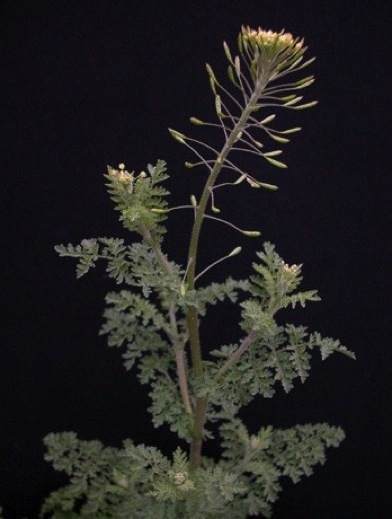
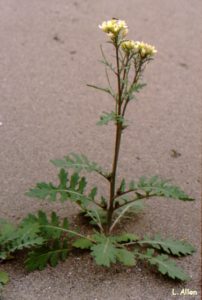
Exactly which Tansy Mustard you have will be a bit of a guess as well. Locally, here in Florida, I seem to find the Western Tansy Mustard. (It is called western so not to confuse it with one growing in Europe which is not called the Eastern Tansy Mustard.) And although I sit on the semi-tropical temperate line the tansy mustard is known as a plant found around the top of the world, not the equator.  There are also a lot of subspecies so you may never know exactly what tansy mustard you have.

Botanically it is Descurainia pinnata, des-koor-RAY-nee-uh pin-NAY-ta.) In this instance, the name doesn’t help much. The first part honors Francois Descourain (1658-1740), a French botanist, physician and pharmacist. The second part, pinnata, means feather-like, or feathery et cetera and this is true in the sense that the leaves are wispy.

Dog Mustard is perhaps the least common of the little mustards.

Perhaps I’m not looking for Tansy Mustard, but it does not seem to me to be as common as other little mustards but it certainly likes the same environment: Think dry pastures.  Six to 20 inches tall or so, fine, delicate, and like the other little mustards a nibble, a salad addition and when cooked to tolerability, a green. Its texture is mealy or hairy… kind of both.

The tansy mustard, also tansymustard, has one to several densely hairy stems, giving it a different texture than most Little Mustards. The basal leaves are divided twice into small segments, very hairy, stem leaves are divided into small segments once, very hairy. The flowers are bright yellow to almost white, fruit stalk long, elongated dark red seeds. If it looks like a tansy but is peppery like a mustard… it just might be the tansy mustard.

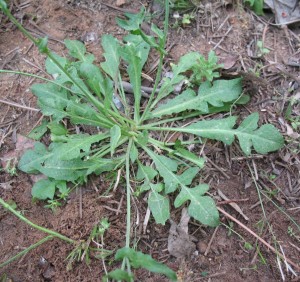
Quite common locally is the Hairy Bittercress, or Cardamine hirsuta, kar-DAM-en-neh her-SOO-tuh. Unlike the Tansy Mustard, it likes to grow where it is damp. In northern climes it germinates in the fall and stays green under the snow. Here in Florida we see it popping up in our winter, which is Christmas to Valentines Day. But it can be found in cooler shady wet spots for perhaps nine month of the year.

Sibara virginica

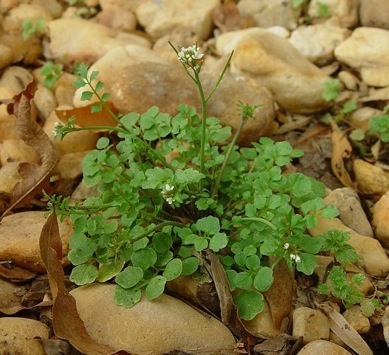
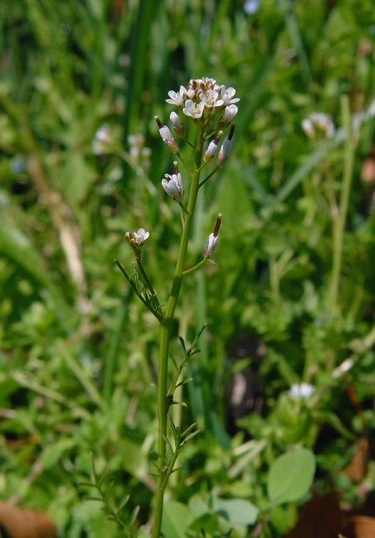
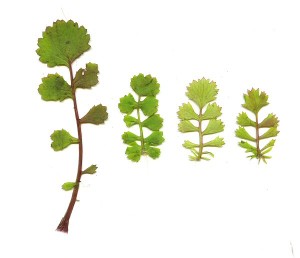
This little mustard is nearly hairless, stems are green or sometimes purplish in strong sun, not hairy, circular, tapering towards both ends, from a tap root. Usually many stems growing from a tap root. Basal leaves, however, have hairy stems. Leaves can be rounded to wedge-shaped, with little hairs, can flower when very small. Each leaf generally contains 4 to 8 leaflets arranged alternately along the leaf stem (rachis.) Seed capsule is 10 times longer than wide. Unlike other little mustards it looks like something one might grow in an herb garden.  Flowers are small, usually a group of them, four white petals, on the ends of wiry stems. The long narrow seed pods (siliques, said sah-LEEKS)  and alternating round leaflets are prime elements of identification. The little siliques tend to grow upright.

Shepherds Purse is another mustard clan of spring.

Shepherds Purse is another mustard clan of spring.

It is also often found in garden centers because of the watering, or in lawns. If you are an organic gardener, aphids love the Hairy Bittercress meaning you can use them as a trap crop. Leaves and flowers – raw or cooked — have a hot cress-like flavor, often used as a garnish or for flavoring. Can be used as a potherb but as with the other little mustards, proceed carefully.

Dog Mustard, also called the Hairy Rocket and French Rocket, is our least common little mustard, and the largest, getting up to a scraggly two feet under optimum conditions.  To my eyes it looks like a ratty wild radish. It was introduced into the US and Canada in the early 1900s and spread along the railroads. It can cross with the rape plant (from which seeds we get canola oil.) This is viewed as good and bad. It can cross on its own and change the plant for the worse or it can be a source of genes should the rape need a shot of new genetics.

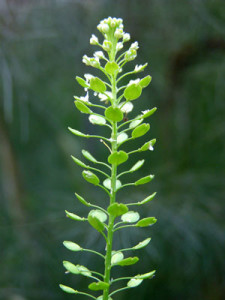
Poor Man's Pepper Grass can be short or tall.

Poor Man’s Pepper Grass can be short or tall.

The Dog Mustard grows upright from a foot to two feet tall, pale yellow to whitish flowers, 4-petals to a half inch wide, petals rounded at on top, narrowing at the base; in a cluster. The seed pod is thin, long, four-angled usually curving up. Lower leaves are oblong, deeply pinnately-divided, end leaflet the longest; stem leaves not clasping, leaves get smaller toward the top. In northern areas it usually begins to blossom in June or so.

Botanically it is known as the Erucastrum gallicum, er-roo-KAS-trum GAL-ee-kum. This time the name tells us little. The first word means resembling the Eruca, which was some ancient plant mentioned by Pliny the Elder. Gallicum means from France.  It is used as a pot herb but may need more than one change of water. Try sparingly.

Mustard Blossoms, regardless of size, have four petals and six stamen, four long two short. Here the short ones are on the sides.

Mustard Blossoms, regardless of size, have four petals and six stamen, four long two short. Here the short ones are on the sides.

Now we get to the mustard that is coming and going. If you think you have a Sibara (SIGH-bar-ah) , you might actually have an Arabis  (ARE-uh-bis or ARE-you-bis.) Arabis means from Arabia (read Eurasia ) and both the genera Arabia and Sibara used to be all Arabias. Then it was decided six species were native to North America, which hardly made them from Eurasia or Arabia. So those Arabis were renamed Sibara, which is Arabis spelled backwards.  Ain’t that almost clever. They are Sibara deserti, Sibara filifolia, Sibara grisea, Sibara rosulata, Sibara viereckii, and Sibara virginica.

This close up shows the female part of the flower in the middle, four tall stamen and two short ones.

This close up shows the female part of the flower in the middle, four tall stamen and two short ones.

This is a winter annual from a rosette of deeply dissected leaves, five to 14 divisions on each side of the main leaf stem. The leaves at the base of the plant are slightly hairy. Leaf segments are narrow, the terminal segment though is somewhat larger, or broader. Flowers are white with four small petals. The fruit (silique) is stalked, long, very narrow with around 15 flat seeds. You can tell it from the Hairy Bittercress above (Cardamine hirsuta) by having larger siliques and narrow leaf segments. The rosette overwinters. It likes disturbed, waste ground, unused fields, and roadsides.

Senecio glabellus often grows the same time as mustards and is toxic. It has a yellow daisy-like blossom.

Senecio glabellus often grows the same time as mustards and is toxic. It has a yellow daisy-like blossom.

Lastly, a common toxic look-alike in the rosette stage is the Senecio glabellus. When dried and fed to rats 20% of their body weight killed them. While the blossom is different than the mustards, the basal rosette can look similar.  S. Glabellus leaves are toothy and mild whereas the mustard leaves are not toothy and are usually  peppery. It has pyrrolizidine which is a chemical that can clog up small veins in your liver causing fluid retention and death.  The Senecio yellow blossom is daisy-ish whereas mustards have a four-petal X or H shape blossom.


{ 16 comments }

Chickweed Thrives in Cooler Weather. Photo by Green Deane

Chickweed Connoisseurs

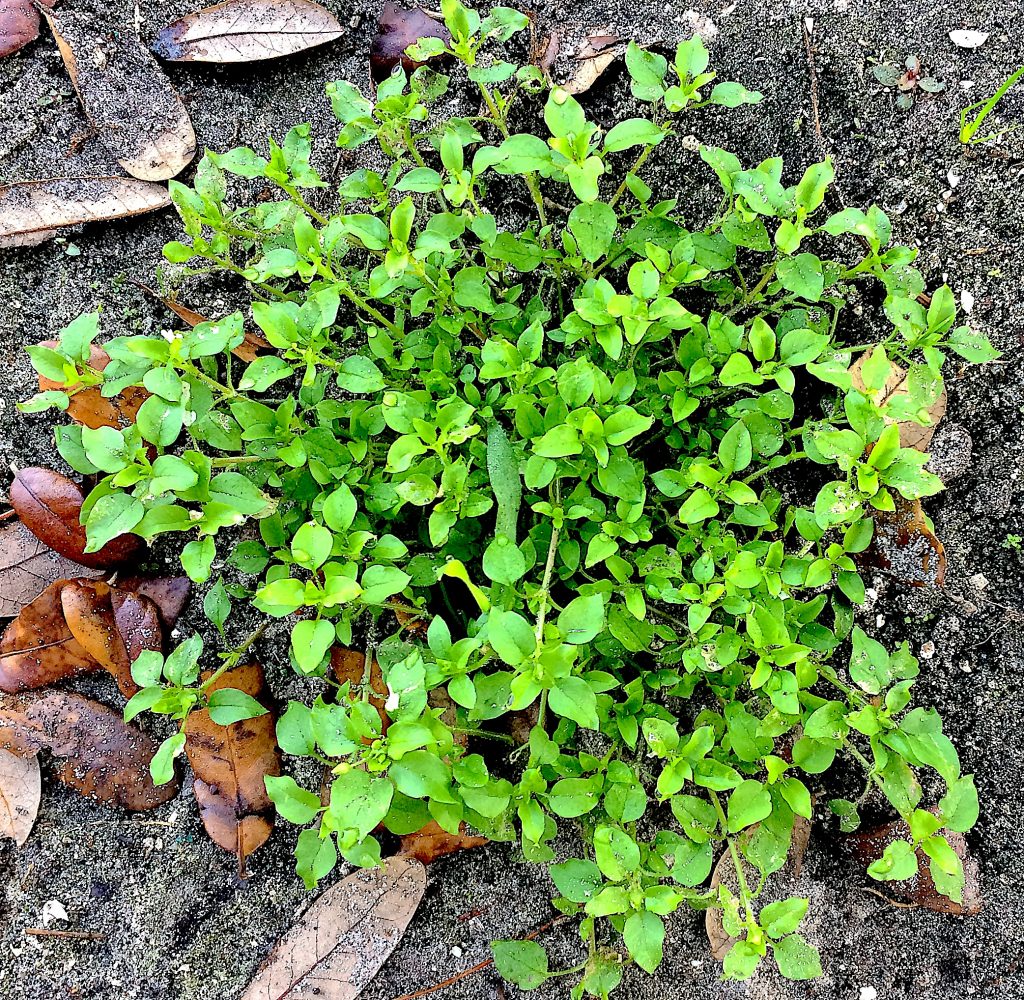
You never know where you’ll find Chickweed but locally you know when: Winter. When I owned a lawn it showed up gloriously every December. (If you live up north, think soon after the snow goes.) 

Chickweed has a stretchy inner core. Photo by Green Deane

Of course, few lawn owners view Chickweed as glorious. Decapitated grass has given chickweed a bad rap.  Instead of lawn lovers pulling out a clump of chickweed and having it for dinner, they spend a lot of green to get rid of the green. Killing chickweed is a million-dollar business which is a large expense and a waste of food.

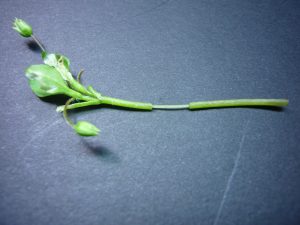
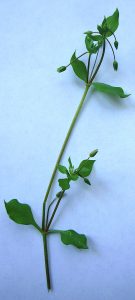
Chickweed has a side-shifting single line of hair down the stem.

Chickweed tastes good and is good for you with ascorbic-acid, beta-carotene, calcium, magnesium, niacin, potassium, riboflavin, selenium, thiamin, zinc, copper, and Gamma-linolenic-acid.  That’s a win win as they used to say. Raw, it tastes exactly like corn silk, if you’ve ever tried that. Cooked it is similar to spinach though the texture is different. It can be added to soups or stews but in the last five minutes to prevent overcooking. Unlike many wild edibles, the chickweed’s stems, leaves, flowers and seeds are all edible. It does hold nitrates and people with allergies to daisies might want to pass it by. Only the Mouse-Ear chickweed should be cooked because of texture issues. The rest of the Chickweeds can be eaten raw but I think they taste better cooked.

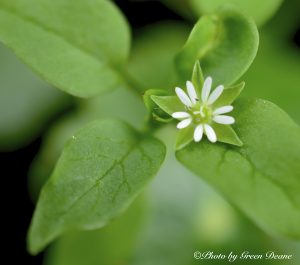
The incised five-petaled blossom looks like ten petals. Photo by Green Deane

The species scientific name is Stellaria media (Stel-LAY-ree-uh MEED-ee-uh which means “little star in the mist.” Probably from Eurasia, it is now found around the world even in the arctic circle and Greenland (as are thistles, mustards, clover, and blackberries.) Chickweed is also a back yard barometer. Its leaves fold up when it’s going to rain. The leaves also fold up at night. Cute. Also, chickweed is not an early riser: The blossoms open late in the morning. And it’s called chickweed because chickens love it. There are some reasonably close look-alikes, but three things separates chickweed from poisonous pretenders. First, it does not have milky sap. Next, it has one line of hairs on its stem that changes sides at each pair of leaves. And if you bend or crease the stem, rotate each end counter with each other, and pull gently the outer part of the stem will separated but the elastic inner part will not and you will have a stretched inner part between the two stem ends. See picture above right.

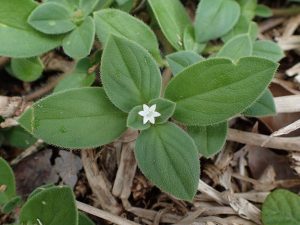
Richardia scabra is mistaken for Chickweed.

If you have chickweed but it doesn’t quite fit the description, look at my article on Drymaria coradata, a Chickweed cousin that shares some characteristicsA second plant that is commonly mistaken for Chickweed is Richardia scabra. That always surprises me as Richarda is rougher and ranker. Folks get thrown off by the species’ blossom. Richardia is generally consider not edible and at least one species will make you throw up, Richardia emetica (also called Richardia brasiliensis.) Can you eat R. scabra? I know some people who have mistakenly done so. They didn’t eat a lot of it but none reported any immediate ill effects.  

Chickweed Bread

2 cups of chopped chickweed leaves and stems.

¼ cup minced onion

2 tablespoons oil

2 tablespoons honey, fruit juice concentrate, or sugar

1 teaspoon salt

3 cups wheat flour

¾ cup warm water

1 packet yeast

Sauté onion and chickweed until tender (not brown). Dissolve honey and yeast into the warm water and then the salt. Mix the yeast mixture with the cooled sautéed chickweed and onions and slowly add the flour until the dough no longer sticks to your fingers Form into a ball and let it rise to twice its volume. Shape into loaves and let rise again. Bake at 375 .F for 40-45 minutes.

 Chickweed And Bacon Pie is best hot; it will keep one to two days in the refrigerator and can be reheated.

One 10-inch pie crust

3 cups chopped chickweed

1 cup diced slab bacon

½ cup finely chopped onion

3 large eggs

1½ cups sour cream

1 tablespoon all-purpose flour

½ teaspoon grated nutmeg

Preheat oven to 325 degrees. Line a 10-inch pie dish with crust and make a raised border around the rim to prevent filling from overflowing during baking.

To prepare chickweed, remove all leaves, twigs and root ends, reserving only the greenest, leafiest parts. Rinse thoroughly in a colander and gently dry with paper towels. Bunch the chickweed together into a ball and chop it with a sharp knife until reduced to a confetti texture. Measure, then put chickweed in a large bowl.

Fry diced bacon in a skillet until it begins to brown, then add onion. Cook about 3 minutes, or until onion wilts. Using a slotted spoon, transfer bacon and onions to bowl with chickweed. Discard drippings from pan.

In a separate bowl, beat eggs until lemon colored, then add sour cream, flour and nutmeg. Add egg mixture to chickweed, onions and bacon. Spread filling evenly in the pie shell and pat down firmly with a spoon. Bake 45 to 50 minutes, or until pie has set in center and top looks golden.

—Adapted from Pennsylvania Dutch Country Cooking by William Woys Weaver (Abbeville Press, 1993).

Green Deane’s “Itemized” Plant Profile

IDENTIFICATION:

Annual herb with slender, smooth stems to about a foot long, one row of tiny hairs growing in a row on one side of the stem, switching to other side at each pair of opposite, oval pointed leaves. Old leaves have stalks, young leaves do not. Flowers, small, white with five petals so deeply notched that they look like ten petals.  Does NOT have milky sap. If you have a plant you think is chickweed and it has milky sap you have the wrong plant.

TIME OF YEAR:

During the cool weather of spring, which in Florida is February.  Dislike heat, germinates in the winter.

ENVIRONMENT:

Likes moist soil and or shady areas.

METHOD OF PREPARATION:

Numerous, usually chopped and boiled or fried, or added raw to salad.  Chickweed can be stringy so it is often  chopped.   Has many herbal uses, too numerous to mention. 

Chickweed in mulch going out of season. Photo by Green Deane


{ 36 comments }