

The lotus is the largest native blossom in North America. Photo by Green Deane
More American than apple pie
Nature fights back.
Much of Florida is giving way to housing. For several years I passed a large abandoned pasture with a dry lake bed. Then it was developed into a subdivision and the lake bottom lowered to accommodate the lower water table. For a while very little seemed to grow in the lake — typical subdivision nudity — and then from shore to shore it was covered with American Lotus, Nelumbo lutea (nay-LUM-bo LOO-tee-uh.) When nature finds the right environment, plants find their way there, or come out of dormancy. Mostly likely the lotus seeds had waited decades to sprout.
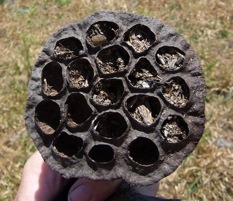
Lotus’ unmistakable seed pod
American Lotus was a main food source for Native Americans and it is basically found east and south of the Rockies plus parts of California. While the root, shoots, flowers and young seeds are edible, it was the root the Indians counted on to get them through the winter. The popularity of the N. lutea no doubt has also led to its many common names: American Lotus, Yellow Water Lotus, Yellow Lotus, Alligator Buttons, Duck Acorns, Water Chinquapin, Yonkapin, Yockernut and Pondnut. Many of those names refers to the plant’s round, dark brown, half-inch seeds. Even its name is about the seed. Nelumbo is Ceylonese and means “sacred bean.” Lutea is Dead Latin for yellow. The species can produce more than 8,000 long-stem yellow flowers per acre and its empty seed pods are often found in flora arrangements. The stamens of the flower can be dried and used to make a fragrant tea and entire dried flowers are used in cooking.
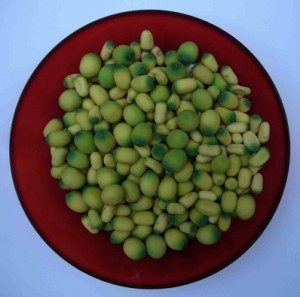
Fresh lotus seeds ready for cooking, photo by Green Deane
N. lutea likes to grow in shallow ponds and along the edges of slow streams with clean water. It propagates from seed or root. The root is banana shaped and thick, sometimes reaching close to a foot long. When cut it resembles a wagon wheel in appearance. Unlike many “water lilies” the N. lutea leaves are round and not split, with the stem attaching to the middle of the leaf. Some leaves are on the water and some above it. The lotus is a favorite water plant among fishermen because unlike other water lilies the lotus does not grab fishing line in the clef. The unopened leaves are edible like spinach and older leaves can be used to wrap food. Stems taste somewhat like beets and are usually peeled before cooking.
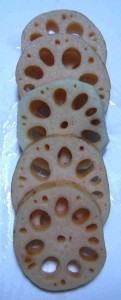
Root is similar to Oriental Lotus root
And while the N. lutea is not a day lily it is a two-day flower, the blossoms open one day, close for one night, open the second day then the petals drop off. The center of the flower grows and gets about three-inches across. It develops a seed pod with around 20 seeds and looks like a shower head. American lotus seeds have bloomed after 200 years, some 400 years, and some in China were viable after 1,200 years. The seeds can also be boiled down and made into a paste. When combined with sugar it is often used in pastries. Lotus seeds range from about a half inch in length and third of an inch wide. The inside of the seed has a hollow canal running end for end with a little sprout inside that is too bitter to eat when seeds are mature. Mature seeds also have a good quantity of oil and can be popped. They can be eaten like peas when young. Boil in ample water 20 minutes, push them out of their shell, salt. They are delicious. I think the plump green seeds when boiled taste similar to chick peas, with a little chestnut or corn flavor tossed in. Very, very tasty. Skinny seeds tend to be bitter. If the cooked sprout in the seed is bitter, don’t eat it, or if that doesn’t upset your stomach, enjoy. I seem to have a tender tummy. Older seeds can be ground in to flour.

Lotus leaves are not split. Photo by Green Deane
There are about 1,475 calories in one pound of lotus flour. Lotus flour is approximately: 72% carbohydrate, 7.8% protein, 0.7% fat, 12.2% fiber, 4.0% water, and 3.3% minerals. Per 100 grams there are 63-68 grams carbohydrate (mostly starch), 17-18 grams of protein, only 1.9-2.5 grams fat; the remainder is water (about 13%), and minerals, mainly sodium, potassium, calcium, and phosphorus. Calories per 100 grams is about 350. It is also a good source of protein, up to 19% with a one ounce serving of dried seeds providing 5 grams. The seeds are low in fiber and not a good source of vitamins but are a good source of oil. Half ripe seeds are delicious raw or cooked, and taste similar to chestnuts.
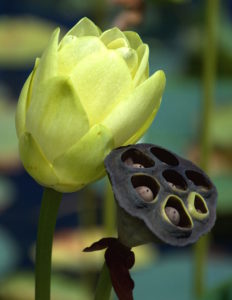
Blossoms stay open for two days. Photo by Green Deane
Lotus root is sweet and can be eaten as raw, sliced stir fried, or stuffed and is similar to sweet potato. Young lotus roots are good for salads while the starchy roots are good for making soups. The root discolors quickly when cut, so treat like an apple or pear as soon as it is peeled and cut up drop it into water with lemon juice or citric acid. It is often left to soak in water to reduce any bitterness. There are only two species of Nelumbo, one in the Americas, yellow, and one in Asia, pink. It is probably second only to the cattail as for usefulness and that is for two reasons. The roots can be buried deep and are best in the fall. Also the entire plant can be bitter so while it is edible raw it is far better cooked.
Culturally the lotus has been cited for thousands of years. It is found in the early art of India, Assyria, Persia, Egypt and Greece. In India it was considered sacred. In ancient Greece the lotus symbolized beauty, eloquence and fertility. Idylls, a poem written by Theocritus of Syracuse between 300-250 B.C., described how maidens wove lotus blossoms into Helen’s hair on the day she married. The Egyptians placed a lotus flower on the genitalia of female mummies.
Lastly, in Japan some people think health-giving juices can be extracted from the lotus by cutting leaves with 12-18 inch stems. They then pierce the top center of the leaf where the stem is on the other side, fill the cupped leaf with wine, and holding it overhead drink the wine through the stem. While it might be a picturesque party ploy I would think the bitter raw sap would take away from the moment.
Stir-Fried Lotus
Two pounds of lotus root, trimmed and peeled
Two tablespoons sesame oil
1.5 tablespoons sugar
1 cup sake (or pale dry sherry)
2 tables spoons dark soy sauce (or regular if you prefer)
1 teaspoon toasted sesame seeds
One small hot pepper of your choice, mine is one chipotle pepper in adobo sauce
Optional: two scallions
Cut the lotus crosswise in quarter-inch slices. Soak in water, change until water runs clear. Dry. Heat sesame oil. Add lotus roots and toss for a minute. Add the rest of the ingredients. Stir continuously until reduce, about 10 minutes. Good hot and warmed up.
Green Deane’s “Itemized” Plant Profile
IDENTIFICATION: Large, showy yellow or pink flowers on long stems, leaves round, some floating, some out of the water, stem attaches to the middle back of the large leaf.
TIME OF YEAR: Roots year round though best in autumn, flowers in late spring or summer in Florida, later in northern climes, June through September.
ENVIRONMENT: Shallow ponds, edges of slow rivers, essentially fresh quiet waters.
METHOD OF PREPARATION: Numerous, all parts of the plant raw or cooked, root, seeds, unopened leaves, and stems. HOWEVER, all parts better seeped in water and cooked to reduce any bitterness. Boiled greens, seeds squeezed out of their shell are especially tasty. Dried flowers for tea or added to soups. Lastly, the wilted leaves — held next to a fire — can be used to wrap food in for cooking.
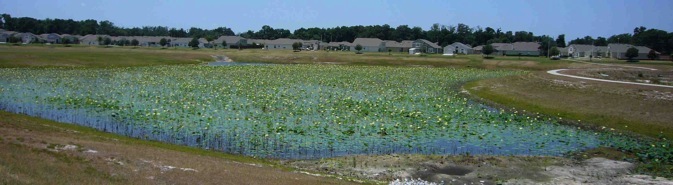
Acres of easy to pick American lotus

You should add information on what ANIMALS eat the american lotus flower. I am doing a school project and I need that info. You have a lot of good information but you should add what types of animals eat the flower. Thanks(:
Good info, but as with all aquatic root plants they tend to concentrate heavy metals (Pb, Zn, Cu, Cd, Hg …) in the root tissues, you can avoid some of that by peeling the tubers, but you always want to be careful of the soil an locations that you grow such plants. The seeds should be fine, but I’d still recommend eating small amounts and not more than a few times a month. Cattails have the same problem, otherwise they would probably be THE flour plant in the US.
You got that right Neale! Lotus grows here in Calif in the delta which is heavily polluted due to boating & lg ships,especially naval, who have no restrictions against dumping wastes.The Chinese say the root is good for the lungs but good luck with Chinese products. For heavy metals,I just swallow a small magnet which removes them. Just kidding. It dosen’t work for lead,etc.
No, but reportedly cilantro and chlorella (broken cell wall) can help remove heavy metals from the human body.
On my list of things to do in this lifetime is to develop systems for harvesting heavy metal accumulator plants, and recovering the metals, thus cleaning the contaminated soils and water, and maybe reducing mining pressure – but moving away from so much heavy metal use would be better.
How?
-Buy quality and keep it for our lifetime, and for our grandchildren’s grandchildren’s use. Our ‘throw-away’ culture is one of the most destructive forces the bio-sphere of this planet has ever seen.
– Buy good used items, as needed.
– Use hand tools whenever possible. Hand powered egg beaters work great & use no electricity, for instance.
-Use milk paint w/earth pigments instead of whatever the ‘home improvement’ stores are selling. For bare wood, seek out real 100% tung oil (not the stuff laced with petroleum distillates sold everywhere). This can also be tinted with earth pigments for decks, wood siding, etc.
-Use slate roofing tiles. This will last ‘forever’. Sure, it may need a small repair now and then, but will not leach cadmium and a slew of other toxins into your rainbarrel, cistern, or the soil around your home. Real ceramic tile is a good choice, too, especially in dry climates. Cedar wood shingles will last as long as asphalt shingles. Yes, really! They are only suitable in humid climates (mostly east of the Mississippi), and should be used on roofs with sufficient pitch. (The new metal roofing can be a good choice, but most have a color coating that contains… heavy metals!)
– Avoid plastics whenever and wherever possible. Plastics are so incredibly toxic – from sourcing & transporting the raw material (petroleum), through manufacture, use, and disposal. More and more is being learned about how readily plastics, even ‘food grade’ plastics, transfer harmful synthetic chemicals to food and liquids. Skin contact w/pastics can expose us to substances our bodies were never designed/evolved to handle, too. And many plastics contain… heavy metals!
– If you care about your children and grandchildren, love them enough to buy them toys made of unpainted wood, natural fiber clothes & bedding (childrens’ clothing and bedding is usually loaded with flame- retardant chemicals). Many natural fibers are naturally flame- retardant, equalling or exceeding the standards for the chemical-laced stuff: wool, alpaca fiber, cashmere, angora, mohair.
Just a few ideas, but every small step in the right direction makes a positive difference!
Thanks for your good advice!
These are all good points. I take spirulina tablets to detox any errant heavy metals i may encounter (like from secondhand smoke) but the source of the spirulina and chlorella is important; most available commercially are from China or another heavily-polluted location. Look for Hawaiian-grown.
The heavy metals present in these wild-collected foods may be high, however, there is no guarantee that any other food that you buy isn’t just as polluted or worse. And, growing wild, these plants (most likely) weren’t exposed to pesticides etc. Just the fact that the land wasn’t used previously for agriculture means that the nutrient levels in the soil, and so the plants, are higher than average. To me the benefits of a meal you can gather yourself, fresh and alive and (relatively ) clean far outweigh the possible downsides. Thanks for a wonderful post!
I read that pill bugs (actually arthropods, not insects), help process heavy metals in soil.
Perhaps, if the metals are there.
Right, so this has absolutely NOTHING to do with the article, but why is the saying “as American as APPLE pie”? I think pumpking pie would be much better. After all, what’s Thanksgiving (a very American holiday) without pumpkin pie? And besides, apples were developed in Asia while pumpkins (as with all squash) were developed in the Americas.
Yes, I know this is incredibly random, but oh well.
There are native members of the apple family in America but I suspect it goes back to Johnny Appleseed and the lve affair Americans had with the apple. Everyone who had any land had an apple orchard to produce cider.
So, I guess the saying should be “as american as apple cider.”
Just a thought on heavy metals in soil. How would timber do to absorb heavy metals, they used as framing it would be dried and encapsulated .
Willows are supposed to be able to accumulate heavy metals in quantities that sicken moose grazing on the bark.
This is great! Can you tell me where I can buy/order fresh lotus pods? Thanks.
Does anyone on the mid north coast of NSW want to grow these? I have plenty and harvest season is coming up.
hello heather,
i’m in northern california and very interested in growing these, have been for years actually. please email me if you can. thanks so much!
Heather, I’m interested in purchasing the fresh pods varying from young to mature. How should I contact you?
i live in a marsh in the southeastern u.s. i can send you all the lotus pods you want at no charge. just reply if interested
Hi, Chris, I am in Raleigh, NC and I am looking for a few lotus seeds to plant for fun. Do you still have some?
hi Chris! I want to plant lotus seeds, please email me. thanks
Hi Chris, I’d be interested in some lotus pods if the offer is still available. Thanks!
Hi Chris I would also like some lotus seeds please thank u
Hi! Chris, if you still have lotus seeds I would love about 5 or 6. Will pay shipping and Handling. I live with a stream in the back of my property with a very high water table. Wanting to plant these in the wet areas. Thanks in advance. Regards,
jackie
Hi again Chris, I forgot to ask you, are these American Lotus? I only want to plant American Lotus that are native to Pa. The Asian variety will be a non native plant and not what I am looking for. thanks again.
Hi Chris, I live in Southeast Mo. and would love to plant some lotus seeds in my pond. I will gladly pay shipping. Please email me. Thanks
Do you still have 3-4 lotus pods available? I’m very much interested in getting some from you. Thank you in advance.
No, but there will be all kinds of seed available soon as the season goes on.
Would be interested in receiving some pods with seeds or just seeds. What color are the lotus?
Hi Chris I would live some lotus plants for my bog garden.
I love in fl do you still have lotus seed pod, I would love to get some, thanks
HI Chris,
This is many years later but if you have any seeds left, I would love to purchase some from you!
Please email me at sailswithgrace@yahoo.com
Thanks!
Can I buy some lotus seeds from you?
Would like to have some lotus to growing a small pond
Hi I’d love to have some if u are still offering
Hi, Chris. This post is so old, buuuuut…..do you still have lotus pods and seeds? Interested in purchasing!
Chris – I have a pond I want to convert to a lotus pond for my wife. I need several seeds that are ready to plant. I would be glad to pay shipping and handling. Thanks. Richard
Hi Chris,
Please let me know how to get lotus seed pods from you. Thank you.
Hi Heather, I would love to have a few of your seeds. Are they wht. or yellow? Please email me and I’ll give you the addy. Thanks!
are these the water plants that give off gas and actually “croak”?
I’ve nerver heard of that… regarding any plant.
Where could I purchase an American lotus? I have a “dirt” pond with large koi in it- would really like to get this established as shade for them.
Hello I am wondering the climate areas that will sustain lotus growth, in North America.
Thanks you
Richard
They grow to the north end of the old south, if not a some more.
Here in Cincinnati, at the south end of the Old North, I’ve seen them growing in a pond on an old estate turned nature center. That was several years ago; I don’t know if they made it through our recent droughts. That’s the only place I’ve them in this area.
I have never heard about heavy metal problems in lotus roots, but I won’t be surprised if that was really the case these days especially with recently reported problem of arsenic in rice. Anyways, you can pretty much use all parts of the lotus plant. Other than the seeds and roots, you can use the leaves to make juice which you can use to cook rice or drink with other fruits and veggies. Dry the leaves and make tea. Also the stalks can be dried and then boiled, and use the stock for any dish. Flowers can be infused with any tea or beverage. There are hundreds of other uses for the entire plant.
This is in answer to Marilyn who wants to get Lotus started in the Koi Pond. She asked this some time ago, and may have found out by now what I am going to say. I wish I had the money back I paid out for water lillies and lotus plants, the koi thought they were being served a salad. Koi are like pigs in the water, they ate the plants, turned over the containers which were heavy. I would only put the plants in a pond with gold fish as they are not big enough to do much damage. I love my Koi though, they are about 2 1/2 feet long now and have many babies. One other thing, Lotus do not like moving water, and to have a good Koi pond you need to have plenty of air pumped into the water for the fish and this creates a lot of water movement.
My mom had Koi ponds with Lotus for years. The Koi will try to rut into the pots, but we put medium sized white river stones on them to keep the mess down to a minimum. Mom’s waterfall and “sprinkler” both aerated the water and as long as we didn’t put the lotus right on top of the waterfall they didn’t seem to mind and the leaf growth seemed to creep closer to the waterfall as the growing season progressed. Not to say these weren’t high maintenance works of art; Twice a year (at the end of the blooming season and about 3 wks before) we had 2 day pond cleaning parties to repot the lotus. Tons of fun though and a great excuse to trap kids and friends into hanging out with the old folks. Lots of hard work, but a lesson for the kids about the beauty that comes from that work. During full bloom it was breathtaking and everyone agreed it was worth the effort.
Is lotus root or the edible seeds grown on a large scale anywhere in the US?
Not that I know of but in some southern states it is considered a pesky native weed clogging waterways.
This is great. I’m surrounded by acres and acres of lotus.
For those of you near southern Illinois there are vast acreages of Lotus blooming right now at Horseshoe Lake near Miller City, Illinois (very close to the Mississippi and north of Cairo) http://dnr.state.il.us/lands/landmgt/parks/r5/horshu.htm
Hi DG. I’m in Wisconsin and was wondering if you could get some fresh Lotus seed Pods and send them to me? I had those as a young girl and deff miss it.
We have a fish pond in the front yard that has white water lillies. Are these edible?
Got a picture? I ask because many plants are called white water Lillies.
In th1970’s I worked summers for my uncl e that sold cattails to florist. In Fall we’d pick lotus pods. Thousa nds of them and ay 15 cents each we paid local kids 50 cents a busbel to pick for us. A couple pickup beds full was worth a few thousand bucks azdllt florist wholesellers all over the midwest from Chicago to Denver, Omaha to Dallas. We delivered or shipped.
Russ would you or anyone you know be willing to harvest these like you did back then? I’d be willing to pay current market price for fresh large green pods and tubers. Please text me at 408-666-3404. Thanks a lot.
I would love to have that Chris send me some lotus seeds. or have some reply as to if he is still sending out seeds. can you, Green Deane, pass on the email address to him thru this post?? thanks.
Interesting. Just don’t harvest near highways in retention ponds and in subdivisions near parking lots where you can pick up contaminants. Same for cattails. I used to see a lot of these in the Chain of Lakes in Central Florida when I lived there.
If you want to see a good example of a “Living Machine” used to purify water and remove metals, etc., go to Audubon’s Corkscrew Swamp near Immokalee, FL, or google “living machine”.
What is the best time to harvest the seeds for plantings? We want to collect the seeds but don’t know the optimal time.Thanks
Although these plants are tasty they actually plug the waterways here in south louisiana. The atchafalaya basin is completely covered.
i’m stay in viet nam, the place plant very much of lotus, but don’t have “American Lotus”. i’m finding the this kind of.
CAN YOU HELP ME BRING IT TO VIET NAM?
Thankful!
Barbara Null- I have read that lotus do warm the area immediately around them by up to 5*F. I mean, within 2 inches of them.
I got an unidentified root for 1/2 price from Van Ness Water Gardens and have been raising them for food for almost 5 years now. I had a power outage in February and lost my stored foods but I had almost 3 gallons of roots stored in the fridge and have about a dozen 17 gallon pots planted – Put in a fertilizer tab every 3 weeks, keep the water topped up, let lose a few mosquito fish in each pot, and when they go dormant in late November haul them out and only replant 1-2. I use Black Kow as a growing medium.
Aloha I live in Hawaii and have a couple lotus and Lily ponds, but they are all pink Lotus flowers~I would lOVE some yellow or white Lotus seeds or pods and also some instructions or a manual suggestion for planting, growing, harvesting the root and then drying, and preparing the root section for food. Also the seeds. Has anyone dehydrated either of these with success?
Mahalos!!!
Look for Sunny Savage in my list of instructors. I am sure she can help and she is in Hawaii (and just released a book about foraging in Hawaii.)
Stunning photograph! The first one. For a second, I thought I was looking at a completely different plant lol. It has a dreamy, floating feeling to it all. Amazing contrast in colors.
When I lived in China, one of my favorite dishes was fried lotus root. As I remember, it was sliced into “steaks,” battered, and deep fried. yummy.
When you were talking about boiling them like peas. You said to boil them for 20 minutes, push them out of their shell, then salt and eat. By shell do you mean the pod or do you mean each individual seed has a shell that should be removed? I am excited to try some of these recipes. Tons of lotus around. Thanks for the article.
Each seed in the nozzle head has a shell of its own.
I have lotus seeds and fresh pods available right now. I have a lotus collection permit issued by the Florida dept. of Agriculture. This permit ensures I am harvesting in a sustainable way. Feel free to contact me for prices and shipping. I have sprouted seeds which I can ship via us mail. I sell 3 sprouted seeds for $10.00 plus $6.00 shipping ( US and Puerto Rico) Namaste !
Mr. O’Connor!
I was wondering if you have any American lotus (Nelumbo lutea) seed for sale, as I know its pretty late in the season and would like to start seed next spring.
I’m in North Carolina and I work for a wetland restoration firm as the nursery head and I know that everyone here would love to see our collection expand to the fantastic N. lutea!
Let me know and thanks again!
Do you still have American lotus seed or plants available? Prefer pink and white? If so please advise price.
Thanks.
Can you tell me how to order from you? I would like to get about 10 to start. I live in IL.
I would like to purchase some lotus seeds, please email me.
Hi Rick,
I’d like to buy some sprouted seeds. These are the native and edible variety?
Please contact me.
Thanks,
Melissa
Hi I am interested in your sprouted seeds and flowers if you know of root and flower vendors?
Thanks
Bridget
Can you just send sprouted seeds to new jersey / mont claire that they arrive till coming we latest?
How to pay you in case?
Regards
Hermann
Looking for info where to purchase american lotus seeds and what the cost of these seeds
hey i came to your website looking for info on western sweetvetch, but found nothing could you point out the article or created one on it? would be appreciated.
Cornucopia II says on page 105 regarding Hedysarum occidentale: “The roots have a sweet, licorice-like flavor and are much eaten in the spring but become woody and lose their juiciness and crispness as the season advances.”
Hello,
1)I am just wondering if all lotus roots of any kind are edible?
2) can you grow the american lotus in zone 9?
3) do lotus grow well in water pond run by circulating water from a small pump.
4) when can you harvest lotus roots? And the season to do so?
5) what is the price for lotus seeds without pre germination to be shipped to california?
Thanks for your time.
I’d like to potting grow some Asian lotus in Oklahoma. Please instruct me how to start it. I’d like to order the supply from you.
Thanks
Peter
Sorry, I don’t sell plants or seeds and the like.
is there an easy bib citation that i can use?
Do you know whether lotus root is being grown as a crop in the United States at all?
I would think so but I don’t really know so.
I got a call from the Fla. Dept of Agriculture this week regarding a post I put on this site several years ago. I’m not upset, the call cleared up the problem. I did and still do have a permit to harvest American Lotus on Lake Toho, in Osceola County Florida. I’m allowed to harvest entire plants, but have been harvesting seeds only because of the difficulty and mess harvesting entire plants presents. I have seeds for sale, both green and fully mature. They are not easy to harvest, and lake Toho is full of alligators, currently grumpy because it’s mating season. If you want some seeds, contact me. I can help you out “legally”.
My permit to harvest American Lotus is valid until May of next year. I got a call from the Florida Department of Agriculture this week regarding a comment from this site and the validity of my permit. You can be assured, it is valid. I am allowed to harvest the entire plant ( American Lotus), but because of the difficulty and mess it creates, I’m harvesting only seeds and some leaves. Please let me know if you want to purchase either, I’m trying to create a “retirement job”.
A permit is required to harvest protected plants. I suspect that in some places the plant is clogging waterways and less of it would be better.
do you have contact information Rick?
Rick,
I would be interested in purchasing some American Lotus seeds from you — mature — for germinating. I have a new pond I want to fill with native water plants. Please e-mail me at jay.lechtman@gmail.com with information and pricing.
Thanks!
Jay Lechtman
Vienna, Virginia
Rick, akre you still selling Lotus seeds?
I would like to purchase dried flowers for tea. Is it possible to get whole dried flowers with the stamens?
Produce distributor in CA. Looking to purchase american fresh green lotus seed pods and tuber stalks in bulk. You must be permitted or licensed in your state to harvest in the wild or have a licensed farm to work with us. All must be verified. Orders will be HTL/FTL, smaller quantities are accepted for individual licensed harvesters. Market prices. Please text or call 408-666-3404. Thank you.
Hello there, I just stumbled on this site today, I realized its been a few years old. But I’m interested in owning a few native American Nelumbo Lutea. Can you still possibly send me tubers to grow? thanks, I’m fr SoCal.
Just a quick warning, I believe blue lotus flowers may cause you to hallucinate or something s uh yeah, be careful. I kinda skimmed through the article so the author might have mentioned that, but just a warning.
I’m in Jersey I sell to the flower district and was getting 5$ a stem picked the day ordered I can get skunk cabbage and mustard
I was suggested this web site by my cousin. I am not sure whether this post is written by him as no one else know such detailed about my problem. You are amazing! Thanks!
No, it was not written by your cousin. I have personally written every article on this website (using university libraries for research.) No internet copy and pase.
Hi there, I want tto subscribe for this webpage to take most
up-to-date updates, thus where can i do it please help.
There is no subscription. I do have a facebook page of the same name.