
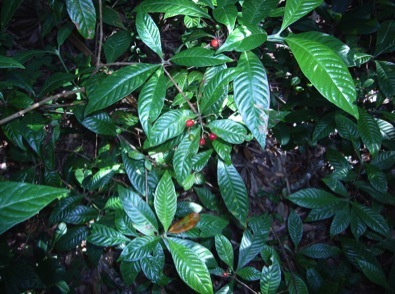
Wild Coffee is usually found on the coast
Psychotria nervosa Florida Style
Because I am constantly asked about it: Yes, you can eat the pulp off the seeds of the wild coffee, and yes, you can make a brew from the seeds. That’s the good news. Now the bad news:
The pulp lacks character. Let’s call it bland with a musty aftertaste, but edible. Some detect a hint of sweetness. As for using the seeds as coffee: Not a good idea but don’t take my words for it. Professor Daniel Austin, author of Florida Ethnobotany, says the brew tastes bad and can leave you with a headache. I would add they also do not have any caffein. If caffein is what you seek, read my article on hollies.
A native of Florida, the wild coffee bush, Psychotria nervosa, (psy-KO-tri-a ner-VO-suh) has red berries from about December to March. It attracts cardinals, mockingbirds, catbirds and spicebush swallowtail butterflies. The attractive plant is easily identified by shiny beautiful evergreen foliage and the bright red berries. Prominent veins give the plant a textured look. You’ll find it on hammocks, barrier islands and in landscaping. Wild coffee likes filtered sunlight and living under cabbage palms and scrub oaks.
While “Wild Coffee” contains no caffein some members of the family are hallucinogenic. The roots can be used like ipecac to induce vomiting. One relative found in warmer climates, Psychotria lingustrifolia, the Bahama Wild Coffee, has edible pulp as well.
It is fairly easy to tell you have a wild coffee plant, but which one is a bit more of a challenge. Psychotria nervosa is an erect, evergreen, branching shrub to 10 feet, smooth to sometimes hairy leaves, sometimes hairy stems. Leaves opposite, simple, no teeth, shiny green above, elliptical to oval, 2.5 to 6 inches long, two inches wide. Flowers white to eight inch, tubular with four or five lobes, stemless clusters, where the upper leaf stems meet the main stem, blossoming usually in spring and summer. Its sessile flower clusters (stemless) is one of two Psychotrias like that, the other is the P. sulzneri but the sulzneri has greenish-white flowers and upper surface of its leaves are dull green/blue and not shiny. It is always hairy. P. lingustrifolia has skinny leaves and long stalked flower clusters. P. punctata has stalked flowers like the lingustrifolia but has dots under leaves.
To recap: If the leaves have dots on the bottom it is a punctata. If it has long-stalked flowers/berries and no dots it is the lingustrifolia. If it has non-shiny leaves it is the sulzneri. If it has shiny leaves, short or stalkless white flowers/red berries and no dots, it is the nervosa. See below for a similar looking non-edible plant.
Psychotria means having medical applications, nervosa means conspicuous veins. Lingustrifolia is tongue like leaves, punctata is dotted, and sulzneri... that’s anyone’s guess but there was a C.F. Sulzner in Miami who was involved with helping the New York Botanical Society about a century ago. P. nervosa also used to be called Suzlner’s Coffee.
Green Deane’s “Itemized” Plant Profile
IDENTIFICATION: Psychotria nervosa is an erect, evergreen, branching shrub to 10 feet, smooth to sometimes hairy leaves, sometimes hair stems. Leaves opposite, simple, no teeth, shiny green above, elliptical to oval, 2.5 to 6 inches long, two inches wide. Flowers white to eight inch, tubular with four or five lobes, stemless clusters, where the upper leaf stems meet the main stem
TIME OF YEAR: Blossoming usually in spring and summer, fruits in winter.
ENVIRONMENT: Shady areas moist and well-drained to moist but not water logged; hammocks, barrier island.
METHOD OF PREPARATION: Flesh of the seed is edible raw, seeds can be roasted and ground for a black drink that may give you a headache.
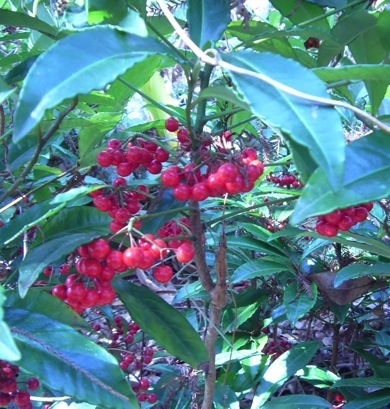
Coralberry’s an invasive from Asia. Note its veins are not as prominent as Wild Coffee and the edges are crenate, resembling blunt teeth.
Don’t confuse the Wild Coffee with the Ardisia crenata, or coralberry. Note the leaves of this ardisia are scalloped, like blunted teeth. The Wild Coffee leaf edges are smooth, also called “entire.” (Kre-NAY-tuh means scalloped.) I have eaten the pulp off one berry and suffered no ill effects that I know of.

I have Ardesia Crenata growing in my yard next to my Lantanas here in Jacksonville. Whenever I’m back there eating the Lantana berries I always grab half a dozen Coralberries and eat the pulp off of them. They have no flavor, but I’ve never been bothered by them…
Hi michael when you get the lantana berries how many of them do you eat at a sitting ? have you ever gotten ill from eating too many. The reason I ask is I have in abundance of lantana plants around my neighborhood and I’ve heard that eating too many can be toxic. Thanks.
I’ve only had a few ripe ones at at time. Morton did not mention amounts.
That’s a dangerous comment to say you eat the fruits of lantana but not identifying the species. The green, unripe fruits of the invasive Lantana camara and L. strigocamara can be fatal if eaten.
yes, the green fruit is not edible. The ripe blue fruit is.
Found tons of these on the Willie Brown trail in Jacksonville today. The taste is pretty neutral and if there is no caffene I will not bother roasting beans to brew. That being said, I actually liked the taste of them.
I talked to my Mom today and she told me when she was little, Willie Brown actually took her and her girl scout troop out on the property to teach them about foraging. When Williw Brown died he gave the land to the state to create a state park and he is burried on the property. Pretty cool.
so if you want to try making a coffee from the seeds you would suggest roasting them first?
Hi, nice article. About 5 years ago no information was online about wild coffee beyond the basics. I’m glad you know someone that tried it. I always wondered about this beautiful plant in connection to the other more well-known and psychoactive psychotrias. In in any case, another topic untouched by this article is the smoking of P. Nervosa’s dried leaves…nearly toxic I would say. Leaves you with a head-buzz that seems dizzying only after one puff. The reason was purely ethnobotanical in the school of Schultes and so forth, but if the berries are edible and non-toxic I wonder what would cause the inhalation of the smoke to be so different, and likewise there may still be the need for a complete assay of the plant’s akaloid contents. Thank you.
Plants are not uniform, chemically. Often different parts have different chemicals. This is why parts of a cashew are edible and parts are poisonous. This is also common of roots which live in a different environment than the rest of the plant.
while Ive always loved this Florida native for it’s beauty and how it attracts a variety of songbirds and butterflies, I would be careful about consuming the berries raw. My dog apparently gorged on a good amount of the ripe berries, and became very ill for an hour or 2. At first she appeared simply exhausted, she had been especially active playing with children that day. I became concerned, after awhile , a closer look an it became apparent she was in some kind of stupor and dehydrated, her normally dark gums were nearly white. I coaxed her to her feet and back outside, and for a moment she was unsteady, then suddenly took off to run wildly for a few minutes, very out of character. She finally drank deeply (water) and started coming out of it. It was only the next day when she relieved herself I saw she had eaten a large amount of ripe , Wild Coffee berries. ( my shrubs are the Pyschotria nervosa species) I have since removed the plants she has access to in the fenced in area. Carol McDonald
I still have difficulty separating the two-Ardisia and Psychotria. My plants readily propogate from seed dropped from the mother plant. Can usually find a mass of young plants together. The root system is “tented” on the mature plants. I am located on St. Simons Island, GA, 50 mil;es from the FL border. Can you help? Thanks
The leaves have different shape and near the coast Psychotria is the more likely candidate.
Wow. Being a coffee roaster, I’m guessing this is not my cup of tea. Is there any way to make this “wild coffee” taste good?
Can the Wild coffee plant (psychotropic nervosa) grow in Northern California along the coast?