
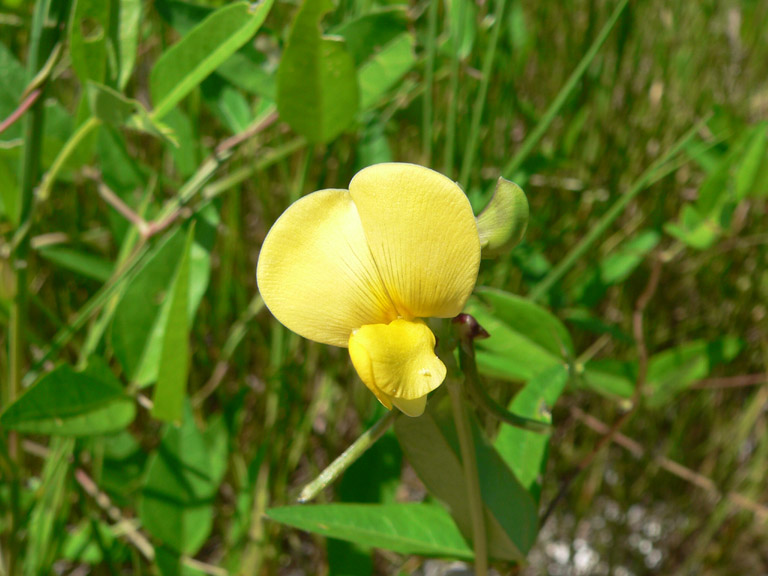
Hairy Cowpea, Vigna Luteola
It’s called a Cowpea but it’s not THAT cowpea, and it has a famous relative that no one calls by its botanical name.
So which Cowpea is it? Vigna luteola (VIG-nah loo-tee-OH-la) a twining vine found from Texas east through the Old South and then north to Pennsylvania. The famous cowpea is Vigna unguiculata, aka Black-Eyed Peas, the traditional New Year’s Day meal of southerners. And the even better-known relative they both have? Vigna radiata, or the Mung Bean. That means, yes ladies and gentlemen, that the Black Eyed Pea is not a pea but a bean, as is our cowpea. Let’s call the Legume de jour by a slightly different name, the Hairy Cowpea (because its pod is slightly hairy.)
Both the Black- Eyed Pea and the Hairy Cowpea are natives of Africa. At one time it was thought the Hairy Cowpea was the ancestor of the Black-Eyed Pea but now they think the “spontaneous” wild Black-Eyed Pea was the ancestor of the cultivated Black-Eyed Pea. Sounds incestuous and confusing. And just how the African Hairy Cowpea got to the Americas, and is also native in the Americas by some accounts, is a bit of a botanical dilemma we need not worry ourselves about. Edibility not origin is our concern.
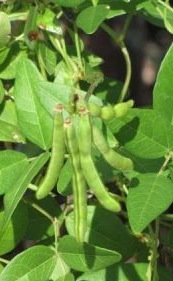
Vigna’s Hairy Pods
An article on the Hairy Cowpea was published in 2004 for PROTAbase, which is Plant Resources of Tropical Africa. It reported what many foragers know: The seeds and flowers are edible cooked. They report the flowers are eaten as a boiled vegetables in Ethiopia and Malawi. I eat them raw as a trail-side nibble. They taste like raw peas or green beans. Also in Malawi children dig up the roots, peel them and chew the roots to extract a sweet juice. Hairy Cowpeas seeds are boiled and eaten. The plant is about 17.5 percent protein and has high amount of the amino acid cystine. It is also good food for livestock. Another relative, the blue-flowered Vigna membranacea has edible leaves. They are eaten after frying or boiling .
The genus is named for Professor Dominico Vigna, a 17th century Italian botanist and director of the botanical garden in Pisa. Luteola means yellowish. There are about 80 species in the genus. The report said nine years ago that the Americas’ Vignas would be moved into a new genus. Don’t hold your breath. It ain’t happened yet.
Green Deane’s “Itemize” Plant Profile: Hairy Cowpea
IDENTIFICATION: Vigna luteola, Twining or trailing perennial herb; stem up to 20 feet (6 m), hairy but hardly so. Leaflets alternate, groups of three like poison ivy; leaves ovate-lanceolate to lanceolate, flowers in pairs at nodes, yellow, much wider than long. Pod curved with short curved beak, slightly indented between the seeds.
TIME OF YEAR: Year round but favors summer, fruits in fall
ENVIRONMENT: Vigna luteola grows in wet areas, by lakes and streams, swamps and swales… the lawn you water too much
METHOD OF PREPARATION: Flowers and seeds cooked. Flowers raw but I would go light on them. Yellow blossoms in general tend to be laxative.

Apart from its uses as fodder, (grazed or ungrazed) Cowpea – Vigna unguiculata – is very edible in various forms by most Sudanese e.g. some like the raw young leaves and unripe whole fruit. “Buleela” , a common dish of boiled Cowpea seeds salted and spiced with cumin powder you won’nt miss among other dishes during breakfasting in “Rumudan” fasting month of moslims. Occasionally as a gesture of kindness towards the poor “Buleela” with palm dates is donated to poorer peaple – an act known as “Kurama” meant to beg God’s blessings. “Tammya” is another form of edible Cowpea unguiculata made from paste of ground seeds mixed with minced onions, chopped fennel fenicculum and salt, then fried in vegetable oil. In western Sudan ( arid and semi-arid climate with sandy soil) Cowpea unguiculata is a cash crop e.g. states of Kordofan and Darfur natives by relying on rain water, grow the plant during the rainy season. In the rest of the country it is not as intensively grown as in the west and farmers rely on artifictal irrigation.
Hmmm… Do your forging class members have to ‘bare with you’… or your sense of humour, at least? Always wondered what it would be like to be able to attend one.
The observation about the edibility of ‘Z’ twist vines versus ‘S’ twist vines is fascinating. It would be interesting to see a study on this topic. (I’ll keep it in mind for when my ship comes in.)
He is just as entertaining and informative in person as he is in his videos and articles. My daughter and I went on to the Meade garden trip last fall. I highly recommend his classes. I’m planning on going to his Dreher park trip soon.
I just recently identified the hairy cowpea growing on my property in SW Florida. I want to leave it growing. We have macaws that free fly and occasionally forage on our property. Is it safe for our large macaws to eat? Thank you. They love the palm fruit.
I appreciate the researchers, I’d like to keep receiving newsletters from researchers of this website and beyond. I congratulate you for your workdone on making the availability of this Golden Information, I’m reformed on this area, I’ll go a step ahead to use the weed, since it is available in my country. Thanks very much…!