
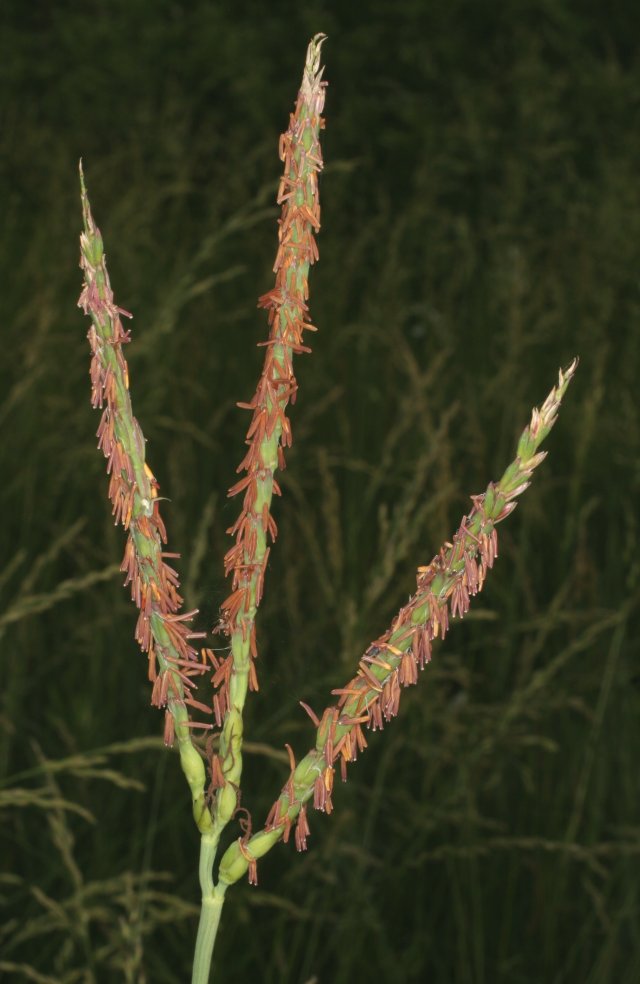
The showly male flowers of the Eastern Gamagrass.
At grass conferences I have been told more than once that there are no toxic native North American grasses (the problem are the imports.) Eastern Gamagrass (Tripsacum dactyloides) delightfully falls into the native description. And at 27% protein it’s one of the more nutritious native grasses if not the most nutritious.
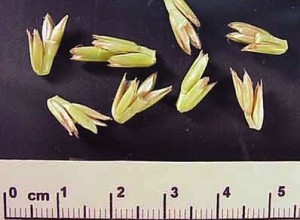
Eastern Gamagrass Seeds
Among its many names are Bullgrass, Eastern Mock Gama, Fakahatchee Grass, Gamagrass, Herbe Grama, Maicilo Oriental, Pasto Guatemala, Wild Corn, Zacate Maicero and Queen of the Grasses. Eastern Gamagrass is conspicoulsly absent from Native American Food Plants by Daniel Moerman. However, most of our ethnobotanical information on Native American foods is from western Indians and this is an eastern species. We certainly know the buffalo liked it as do cattlemen. They call it Ice Cream Grass because the cattle like it so much. In fact over grazing by ranchers led to its replacement by other grasses and grains. (As a clump grass it needs to regenerate if grazed closely.)
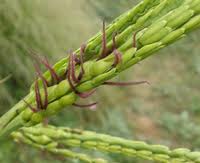
Female Flowers near bottom of spike
From our point of view the edible part is a tough yellow grain. Whether it can be used for flour depends upon availability. Left unmilled the grains will pop like Strawberry Popcorn. They can also be cooked whole like wheatberries or made into a gruel.
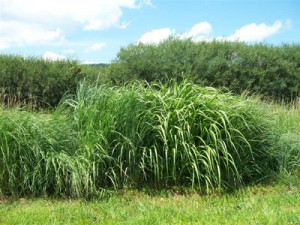
Eastern Gamagrass can grow nine feet tall.
The species can be found east of the Rocky Mountain states excluding northern New England. It is also native to Central and South America and the Caribbean. The large clumps of grass can live to be 50-years old or more. Growing to eight or nine feet tall the leaf blades are flat and long, 12 to 30 inches and up to more than an inch wide. Leaves have a well-defined mid-rib near the stalk. Flower spikes are six to 10 inches long and are made up of several spikes, often three. Similar to corn it has separate male and female flowers but unlike corn each spike has both male and female flowers. Male flower are found on the top three-quarters of the spike and female flowers on the bottom fourth. (Look for gold rice-like bits on top of the spike, and red-brown thread on the bottom quarter.) Technically it is male flowers on top with extruded anthers and cupulate fruit-cases on the bottom. One issue with the grass, however, is chill hours needed to germinate. Moist seed kept in cold storage for six to eight weeks germinate better than non-chilled seeds. There are two commercial cultivars, “Pete” and “Iuka IV.” Commercially a pound of seed costs about $20 if you order only one pound, around $17.50 per pound if you order a lot. There are 5,000 to 7,000 seeds per pound.
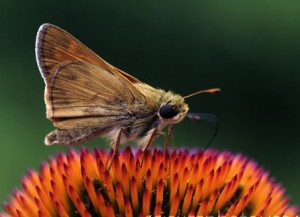
The Bunchgrass Skipper and deer like the species.
Flower spikes ripen from the top down. Seeds are produced from June to September. Yield is not high so it is a grain added to other mixtures unless one can find enough to make flour out of it. Efforts are underway to cross breed the plant to produce more grain but that will likely result in a hybrid with less protein content.
There is no agreement on what Tripsacum means. Many copied Internet sources say it means “polished” from the Greek verb Trivo, to polish or show signs of wear (the stem is smooth.) Frankly I think that is nonsense. I have a hard time getting triP… out of triV… Not close even considering the Dead latin influence. More so the usual botanical Greek term for polished is “gano” as in Ganoderma (polished leather.) Here’s a different view: The grains are tough. “Tripsis” in Greek — with a P not a V — means durable, tough. And “psakas” means grain or a small piece broken off. Put those together and bastardize them through Dead Latin and I can see easily Tripsacum. So I am going to say Tripsacum (TRIP-suh-kum) means “tough grain.” Dactyloides (dack-ta-LEED-deez) means finger-like, referring to the flower spikes…. ghoulish long skinny fingers…
Deer like the seed as well and the plant is the larval food of choice for the Bunchgrass Skipper butterfly. There is also a native Florida Gamagrass but it is confined to the southern part of the state, is much smaller, skinnier and endangered.
Green Deane ITEMIZED Plant Profile: Eastern Gamagrass
IDENTIFICATION: Tripsacum dactyloides, fountain-like clumps to nine feet tall, 4 feet wide. The leaves erect up to 2.5 ft long and an inch wide. Stems can reach six-feet long. Distinctive flowers spikes rise above the leaves on slender stems. Spikes have many tightly fused spikelets that take on the appearance of being ‘jointed’. When in flower the spikes appear to have golden grains of rice hanging from them. Leaves lack auricles but have a ligule that is a fringe of hairs. Rootstock is usually wider than the plant one reason for its use in land reclamation.
TIME OF YEAR: Flowers in late spring to mid-summer, seeds in late summer to fall. Frost colors the leaves red and bronze.
ENVIRONMENT: Moist areas around lakes, streams, swamps, ditches et cetera, full sun, fertile soil. Evergreen in frost-free areas.
METHOD OF PREPARATION: Winnowed seeds can be used like wheat. Seed will pop like corn.

Do you have a photo of the prepared product? I’ve read before where it’s edible and that the seads “pop like popcorn” but I’ve never known anyone to actually do that (I suspect much that’s written of its edibility is information copied from one author to another). I’d really like a first-hand account and to see a photo.
I’ve eaten them raw and parched. Tough.Locally they are not rare but isolated from each other, a few here, a few there. Hard to get a lot of grains at one time.
And tell me, please, what is strawberry popcorn?
Red popcorn on coops that look like large strawberries.
Do you think this could be juiced similar to wheat grass?
Sprouts might be…there’s no known toxic qualities to it.
Thank you for the enlightment to what is adible around us, praise God!
Is the Eastern Gamagrass found in west central FL? I live in Ruskin And have found many wild edibles around me. I do it for fun along with hunting! Make a meal right off the land! Man I would love to go for a walk with you in the woods in my area … And learn how much more there is.
If you mean Tripsacum dactyloides, yes it grows in your area.
Thank you for another great read Dean, perfect timing too. I had just photographed this grass and had added it to my list of unknown plants 2 days ago.
That was my reaction when I first saw the monster plant growing by my front gate at the farm…it looked like a blend of Johnsongrass and K31 tall fescue but bigger. Take a good look at the base of the plant, the way it grows in a circle and sort of looks like coiling segmented worms on the surface. That pattern is fairly uncommon and will let you find it even where stock have defoliated it or it has died back for the winter. One of the better ways to spread it is by way of the digestive system of a bovine…seems even more effective than the chilling Deane mentions. When it comes out the back end it is protected for quite a while because it is encased in its own manure case…the stock leave it alone for about a year. Enjoy finding gamagrass…I think it is one of the most remarkable plants on this continent.
Another reason to establish gamagrass…it is extremely deep rooted, what you see above ground is repeated below ground, sometimes up to 30 feet down…makes it drought proof really. Here on the AR/MO border it breaks dormancy in late Jan or early Feb and is still vegetative in late Nov to mid Dec. That is almost year round. Once you control the grazing duration times, as in managed grazing programs, it is very regenerative even though the stock take it down to the ground when they can. It is an attractive speciman plant as well as a living screen. You can harvest the leaves for a very good mulch. I didn’t know about humans eating the seeds but it stands to reason since there seems to be an ancestoral link to maize.
Another way to propagate it would be to find patches along road sides and dig up the smaller plants, usually just a few leaves. Anything bigger is almost impossible to dig out…the roots are too deep. Be sure you are not doing this on protected lands but here in AR and in MO you can find it all over the place along the roadways. And it is not going extinct anytime soon. Once you train your eyes to see that distinctive seed head it is easy to find. Needless to say, I havc a love affair with this plant, as did my cattle, sheep and goats back when I had that farm.
Question: does any one know if this grass is gluten free?
As a close relative of corn I think it has gluten.
Good collection of info on eastern gamagrass… I never would have guessed that you could eat it! Just a small note, the image above that depicts eastern gamagrass seeds is actually the remnant male flowers from the inflorescence. The seed units are located at the base of the inflorescence, as mentioned in the text, and are very hard, almost woody.
I agree that the photo of the seed is wrong. I will try to send a photo of seeds of T. dactyloides. I love this plant. How does T. floridanum compare, other than being smaller, thinner leaves, etc? The seeds are similar, but smaller. Is it actually listed as endangered, or just uncommon?
Winter hardiness? Here in Ontario along the north shore of lake Erie we have the Carolinian climate; same as N. Carolina.
Tom, here in Georgia (zone 8a) the gamagrass keeps some green on it all winter. Even if the frost turns it all brown, it will definitely survive the winter in a Carolinian climate.