
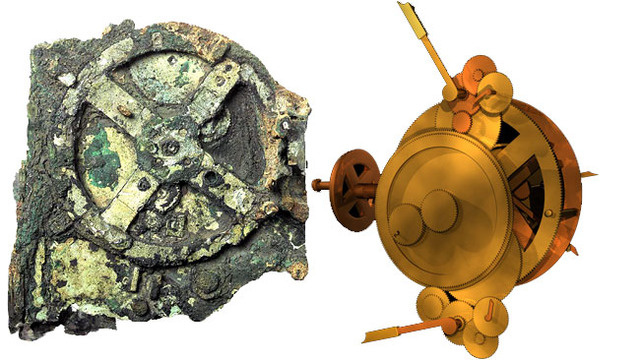
The Antikythera Mechanism is unique, kind of like a monotypic genus plant. In fact, this short article was originally written as the introduction for the page “Only Plant In Its Genus.” It didn’t quite fit and I also didn’t want to throw it away, thus it is here in a personal blog.
Said “anti-KITH-air-rah” it loosely translates into “Opposite of the Guitar.” Why? Because the nearby large island of Kythera, which has some 3,000 permanent residents, is shaped like a harp. The Greek government want’s to repopulate the island. If you have kids or can have kids they will give you a house and land if you move there.
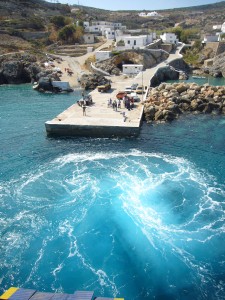
The only port on Antikythera at Potamos. Photo by Green Deane
which is called a “kythera” from which we get the English word “guitar.” It is also where some 60,000 Greeks in Australia can claim ancestry. Almost no one claims ancestry from Antikythera which is 23 miles to the southeast. In land mass “Little Kythera” is about nine square miles and had only 13 permanent residents when I was there. Now it has about four dozen and is the most remote inhabited island in the Mediterranean. Crete is 18 miles to the southeast. In season the ferry stops twice a week and literally for only two or three minutes. It’s the nautical equivalent of an airport touch and go. The ferry backs up lowering the rear gang plank. A minute or less is spent off or on loading people and vehicles then the ferry pulls away gang plank still down.
From Gythio in The Mani — the main city on the eastern side of the central peninsula in southern Greece, one can sight navigate to Kythera. From Kythera you can sight navigate to Antikythera. From Antikythera you can sight navigate to the Rodopou Peninsula on Crete. In ancient days it was the main shipping lane. It’s a route still followed by ferries and weekend sailors. The Historian Plutarch said King Kleomenes III of Sparta occupied the island on his way to Egypt after his defeat in Sellasia in 222 BC. He also tells us a faithful follower of Kleomenes, Thirykion, committed suicide there because as a Spartan he could not bear the shame of retreating. In the 1800s most of the island’s inhabitants were Greeks from Crete or southern Peloponnesos escaping murderous Turks. Following the Greek Civil war (immediately after WWII) exiled politicians were sent to Antikytheria as a form of “island arrest” until 1964.
Tiny Antikythera has three claims to fame: 1) On 11 August 1903, an 8.3 earthquake raised part of the island 20 feet, a riff easily seen today (the grassy area in the photo lower right.) That means in the picture to the upper left the harbor used to extended inland to beyond all the nearby buildings. In retrospect it is probably better for an island to go up 20 feet than go down 20 feet. 2) The island was the home base of fort-building pirates for several hundred years before and after 0 AD. They anchored in the protective harbor the rising island eliminated. And 3) the Antikythera Mechanism, the world’s first mechanical computer.
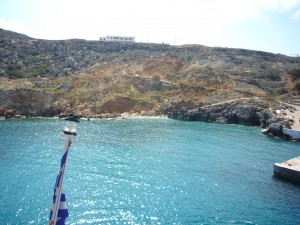
Visible effect of the earthquake on Little Kythera
Made around 1500 BC to predict astronomical events the Antikythera Mechanism was 1,500 years ahead of its time, or, everyone else was 1,500 years behind the times. The mechanism was found by sponge divers a century ago. Were the pirates involved? The time period is right. Was the mechanism lost plunder? Did it sink unknown to the pirates? What was it doing there? Was it from the mainland heading towards points south and east, or, from the Middle East heading towards points north and west? Was technology set back 1,500 years? Since we know know it had at least one dial to track the Olympics — every four years — we know it was at least used by Greeks if not made by them.
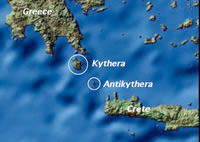
One can sight navigate from Crete to the Greek mainland.
Consider these islands 1,500 years ago or even today. The vegetation was sparse, and still is, mostly scrub for goats plus a few spices, thyme, marjoram, oregano, capers. Other edibles included some thistles, wild onions, and a few greens. Most food came from the sea, or robbing, the main occupation. Most of these islands have no springs. Life was harsh. Was the mechanism overlooked for a clay pot of olives, or wine? We’ll never know.
On Cyprus, a few hundred miles to the east, less than five dozens plants are used for food, including several spices. Even soil is hard to come by. In my grandfather’s village of Karea in The Mani (south of Sparta) soil is brought in to create elevated gardens on slabs of bare rock. The land is basically crushed boulders and gravel. Foraging was, and still is a way of life there. But one has to scrounge to find enough to eat. Even in the best of seasons it is like a rocky desert and one reason why the area was never occupied by the Turks or the WWII Germans.
To videos about the Mechanism go click here and here.

Mr. Deane,
This website, out of the 1,000,000,000+, has become one of my top fives! Eattthewweds.com has its own designated permanent tab on myphone and computer. Thank you so much!
Although it’s a couple years after the last comment, I’ll second that! I am retired and spend more time perusing the plants than I ever had a chance to before, and I love it! And this website! Thank you for sharing your knowledge and experience Deane, truly priceless!
I remember reading about the mechanism years ago, when they weren’t even quite sure what to make of it! I find it truly fascinating to look at ancient civilizations in a new light—that they were in many ways more advanced than we ever guessed. I love the speculation that the big pyramids may have been a power source too…so interesting! And the guy here in FL who built the Coral Castle himself and said he harnessed the same power as they used to build the pyramids? Intriguing!